SEO trends in 2026: what you need to know
TL;DR:
- By 2026, success in SEO depends on gaining citations in AI-generated answers rather than ranking on the first page. Core SEO fundamentals, structured content, and technical hygiene remain essential, with new strategies like schema markup and llms.txt gaining importance for AI citation. Adapting to AI-driven search requires integrating traditional techniques with proxy signals to enhance visibility in an evolving digital landscape.
SEO in 2026 is defined by a single shift: success is measured by being cited within AI-generated answers, not by holding a position on page one. The global SEO services market is projected to reach nearly $84 billion this year, reflecting the scale of investment now flowing into AI-integrated search strategies. Generative Engine Optimisation (GEO) and Answer Engine Optimisation (AEO) have moved from emerging concepts to operational priorities. If you are a digital marketer, SEO professional, or ecommerce business owner, the question is no longer whether AI changes your search strategy. It is how quickly you adapt.
What are the biggest SEO trends in 2026?
The defining trend is the rise of AI-generated answers as the primary interface between search engines and users. Google’s AI Mode and AI Overviews now serve over 3.5 billion monthly users, with the Gemini app alone reaching 900 million users after doubling its user base in a short period. That scale changes everything about how organic visibility works.
Traditional SEO measured success by ranking position. In 2026, a brand can rank third on a results page and still lose the majority of its traffic if it is not cited in the AI Overview sitting above all organic results. AI Overviews appear in 30% of informational queries with zero-click rates exceeding 60%, meaning more than half of users who see an AI-generated answer never scroll to the organic listings below. The practical consequence is stark: click-through rates on positions four through ten have dropped between 30% and 60% since AI Overviews matured.
“Successful SEO strategies now integrate content authoritativeness, citation patterns, and ongoing conversational query optimisation rather than one-off keyword targeting.” — Google I/O 2026 SEO and GEO Takeaways
User behaviour has shifted alongside these tools. Searchers increasingly expect synthesised answers and follow-up dialogues rather than a list of blue links. This conversational search model means your content must answer not just the primary query but the likely follow-up questions within the same piece. The future of SEO is one of ongoing optimisation cycles, not campaign-based bursts.
Key signals driving this change include:
- Zero-click search rates above 60% for AI Overview queries
- Gemini app usage doubling, reaching 900 million active users
- CTR collapse for positions four to ten across informational content
- Conversational search dialogues replacing single-query sessions
Do core SEO fundamentals still matter in 2026?
They do, and dismissing them in favour of AI-only tactics is a mistake we see brands making right now. The fundamentals have not been replaced. They have become the foundation on which AI visibility is built.
Here is what still carries direct weight in 2026:
- Title tags and meta descriptions remain the primary signals for topical relevance. AI engines read them to categorise content before deciding whether to cite it.
- Core Web Vitals have increased in ranking weight this year. LCP under 2.5 seconds, INP under 200 milliseconds, and CLS under 0.1 are now harder thresholds, not soft targets. Pages that fail these benchmarks are less likely to be indexed for AI citation pipelines.
- Schema markup is the bridge between your content and AI extractability. FAQPage schema in particular is worth prioritising: pages with FAQPage schema get cited two to four times more often by AI engines and frequently appear in rich results. The implementation cost is roughly ten minutes per page.
- Internal linking supports entity recognition across your site, helping AI engines understand the breadth and depth of your topical authority.
- Mobile-first design is non-negotiable. Google’s mobile-first indexing has been in place for years, but with AI Mode predominantly accessed on mobile devices, a poor mobile experience now directly limits your citation potential.
Pro Tip: Run a Core Web Vitals audit using Google Search Console and PageSpeed Insights before making any GEO-specific content changes. Fixing performance issues first means your improved content actually gets indexed and cited.
The brands that will struggle in 2026 are those treating GEO as a replacement for technical hygiene. It is not. It is an addition to it.
What do GEO and AEO mean for your content strategy?
Generative Engine Optimisation is the practice of structuring content so that AI engines can extract, verify, and cite it accurately. Answer Engine Optimisation focuses specifically on being the source an AI assistant draws on when answering a direct question. Both disciplines share the same core requirement: content that is machine-readable, verifiable, and contextually precise.

The primary objective of enterprise SEO has shifted from ranking to securing citations in AI-generated responses. This changes the metrics you track. Citation volume, citation precision, and AI referral traffic now sit alongside traditional rank tracking and organic sessions.
| Traditional SEO metric | GEO/AEO equivalent |
|---|---|
| Keyword ranking position | Citation frequency in AI answers |
| Organic click-through rate | AI referral traffic and assisted conversions |
| Domain authority score | Entity authority and named author signals |
| Page impressions | Citation share across AI platforms |
Practically, this means your content structure matters as much as your content quality. AI engines favour:
- Definitions and direct claims at the start of sections, not buried in paragraph three
- Named statistics with source attribution, which signal verifiability
- FAQ sections with FAQPage schema, which are cited two to four times more frequently
- Named author bylines with linked author profiles, which strengthen entity signals
- Short, declarative paragraphs that answer a single question completely
One finding that surprises most SEO professionals: 37% of AI citations come from domains not visible in traditional SERPs. This means a brand with modest traditional rankings can still earn significant AI visibility if its content is structured correctly. The inverse is also true: a top-ranking page with poor extractability may be ignored entirely by AI citation pipelines.
Pro Tip: When writing for AI citation, treat every H2 section as a standalone answer. If someone asked that heading as a question to ChatGPT or Gemini, your section should provide a complete, citable response without requiring the reader to have read the rest of the article.
For ecommerce brands, writing content for online stores with GEO principles built in from the start is far more efficient than retrofitting existing pages.
How does technical SEO need to adapt for AI search?
The technical layer of SEO has gained new complexity in 2026, and two specific areas demand attention: crawler separation and crawl governance.
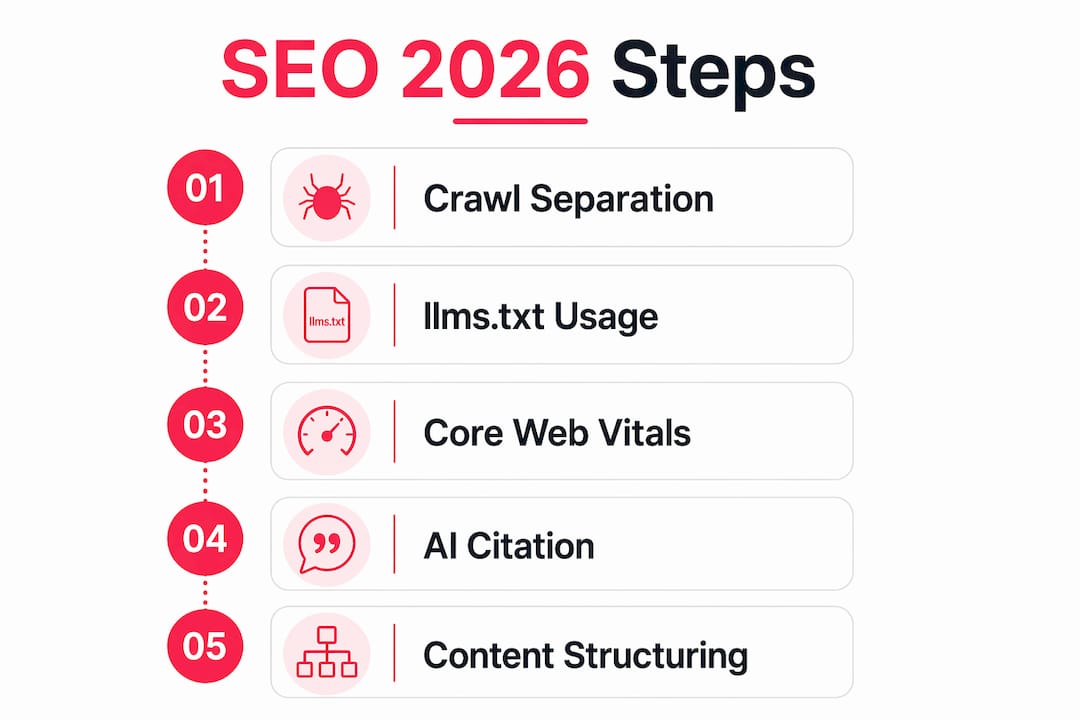
Googlebot versus Google-Extended are separate indexing processes. Googlebot feeds traditional search results. Google-Extended feeds AI citation pipelines. Content behind JavaScript rendering is frequently invisible to Google-Extended, which means a page that ranks well in traditional search may never appear in an AI-generated answer. Raw HTML visibility is the standard to aim for.
| Technical factor | Traditional SEO impact | AI citation impact |
|---|---|---|
| JavaScript-rendered content | Moderate risk | High risk of invisibility |
| Raw HTML content | Standard requirement | Required for Google-Extended |
| robots.txt configuration | Crawler access control | Now a strategic policy document |
| llms.txt file | Not applicable | Signals AI crawler permissions |
| Schema markup | Rich result eligibility | Direct citation extractability |
robots.txt has evolved beyond simple crawler access control. It is now a strategic policy document that signals to multiple AI crawlers which content you want indexed, cited, or excluded. Brands that have not reviewed their robots.txt configuration in the past twelve months are likely blocking AI crawlers unintentionally.
llms.txt is the emerging standard worth understanding now. Around 2% of sites had adopted llms.txt by 2025, with adoption expected to grow significantly through 2026. The file signals to AI crawlers which content is available for training and citation, and which is restricted. Think of it as a robots.txt specifically designed for large language model crawlers. Early adoption gives you direct control over how AI engines interact with your content before the standard becomes mandatory.
For a broader view of how ecommerce automation and AI are reshaping retail operations alongside search, the technical SEO changes above sit within a much larger shift in how AI touches every part of an online business.
Practical steps for a technical SEO audit in 2026:
- Verify Google-Extended is not blocked in your robots.txt
- Test key landing pages for raw HTML content using a JavaScript-disabled browser
- Audit schema markup coverage across product, category, and content pages
- Create or review your llms.txt file and define clear AI crawler permissions
- Check Core Web Vitals scores monthly, not quarterly
Key takeaways
SEO in 2026 requires a unified approach combining technical hygiene, structured content, and AI citation optimisation to maintain and grow organic visibility.
| Point | Details |
|---|---|
| AI citation is the new ranking | Being cited in AI Overviews matters more than holding positions four to ten in traditional results. |
| Core Web Vitals are harder thresholds | LCP, INP, and CLS benchmarks carry greater ranking weight in 2026 and affect AI indexing. |
| FAQPage schema multiplies citation rates | Pages with FAQPage schema are cited two to four times more by AI engines for minimal implementation effort. |
| Google-Extended needs raw HTML | JavaScript-rendered content risks invisibility in AI citation pipelines regardless of traditional ranking. |
| llms.txt is worth adopting now | Early adoption of llms.txt gives you direct control over AI crawler access before it becomes a standard requirement. |
Why I think the SEO industry is underselling this shift
I have watched SEO go through several cycles of “everything has changed” announcements, and most of the time the fundamentals held steady underneath the noise. This time feels genuinely different, and I say that with some caution because I know how that sounds.
The metric shift from ranking to citation share is not cosmetic. When 37% of AI citations come from domains that do not appear in traditional SERPs, you are looking at a parallel visibility system that operates by different rules. Brands that only track rank and organic sessions are flying blind to a significant portion of their potential reach.
What I find most practically useful is treating SEO and GEO as a single programme rather than two separate workstreams. The content that earns AI citations tends to be the same content that performs well in traditional search: authoritative, well-structured, fast to load, and written by identifiable experts. The difference is in the execution details. Named author bylines, FAQPage schema, raw HTML delivery, and llms.txt configuration are not optional extras. They are the difference between being cited and being ignored.
My honest caution is this: do not abandon traditional SEO hygiene in the rush to optimise for AI. The brands that will win long-term are those building on solid technical foundations while layering GEO and AEO practices on top. Chasing AI citations with poorly structured, slow-loading pages is a short-term play at best.
Measure citation share alongside rank. Track AI referral traffic in your analytics. And review your robots.txt and llms.txt configurations before you do anything else.
— Steve
How Bigeyedeers can help you stay ahead
At Bigeyedeers, we work with ecommerce brands on Magento and Shopify who are navigating exactly these changes. Our approach combines technical SEO audits, structured content strategy, and schema implementation with the platform-level expertise to make changes that actually stick.

Whether you need a full GEO audit, a Core Web Vitals overhaul, or a content architecture review built for AI citation, our team in Cardiff and Exeter brings over 17 years of ecommerce experience to the work. We do not offer generic SEO packages. We build strategies around your platform, your catalogue, and your commercial goals. Meet the team to find out how we approach SEO for growing and enterprise retail brands, or explore our Shopify SEO services to see what a tailored 2026 strategy looks like in practice.
FAQ
What is GEO and how does it differ from traditional SEO?
Generative Engine Optimisation (GEO) is the practice of structuring content so AI engines can extract and cite it accurately in generated answers. Traditional SEO focuses on ranking position; GEO focuses on citation frequency and precision within AI-generated responses.
Will traditional SEO rankings still matter in 2026?
Yes. A top Google position correlates with roughly a 46 to 48% chance of LLM citation, so traditional rankings still influence AI visibility. However, 37% of AI citations come from domains not visible in standard SERPs, so GEO-specific optimisation is also required.
What is llms.txt and do I need one?
An llms.txt file signals to AI crawlers which content on your site is available for citation and which is restricted. Around 2% of sites had adopted it by 2025, with adoption growing through 2026. Adding one now gives you early control over how AI engines interact with your content.
How do I know if my content is being cited by AI engines?
Track AI referral traffic in Google Analytics 4 by identifying sessions from sources such as ChatGPT, Perplexity, and Gemini. Monitor citation share using tools that track brand mentions in AI-generated answers, and review Google Search Console for AI Overview impressions alongside traditional rank data.
Is FAQPage schema worth implementing for ecommerce sites?
Pages with FAQPage schema are cited two to four times more often by AI engines and frequently appear in rich results. For ecommerce sites with product and category pages, adding FAQ schema to key pages is one of the highest-return technical changes available in 2026.
Recommended



Adobe Commerce (Magento)
Formerly known as Magento, Adobe Commerce is built for complex catalogues, integrations, and long term growth. We design and develop stable, scalable stores that support demanding eCommerce requirements, including multi-store setups, complex pricing, and Hyva based performance improvements.

Bespoke Build
We design and build custom eCommerce platforms for businesses with complex workflows, integrations, or non standard requirements. Built from scratch around your business needs using Laravel and modern architectures.
Working with brands across the UK from our offices in Cardiff and Exeter, you deal directly with a senior team of designers and developers specialising in Shopify, Magento, WordPress and bespoke eCommerce platforms.
We focus on commercial outcomes. Better conversion rates, strong SEO foundations and eCommerce platforms that continue to improve long after launch.