Why optimise B2B catalogues: the complete 2026 guide
TL;DR:
- B2B catalogue optimisation enhances product discoverability, accuracy, and personalization, leading to higher revenue and fewer returns. Centralized data management, ERP integration, and continuous governance are essential for scaling and maintaining quality. Treating catalogue work as a strategic function with clear ownership and ongoing processes yields lasting commercial results.
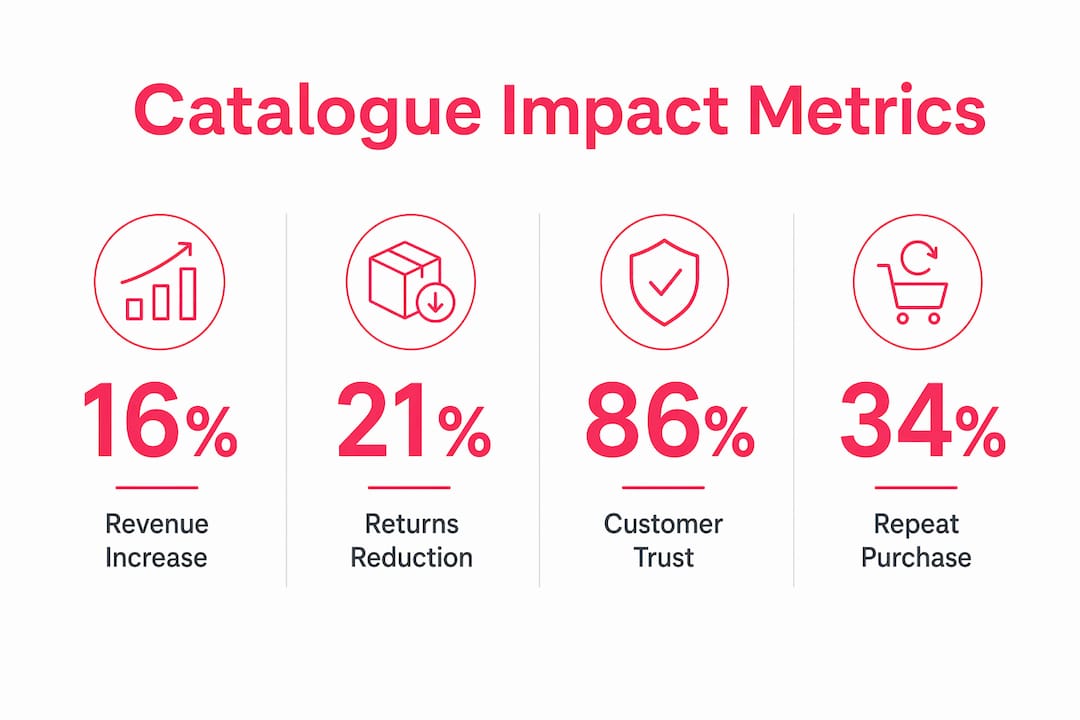
B2B catalogue optimisation is the process of structuring, enriching, and governing product information to improve discoverability, accuracy, and personalised buyer experiences across digital sales channels. Done well, it is one of the highest-return investments a B2B ecommerce manager can make. Research from Inriver shows that centralised product information management reduces time-to-market by 29%, decreases product returns by 21%, and increases product revenue by 16%. Those are not marginal gains. They are the kind of numbers that shift how leadership views catalogue work, from administrative overhead to commercial priority.
Why optimise B2B catalogues: the sales and experience case
A B2B catalogue is not simply a product list. According to Virtocommerce, it functions as an operating system for sales, directly affecting purchasing speed, order accuracy, and operational efficiency across every transaction. When product data is incomplete or inconsistent, buyers cannot make confident decisions. That friction translates directly into lost orders.
The numbers are stark. 86% of consumers are unlikely to repurchase after encountering inaccurate product information, and retailers lose 8.7% of sales to inventory inaccuracies. In B2B, where order values are higher and relationships are longer, the cost of that erosion compounds fast.
Personalisation is where optimised catalogues create a genuine competitive edge. When your catalogue surfaces account-specific pricing, contract terms, and curated assortments for each buyer, you remove the need for manual quoting and back-and-forth negotiation. Buyers get what they need faster. Your sales team spends less time on admin. That is a win on both sides of the transaction.
By 2026, 80% of B2B sales interactions occur digitally, and buyers expect self-service experiences comparable to B2C ecommerce. Meeting that expectation requires catalogue data that is accurate, complete, and structured to support fast, confident purchasing decisions.
- Completeness: Every product needs full attribute sets, including dimensions, materials, compatibility, and lead times. Missing attributes prevent comparison and kill discoverability.
- Accuracy: Pricing, stock status, and specifications must reflect reality in real time. Stale data destroys trust.
- Personalisation: Account-level visibility rules, tiered pricing, and role-based access turn a generic catalogue into a tailored buying tool.
- Searchability: Products structured around buyer language, not internal SKU logic, are found faster and purchased more often.
Pro Tip: Map your top ten buyer journeys before auditing your catalogue. You will quickly identify where missing attributes or poor categorisation are causing drop-off at the point of decision.
What are the operational benefits of catalogue optimisation?
The sales case is compelling, but the operational case is equally strong. Fragmented, manually maintained catalogues create a specific kind of organisational drag: data silos, duplicated effort, and errors that surface at the worst possible moment, usually mid-transaction.

Centralising product information through a PIM (Product Information Management) solution addresses this directly. When a single source of truth governs all product data, updates propagate across every channel simultaneously. A price change made once reflects everywhere. A new specification added to a product record appears in every storefront, export, and integration without manual intervention.
Here is how the operational gains stack up in practice:
- Faster product launches. Centralised PIM reduces time-to-market by 29%, meaning new products reach buyers weeks earlier than with spreadsheet-based workflows.
- Fewer returns. 34% of product returns are caused by poor product descriptions. Accurate, governed content reduces this directly.
- Lower maintenance costs. Automation handles attribute completion, taxonomy enforcement, and channel-specific formatting, cutting the manual workload significantly.
- Reduced pricing errors. ERP-integrated catalogues sync contract pricing and inventory in real time, eliminating the costly delays that standalone catalogue management creates.
- Improved compliance and governance. Role-based access controls mean the right people update the right data, and audit trails make errors traceable and correctable.
“Product information quality is a measurable business lever tied to revenue growth and retention, not just operational utility.” — Inriver
It is worth being direct about one thing: improving product descriptions alone will not solve your returns problem. Governance matters as much as content quality. If your descriptions are accurate at launch but drift out of date as products evolve, the gap between promise and delivery remains. Sustained catalogue quality requires process discipline, not just a one-off enrichment project.
Manual vs automated catalogue management: which approach scales?
Manual catalogue management, typically built around spreadsheets, shared drives, and email-based approval chains, works at low volume. Once you are managing thousands of SKUs across multiple channels, customer segments, and pricing tiers, it breaks down fast.
Manual workflows cause data desynchronisation, rising maintenance costs, and customer trust erosion. A product updated in one spreadsheet but not another creates conflicting information across channels. A pricing change applied to one customer segment but missed in another leads to incorrect invoicing. These are not hypothetical risks. They are the daily reality for B2B teams that have outgrown their tools.
AI-driven catalogue optimisation addresses this at scale. AI fills missing attributes, improves categorisation accuracy, and keeps data continuously synchronised across all connected systems. For a catalogue with 50,000 SKUs, that is the difference between a team of people doing data entry and a system that handles enrichment automatically.
| Approach | Strengths | Weaknesses |
|---|---|---|
| Manual (spreadsheets) | Low setup cost, familiar tooling | Error-prone, slow to update, does not scale |
| PIM without AI | Centralised data, better governance | Requires manual enrichment, still labour-intensive |
| AI-powered PIM | Automated enrichment, continuous sync, scales to large SKU counts | Higher initial investment, requires clean input data |
| ERP-integrated catalogue | Real-time pricing and inventory accuracy | Complex to implement, needs ongoing technical support |
The right choice depends on your catalogue size, channel complexity, and internal resource. For most growing B2B operations, a PIM solution with ERP integration is the baseline. AI enrichment becomes worthwhile once your SKU count makes manual attribute management genuinely unmanageable.
Pro Tip: Before selecting a PIM or AI enrichment tool, audit your existing data quality first. Garbage in, garbage out applies here. A clean data foundation makes every downstream tool more effective.
What best practices should B2B marketers follow for catalogue optimisation?
Sustained catalogue quality does not happen by accident. It requires deliberate process design, clear ownership, and the right technical foundations. Here are the practices that separate high-performing B2B catalogues from the rest.
- Establish data governance from the start. Assign clear ownership for each product category. Define mandatory fields, acceptable formats, and approval workflows before you begin enrichment. Without governance, quality degrades as soon as the initial project ends.
- Structure your catalogue around buyer logic, not internal systems. Your ERP uses part numbers. Your buyers use product names, applications, and compatibility requirements. Align your taxonomy and search attributes to how buyers think, not how your warehouse is organised.
- Integrate with your ERP for real-time accuracy. ERP integration is non-negotiable for B2B catalogues where pricing, stock, and contract terms change frequently. Standalone catalogue management creates costly delays and inconsistent data.
- Implement role-based access and account-specific visibility. B2B buyers operate within defined purchasing parameters. Your catalogue should enforce those parameters automatically, showing each account only the products, prices, and terms relevant to their contract.
- Audit continuously, not annually. Schedule monthly data quality reviews. Track metrics like attribute completeness rates, search-to-purchase conversion by category, and return rates by product type. These signals tell you where catalogue gaps are costing you revenue.
- Treat enrichment as an ongoing process. Products evolve. Specifications change. New compliance requirements emerge. A catalogue that was accurate six months ago may not be accurate today. Build enrichment into your operational rhythm, not just your project plan.
For B2B teams running on Magento, catalogue search performance is a direct extension of data quality. Well-structured attributes feed better search results, which means buyers find products faster and purchase with greater confidence.
Key takeaways
Optimising B2B catalogues drives measurable gains in revenue, return rates, and operational efficiency, but only when data governance and ERP integration are treated as non-negotiable foundations.
| Point | Details |
|---|---|
| Revenue and returns impact | Centralised PIM increases product revenue by 16% and reduces returns by 21%, per Inriver research. |
| Accuracy is a retention lever | 86% of buyers will not repurchase after encountering inaccurate product information. |
| Manual workflows do not scale | Spreadsheet-based management causes data desynchronisation and trust erosion at scale. |
| Governance sustains quality | Role-based access, mandatory fields, and regular audits prevent quality drift after initial enrichment. |
| ERP integration is non-negotiable | Real-time sync between catalogue and ERP eliminates pricing errors and inventory inaccuracies. |
Catalogue optimisation is a strategic shift, not a tidy-up project
I have worked with enough B2B ecommerce teams to know how catalogue work gets framed internally. It is usually positioned as a maintenance task, something the marketing team handles when there is spare capacity. That framing is the single biggest obstacle to getting it right.
The teams that see real commercial returns from catalogue optimisation treat it as a strategic function. They assign dedicated ownership. They set quality metrics alongside revenue metrics. They build enrichment into their product launch process rather than bolting it on afterwards. The difference in outcomes is not subtle.
What I find consistently underestimated is the compounding effect of poor data. One missing attribute on one product is invisible. Ten thousand products with inconsistent attributes create a catalogue that buyers cannot navigate, search engines cannot index properly, and your sales team cannot confidently reference. The problem is not dramatic. It accumulates quietly until it shows up in your conversion rate and your return rate simultaneously.
The technology has genuinely improved. AI enrichment tools, modern PIM platforms, and Magento’s B2B capabilities make it possible to manage complex catalogues at scale without armies of data entry staff. But technology without process discipline produces clean-looking data that is still wrong. The organisations that get this right combine the two: good tooling and clear ownership.
If you are starting this work now, do not try to fix everything at once. Identify your highest-revenue product categories, audit those first, and build your governance model around what you learn. Then expand. That approach delivers faster ROI and builds the internal capability you need to sustain quality long-term.
— Steve
How Bigeyedeers supports B2B catalogue optimisation
Bigeyedeers builds and supports Magento platforms specifically designed for the complexity of B2B ecommerce, including custom catalogues, tiered pricing, account hierarchies, and ERP integrations. If your current catalogue setup is holding back your sales performance, we can help you identify where the gaps are and build the technical foundations to fix them.

Our team works across Magento Open Source and Adobe Commerce, with experience in Hyvä frontends, Klevu search and merchandising, and multi-store configurations for wholesale and DTC trading models. Whether you need a full catalogue rebuild or targeted improvements to your existing platform, our Magento web design services are built around your commercial goals, not a generic template. Get in touch to discuss what better catalogue performance could mean for your business.
FAQ
What is B2B catalogue optimisation?
B2B catalogue optimisation is the process of structuring, enriching, and governing product data to improve accuracy, discoverability, and personalised buyer experiences across digital channels. It covers everything from attribute completeness and taxonomy design to ERP integration and role-based pricing visibility.
How much can catalogue optimisation reduce product returns?
Centralised PIM reduces product returns by 21%, according to Inriver research. A separate Inriver study found that 34% of returns are caused specifically by poor product descriptions, making content accuracy a direct lever for return rate reduction.
Why do manual catalogue workflows cause problems at scale?
Manual workflows based on spreadsheets and shared files cause data desynchronisation across channels, rising maintenance costs, and customer trust erosion. When the same product exists in multiple files with conflicting information, errors reach buyers and damage purchasing confidence.
How does ERP integration improve catalogue accuracy?
ERP integration enables real-time synchronisation of pricing, stock levels, and contract terms between your back-end systems and your customer-facing catalogue. Without it, standalone catalogue management creates delays and inconsistencies that lead to incorrect orders and pricing disputes.
What is the first step to improving a B2B catalogue?
Start with a data quality audit of your highest-revenue product categories. Identify missing attributes, inconsistent formatting, and outdated specifications. Use those findings to define your governance model, including ownership, mandatory fields, and update workflows, before investing in enrichment tools or platform changes.
Recommended



Adobe Commerce (Magento)
Formerly known as Magento, Adobe Commerce is built for complex catalogues, integrations, and long term growth. We design and develop stable, scalable stores that support demanding eCommerce requirements, including multi-store setups, complex pricing, and Hyva based performance improvements.

Bespoke Build
We design and build custom eCommerce platforms for businesses with complex workflows, integrations, or non standard requirements. Built from scratch around your business needs using Laravel and modern architectures.

Working with brands across the UK from our offices in Cardiff and Exeter, you deal directly with a senior team of designers and developers specialising in Shopify, Magento, WordPress and bespoke eCommerce platforms.
We focus on commercial outcomes. Better conversion rates, strong SEO foundations and eCommerce platforms that continue to improve long after launch.