Ecommerce Branding Workflow for High-Impact UK Stores

Brand perception can change in an instant, especially for British ecommerce managers shaping ambitious retail brands. With over 80 percent of online shoppers expecting a cohesive brand experience across every touchpoint, the challenge of standing out grows sharper. Whether managing multiple Magento or Shopify stores, refining your branding workflow is key to building trust and driving conversions. This guide brings clarity to establishing unmistakable identity, consistent journeys, and seamless design for the British ecommerce market.
Table of Contents
- Step 1: Define Brand Positioning And Core Values
- Step 2: Map User Journeys And Wireframe Key Touchpoints
- Step 3: Design Cohesive Visual And Interface Systems
- Step 4: Implement Branding Across Ecommerce Platforms
- Step 5: Test And Verify Consistency And User Impact
Quick Summary
| Key Point | Explanation |
|---|---|
| 1. Define Your Brand Positioning | Conduct thorough market research to identify your unique selling proposition in the e-commerce landscape. |
| 2. Identify Core Brand Values | Develop three to five authentic principles that communicate your brand’s ethos and resonate with your target audience. |
| 3. Map User Journeys Effectively | Create detailed user journey maps to understand customer interactions and identify key touchpoints for improvement. |
| 4. Establish a Cohesive Visual Identity | Build a comprehensive design system that allows for consistent visual engagement across various devices. |
| 5. Test for Consistency and User Impact | Implement rigorous testing protocols to ensure brand elements function well across platforms and enhance user experience. |
Step 1: Define Brand Positioning and Core Values
Developing a compelling brand identity starts with understanding how your ecommerce store will uniquely position itself in the UK market. Strategic brand positioning requires deep insight into your target audience and what distinguishes your online store from competitors.
Begin by conducting comprehensive market research to uncover your audience’s core demographics and psychological preferences. This means diving into their purchasing behaviours, lifestyle aspirations, and pain points. Your goal is to craft a positioning statement that resonates emotionally and practically. For instance, are you a premium retailer offering exceptional quality or a budget friendly option prioritising value? Your positioning should clearly communicate this distinctive character.
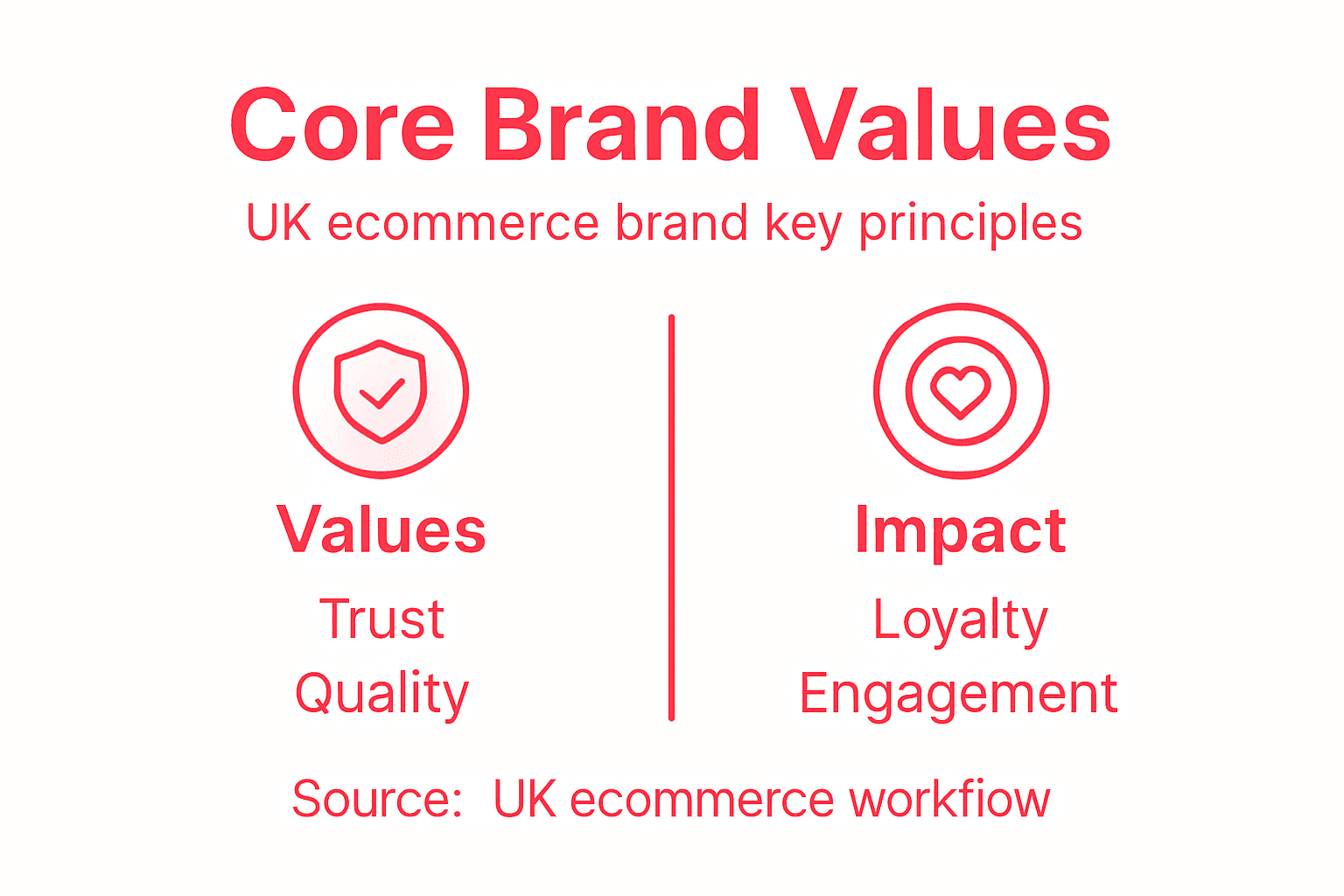
Map out your brand values by identifying three to five core principles that genuinely reflect your business ethos. These values must be authentic and actionable. Brand values reinforce consumer perception through consistent messaging across all customer touchpoints. Whether it is sustainability, innovation, customer service excellence, or transparency, these principles will guide your communication strategy and help build long term customer loyalty.
Here is a summary of common ecommerce brand values and their impacts on customer perception:
| Brand Value | Description | Customer Impact |
|---|---|---|
| Sustainability | Eco-friendly operations | Increases trust and loyalty |
| Innovation | Adoption of new solutions | Attracts forward thinkers |
| Customer Service | Prioritising client needs | Enhances overall satisfaction |
| Transparency | Honest communications | Boosts credibility |
| Quality Excellence | Outstanding product focus | Drives premium positioning |
Expert Advice: Validate your brand positioning with actual customer feedback to ensure it genuinely connects with your target market.
Step 2: Map User Journeys and Wireframe Key Touchpoints
Developing a comprehensive user journey map is crucial for understanding how customers interact with your online store. User journey mapping helps visualise the entire customer experience from initial contact through purchase and beyond.

Start by identifying your primary customer personas representing different segments of your target audience. Consider their motivations, pain points, and specific objectives when navigating your ecommerce platform. Sketch out each persona’s potential path through your website tracking every interaction point. This means documenting touchpoints like homepage entry, product browsing, search functionality, product pages, basket interactions, checkout process, and post purchase support.
Customer journey visualization requires detailed observation of emotional and functional experiences. Use tools like Figma to create wireframes that illustrate these pathways. Pay attention to potential friction points where customers might abandon their journey. Analyse each stage critically think about how you can streamline navigation make information easily accessible and create intuitive user experiences that guide customers smoothly towards conversion.
Below is a comparative table of key ecommerce touchpoints and typical user motivations at each stage:
| Touchpoint | User Motivation | Critical UX Priority |
|---|---|---|
| Homepage Entry | Find desired products | Quick product access |
| Product Browsing | Explore options | Clear categorisation |
| Basket Interaction | Review and manage items | Transparency and control |
| Checkout Process | Complete purchase | Ease and simplicity |
| Post Purchase | Support and assurance | Responsive help channels |
Expert Advice: Always test your user journey maps with real users to validate your assumptions and uncover hidden insights.
Step 3: Design Cohesive Visual and Interface Systems
Creating a seamless visual identity requires a strategic approach to design that goes beyond aesthetic appeal. User experience design principles emphasise developing intuitive interfaces that guide users effortlessly through your online store.
Begin by establishing a comprehensive design system in Figma that defines your brand’s visual language. This includes selecting a consistent colour palette that reflects your brand values, typography that communicates your brand personality, and a set of reusable interface components. Consider how each visual element interacts across different devices and screen sizes ensuring a uniform experience. Your design system should include clear guidelines for button styles, form inputs, navigation elements, and interactive states that maintain visual harmony.
E-commerce interface design demands intelligent classification and thoughtful user interaction. Focus on creating clear visual hierarchies that guide users naturally through product discovery and purchase processes. Develop wireframes that prioritise user needs by simplifying complex interactions and reducing cognitive load. Each design decision should enhance user satisfaction and streamline the path to conversion.
Expert Advice: Regularly conduct user testing to validate and refine your visual design system for maximum effectiveness.
Step 4: Implement Branding Across Ecommerce Platforms
Ensuring a consistent brand experience requires strategic implementation across multiple digital touchpoints. Cross platform brand consistency demands meticulous attention to detail and a holistic approach to your digital presence.
Start by auditing your existing platforms to identify areas where brand messaging and visual identity can be unified. This means examining your Magento and Shopify stores, social media channels, email marketing templates, and customer support interfaces. Create a comprehensive brand guidelines document that specifies exact colour codes, typography rules, image styling, tone of voice, and interaction patterns. Ensure that every element from product descriptions to checkout processes reflects your brand personality consistently.
Translate your brand identity into practical design elements that work across different devices and platforms. This involves developing responsive design templates that maintain visual integrity whether viewed on mobile, tablet, or desktop. Pay special attention to interactive elements like buttons, form fields, and navigation menus to guarantee they communicate your brand essence while providing intuitive user experiences. Consider how your brand colours, fonts, and graphic elements can create a seamless journey that feels cohesive and intentional.
Expert Advice: Conduct periodic brand consistency reviews to ensure your digital platforms continue to represent your evolving brand identity.
Step 5: Test and Verify Consistency and User Impact
Rigorously testing your brand implementation requires a systematic approach to ensuring visual consistency and user experience quality. Ecommerce testing strategies are critical for maintaining seamless functionality across all digital platforms.
Develop a comprehensive testing protocol that covers multiple dimensions of your online store. This involves cross browser and cross device testing to verify that your brand elements render consistently on different screen sizes and platforms. Use tools like Browserstack or Responsinator to simulate various device environments and check that typography, colour schemes, button styles, and interactive elements maintain their intended appearance and behaviour. Pay close attention to critical user paths such as product search, category navigation, product details, cart interactions, and checkout processes.
UI consistency verification demands more than visual alignment. Conduct user experience testing that evaluates emotional responses and interaction quality. Recruit a diverse group of testers who represent your target audience and gather qualitative feedback on how your brand feels across different touchpoints. Use heatmap tools like Hotjar to understand user interactions and identify potential friction points that might disrupt your brand narrative or user journey.
Expert Advice: Always conduct multiple rounds of testing with real users to capture nuanced insights that automated tools might miss.
Elevate Your UK Ecommerce Brand with Expert Support
Building a high-impact ecommerce store in the UK means mastering every step from defining brand positioning to testing user impact. If you recognise the challenge of creating authentic brand values, mapping seamless user journeys, and designing cohesive visual systems as outlined in the article, you are not alone. Key goals like ensuring consistent brand messaging, delivering intuitive customer experiences, and achieving cross-platform visual harmony require specialised knowledge and tools.
At Big Eye Deers, we understand these critical pain points because our approach mirrors best practice workflows using Figma for user journeys and interface design. With over 17 years experience across Magento and Shopify platforms, including advanced B2B setups and custom integrations, we help UK ecommerce businesses craft stores that are secure, performant, and designed for sustainable growth. Explore how our expert team can bring your brand vision to life while optimising conversion and retention through smart lifecycle marketing and enhanced product discovery.
Ready to turn your ecommerce branding strategy into a powerful online presence that truly connects with your audience? Visit Big Eye Deers today to discover how our design, build, and support services will keep your brand consistent and compelling across every digital touchpoint. Partner with us now to future-proof your store for long-term success.
Frequently Asked Questions
How do I define my brand positioning for my ecommerce store?
To define your brand positioning, conduct thorough market research to understand your target audience’s demographics and preferences. Identify what makes your store unique, such as being a premium or budget-friendly retailer. Aim to create a clear positioning statement that resonates with your audience within the next few weeks.
What are the essential brand values I should consider for my ecommerce brand?
Consider focusing on three to five core brand values that reflect your business ethos, such as sustainability, quality excellence, or customer service. Articulate these values clearly in your messaging to build customer trust and loyalty. Review and refine your brand values periodically to ensure they remain relevant.
How can I effectively map user journeys for my ecommerce website?
Start by identifying your primary customer personas and detailing their motivations and pain points. Document each persona’s potential journey through your website, noting key touchpoints and interactions. Regularly test these maps with real users to uncover insights that can enhance their experience within 30 days.
What steps should I follow to design a cohesive visual identity for my ecommerce brand?
Begin by creating a design system that includes a consistent colour palette, typography, and reusable interface components. Ensure that each visual element is optimised for various devices. Review your design system regularly to maintain visual harmony and improve user experience on your site.
How can I ensure brand consistency across different ecommerce platforms?
Audit your existing platforms to identify inconsistencies in brand messaging and visual identity. Create a comprehensive brand guidelines document that details colour codes, typography, and tone of voice. Conduct consistency reviews every few months to ensure your branding remains cohesive across all customer touchpoints.
What testing methods can I use to verify user experience and brand impact?
Develop a testing protocol that includes cross-browser and cross-device testing to check the appearance and functionality of your brand elements. Conduct user experience testing to gather qualitative feedback from a diverse group of testers. Aim to perform these tests regularly to capture insights and improve the user journey continuously.
Recommended


Adobe Commerce (Magento)
Formerly known as Magento, Adobe Commerce is built for complex catalogues, integrations, and long term growth. We design and develop stable, scalable stores that support demanding eCommerce requirements, including multi-store setups, complex pricing, and Hyva based performance improvements.

Bespoke Build
We design and build custom eCommerce platforms for businesses with complex workflows, integrations, or non standard requirements. Built from scratch around your business needs using Laravel and modern architectures.

Working with brands across the UK from our offices in Cardiff and Exeter, you deal directly with a senior team of designers and developers specialising in Shopify, Magento, WordPress and bespoke eCommerce platforms.
We focus on commercial outcomes. Better conversion rates, strong SEO foundations and eCommerce platforms that continue to improve long after launch.