How to Plan Ecommerce Website for High Conversion Success

Nearly 80 percent of british retail brands struggle to convert ambitious ecommerce plans into results that drive long term growth. For ecommerce managers, building a high performing Magento or Shopify site means more than choosing the right technology. You need a process that aligns business goals, customer journeys, technical choices, design strategies, and rigorous testing. In this guide, discover actionable steps proven to help british brands create digital storefronts that deliver measurable results.
Table of Contents
- Step 1: Define Business Objectives And Ecommerce Requirements
- Step 2: Map User Journeys And Draft Wireframes In Figma
- Step 3: Select Technology Stack And Key Integrations
- Step 4: Design For Conversion, Discovery And Retention
- Step 5: Validate User Experience And Performance Readiness
Quick Summary
| Key Insight | Explanation |
|---|---|
| 1. Set Clear Business Objectives | Define specific financial and customer targets to guide your ecommerce strategy effectively. |
| 2. Map User Journeys Precisely | Create detailed flow diagrams to ensure a seamless customer experience from landing to checkout. |
| 3. Choose the Right Technology Stack | Identify essential integrations and modular solutions that support growth and effective operations. |
| 4. Focus on Design for Conversion | Develop a user-friendly design that guides customers and enhances retention through personalisation. |
| 5. Validate Performance Thoroughly | Conduct rigorous testing to ensure your ecommerce platform meets user expectations and handles traffic. |
Step 1: Define business objectives and ecommerce requirements
Successful ecommerce planning begins with crystal clear business objectives that transform your digital ambitions into actionable strategies. By establishing precise goals and requirements upfront, you create a robust foundation for your online retail venture.
Defining your business objectives involves identifying specific targets aligned with your market positioning and growth strategy. This process requires comprehensive analysis of multiple dimensions including financial performance, customer satisfaction, and competitive landscape. Detailed legal compliance standards should be integrated into your planning to ensure regulatory adherence. Key objectives might encompass profitability targets, market share expansion, customer acquisition rates, and revenue growth projections.
To systematically define your ecommerce requirements, start by mapping out critical components such as product catalogue structure, payment gateway integrations, shipping mechanisms, and customer experience workflows. Consider technical infrastructure needs including platform selection, scalability requirements, security protocols, and potential future expansion capabilities. Your requirements should reflect both current operational constraints and anticipated growth trajectories.
Here’s a summary of core ecommerce requirements and their strategic business impact:
| Requirement Area | Example Considerations | Strategic Impact |
|---|---|---|
| Product Catalogue | Categorisation, variants | Enables clear product discovery |
| Payment Gateway | Currency support, security | Improves trust and conversion rates |
| Shipping Mechanism | Options, delivery tracking | Enhances customer satisfaction |
| Customer Experience Flow | Checkout, navigation | Reduces abandonment, boosts loyalty |
| Technical Infrastructure | Scalability, security | Supports long-term growth |
Top tip: Conduct a comprehensive stakeholder workshop to capture diverse perspectives and ensure your business objectives are holistic and representative of organisational aspirations.
Step 2: Map user journeys and draft wireframes in Figma
User journey mapping and wireframing are critical steps in transforming your ecommerce strategy into a tangible digital experience that resonates with your target audience. By meticulously visualising how customers will interact with your online store, you can design intuitive pathways that streamline purchasing decisions.
Begin by understanding comprehensive user journey mapping techniques that uncover every potential interaction point. Create detailed flow diagrams that track customer movements from initial landing to final checkout, identifying potential friction points and opportunities for optimisation. In Figma, start with a blank canvas and develop low fidelity wireframes that sketch out key page layouts, navigation structures, and critical conversion elements like product displays, search functionality, and call to action buttons.
While drafting wireframes, focus on creating consistent user experience across different device types and screen sizes. Use Figma’s responsive design tools to prototype how your layouts will adapt from desktop to mobile interfaces. Annotate each wireframe with specific user interaction notes and potential conversion enhancement strategies. Pay close attention to information hierarchy, ensuring that critical purchase decision elements are prominently positioned and easily accessible.

Insider advice: Always validate your initial wireframes with a small test group to gather immediate feedback and identify potential usability challenges before moving into full design development.
Step 3: Select technology stack and key integrations
Selecting the right technology stack is a critical decision that will define your ecommerce platform’s performance, scalability, and future growth potential. Your technology infrastructure forms the backbone of your digital retail strategy, supporting everything from product management to customer experience.
Comprehensive ecommerce technology integration requires a strategic approach that balances immediate business needs with long term flexibility. Begin by mapping out essential functional requirements such as product catalogue management, payment processing, inventory tracking, customer relationship management, and analytics capabilities. Consider platforms like Magento and Shopify that offer robust ecosystems with extensive integration possibilities, ensuring you can connect critical tools for marketing automation, shipping logistics, and customer support.
Prioritise modular solutions that allow seamless communication between different technology components. Evaluate each potential integration based on criteria including API compatibility, security standards, performance metrics, and total cost of ownership. Pay special attention to payment gateways, ensuring they support multiple currencies and offer robust fraud protection. Your technology stack should provide real time data synchronisation, enabling you to make informed decisions quickly and adapt to changing market dynamics.
Insider advice: Create a detailed requirements matrix before selecting technologies, ranking potential solutions against your specific business objectives to ensure precise alignment.
Step 4: Design for conversion, discovery and retention
Designing an ecommerce website that drives conversions requires a strategic approach that goes beyond aesthetic appeal. Your design must create intuitive pathways that guide customers seamlessly from initial discovery through to confident purchasing decisions.
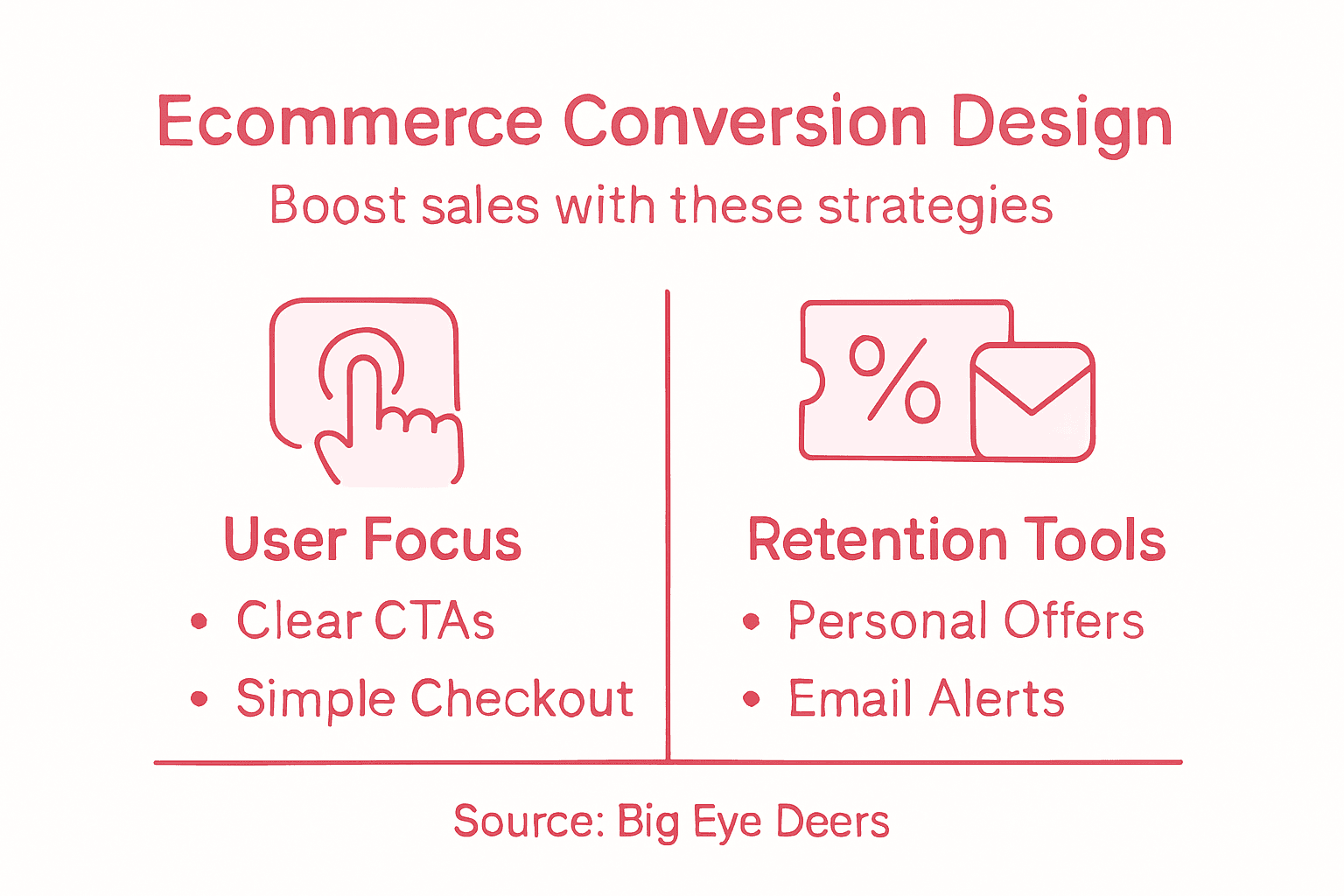
Human-centred design principles emphasise creating digital experiences that anticipate and respond to user needs. Start by mapping customer journeys that minimise friction and cognitive load. This means developing clear visual hierarchies, implementing streamlined navigation, and ensuring product information is presented transparently and accessibly. Focus on creating logical progression through your website, with prominent call to action buttons, simplified checkout processes, and clear product categorisation that helps customers find exactly what they want with minimal effort.
Retention strategies should be woven directly into your design infrastructure. Implement personalisation features that remember user preferences, suggest relevant products, and create a sense of tailored experience. Use intelligent search functionality, dynamic pricing displays, and customer review integrations that build trust and encourage repeat purchases. Consider implementing progressive disclosure techniques that reveal information gradually, preventing overwhelming users while maintaining engagement and curiosity about your product offerings.
This table provides a quick reference for key ecommerce design strategies:
| Strategy | Purpose | Expected Business Benefit |
|---|---|---|
| Personalisation Features | Tailor user experience | Boosts retention and repeat sales |
| Intelligent Search | Simplifies product discovery | Increases conversion rates |
| Dynamic Pricing Displays | Displays relevant deals | Drives urgency to purchase |
| Customer Reviews | Builds trust and confidence | Encourages new customer acquisition |
| Progressive Disclosure | Manages information visibility | Reduces cognitive load, improves engagement |
Insider advice: Conduct regular user testing and analyse heat map data to continuously refine your design approach and identify subtle user experience improvements.
Step 5: Validate user experience and performance readiness
Validating your ecommerce platform requires a comprehensive approach that goes beyond surface level testing, ensuring your digital storefront can confidently handle real world customer interactions and business demands.
Market readiness assessment involves rigorous evaluation of both technical performance and user experience. Begin by conducting extensive user testing with representative customer groups, tracking key metrics such as navigation efficiency, conversion rates, page load times, and overall satisfaction. Employ tools like heat mapping, session recording, and A/B testing to gain granular insights into user behaviour and identify potential friction points in the customer journey.
Performance validation extends beyond user interactions to include critical infrastructure considerations. Stress test your platform under simulated high traffic conditions, ensuring scalability and stability during peak shopping periods. Implement comprehensive security protocols that protect customer data and build trust. Pay close attention to mobile responsiveness, checkout process efficiency, and seamless integration of payment gateways. Regular performance audits will help you continuously refine and optimise your ecommerce platform, maintaining its competitive edge and ability to deliver exceptional customer experiences.
Insider advice: Create a dedicated testing environment that mirrors your production setup, allowing you to identify and resolve potential issues before they impact live customer interactions.
Unlock High Conversion Success with Expert Ecommerce Planning
Planning an ecommerce website that truly converts requires more than just design flair. As highlighted in “How to Plan Ecommerce Website for High Conversion Success,” clear business objectives, user journey mapping in Figma, technology stack selection, and performance validation all play crucial roles. Common challenges include creating seamless checkout flows, supporting multi-channel sales, and maintaining robust security to build customer trust. At Big Eye Deers, we specialise in tackling these exact pain points with over 17 years of experience delivering complex Magento and Shopify solutions tailored for growth-oriented retailers.
Our approach combines expert UX design, technology expertise, and ongoing support to ensure your ecommerce platform is not only built for conversions but also designed for long-term retention and scalability. We use Figma to map user journeys and wireframes clearly before development, optimise product discovery with tools like Klevu search, and protect your business with proactive security from Sansec. By partnering with us, you can confidently navigate the challenges of ecommerce planning and accelerate your journey to sustainable success.
Explore how our tailored services can turn your ecommerce goals into reality at Big Eye Deers.
Ready to transform your ecommerce website into a high-converting store that drives real growth? Contact us today at Big Eye Deers to discuss your project and discover solutions designed specifically for your business objectives. Don’t wait to elevate your online store’s performance and retention — take the next step with trusted UK ecommerce specialists.
Frequently Asked Questions
What are the key business objectives to consider when planning an ecommerce website?
Defining clear business objectives such as profitability targets, customer acquisition rates, and market share expansion is essential for successful ecommerce planning. Start by assessing your current position and imagining where you want the business to be in the next 1–3 years.
How can I create effective user journeys for my ecommerce site?
Map out customer interactions by detailing every step from landing on your website to completing a purchase. Identify potential friction points and opportunities for improvement to streamline the customer experience, ensuring clarity and ease during navigation.
What technology stack should I choose for my ecommerce website?
Select a technology stack that balances your immediate functional needs with long-term adaptability. Consider platforms that provide robust integration options for essential functions like payment processing and inventory tracking, and establish a requirements matrix to guide your decision-making.
How do I design an ecommerce website for higher conversion rates?
Focus on building intuitive pathways that encourage users to make purchases. Implement clear visual hierarchies, streamline navigation, and emphasise key elements like call-to-action buttons and product categorisation to minimise customer effort in finding items.
What steps should I take to validate the user experience of my ecommerce platform?
Conduct extensive user testing with representative groups to evaluate navigation ease, conversion rates, and overall satisfaction. Regularly use A/B testing and performance audits to identify areas for optimisation and ensure your platform can handle peak traffic efficiently.
How can I improve customer retention through my ecommerce design?
Incorporate personalisation features that adapt to user preferences, such as recommending products based on past purchases. Focus on integrating tools that enhance the shopping experience, making it tailored and engaging to encourage repeat visits.
Recommended



Adobe Commerce (Magento)
Formerly known as Magento, Adobe Commerce is built for complex catalogues, integrations, and long term growth. We design and develop stable, scalable stores that support demanding eCommerce requirements, including multi-store setups, complex pricing, and Hyva based performance improvements.

Bespoke Build
We design and build custom eCommerce platforms for businesses with complex workflows, integrations, or non standard requirements. Built from scratch around your business needs using Laravel and modern architectures.

Working with brands across the UK from our offices in Cardiff and Exeter, you deal directly with a senior team of designers and developers specialising in Shopify, Magento, WordPress and bespoke eCommerce platforms.
We focus on commercial outcomes. Better conversion rates, strong SEO foundations and eCommerce platforms that continue to improve long after launch.