Why site speed costs UK ecommerce stores sales in 2026
TL;DR:
- Slow ecommerce websites cost UK retailers billions annually through lost sales and decreased customer trust.
- Improving site speed can significantly increase conversions and reduce bounce rates, especially on mobile devices.
- Continuous optimization is essential, as speed performance impacts SEO, user experience, and competitive advantage.
Every second your ecommerce site takes to load, shoppers are quietly leaving. Not browsing elsewhere, just gone. Slow retail websites are costing UK retailers billions in lost revenue each year, and most store owners underestimate just how brutal the numbers are. This article breaks down the real commercial cost of poor site speed, explains how it directly affects your conversion rates and customer satisfaction, and gives you practical steps to fix it. Whether you are running a Shopify store or a complex Magento setup, speed is not a technical nicety. It is a revenue lever.
Table of Contents
- The true cost of a slow website
- How website speed influences conversion and satisfaction
- Mobile matters: Why speed on phones makes or breaks sales
- Practical steps to turbocharge your ecommerce site speed
- Our take: Why speed is the overlooked edge in ecommerce
- Let experts help you master ecommerce speed
- Frequently asked questions
Key Takeaways
| Point | Details |
|---|---|
| Speed boosts sales | Even a 1-second delay can reduce conversions by over 7% for UK ecommerce stores. |
| Mobile is pivotal | More than 70% of online shoppers in the UK now use a mobile device, expecting sites to load within 2 seconds. |
| Beyond ‘good enough’ | Pushing site load times below the basic standards can bring up to 48% higher conversions than just meeting the minimum benchmarks. |
| Continuous optimisation wins | Website speed requires constant monitoring and improvement as technology, traffic and competition evolve. |
The true cost of a slow website
Let us put some hard numbers on the table. 88% of UK adults will abandon a purchase if a site is too slow, and that same research points to £38 billion in lost retail revenue in 2024 alone. Seventy-six per cent of shoppers describe slow sites as frustrating. That is not just a bad user experience. That is a direct hit to your bottom line.
The frustration compounds quickly. A shopper lands on your product page, waits more than three seconds, and leaves. They do not come back. They do not send a complaint. They simply buy from a faster competitor. And the impact scales up alarmingly at enterprise level. Amazon found that every 100 milliseconds of additional delay cost them 1% in sales, while Google saw a 0.6% revenue loss per 100ms slowdown in search. If those numbers feel abstract, consider what a 1% revenue drop means across your annual turnover.
Here is a quick snapshot of what a slow site actually costs you:
| Impact area | Effect of slow load times |
|---|---|
| Bounce rate | Increases sharply after 3 seconds |
| Conversion rate | Drops by up to 7% per second of delay |
| Customer trust | Damaged, often permanently |
| SEO rankings | Penalised by Google’s Core Web Vitals |
| Revenue | Billions lost sector-wide annually |
“76% of UK shoppers find slow websites frustrating, and 88% will abandon a purchase entirely if a site does not load quickly enough.”
The risks stack up fast:
- Lost first-time buyers who never return
- Reduced repeat purchase rates from frustrated existing customers
- Lower organic search visibility, meaning fewer visitors in the first place
- Damaged brand perception in a crowded market
If you want to increase ecommerce conversions, speed is the foundation everything else sits on. Urgency tactics, strong copy, and great imagery all fall flat if the page takes five seconds to appear. The same applies when you look at emerging trends to boost site conversion rate. None of them work if your load time is working against you.
How website speed influences conversion and satisfaction
The relationship between speed and revenue is not theoretical. It is measurable, repeatable, and surprisingly precise. Research shows that a 1-second delay reduces conversions by 7%, and Google’s work with Deloitte found an 8% lift in conversions for every 0.1-second improvement. That is not a rounding error. That is a meaningful commercial gain achievable through technical work alone.
Google’s Core Web Vitals (CWV) framework gives us a structured way to measure this. CWV covers three key signals: Largest Contentful Paint (LCP, meaning how fast the main content loads), Interaction to Next Paint (INP, measuring responsiveness), and Cumulative Layout Shift (CLS, tracking visual stability). Sites with an LCP of around 2 seconds see 40 to 50% higher conversion rates compared to those loading at 4 to 5 seconds. Vodafone improved their mobile web experience and saw an 8% uplift in sales as a direct result.
Here is how slow speeds interrupt the purchase journey step by step:
- Shopper clicks a product link or ad
- Page takes more than 3 seconds to load
- Shopper bounces before seeing the product
- No product view means no add-to-cart
- No cart means no checkout, no sale
- Shopper finds a faster competitor and converts there instead
Mobile versus desktop behaviour differs significantly here. Fifty-three per cent of mobile users abandon a page after just 3 seconds of waiting, compared to a higher tolerance on desktop. Mobile shoppers are often on the move, with less patience and more alternatives a tap away.
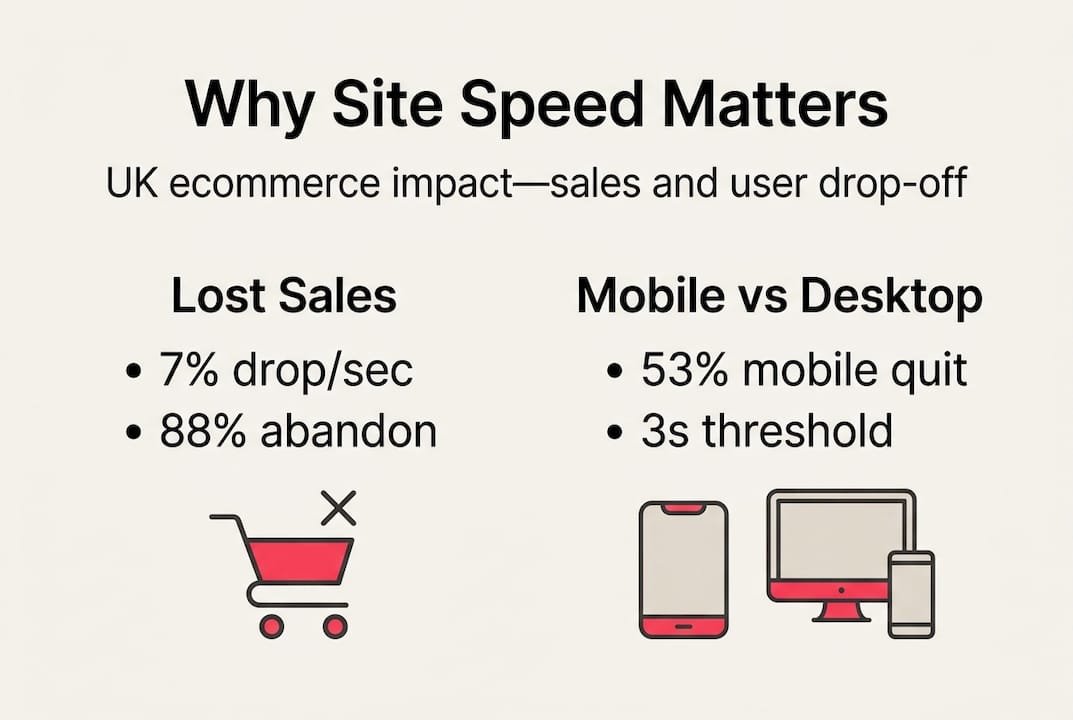
| Device | Abandonment threshold | Conversion sensitivity |
|---|---|---|
| Mobile | 3 seconds | Very high |
| Desktop | 4 to 5 seconds | High |
If you want to genuinely increase conversion rate on your store, the speed conversation has to happen before you touch anything else. And when you optimise store UX, speed is inseparable from the experience itself. A beautiful design means nothing if it arrives too late.
Mobile matters: Why speed on phones makes or breaks sales
More than 70% of ecommerce traffic now comes from mobile devices, and mobile pages suffer 2.8 times more poor LCP scores than their desktop equivalents. That gap is enormous. It means the majority of your visitors are having a measurably worse experience than desktop users, and most store owners have no idea.
Mobile speed problems tend to cluster around a few recurring culprits:
- Unoptimised images served at desktop resolution on mobile screens
- Heavy JavaScript that blocks rendering before the page is visible
- Third-party scripts from chat widgets, analytics tools, and ad trackers loading synchronously
- Poor hosting infrastructure with slow Time to First Byte (TTFB) on mobile networks
- No lazy loading on below-the-fold content, causing unnecessary data transfer
- Large CSS files that delay initial paint on slower connections
The 53% abandonment rate after 3 seconds hits mobile users hardest, because mobile networks are inherently more variable than fixed broadband. A shopper on a train or in a shopping centre is not going to wait. They will tap back and try somewhere else.

Pro Tip: Run your store through Google PageSpeed Insights and filter the results by mobile specifically. Most teams focus on desktop scores and miss the mobile performance gap entirely. Fix mobile first, and your overall metrics will follow.
For practical guidance on getting the design and speed balance right, our ecommerce design tips for UK retail brands cover how to build experiences that load fast and convert well on every device. Mobile is not a secondary consideration anymore. It is where the majority of your revenue is won or lost.
Practical steps to turbocharge your ecommerce site speed
Knowing speed matters is one thing. Fixing it is another. Here is a practical action plan you can work through:
- Audit your current speed using Google PageSpeed Insights, GTmetrix, or WebPageTest. Get a baseline score for both mobile and desktop before touching anything.
- Optimise your images by compressing them, converting to WebP format, and serving correctly sized assets per device. Image optimisation alone can cut page weight by 40 to 60%.
- Minify and defer scripts so JavaScript does not block the initial page render. Load non-critical scripts after the main content appears.
- Implement a CDN (Content Delivery Network) to serve assets from servers geographically closer to your shoppers, reducing TTFB (Time to First Byte).
- Audit third-party apps and scripts. Third-party scripts are one of the biggest performance killers in ecommerce, particularly on Shopify stores loaded with review widgets, loyalty apps, and chat tools.
- Review your hosting. Shared hosting environments often throttle performance under load. Consider dedicated or cloud hosting with proper caching layers.
- Target Core Web Vitals thresholds specifically. Passing CWV is good. Going beyond them is where the real gains are.
Key best practices for ecommerce speed consistently point to image optimisation, script minification, CDN implementation, and TTFB reduction as the highest-impact areas. These are not complex in principle, but they require disciplined implementation.
Pro Tip: On Magento, switching to a Hyvä frontend removes the heavy JavaScript overhead of the default Luma theme and delivers dramatically faster Core Web Vitals scores out of the box. It is one of the most impactful single changes a Magento store can make.
For a structured approach, our guide on how to audit ecommerce performance walks through the full process. And if you are on Magento specifically, our Magento speed optimisation techniques cover platform-specific fixes that make a real difference.
Our take: Why speed is the overlooked edge in ecommerce
Here is something we see repeatedly in our work with ecommerce clients. Speed gets treated as a one-off project. The team runs an audit, fixes the obvious issues, passes Core Web Vitals, and considers it done. Then six months later, new apps get installed, images creep back up in size, and the score quietly degrades. Nobody notices until conversion rates start slipping.
The brands that genuinely pull ahead treat speed as a continuous discipline, not a checkbox. And the data supports this approach. Optimising beyond CWV thresholds, pushing LCP to around 1.3 seconds rather than simply passing at 2.5 seconds, delivers 48% higher conversions and 26% lower bounce rates compared to stores that just scrape a pass.
That gap is your competitive edge. Most of your competitors are aiming to pass. You should be aiming to lead. We have seen this play out with clients who invest in leaner frontends, such as better Magento storefronts built on Hyvä, and the performance gains compound over time. Speed is not just a checkout-period concern either. Shoppers judge your brand every time they land on any page, at any point in the year.
Let experts help you master ecommerce speed
If reading this has made you want to check your own site scores, that is a good start. But diagnosing and fixing speed issues at a platform level takes more than a free tool and a weekend.

At Big Eye Deers, we work with ecommerce businesses across the UK to audit, redesign, and optimise online stores for genuine performance gains. Whether you need Shopify experts to streamline a bloated theme, a full Magento web design rebuild on a faster frontend, or simply a thorough performance audit from experienced ecommerce site specialists, we can help. Speed improvements we deliver are not temporary fixes. They are built to hold and grow with your business.
Frequently asked questions
How fast should an ecommerce website load in 2026?
47% of shoppers expect a site to load in under 2 seconds, and leading ecommerce stores now target sub-2-second load times on both mobile and desktop for the strongest conversion rates.
Does website speed affect SEO and Google rankings?
Yes, speed is a confirmed Google ranking signal. Passing Core Web Vitals improves both search visibility and on-site conversion, making it one of the highest-return technical investments you can make.
What are the most effective ways to improve ecommerce site speed?
Image optimisation and script reduction are consistently the highest-impact fixes, alongside implementing a CDN and running regular performance audits to catch regressions before they cost you sales.
What is Core Web Vitals and why does it matter?
Core Web Vitals are Google’s speed and user experience benchmarks covering load time, responsiveness, and visual stability. LCP scores directly affect conversion rates by up to 50%, making them a critical metric for any ecommerce store.
Recommended



Adobe Commerce (Magento)
Formerly known as Magento, Adobe Commerce is built for complex catalogues, integrations, and long term growth. We design and develop stable, scalable stores that support demanding eCommerce requirements, including multi-store setups, complex pricing, and Hyva based performance improvements.

Bespoke Build
We design and build custom eCommerce platforms for businesses with complex workflows, integrations, or non standard requirements. Built from scratch around your business needs using Laravel and modern architectures.

Working with brands across the UK from our offices in Cardiff and Exeter, you deal directly with a senior team of designers and developers specialising in Shopify, Magento, WordPress and bespoke eCommerce platforms.
We focus on commercial outcomes. Better conversion rates, strong SEO foundations and eCommerce platforms that continue to improve long after launch.