What is headless commerce? The flexible future of e-commerce
35% of Fortune 500 retailers have already adopted headless commerce, and yet many UK business owners still assume it’s reserved for global giants with enormous development budgets. It isn’t. Headless commerce is reshaping how retailers of all sizes build, manage, and grow their online stores, and the flexibility it offers is genuinely compelling. Whether you’re running a mid-market Magento store or scaling a Shopify operation, understanding how headless works could change the decisions you make about your platform this year. This guide breaks down what headless commerce actually is, why it’s gaining serious ground in the UK, and what it might mean for your business.
Table of Contents
- Understanding headless commerce: The fundamentals
- Why headless commerce is gaining traction in the UK
- Headless commerce vs traditional platforms: Key differences
- How UK retailers are implementing headless commerce
- Why the smartest retailers start small with headless commerce
- Optimise your e-commerce store with expert help
- Frequently asked questions
Key Takeaways
| Point | Details |
|---|---|
| Ultimate flexibility | Headless commerce enables your business to design unique digital experiences across any channel. |
| API-driven integration | Connecting backend and frontend via APIs offers seamless scalability and integration with modern tools. |
| Real-world advantage | UK retailers of all sizes are adopting headless commerce for faster innovation and customer-centricity. |
| Start small, iterate | Successful businesses typically pilot headless projects on select channels before fully re-platforming. |
Understanding headless commerce: The fundamentals
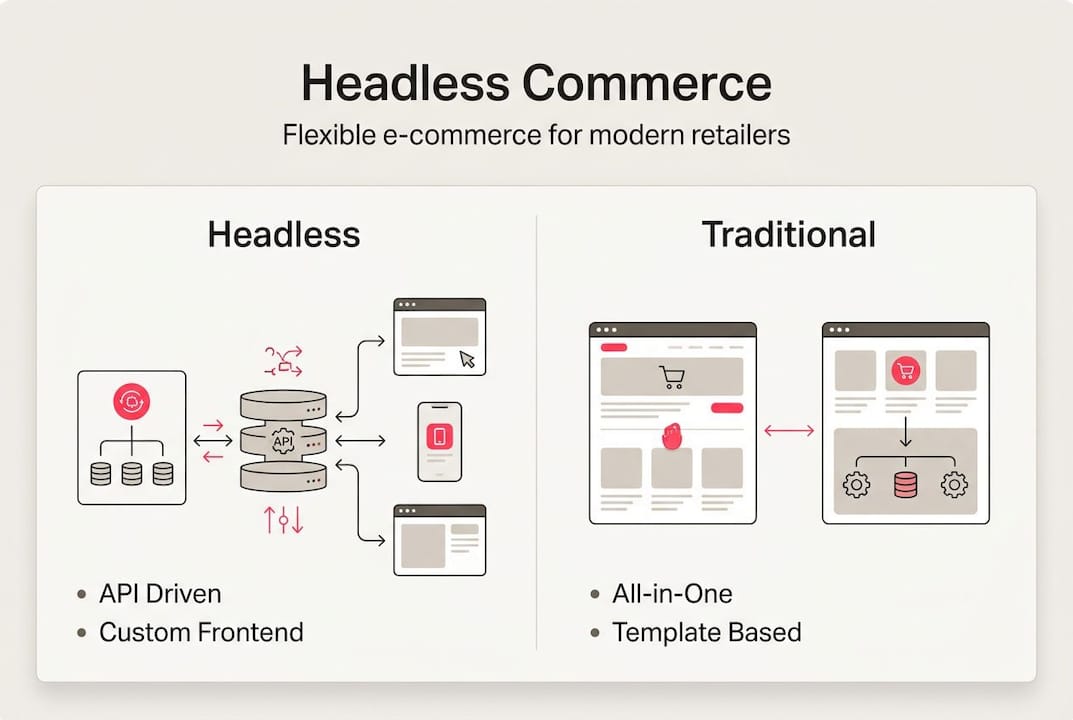
At its core, headless commerce means separating the frontend (what your customers see and interact with) from the backend (where your product data, orders, pricing, and inventory live). In a traditional e-commerce setup, these two layers are tightly coupled. Change something in one, and you risk breaking the other. With headless, they operate independently, communicating through APIs (Application Programming Interfaces).
Think of it like a restaurant kitchen and its dining room. The kitchen (backend) prepares everything. The dining room (frontend) presents it. They don’t need to look the same or even be in the same building, as long as the serving system (the API) works reliably between them.
Here’s a quick breakdown of what each layer handles:
Frontend responsibilities:
- Page layouts, visual design, and user interface
- Navigation, search, and product discovery
- Device-specific experiences (mobile, tablet, kiosk, voice)
- Speed and performance optimisation
Backend responsibilities:
- Product catalogue and inventory management
- Pricing rules, promotions, and discounts
- Order processing, fulfilment, and returns
- Customer accounts and data
The connective layer between these two is the API. Communication via REST or GraphQL enables what’s known as MACH architecture, which stands for Microservices, API-first, Cloud-native, and Headless. This is the foundation of composable commerce, where you assemble your tech stack from best-in-class components rather than relying on a single monolithic platform.
Traditional platforms feel rigid because every change, whether it’s a homepage redesign or a new checkout flow, requires working within the constraints of the platform’s built-in templating system. With headless, your frontend team can build whatever experience they like, using modern frameworks like React or Vue.js, without touching the backend at all. That’s a significant operational advantage, especially if you want to move fast.
Pro Tip: If you’re evaluating headless, start by auditing how often your current platform’s limitations have blocked a design or feature request. That friction is exactly what headless is designed to remove. You can also explore API adoption in UK retail to understand how widely this shift is already happening.
Why headless commerce is gaining traction in the UK
With the foundations in place, let’s see why this model is booming among UK retailers.
UK consumers are shopping across more devices and touchpoints than ever before. Mobile commerce alone accounts for a substantial share of UK online retail, and that’s before you factor in smart speakers, connected TVs, and in-store digital kiosks. Traditional platforms weren’t built for this kind of multi-channel reality. Headless was.
The drivers behind adoption are clear:
- Multi-device behaviour: UK shoppers routinely browse on mobile, purchase on desktop, and track orders via app. Headless lets you serve optimised experiences across all of these without rebuilding your backend each time.
- Speed expectations: Slow pages cost conversions. Headless frontends, built with modern JavaScript frameworks, are typically faster and more responsive than theme-based alternatives.
- Integration flexibility: Need to plug in a new payment provider, a loyalty platform, or a shipping tool? With an API-first architecture, integrations are cleaner and less likely to destabilise your store.
- Faster iteration: Marketing teams can test new landing pages or promotional experiences without waiting for a full development cycle.
The financial trajectory of this technology tells its own story. The global headless commerce market is projected to grow from $1.74 billion in 2025 to $7.16 billion by 2032, a compound annual growth rate of 22.4%. That’s not a niche trend. That’s a structural shift in how e-commerce is built.
“Headless commerce isn’t just a technical upgrade. It’s a strategic decision to put experience first and let the technology follow.”
For UK retailers specifically, the ability to respond quickly to shifting consumer expectations, whether that’s launching a mobile-first campaign or integrating a BNPL (Buy Now, Pay Later) provider, is a genuine competitive edge. Keeping pace with e-commerce trends in the UK means having a platform that can move as fast as your market does.
Headless commerce vs traditional platforms: Key differences
Understanding why headless commerce is surging begs the question: how does it differ from the more familiar platforms most retailers use?
| Feature | Headless | Traditional |
|---|---|---|
| Frontend flexibility | Very high | Limited by templates |
| Speed to market | Fast for frontend changes | Slower, coupled deployments |
| Integration options | API-first, broad | Platform-dependent |
| Scalability | High, composable | Can hit ceilings |
| Upfront complexity | Higher | Lower |
| Technical expertise needed | Significant | Moderate |
The contrast becomes most obvious when you consider a practical example. Suppose you want to launch your store on a smart home device or a voice assistant. With a traditional platform, that’s a significant rebuild. With headless, you expose your existing backend data via API and build a lightweight new frontend for that channel, without touching your core commerce logic.

This is the essence of what MACH architecture and composable commerce enable, and it’s why so many growing retailers are making the switch.
That said, headless isn’t without its challenges. Here are the key considerations before you commit:
- Higher upfront investment: Decoupled architectures require more planning, more development time, and often more specialist resource.
- Ongoing maintenance: Two separate layers mean two separate things to monitor, update, and secure.
- Team capability: You’ll need frontend developers comfortable with modern JavaScript frameworks, not just platform theme editors.
- Content management: You’ll likely need a headless CMS alongside your commerce backend, adding another integration to manage.
Pro Tip: Look at web design trends for e-commerce and omnichannel e-commerce integration before committing to a headless build. Understanding where design and channel strategy are heading will help you make a more informed architectural decision.
How UK retailers are implementing headless commerce
Armed with the contrast, many UK businesses are already putting headless into practice. Here’s how they’re doing it.
The most common approach is to use an existing commerce platform, such as Magento or Shopify, as the backend, and build or adopt a custom frontend on top. Both platforms have strong API-first communication capabilities, making them well-suited to composable, scalable headless architectures.
| Use case | Platform or tech | Benefit |
|---|---|---|
| Mobile-first storefront | Shopify + React frontend | Faster load times, better UX |
| B2B portal with custom pricing | Magento + headless CMS | Tailored account experiences |
| Omnichannel retail | Magento + API integrations | Unified data across channels |
| Content-led commerce | Shopify + Contentful | Richer editorial experiences |
For UK retailers starting this journey, the steps typically look like this:
- Audit your current setup: Identify where your existing platform is holding you back. Is it page speed? Checkout flexibility? Integration limitations?
- Define your goals: Headless for its own sake is a waste of budget. Set clear, measurable outcomes, whether that’s a target page load time, a new sales channel, or a specific conversion improvement.
- Choose your stack: Decide whether to keep your existing backend (Magento or Shopify) or migrate. Then select your frontend framework and CMS.
- Build incrementally: Start with one channel or one part of the experience. Don’t attempt a full re-platform on day one.
- Engage the right team: Headless builds require specialist expertise. The benefits of custom web development are significant, but only when the team executing it knows what they’re doing.
For Magento users in particular, Hyvä frontend for Magento offers a compelling middle ground: a dramatically faster, leaner frontend that doesn’t require a full headless architecture but delivers many of the same performance benefits.
Why the smartest retailers start small with headless commerce
We’ve seen a pattern with UK retailers who dive headfirst into headless commerce. They over-engineer the solution, underestimate the integration complexity, and end up with a technically impressive build that takes twice as long and costs twice as much as planned. Not good.
The retailers who get the best results from headless are the ones who treat it as an incremental strategy, not a big-bang re-platform. Pick one channel, one pain point, or one customer journey that your current platform genuinely can’t serve well. Build headless there. Measure the outcome. Then expand.
Over-customisation is a real risk. Every bespoke integration you add is something you’ll need to maintain, update, and eventually migrate. The goal isn’t to build the most sophisticated stack possible. It’s to build the right stack for your commercial goals right now, with room to grow.
We’d also encourage you to look at emerging e-commerce trends with a critical eye. Not every trend warrants a platform overhaul. But when a technology genuinely removes a constraint that’s costing you revenue or agility, that’s when it’s worth acting.
Optimise your e-commerce store with expert help
If this article has got you thinking about whether headless commerce is the right move for your store, we’re here to help you work that out properly.
At Big Eye Deers, we’ve spent over 17 years getting e-commerce right for UK retailers across Magento and Shopify. Whether you’re considering a headless build, exploring a Magento web design upgrade with a Hyvä frontend, or looking for a Shopify design agency that understands performance and conversion, we can assess your current setup and recommend the right path forward. No jargon, no overselling. Just honest advice and proven delivery.
Frequently asked questions
What does ‘headless’ mean in e-commerce?
Headless e-commerce separates the customer-facing frontend from the backend system, with REST or GraphQL APIs handling communication between the two for maximum flexibility and scalability.
Is headless commerce only for large retailers?
Not at all. While 35% of Fortune 500 retailers use headless commerce, UK businesses of all sizes can benefit from its flexibility, faster integrations, and improved customer experience.
Can I use Magento or Shopify in a headless setup?
Yes, both platforms support headless configurations using their API-first architecture, enabling advanced customisation and omnichannel experiences without replacing your entire commerce backend.
How does headless commerce impact website speed?
Headless commerce allows you to build lightweight, optimised frontends tailored to specific devices, which typically results in significantly faster page load times and a smoother user experience.
Recommended



Adobe Commerce (Magento)
Formerly known as Magento, Adobe Commerce is built for complex catalogues, integrations, and long term growth. We design and develop stable, scalable stores that support demanding eCommerce requirements, including multi-store setups, complex pricing, and Hyva based performance improvements.

Bespoke Build
We design and build custom eCommerce platforms for businesses with complex workflows, integrations, or non standard requirements. Built from scratch around your business needs using Laravel and modern architectures.
Working with brands across the UK from our offices in Cardiff and Exeter, you deal directly with a senior team of designers and developers specialising in Shopify, Magento, WordPress and bespoke eCommerce platforms.
We focus on commercial outcomes. Better conversion rates, strong SEO foundations and eCommerce platforms that continue to improve long after launch.