
Over 40 percent of British shoppers abandon online purchases due to poor website experiences. For ecommerce managers aiming to build trust and win sales in the highly competitive British retail sector, launching a Magento or Shopify site is more than just going live. Success depends on precise planning, flawless user journeys, and robust security at every touchpoint. This guide delivers actionable insights to help you set clear objectives, streamline your launch process, and make your ecommerce website stand out where it matters most.
Table of Contents
- Step 1: Define Launch Objectives And Finalise Requirements
- Step 2: Configure Platform Settings And Integrations
- Step 3: Implement Ux Designs And Performance Enhancements
- Step 4: Verify Site Security And Compliance Measures
- Step 5: Test Checkout, Search, And User Journeys
- Step 6: Review Analytics Setup And Execute Launch
Overview
| Main Insight | Detailed Explanation |
|---|---|
| 1. Define Clear Objectives | Establish specific, measurable goals to guide your ecommerce site development. This should include revenue targets and customer acquisition costs. |
| 2. Configure Platform Settings | Ensure all necessary platform settings and integrations are set up correctly to enhance operational efficiency and compliance with UK regulations. |
| 3. Optimise User Experience | Create an intuitive and responsive design that prioritises readability and quick loading times to improve conversion rates and user satisfaction. |
| 4. Implement Strong Security Measures | Adhere to GDPR guidelines and ensure robust encryption and payment security to build customer trust and protect sensitive information. |
| 5. Conduct Thorough Testing | Systematically test all user journeys and functionalities to identify and resolve potential issues before launch, ensuring a seamless customer experience. |
Step 1: Define launch objectives and finalise requirements
Starting an ecommerce website requires crystal clear planning and strategic thinking about your business goals. This crucial first step involves mapping out exactly what you want to achieve and establishing comprehensive requirements that will guide your entire website development process.
To begin, you need to conduct a thorough assessment of your business needs and market positioning. Understanding the legal foundations for UK ecommerce sites is paramount. Your launch objectives should encompass multiple dimensions beyond just selling products. Consider factors like target audience demographics, sales channels, product range complexity, payment gateway requirements, shipping strategies, and customer experience benchmarks. Create a detailed document that outlines specific measurable goals such as monthly revenue targets, conversion rates, average order values, and customer acquisition costs.
When finalising requirements, break down your objectives into technical and operational components. This means defining your technology stack, identifying necessary integrations with inventory management systems, accounting software, and customer relationship management platforms. You will also need to map out user journeys, determine website functionality requirements, and establish performance metrics that align with your business strategy.
Expert Suggestion: Consider creating a living document that can be continuously updated as your ecommerce strategy evolves, ensuring flexibility and adaptability throughout your website launch process.
Here is a summary of key ecommerce website requirements and their business impact:
| Requirement Category | Example Specification | Business Impact |
|---|---|---|
| Technology Stack | Cloud hosting, CMS, APIs | Scalability and future adaptability |
| Payment Gateway Integration | PCI-compliant provider, UK support | Secure transactions, customer trust |
| Customer Experience Goals | Low bounce rate, mobile optimisation | Improved conversion rates |
| Inventory Management | Real-time synchronisation | Reduced stock errors, smoother ops |
Step 2: Configure platform settings and integrations
Configuring your ecommerce platform is a critical phase that determines how smoothly your online store will operate. This step involves carefully setting up technical foundations that will support your business operations and provide a seamless customer experience.

Selecting the right ecommerce platform configurations requires strategic thinking about your specific business needs. Start by mapping out your essential functional requirements like payment gateway integrations, shipping methods, tax calculation systems, and inventory management. Carefully review each platform setting to ensure it aligns with your business model. This means configuring product categories, setting up pricing rules, establishing shipping zones, and selecting appropriate payment processors that support UK financial regulations.
Next, focus on integration capabilities that will streamline your operations. Connect your platform with critical business systems such as accounting software, customer relationship management platforms, email marketing tools, and analytics services. Prioritise integrations that provide real-time data synchronisation and automate repetitive tasks. Ensure each integration is thoroughly tested to confirm smooth data flow and minimal operational friction.
Expert Suggestion: Test all platform integrations in a staging environment before going live to identify and resolve potential connectivity issues without risking your actual business operations.
This table compares three top ecommerce platform features and their operational benefits:
| Platform Feature | Purpose | Operational Benefit |
|---|---|---|
| Tax Calculation System | Automates VAT across UK regions | Compliance, simplified accounting |
| Shipping Zone Settings | Customises delivery fees/location | Targeted offers, cost control |
| Analytics Integration | Tracks user behaviour and sales | Data-driven optimisations |
Step 3: Implement UX designs and performance enhancements
This step focuses on transforming your website design from conceptual plans into a high-performing, user-friendly digital experience that converts visitors into customers. Your goal is to create an intuitive interface that seamlessly guides users through their purchasing journey.
Comprehensive usability research reveals critical design principles for ecommerce success. Begin by establishing a clear visual hierarchy that guides users’ attention to key conversion elements. This means strategically placing product information, pricing, call-to-action buttons, and trust signals where users naturally look. Pay special attention to mobile responsiveness, ensuring your design adapts perfectly across different screen sizes and devices. Your layout should prioritise readability, with sufficient white space, legible typography, and intuitive navigation paths that reduce friction in the user experience.
Performance optimisation is equally crucial. Implement techniques that minimise page load times, such as image compression, browser caching, and efficient code structure. Test your website thoroughly using performance monitoring tools to identify and eliminate bottlenecks. Focus on creating a smooth, fast browsing experience that keeps potential customers engaged and reduces bounce rates. Remember that every second of load time can significantly impact conversion rates and overall user satisfaction.
Expert Suggestion: Conduct regular user testing and performance audits to continuously refine your website design and ensure it meets evolving user expectations and technological standards.
Step 4: Verify site security and compliance measures
Securing your ecommerce website is not just a technical requirement but a critical trust-building exercise with your customers. This step involves implementing robust security protocols that protect both your business and your customers’ sensitive information.
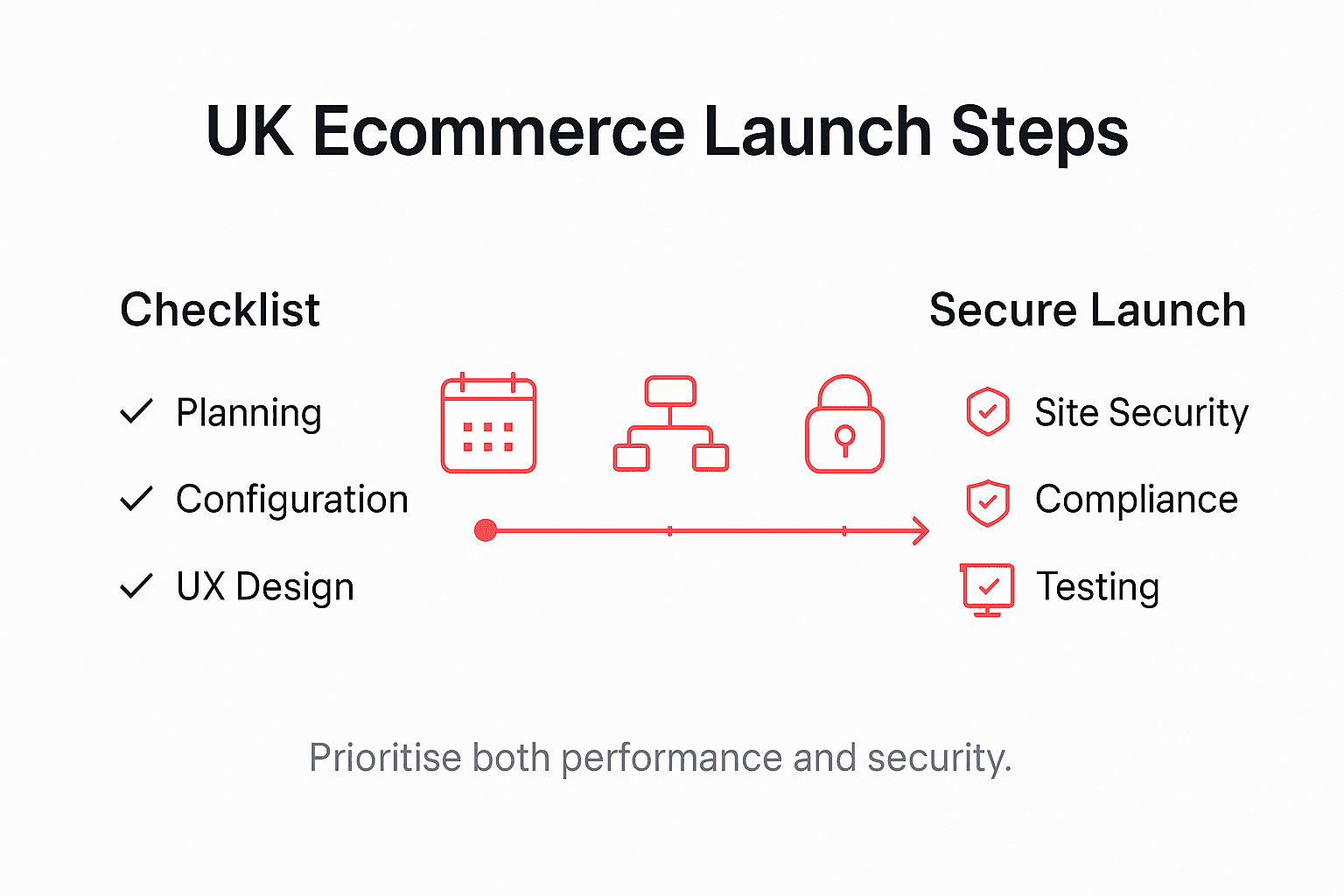
Understanding UK data protection regulations is fundamental to creating a compliant online store. Begin by thoroughly reviewing your data handling processes to ensure full alignment with GDPR and Information Commissioner’s Office guidelines. This means establishing clear consent mechanisms for data collection, implementing transparent privacy policies, and creating secure methods for customers to access, modify, or request deletion of their personal information. Pay special attention to how you collect, store, and process customer data across all touchpoints of your ecommerce platform.
Next, focus on payment security and technical safeguards. Comprehensive PCI DSS compliance frameworks require meticulous implementation of encryption protocols, secure payment gateways, and robust authentication mechanisms. Conduct thorough vulnerability assessments, implement multi factor authentication, and ensure all payment processing systems meet the latest security standards. Regular security audits, penetration testing, and staying updated with emerging cybersecurity threats are crucial to maintaining a resilient online store.
Expert Suggestion: Engage a professional cybersecurity consultant to conduct an independent security audit and provide tailored recommendations for your specific ecommerce platform.
Step 5: Test checkout, search, and user journeys
This critical phase ensures your ecommerce website delivers a seamless user experience across all key interaction points. Testing comprehensively will reveal potential friction points that could prevent customers from completing purchases and exploring your product range.
Comprehensive checkout usability research demonstrates the importance of creating a smooth, intuitive purchasing pathway. Systematically test every stage of the checkout process including product selection, cart management, shipping options, payment methods, and confirmation screens. Simulate different user scenarios such as guest checkouts, account registrations, multiple product purchases, and various payment types. Pay special attention to mobile responsiveness, ensuring the checkout flow works flawlessly across smartphones, tablets, and desktop devices.
Beyond checkout, rigorously evaluate your website’s search and navigation functionalities. Ecommerce testing methodologies recommend comprehensive user journey mapping to identify potential navigation challenges. Test product search accuracy, filtering mechanisms, category browsing, and recommendation algorithms. Verify that search results are relevant, load quickly, and provide clear product information. Create test scenarios representing different customer personas to ensure your website meets diverse user expectations and provides an inclusive, accessible browsing experience.
Expert Suggestion: Recruit real users from your target demographic to perform independent testing and provide unfiltered feedback about their website experience.
Step 6: Review analytics setup and execute launch
This final stage marks the culmination of your strategic planning and technical preparation. Your goal is to ensure comprehensive tracking capabilities and a smooth transition from development to live operations, setting the foundation for ongoing performance measurement and continuous improvement.
Comprehensive ecommerce analytics implementation requires meticulous configuration of tracking systems. Begin by integrating advanced analytics tools that provide granular insights into user behaviour, conversion funnels, and revenue generation. Set up enhanced ecommerce tracking to capture detailed metrics including product impressions, click through rates, average order values, and customer lifetime value. Configure custom event tracking for critical user interactions such as product views, add to cart actions, checkout initiation, and purchase completions.
As you prepare for launch, conduct a final systems check to verify all tracking mechanisms are functioning correctly. Validate that analytics dashboards are correctly populated, conversion goals are properly defined, and real time reporting is operational. Create a staged rollout strategy that allows for gradual traffic introduction, enabling you to monitor performance metrics and quickly address any unexpected issues. Ensure your team is prepared to interpret initial data and make rapid adjustments to optimise user experience and conversion rates.
Expert Suggestion: Schedule a post launch review within the first two weeks to analyse initial performance data and identify immediate opportunities for website refinement.
Launch Your Secure UK Ecommerce Store with Confidence
Launching a secure and high-performing ecommerce website requires meticulous attention to detail, from defining clear objectives and configuring the right platform integrations to ensuring GDPR compliance and optimised user experience. If you are aiming to build an online store that meets these critical needs while delivering seamless checkout journeys and robust security measures, you need a partner with proven expertise in the UK ecommerce space.
Big Eye Deers is a UK-based ecommerce agency with over 17 years of experience specialising in Magento and Shopify solutions built for growth and security. We understand the importance of implementing PCI-compliant payment gateways and GDPR-aligned data protection while enhancing user journeys with tools like Klevu search and Klaviyo lifecycle marketing. Our development process using Figma ensures every detail of your UX design is tested before launch, reducing friction and boosting conversions.

Start your journey towards a secure, scalable, and customer-friendly online store today. Discover how our bespoke ecommerce services can simplify your platform setup and safeguard your business compliance at Big Eye Deers. Learn more about our Magento and Shopify design and build services and how we support ongoing site performance and security so you can focus on growing your brand with confidence.
Frequently Asked Questions
What are the key objectives to define before launching my ecommerce website in the UK?
To effectively launch your ecommerce website, clearly outline your business objectives, including target audience demographics, monthly revenue goals, and customer experience metrics. Create a detailed document that specifies these goals and ensures all design and technical decisions align with them.
How do I ensure that my ecommerce platform is configured properly?
Start by mapping out your essential functional requirements, such as payment gateway integrations and shipping methods. Thoroughly review and adjust each platform setting to ensure it aligns with your business model, focusing on aspects like product categories and pricing rules.
What steps should I take to optimise the user experience on my ecommerce site?
Create an intuitive design that guides users through their purchasing journey by establishing a clear visual hierarchy and optimising for mobile responsiveness. Regularly test your website’s usability and performance to identify and eliminate potential issues that could hinder user engagement.
How can I secure my ecommerce website and comply with UK regulations?
Implement robust security measures, including encryption protocols and secure payment gateways, to protect customer data. Review your data handling processes to ensure they comply with GDPR and establish clear consent mechanisms for data collection and storage.
What should I test before launching my ecommerce site?
Test every aspect of the user journey, from product selection to the checkout process, to ensure a seamless experience. Evaluate functionalities like search accuracy and navigation efficiency, and ensure all tests account for different user scenarios to capture diverse interactions.
How do I set up analytics tracking for my ecommerce website?
Integrate advanced analytics tools to capture detailed metrics of user behaviour, such as conversion funnels and revenue generation. Ensure your tracking mechanisms are configured properly and ready for monitoring upon launch to provide actionable insights from day one.