Account hierarchies in ecommerce: the UK manager’s guide
TL;DR:
- Managing multiple related customer accounts in B2B ecommerce requires well-structured account hierarchies to control permissions, credit limits, and payments effectively. These hierarchies mirror internal company structures, supporting complex multi-level relationships, and must be regularly maintained for compliance with VAT and GDPR regulations. Leading platforms like Oracle Siebel and NetSuite offer scalable solutions, but success depends on careful design, ongoing management, and integration with accounting systems.
Managing multiple related customer accounts in B2B ecommerce is one of those challenges that sounds simple until you are actually doing it. Account hierarchies in ecommerce give you the structural framework to control access, credit limits, pricing, and purchasing permissions across interconnected companies, branches, and teams. Without them, you end up with duplicate accounts, inconsistent pricing, and finance teams manually reconciling invoices that should have been automated months ago. This guide covers what hierarchies actually are, how leading platforms implement them, and the management practices UK ecommerce managers need to get this right at scale.
Table of Contents
- Understanding account hierarchies in B2B ecommerce
- How major ecommerce platforms handle account hierarchies
- Key management strategies and compliance considerations
- Comparing ecommerce hierarchy models and their application
- Optimising your account hierarchy for performance and growth
- Rethinking account hierarchies: what most managers overlook
- How Big Eye Deers supports your ecommerce account hierarchy needs
- Frequently asked questions
Key Takeaways
| Point | Details |
|---|---|
| Definition of hierarchies | Account hierarchies group related customer accounts to simplify B2B ecommerce management. |
| Platform functionality | Leading platforms offer varied hierarchy features enabling central control and payment consolidation. |
| Management best practices | Role-based permissions and VAT-compliant integrations reduce risk and improve control. |
| Model selection | Choose hierarchy complexity based on business size, branching and operational needs. |
| Continuous maintenance | Regular audits and automated alerts keep hierarchies accurate, especially in mergers. |
Understanding account hierarchies in B2B ecommerce
An account hierarchy is a parent-child structure that groups related customer accounts under a single organisational umbrella. Think of it like a company’s org chart, but for your ecommerce platform. At the top sits the parent account, and below it any number of subsidiaries, divisions, or branch accounts inherit settings, permissions, and credit arrangements from above.
The account hierarchies meaning in a B2B context goes beyond simple grouping. These structures define who can buy, what they can buy, at what price, and how those purchases are approved and paid for. Get it right and you create a buying experience that mirrors how your customers actually operate internally. Get it wrong and you create friction, billing errors, and account managers chasing down duplicate purchase orders.
A well-configured hierarchy typically controls:
- Permissions and access: which users can view certain catalogues or pricing tiers
- Credit terms: shared or tiered credit limits across parent and child accounts
- Approval workflows: purchase sign-off routing based on account level or spend threshold
- Payment consolidation: rolling up invoices across subsidiary accounts into a single parent statement
- Product visibility: restricting specific SKUs or categories to certain divisions
Account hierarchies support any number of child accounts per parent, with multiple levels ideal for complex B2B structures like headquarters, divisions, and branches. This unlimited depth is what makes them genuinely useful for enterprise-level UK businesses with regional offices, trading subsidiaries, or franchise networks.
Following ecommerce best practices when designing your hierarchy from the outset saves significant rework later, particularly when those structures need to reflect real-world M&A activity or rapid business growth.
Now that we understand what account hierarchies mean, let’s explore how leading ecommerce platforms implement these structures.
How major ecommerce platforms handle account hierarchies
Not all platforms treat account hierarchies the same way. The capabilities vary considerably, and choosing the wrong platform for your complexity level is an expensive mistake. Here is how the major players approach hierarchical structure in ecommerce.
Microsoft Dynamics 365 Commerce allows associating B2B channels to specific customer hierarchies, restricting access per hierarchy group and assigning user roles accordingly. This is particularly useful for UK distributors managing multiple trade account tiers with different channel access requirements.
Adobe Commerce (Magento) handles account management in online retail through a company hierarchy model where parent settings can be pushed down to child companies. The catch? Applying parent settings to child companies replaces child configurations entirely, which means thorough testing before rollout is non-negotiable. Adobe Commerce typically supports 2 to 3 hierarchy levels, which covers most mid-market UK businesses without the complexity overhead of deeper structures.
Oracle Siebel CRM takes a more enterprise-grade approach. Oracle Siebel supports unlimited hierarchy levels and creates account roll-up relationships for billing and discounting, making it suited to large corporations with elaborate divisional structures.
NetSuite approaches the problem from a financial management angle. Its Consolidated Payments feature applies a top-level credit limit to the entire customer hierarchy and consolidates invoice and payment data, giving finance teams a single view of exposure across an entire corporate family.
| Platform | Hierarchy depth | Credit consolidation | Key strength |
|---|---|---|---|
| Microsoft Dynamics 365 | Multi-level | Partial | Channel access control |
| Adobe Commerce | 2 to 3 levels | Limited | Catalogue and pricing control |
| Oracle Siebel | Unlimited | Yes, with roll-up billing | Enterprise complexity |
| NetSuite | Multi-level | Yes, top-level limit | Financial oversight |
For UK businesses running Magento multi-store setups, Adobe Commerce’s B2B module is often the starting point. It covers the majority of mid-market use cases without requiring the full complexity of a Siebel implementation.
Pro Tip: If your B2B customers operate across multiple UK legal entities, model your hierarchy in a spreadsheet before touching any platform configuration. Mapping parent-child relationships first prevents costly restructuring once data is live.
Understanding platform capabilities lets us examine the nuanced management strategies essential for UK ecommerce businesses.
Key management strategies and compliance considerations
Setting up the hierarchy is only half the job. The other half is managing it well. Poorly maintained account organisation for online shops creates maverick spend, where buyers circumvent approval processes because the system makes compliance too difficult.
Here is what good hierarchy management looks like in practice:
- Define user roles clearly. Every account level should have explicit permissions. A branch buyer should not have the same access as a divisional finance manager. Role clarity prevents both security issues and purchasing chaos.
- Build approval workflows into the hierarchy. Approval routing based on account level or order value is one of the most valuable features of a well-configured hierarchy. Without it, high-value orders can slip through without proper authorisation.
- Implement delegated budgets. Assign spending limits per user role within each account level. This is how team-based buying workflows operate effectively in sophisticated B2B environments.
- Audit regularly. People leave companies, businesses restructure, and accounts get orphaned. A quarterly review of your hierarchy keeps the configuration aligned with reality.
For UK businesses, two compliance considerations sit above all others. First, VAT. B2B ecommerce hierarchies require tight VAT compliance and integration with accounting platforms like Xero, QuickBooks, or NetSuite for automated order-to-cash workflows as sales scale. If your hierarchy spans both VAT-registered and non-registered entities, that distinction must be captured at account level, not fixed manually per order.
Second, GDPR. Customer account data held within hierarchy structures falls squarely under UK GDPR obligations. Ensure that data access permissions in your hierarchy align with your data governance policies, particularly when child account users can view order history from sibling accounts.
Enterprise ecommerce solutions built with compliance baked in from the start are significantly cheaper to maintain than those where compliance is retrofitted later.
Pro Tip: When setting credit terms at parent level, document which child accounts inherit those terms versus which have overrides. This single piece of documentation prevents enormous confusion when your finance team and your ecommerce platform disagree about who owes what.
With solid management practices covered, we now compare different hierarchy structures to clarify when and how to implement them.
Comparing ecommerce hierarchy models and their application
Choosing the right model for your hierarchy is a decision that shapes every downstream configuration. There is no universally correct answer, only the right fit for your business complexity.
-
Two to three-level model. This suits most UK mid-market businesses. A typical setup would be: Parent Company > Regional Division > Individual Branch. Adobe Commerce supports 2 to 3 levels, which covers this structure well. Centralised settings from the parent cascade down, keeping pricing and catalogue management efficient without requiring granular configuration at every node.
-
Unlimited-level model. This is the territory of large enterprises with genuinely complex organisational structures. Headquarters, international divisions, country offices, regional branches, and individual cost centres might all need representation. Oracle Siebel supports unlimited levels, making it suited to global or highly federated organisations where a three-level cap simply does not reflect how the business operates.
-
Consolidated payment model. This is less about depth and more about financial architecture. Rather than managing credit per child account, you apply a single credit limit at the top of the hierarchy and consolidate all invoicing upward. NetSuite does this well. It suits businesses where the parent company is the financially responsible entity regardless of which subsidiary places the order.
-
Hybrid model. Many UK businesses end up here. Legal entities managed separately for VAT purposes, but purchasing consolidated under a trading parent for credit and pricing. This is harder to configure but reflects how many group companies actually operate.
| Model | Depth | Best for | Main challenge |
|---|---|---|---|
| Two to three-level | Shallow | Mid-market UK businesses | Limited flexibility |
| Unlimited-level | Deep | Large enterprises, global groups | Configuration complexity |
| Consolidated payment | Varies | Finance-led organisations | Requires robust accounting integration |
| Hybrid | Varies | Group companies, holding structures | Dual-logic maintenance |
For businesses running multi-store ecommerce strategies, the hierarchy model must align with the store architecture. A child account in one legal entity should not automatically have access to a store configured for a different trading brand.
Optimising your account hierarchy for performance and growth
Once your hierarchy is live, the real work begins. Configuration drift, where your platform’s account structure diverges from your actual business structure, is the single biggest operational risk for B2B ecommerce managers.
Here is how to stay on top of it:
- Set automated alerts for parent account changes. When a parent account is modified, child accounts may be affected in ways that are not immediately obvious. Automated notifications catch these cascading changes before they cause billing or routing errors.
- Use validation rules. Prevent child accounts from being created without a confirmed parent assignment. Orphaned accounts are how duplicate outreach and inconsistent pricing creep in.
- Review hierarchy structures after any M&A activity. This sounds obvious. It is still regularly overlooked. Automated triggers and quarterly audits prevent errors and duplicate outreach, which is particularly important in active acquisition environments.
- Test before rollout. If you push parent settings down to child accounts, run the change in a staging environment first. Adobe Commerce, for instance, will overwrite child configurations entirely, which is not a problem if you have planned for it and a significant problem if you have not.
Pro Tip: Treat your hierarchy documentation like source code. Version-control it, date every change, and record the business reason behind each structural decision. When something breaks six months later, that documentation is the difference between a one-hour fix and a two-day investigation.
Leverage user roles within the hierarchy to speed up purchasing. When buyers at branch level can approve orders up to a defined threshold without escalating to division level, ecommerce optimisation translates directly into faster order cycles and better buyer satisfaction scores.

Rethinking account hierarchies: what most managers overlook
Here is something we see consistently: account hierarchies get treated as a setup task rather than an ongoing operational discipline. A manager configures the structure at launch, it works reasonably well for twelve months, and then a business reorganisation happens and nobody updates the hierarchy. That is when the problems start.
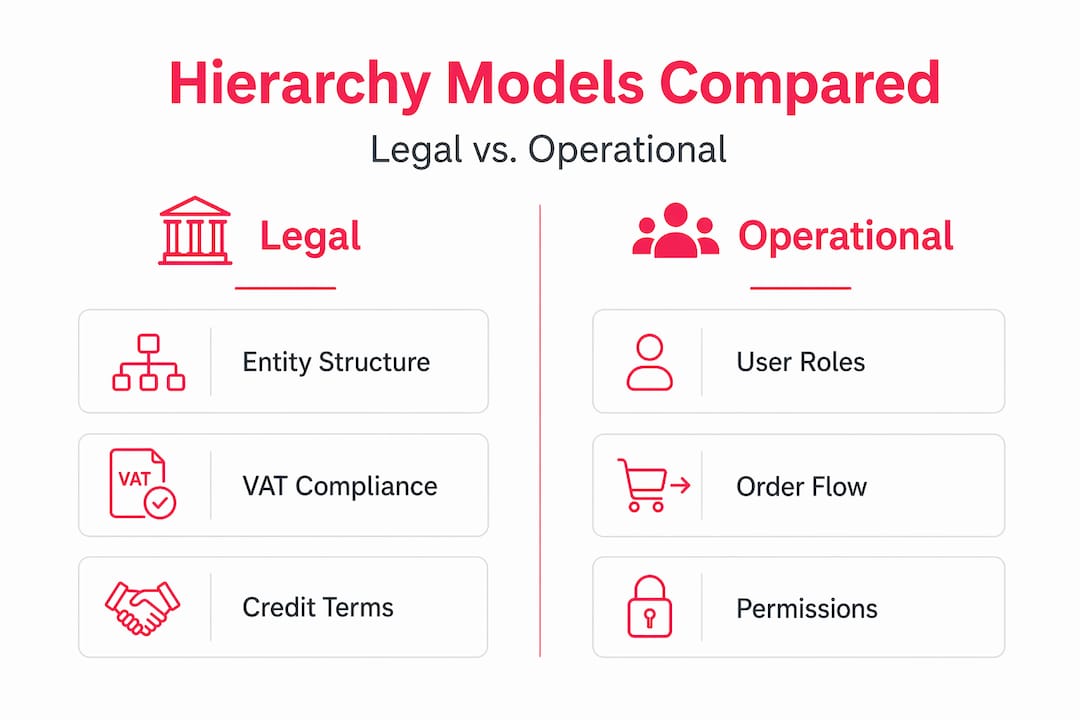
The subtler issue is that most businesses actually need two overlapping hierarchy views, not one. There is the legal hierarchy (which entity owns which, relevant for contracts and VAT) and the sales hierarchy (which accounts are managed together for pricing, territory, and credit purposes). These are often different. Enterprise organisations frequently need separate hierarchy views for legal ownership versus sales territory logic, and M&A requires quarterly audits to maintain accuracy and prevent routing errors.
Most ecommerce platforms are built around a single hierarchy model. That means you either maintain two parallel data structures or you accept that one of your two needs is being handled manually outside the platform. Neither is ideal, but knowing which compromise you are making is far better than not realising the problem exists.
The managers who get this right treat their hierarchy as a living document. They have someone accountable for it. They review it quarterly. They test changes before deploying them. And they have built complex B2B ecommerce thinking into how their platform is configured from day one. The hierarchy is not a database quirk. It is the operational spine of your entire B2B buying experience.
How Big Eye Deers supports your ecommerce account hierarchy needs
Account hierarchy design is one of the most technically demanding aspects of B2B ecommerce, and getting the foundations wrong creates compounding problems as your business grows.
At Big Eye Deers, we specialise in designing and building B2B ecommerce architectures on Magento and Adobe Commerce that reflect how your business actually operates, not how a default platform configuration assumes it does. That means custom account hierarchies with role-based permissions, approval workflows, tiered pricing, and accounting integrations with platforms like NetSuite, Xero, and QuickBooks. We have been doing this for over 17 years across growing and enterprise UK brands. Our expert ecommerce team works with you to map your organisational structure before writing a line of code, so the configuration fits the business rather than the other way round. If your current hierarchy is causing friction or you are planning a B2B build, we would be glad to talk it through.
Frequently asked questions
What is an account hierarchy in ecommerce?
An account hierarchy is a structured grouping of related customer accounts allowing central management of permissions, payments, and pricing within B2B ecommerce. Hierarchies support any number of child accounts per parent, making them well suited to complex B2B structures such as holding companies, divisions, and branches.
How do ecommerce platforms enforce credit limits in hierarchies?
Platforms like NetSuite apply a top-level credit limit across the entire customer hierarchy, overriding individual sub-account settings to simplify financial risk management across corporate families.
Why are regular audits important for account hierarchies?
Regular audits ensure hierarchy data stays aligned with your actual business structure, preventing duplicate outreach and billing errors. M&A activity specifically requires quarterly audits to maintain accuracy and prevent routing mistakes across corporate families.
How can I manage user roles within account hierarchies?
Assign specific roles and permissions at each account level to support team buying, delegated budgets, and approval workflows. User roles and permissions in hierarchies directly reduce maverick spend by ensuring every purchase follows the correct authorisation path.
What integration is important for UK ecommerce account hierarchies?
Connecting your ecommerce platform to accounting software is essential for automating VAT compliance and order-to-cash processes. B2B ecommerce hierarchies require integration with platforms like Xero, QuickBooks, or NetSuite to handle credit terms and tax obligations accurately as order volumes grow.
Recommended



Adobe Commerce (Magento)
Formerly known as Magento, Adobe Commerce is built for complex catalogues, integrations, and long term growth. We design and develop stable, scalable stores that support demanding eCommerce requirements, including multi-store setups, complex pricing, and Hyva based performance improvements.

Bespoke Build
We design and build custom eCommerce platforms for businesses with complex workflows, integrations, or non standard requirements. Built from scratch around your business needs using Laravel and modern architectures.

Working with brands across the UK from our offices in Cardiff and Exeter, you deal directly with a senior team of designers and developers specialising in Shopify, Magento, WordPress and bespoke eCommerce platforms.
We focus on commercial outcomes. Better conversion rates, strong SEO foundations and eCommerce platforms that continue to improve long after launch.