Why use Hyvä themes for your Magento store
TL;DR:
- Hyvä themes are a modern Magento 2 frontend framework that significantly reduces JavaScript size and improves page load times.
- They replace legacy code with Alpine.js and Tailwind CSS, leading to faster performance and better Core Web Vitals.
- Hyvä is best suited for new projects, redesigns, or stores needing upgrades and extension compatibility assessments.
Hyvä themes are a modern Magento 2 frontend framework designed to replace the platform’s ageing default stack with a faster, simpler, and more maintainable alternative. The core case for why use Hyvä themes comes down to three things: dramatically smaller JavaScript bundles, measurably better Core Web Vitals, and a development experience that actually makes sense in 2026. Built on Alpine.js and Tailwind CSS, Hyvä strips out the legacy complexity that has made Magento frontends slow and expensive to maintain for years. If you run a Magento store or build them for clients, this guide covers everything you need to make an informed decision.
Why use Hyvä themes: the technology stack explained
Hyvä themes replace Magento’s default frontend stack, which relies on RequireJS, KnockoutJS, and jQuery, with Alpine.js and Tailwind CSS. That swap is not cosmetic. It fundamentally changes how much code the browser has to download, parse, and execute before your store becomes usable.

The numbers are striking. JS bundle size shrinks from 400–600 KB in a standard Luma setup to around 30–50 KB with Hyvä. That is a reduction of roughly 90%, and it shows up immediately in page load times and Google PageSpeed scores. Alpine.js weighs in at approximately 15 KB, handling interactivity without the overhead of a full framework.
Tailwind CSS adds another layer of efficiency. Tailwind CLI compiles CSS in under 10 seconds, and because Tailwind purges unused styles at build time, the resulting stylesheet is tiny. Developers working on Hyvä projects spend less time waiting for builds and more time shipping features.
Pro Tip: If you are evaluating Hyvä for a new project, check your existing extension list first. Hyvä eliminates RequireJS and KnockoutJS, so third-party modules that depend on those libraries will need compatible versions or replacements before you go live.
| Technology | Luma (default) | Hyvä |
|---|---|---|
| JavaScript framework | RequireJS + KnockoutJS + jQuery | Alpine.js (~15 KB) |
| JS bundle size | 400–600 KB | 30–50 KB |
| CSS approach | LESS with full stylesheet | Tailwind CSS (purged at build) |
| CSS build time | Minutes with full recompile | Under 10 seconds via Tailwind CLI |
| Developer tooling | Legacy Grunt/Gulp | Vite and Tailwind CLI |
How do Hyvä themes improve Core Web Vitals and SEO?
Google’s Core Web Vitals are now a confirmed ranking signal, and Magento stores running the default Luma theme consistently struggle to pass them. Hyvä themes change that picture significantly.
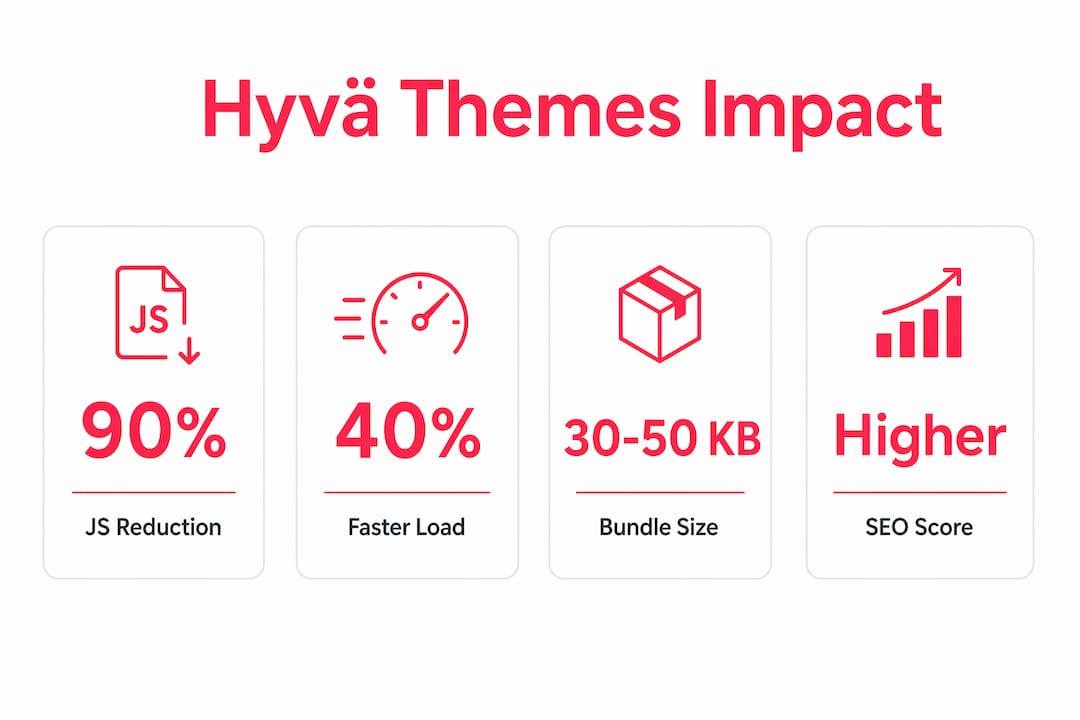
The most visible improvement is in Largest Contentful Paint. LCP drops from roughly 5 seconds to around 2 seconds on mobile devices after migrating to Hyvä. That single metric can be the difference between a Google “Poor” rating and a “Good” one, with real consequences for organic rankings.
The benefits extend across all three Core Web Vitals:
- Largest Contentful Paint (LCP): Faster rendering of the main page element, directly tied to the smaller JS and CSS payloads.
- First Input Delay (FID) / Interaction to Next Paint (INP): Reduced JavaScript execution means the browser responds to user input faster.
- Cumulative Layout Shift (CLS): Cleaner, more predictable HTML output reduces unexpected layout shifts during load.
Mobile performance deserves particular attention. Better Core Web Vitals translate directly into higher Google PageSpeed scores and improved mobile rankings. Given that the majority of ecommerce traffic now arrives on mobile devices, this is not a marginal gain. Stores that have migrated to Hyvä report meaningful increases in organic traffic and conversion rates, driven by faster load times and a smoother browsing experience. For a broader view of how technical SEO drives ecommerce growth, the connection between page speed and search visibility is well established.
What advantages do developers and store owners gain?
The benefits of Hyvä themes split neatly into two groups: what developers experience during the build, and what store owners see in the long run.
For developers, the simplified codebase is the headline gain. Hyvä reduces frontend complexity, making it easier to build features, fix bugs, and upgrade Magento versions without untangling layers of legacy JavaScript. Anyone who has spent an afternoon debugging a KnockoutJS binding in Luma will understand why this matters.
For store owners, the financial case is equally clear. The practical steps to realising those savings look like this:
- Faster feature delivery. Developers build and deploy new functionality more quickly on Hyvä, reducing sprint costs and time to market.
- Lower maintenance overhead. Fewer dependencies mean fewer things to break during Magento security patches and version upgrades.
- Reduced debugging time. A cleaner codebase produces fewer obscure bugs, cutting the billable hours spent on investigation.
- Easier Magento upgrades. Because Hyvä does not rely on the legacy stack, major version upgrades carry less frontend risk.
- Long-term cost savings. Total cost of ownership over 2–3 years is often lower than maintaining a Luma-based store, despite the higher upfront migration investment.
Pro Tip: Before approving a Hyvä migration budget, ask your agency to model the 24-month total cost. Include current maintenance hours, extension update costs, and any revenue lost to slow page speeds. The comparison with Hyvä’s ongoing costs is usually compelling.
The broader Hyvä ecosystem also includes Hyvä Checkout, a purpose-built replacement for Magento’s default checkout that applies the same lightweight principles to the purchase flow. Combining Hyvä Theme with Hyvä Checkout gives store owners a fully modernised frontend from browse to buy. You can read more about the Hyvä frontend benefits in the context of retail-focused Magento stores.
How to plan your move to Hyvä themes
Adopting Hyvä themes is not a drop-in replacement. Planning the migration carefully determines whether you capture the full performance gains or create new problems.
- Audit your extension stack first. Hyvä is incompatible with Luma-based UI components by default. The Hyvä Compatibility Layer exists to bridge legacy extensions, but not every module has a compatible version. Identify gaps before committing to a timeline.
- Prioritise new builds and full redesigns. Hyvä delivers the best return when adopted from the start of a project or as part of a complete frontend rebuild. Bolting it onto a heavily customised Luma store mid-lifecycle is possible but more complex.
- Evaluate store complexity honestly. Stores with large numbers of custom Luma templates or bespoke JavaScript components require more migration effort. Factor this into your ROI estimate.
- Check third-party extension compatibility. The Hyvä community maintains a compatibility list, and most major extension vendors now offer Hyvä-compatible versions. Gaps are narrowing but still exist for niche modules.
- Engage developers with real Hyvä experience. The framework is different enough from Luma that general Magento developers face a learning curve. Agencies with live Hyvä projects deliver faster and with fewer surprises. Bigeyedeers has built and launched Hyvä theme projects for retail and B2B merchants across the UK.
- Model the ROI before you start. Expert agencies confirm that the migration investment pays back within 2–3 years through lower maintenance costs and faster deployment. Build that model before sign-off.
For context on how Luma and modern Magento themes compare technically, the Luma vs F2 theme breakdown on the Bigeyedeers site covers the key differences in performance and architecture.
Key takeaways
Hyvä themes are the most effective way to modernise a Magento 2 frontend, cutting JS bundle size by up to 90%, improving Core Web Vitals, and reducing long-term development costs.
| Point | Details |
|---|---|
| JS bundle reduction | Hyvä cuts JavaScript from 400–600 KB down to 30–50 KB, accelerating page loads. |
| LCP improvement | Largest Contentful Paint drops from roughly 5 seconds to 2 seconds on mobile. |
| Lower total cost | Maintenance and deployment savings make Hyvä cheaper than Luma over 2–3 years. |
| Extension audit first | Check third-party compatibility before migrating to avoid post-launch surprises. |
| Best for new builds | Hyvä delivers maximum value on new projects or complete frontend redesigns. |
Hyvä in practice: what I have actually seen
Working on Magento projects across retail and B2B, the performance gap between Luma and Hyvä is not theoretical. It shows up in the first PageSpeed report after launch, and it holds up under real traffic.
What surprises most store owners is not the speed gain itself but how quickly it affects conversion. Faster load times reduce bounce rates, and that shows up in revenue within weeks of going live. The SEO benefit takes longer, typically two to three months before ranking improvements become visible, but it compounds over time.
The misconception I hear most often is that Hyvä is only for greenfield projects. That is not quite right. A well-planned migration from Luma to Hyvä on an existing store is absolutely viable, provided you audit extensions thoroughly and budget for compatibility work. The stores that struggle are those that underestimate the extension gap or try to migrate without developers who know the framework well.
My honest advice: if your Magento store is due a redesign in the next 12 months, build it on Hyvä. If you are mid-lifecycle and your PageSpeed scores are hurting conversions, the migration ROI case is worth modelling now. The speed and sales impact of switching is real, and waiting another year on Luma has a cost too.
— Steve
Hyvä theme development with Bigeyedeers
Bigeyedeers builds and supports Hyvä-powered Magento stores for retail and B2B merchants across the UK. With over 17 years of Magento experience and live Hyvä projects in production, we know where the complexity sits and how to manage it.
Whether you are planning a new Magento build or migrating an existing store to Hyvä, we handle the full process: extension audits, frontend development, performance testing, and ongoing support. Our Magento web design service covers everything from initial scoping through to launch and beyond. If you want a faster, more maintainable Magento store, talk to the team at Bigeyedeers about what a Hyvä migration could look like for your business.
FAQ
What is a Hyvä theme for Magento?
Hyvä is a modern Magento 2 frontend theme that replaces the default Luma stack with Alpine.js and Tailwind CSS. It delivers significantly faster page loads, smaller asset sizes, and a simpler development experience.
How much does Hyvä improve page speed?
Hyvä reduces JavaScript bundle size from 400–600 KB to around 30–50 KB and cuts Largest Contentful Paint from roughly 5 seconds to 2 seconds on mobile. These gains translate directly into better Google PageSpeed scores and Core Web Vitals ratings.
Is Hyvä compatible with all Magento extensions?
Not all extensions support Hyvä out of the box. Extensions built on Luma UI components require compatible versions or the Hyvä Compatibility Layer. Auditing your extension stack before migration is a critical first step.
When does it make sense to switch to Hyvä themes?
Hyvä delivers the best return on new Magento projects or complete frontend redesigns. Existing stores with slow performance and upcoming redesign plans are also strong candidates, provided extension compatibility is assessed first.
Does Hyvä reduce long-term development costs?
The total cost of ownership over 2–3 years is typically lower with Hyvä than with Luma, due to faster feature deployment, reduced maintenance overhead, and fewer bugs from a simpler codebase.
Recommended



Adobe Commerce (Magento)
Formerly known as Magento, Adobe Commerce is built for complex catalogues, integrations, and long term growth. We design and develop stable, scalable stores that support demanding eCommerce requirements, including multi-store setups, complex pricing, and Hyva based performance improvements.

Bespoke Build
We design and build custom eCommerce platforms for businesses with complex workflows, integrations, or non standard requirements. Built from scratch around your business needs using Laravel and modern architectures.
Working with brands across the UK from our offices in Cardiff and Exeter, you deal directly with a senior team of designers and developers specialising in Shopify, Magento, WordPress and bespoke eCommerce platforms.
We focus on commercial outcomes. Better conversion rates, strong SEO foundations and eCommerce platforms that continue to improve long after launch.