Why invest in mobile-first commerce in 2026
TL;DR:
- Mobile accounts for most UK online retail traffic, making mobile-first the necessary approach for growth. Native apps outperform mobile web in revenue, engagement, and retention, but a strong mobile website is the essential foundation. Successful mobile commerce depends on strategic technology, data, and trust to build long-term customer relationships.
Mobile-first commerce is the strategic approach where mobile devices become the primary platform for online sales and customer engagement. This is not a trend to monitor from a distance. Mobile accounts for 65–72% of UK online retail traffic, which means the majority of your shoppers are already on their phones. If your store is not built around that reality, you are losing revenue to businesses that are. Understanding why invest in mobile-first commerce starts with accepting that mobile is no longer a secondary channel. It is the channel.
Why invest in mobile-first commerce: the measurable business case
The financial argument for mobile-first investment is concrete. ROI for fashion, jewellery, and beauty brands earning between £1M and £2M typically ranges from 150% to 400% in the first year. That is not a projection. That is a benchmark drawn from brands that have already made the shift.
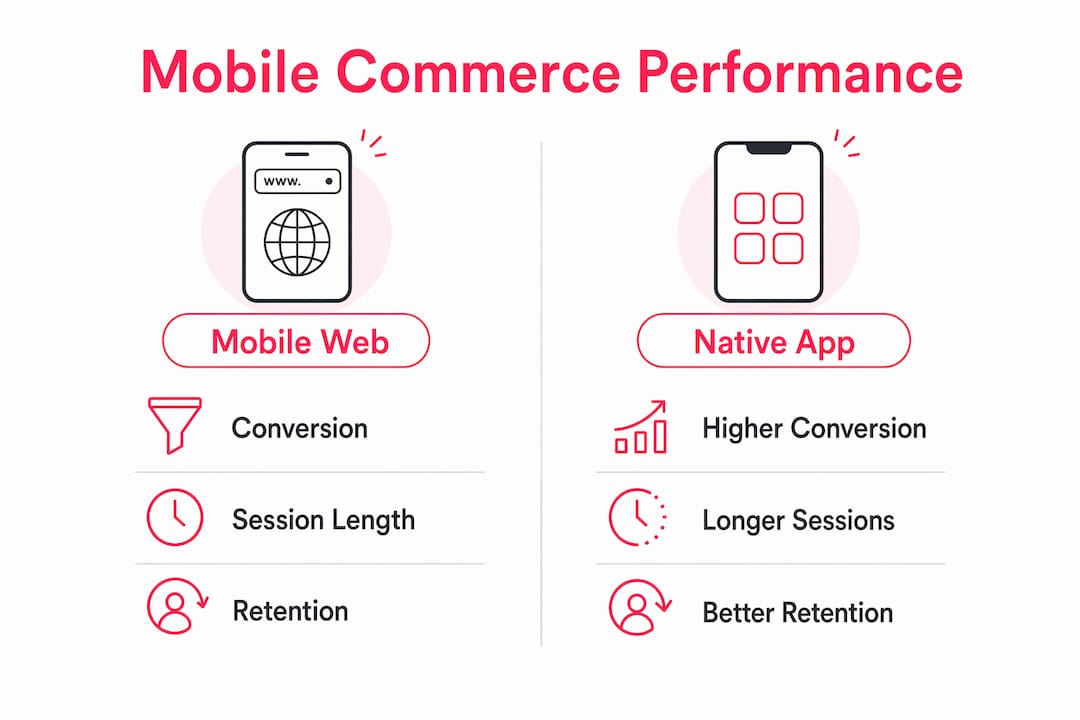
Mobile apps specifically drive 8–30% of total revenue for retailers who have invested in them. The benefits of mobile commerce extend beyond raw sales figures. Native apps outperform mobile web with session frequency 2–8 times higher, longer time on site, and average order values 10–25% above mobile web equivalents. Shoppers who use an app return more often and spend more per visit.
Retention is where the numbers become particularly compelling. Day-30 retention rates sit at 25–40% for brands running active push notification programmes, with Day-90 rates holding at 15–30%. Push notification open rates tell a similar story: transactional notifications achieve 85–95%, personalised messages reach 28–40%, and segmented promotional pushes land at 18–25%. These are not vanity metrics. They represent real re-engagement with shoppers who would otherwise have drifted away.
Here is a quick comparison of how mobile web and native app performance typically differs:
| Metric | Mobile web | Native app |
|---|---|---|
| Conversion rate | 1.8–2.4% | 3–6% (typical range) |
| Session frequency | Baseline | 2–8x higher |
| Average order value | Baseline | 10–25% higher |
| Day-30 retention | Lower | 25–40% with push |
| Brand touchpoint | None between visits | Persistent app icon |
The gap between mobile web and native app performance is significant. For brands in competitive categories, that gap is the difference between growing and standing still.
Pro Tip: Start with mobile web optimisation if a native app is not yet feasible. A well-built, fast mobile site still captures meaningful revenue and gives you the behavioural data you need to justify the app investment later.
How does mobile-first commerce align with evolving consumer behaviour?
Consumer shopping behaviour has changed structurally, not just incrementally. 43% of UK consumers now rank mobile shopping as their first choice, ahead of physical stores and desktop. That figure reflects a genuine shift in how people organise their lives around their phones.

The modern shopping journey is fragmented across multiple touchpoints. A shopper might discover a product via Instagram, research it on a mobile browser, save it in a wishlist app, and complete the purchase on desktop. Mobile sits at the centre of that journey, not at the end. Successful retailers treat mobile as the main persistent interface for their customers, not as an additional channel to manage separately.
The importance of mobile shopping also shows up in how consumers expect to be treated. Shoppers want experiences that feel relevant to them, not generic pages that happen to load on a phone. AI-driven discovery and hyper-personalisation are now central to how leading retailers deliver this. Mobile behavioural data, including browsing patterns, dwell time, and purchase history, gives retailers the raw material to build context-aware experiences that generic desktop sites simply cannot replicate.
Key behavioural shifts driving the mobile-first strategy advantages:
- Shoppers move fluidly across apps, social media, and search engines, with mobile anchoring each transition
- Consumers expect omnichannel consistency across every device and touchpoint, not just a mobile-friendly version of a desktop site
- App engagement creates habitual return visits that social media and email cannot reliably replicate
- Mobile is increasingly where loyalty is built, not just where transactions happen
There is also a trust dimension that business owners cannot ignore. UK consumers in 2026 prefer restrained, transparent marketing that respects their privacy and delivers genuine value. Bombarding shoppers with notifications or harvesting data without clear consent will erode the trust that mobile commerce depends on. Growth comes through consistent, clear engagement, not volume.
What features and technologies drive mobile commerce success?
The mobile-first strategy advantages only materialise when the right technologies are in place. The architecture of your mobile experience determines whether shoppers convert or leave.
-
Native app vs mobile web. A native app is the higher-performing asset for retention and revenue, but a well-optimised mobile web experience is the foundation. Get the mobile site right first. Then build the app on top of the data it generates.
-
Push notifications with genuine personalisation. Generic promotional pushes achieve 18–25% open rates. Personalised messages reach 28–40%. The difference is segmentation and timing. Notifications triggered by browsing behaviour, abandoned baskets, or back-in-stock events outperform scheduled broadcasts every time.
-
Frictionless checkout. Every additional tap in the checkout flow costs conversions. Saved payment details, Apple Pay, Google Pay, and single-page checkout are not optional extras. They are the baseline expectation for mobile shoppers. Investing in mobile ecommerce conversion features at the checkout stage delivers some of the fastest returns of any mobile investment.
-
Loyalty programmes integrated into the app. Points, rewards, and exclusive app-only offers give shoppers a reason to return to the app rather than searching Google again. The app icon on a shopper’s home screen is a persistent brand touchpoint that no other channel can replicate.
-
AI-driven product discovery. Mobile behavioural data enables retailers to move from generic category pages to personalised feeds that surface the right products at the right moment. Tools like Klevu bring this capability to Magento and Shopify stores without requiring a bespoke build.
Pro Tip: First-party data collected through your app, including wish lists, browsing history, and purchase patterns, is your most valuable targeting asset. Build your notification and personalisation strategy around it from day one, before third-party data restrictions tighten further.
What challenges should businesses consider before investing?
The mobile commerce investment rationale is strong, but the path is not without obstacles. Understanding the challenges upfront prevents costly mistakes.
-
App development and maintenance costs. A well-built native app requires meaningful upfront investment and ongoing resource to maintain, update, and support. Businesses that underestimate the maintenance burden often end up with an app that degrades in quality and damages the brand.
-
User acquisition costs. Getting shoppers to download and keep an app is harder than getting them to visit a website. User acquisition costs range from £0.80 to £3.00 per install, and that cost only pays off if the app retains those users. Without a clear retention strategy, acquisition spend is wasted.
-
Mobile web conversion limitations. Mobile web conversion rates sit at 1.8–2.4%, well below desktop rates of 3.5–4.5%. Investing in mobile without addressing the conversion gap on mobile web first means you are driving traffic into a leaking bucket.
-
Integration complexity. Mobile cannot operate as a silo. Your app, mobile site, email, loyalty programme, and in-store experience all need to share data and deliver a consistent experience. Fragmented systems produce fragmented customer experiences, and shoppers notice.
-
Data privacy and consent. Personalisation depends on data. But collecting and using that data requires clear consent and transparent communication. The UK consumer preference for restrained, trustworthy engagement means that overstepping on data use will cost you more in trust than you gain in targeting precision.
The businesses that navigate these challenges successfully are the ones that plan for them before launch, not after.
Key takeaways
Mobile-first commerce delivers measurable revenue growth, stronger retention, and higher average order values, but only when built on the right technology, data strategy, and consumer trust.
| Point | Details |
|---|---|
| Mobile dominates UK traffic | 65–72% of UK online retail traffic comes from mobile devices, making mobile-first the default, not the exception. |
| Apps outperform mobile web | Native apps deliver 10–25% higher average order values and session frequency 2–8 times greater than mobile web. |
| Push notifications drive retention | Personalised push notifications achieve 28–40% open rates, directly supporting Day-30 and Day-90 retention targets. |
| Trust is non-negotiable | UK consumers in 2026 expect restrained, privacy-respecting engagement. Overuse of data erodes the loyalty mobile is built to create. |
| Plan for the full cost | User acquisition costs of £0.80–£3.00 per install require a retention strategy from day one to generate positive ROI. |
Mobile-first in 2026: what I have actually seen working
The retailers I see pulling ahead in 2026 are not the ones with the biggest budgets. They are the ones who made a clear decision to treat mobile as their primary channel and then built everything else around that decision.
What surprises me is how many business owners still approach mobile as a box-ticking exercise. They make the site responsive, call it done, and wonder why conversion rates are flat. The gap between a responsive site and a genuinely mobile-first experience is enormous, and shoppers feel it immediately, even if they cannot articulate why.
The brands doing it well share a few common traits. They invest in understanding mobile behaviour through data before they build anything. They prioritise checkout friction above almost everything else. And they treat push notifications as a relationship tool, not a broadcast channel. The ones who send three promotional pushes a week are the ones whose apps get deleted.
My honest advice: if you are evaluating a native app, do not start with the app. Start with your mobile responsive web design and get that performing properly. The data you collect from a well-optimised mobile site will tell you exactly what your app needs to do. Build the app from evidence, not assumption.
The ecommerce trends shaping 2026 all point in the same direction: personalisation, trust, and mobile-first architecture. The businesses that align with all three will be the ones worth talking about in 2027.
— Steve
How Bigeyedeers builds mobile-first ecommerce that converts
Bigeyedeers has spent over 17 years building high-performing online stores for UK retailers across Magento and Shopify. Mobile performance is not an afterthought in how we work. It is built into the design process from the first wireframe in Figma through to launch and ongoing support.

Whether you need a Magento build with Hyvä frontend performance, a Shopify store built for mobile conversion, or a full audit of your current mobile experience, we bring the technical depth and commercial understanding to make it count. Our team also supports retention through Klaviyo lifecycle marketing and product discovery through Klevu, giving your mobile shoppers a faster, more relevant experience at every stage. If you are ready to build a store that performs where your customers actually shop, our Magento web design service is a strong starting point.
FAQ
What is mobile-first commerce?
Mobile-first commerce is the approach of designing and building an online store with mobile devices as the primary platform, rather than adapting a desktop experience for smaller screens. It prioritises mobile performance, navigation, and checkout from the ground up.
Why does mobile-first matter for UK retailers specifically?
Mobile accounts for 65–72% of UK online retail traffic. With 43% of UK consumers ranking mobile as their preferred shopping channel, retailers who do not prioritise mobile are misaligned with how the majority of their customers actually shop.
What ROI can businesses expect from mobile commerce investment?
Fashion, jewellery, and beauty brands earning £1M–£2M typically see ROI of 150–400% in the first year, with mobile apps contributing 8–30% of total revenue when supported by active push notification and retention programmes.
Is a native app necessary, or is mobile web enough?
Mobile web is the essential foundation, but native apps consistently outperform it on conversion, session frequency, and average order value. The right answer depends on your revenue level, customer base, and retention strategy.
How do I handle data privacy in a mobile-first strategy?
UK consumers in 2026 expect transparent, restrained data use. Collect first-party data through clear consent mechanisms, use it to personalise rather than to broadcast, and build your notification strategy around genuine relevance rather than volume.
Recommended



Adobe Commerce (Magento)
Formerly known as Magento, Adobe Commerce is built for complex catalogues, integrations, and long term growth. We design and develop stable, scalable stores that support demanding eCommerce requirements, including multi-store setups, complex pricing, and Hyva based performance improvements.

Bespoke Build
We design and build custom eCommerce platforms for businesses with complex workflows, integrations, or non standard requirements. Built from scratch around your business needs using Laravel and modern architectures.

Working with brands across the UK from our offices in Cardiff and Exeter, you deal directly with a senior team of designers and developers specialising in Shopify, Magento, WordPress and bespoke eCommerce platforms.
We focus on commercial outcomes. Better conversion rates, strong SEO foundations and eCommerce platforms that continue to improve long after launch.