Explaining omni-channel retail: a 2026 guide for UK retailers
TL;DR:
- Omni-channel retail requires real-time data integration across all channels to deliver a consistent customer experience. The biggest challenge lies in fixing data infrastructure, such as inventory management and attribution models. Focusing on data unification and customer retention produces better long-term growth than expanding channels prematurely.
Omni-channel retail is defined as the full integration of every sales and communication channel a brand operates, so that customers receive a consistent experience whether they shop in store, on mobile, via desktop, or through social media. This is the industry standard term for what many retailers loosely call “being everywhere,” but the two are not the same thing. Brands with strong omni-channel strategies retain 89% of customers, compared to just 33% for those with weak cross-channel engagement. That gap is not a marketing statistic. It is a commercial reality that separates growing retail businesses from stagnant ones.
What is omni-channel retail and how does it differ from multi-channel?
Explaining omni-channel retail starts with clearing up the most common misconception in the industry: having multiple channels is not the same as integrating them. Multi-channel retail means a brand sells through more than one platform, such as a website, a physical shop, and a marketplace. Each channel operates independently, with its own stock levels, customer records, and messaging.

Omni-channel retail goes further. Every channel shares real-time data, and the customer’s profile updates across all touchpoints simultaneously. A central CRM providing a single customer view is the technical foundation that makes this possible. Without it, you are running parallel businesses that happen to share a logo.
Cross-channel retail sits between the two. A customer might add items to a basket online and collect in store, but the experience is still stitched together manually rather than driven by unified data. True omni-channel removes that stitching entirely.
| Approach | Channel integration | Customer data | Experience consistency |
|---|---|---|---|
| Multi-channel | Separate channels, no link | Siloed per channel | Varies by channel |
| Cross-channel | Partial links between channels | Partially shared | Mostly consistent |
| Omni-channel | Fully integrated in real time | Single customer view | Consistent everywhere |
Pro Tip: Audit your current setup by asking one question: if a customer buys in store today, does your email platform know about it by tomorrow? If not, you are operating multi-channel, not omni-channel.
How do UK shoppers actually behave in 2026?
The data on UK consumer behaviour makes the case for omni-channel retail better than any theory. As of Q2 2026, 43% of UK consumers rank mobile as their primary shopping channel, with mobile now accounting for 60% of UK ecommerce transactions. Physical stores still hold 34% of primary channel preference, and desktop accounts for 23%. That split tells you something important: no single channel dominates, and customers move between all three within a single purchase journey.
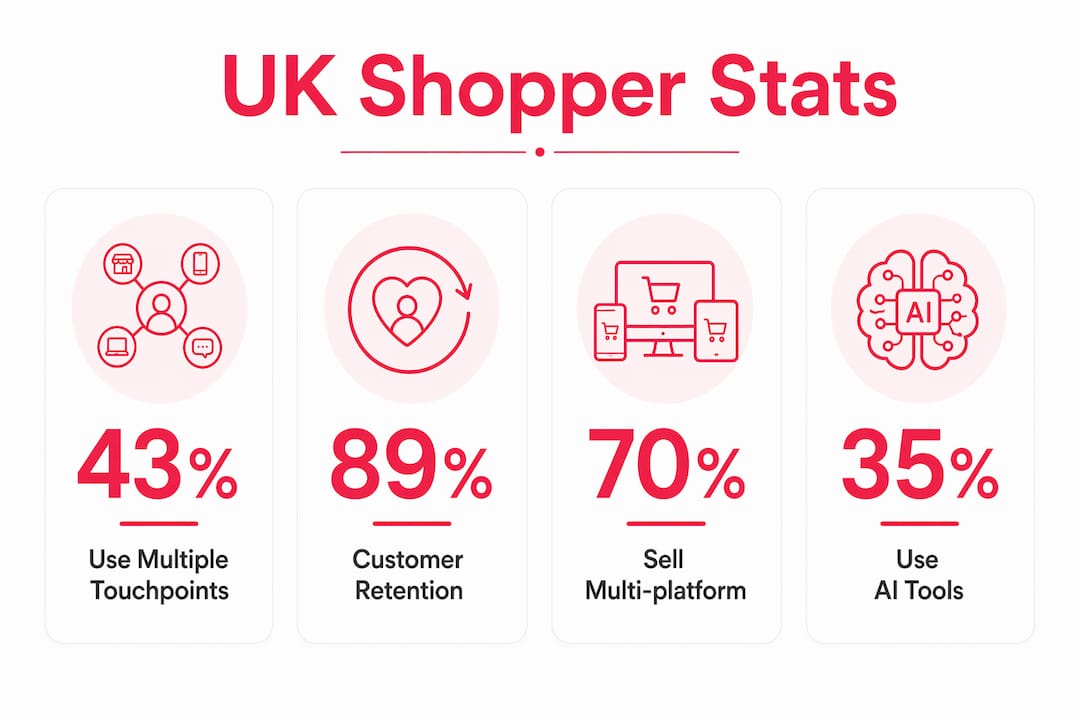
UK shoppers now use a wide mix of touchpoints, including social media, brand apps, websites, and AI tools such as ChatGPT for product discovery and buying decisions. The expectation is not just availability across those channels. It is consistency. A customer who browses a product on Instagram expects to find the same price, the same stock status, and the same promotion when they visit the website ten minutes later.
The UK online retail market adds another layer of context. Online retail share has plateaued at 26–28% for the past four years, with clothing reaching 29% and food still at 10%. Growth no longer comes from pulling more shoppers online. It comes from winning a greater share of each customer’s spend across the channels they already use. That is precisely what a well-executed omni-channel strategy delivers.
Key pain points customers experience when channels are disconnected:
- Receiving promotional emails for products they already purchased in store
- Seeing different prices on the website versus the app
- Being unable to return an online order in a physical shop
- Getting irrelevant product recommendations because purchase history is not shared
- Losing loyalty points earned in one channel when shopping in another
What are the main challenges in implementing omni-channel retail?
The biggest barrier to omni-channel success is not ambition. It is data infrastructure. Personalisation failure is fundamentally a data and infrastructure problem, not a marketing one. When your systems do not communicate, you send irrelevant recommendations and repetitive messages, which actively damages brand loyalty rather than building it.
Inventory synchronisation is a specific and costly version of this problem. Around 70% of UK SMB retailers sell on two or more channels, but only around 30% use dedicated inventory management software. The result is overselling, stock errors, and customer complaints that erode trust quickly. Fixing this is not glamorous work, but it is the foundation everything else sits on.
Attribution modelling is the third major challenge, and it is one that many retailers underestimate. Last-click attribution misleads retailers into over-investing in channels close to purchase while starving discovery channels of budget. A customer might find a product through a Pinterest post, research it via Google, and buy through a direct visit. Last-click credits only the final step. That misrepresentation compounds over time, leading to budget decisions that quietly undermine growth.
Pro Tip: Before investing in new channels, audit whether your existing channels share customer data in real time. Adding a fifth channel to a broken data infrastructure makes the problem worse, not better.
Additional challenges worth planning for:
- Technical debt: Legacy platforms that cannot connect to modern CRM or inventory systems slow every integration project
- Organisational silos: Teams managing separate channels often resist data sharing because it changes how their performance is measured
- Shallow personalisation: Using only a customer’s name in an email while ignoring their purchase history is worse than no personalisation, because it signals that you have the data but are not using it
How to implement an omni-channel retail strategy: practical steps
The most common mistake retailers make when building an omni-channel strategy is starting with channels rather than data. Adding a TikTok shop or a new marketplace listing does not move you closer to omni-channel. Unifying your customer data does.
Follow these steps in order:
- Audit your current data landscape. Map every place customer data lives: your ecommerce platform, your POS system, your email tool, your CRM. Identify where records are duplicated or siloed.
- Invest in a central CRM. A single customer view, updated in real time across every touchpoint, is the non-negotiable foundation. Without it, every other step is compromised.
- Prioritise inventory synchronisation. Implement dedicated inventory management software before expanding to new channels. Overselling on a new platform destroys customer trust faster than not being there at all.
- Integrate channels based on customer behaviour. Use your own data and market research, such as the Drapers 2026 consumer survey, to identify which channels your customers actually use. Prioritise those integrations first.
- Replace last-click attribution with multi-touch measurement. Set up attribution models that capture the full customer journey, including repeat purchases, cross-channel interactions, and offline behaviour. This gives you an accurate picture of which channels genuinely drive revenue.
- Measure retention, not just acquisition. Customer retention is the clearest signal that your omni-channel approach is working. Track repeat purchase rates and lifetime value by channel cohort.
- Implement in phases. Start with data unification and inventory sync. Then layer in personalisation. Then expand channels. Phased delivery reduces technical risk and lets you validate each step before building on it.
Retailers exploring ecommerce trends for 2026 will find that the brands gaining ground are not those with the most channels. They are those with the most coherent customer data.
Key takeaways
Omni-channel retail succeeds when data integration comes before channel expansion, and customer retention is the primary measure of whether the strategy is working.
| Point | Details |
|---|---|
| Definition matters | Omni-channel requires real-time data integration across all channels, not just presence on multiple platforms. |
| Retention gap is significant | Brands with strong omni-channel engagement retain 89% of customers versus 33% for weak strategies. |
| Mobile leads UK commerce | Mobile accounts for 60% of UK ecommerce transactions, making mobile-first integration a priority. |
| Inventory sync is urgent | Only 30% of UK SMB multi-channel retailers use dedicated inventory software, creating costly errors. |
| Attribution must go beyond last-click | Multi-touch attribution reveals the true value of discovery channels that last-click models ignore. |
What I’ve learnt from watching retailers get omni-channel wrong
The retailers I see struggle most are not the ones who lack ambition. They are the ones who confuse activity with integration. They launch on a new marketplace, add a social shop, and call it omni-channel. Then they wonder why customer retention has not improved.
The uncomfortable truth is that most retailers are not ready for omni-channel because their data is a mess. Duplicate customer records, stock figures that differ between systems, and email tools that have no idea what happened in store. That is the real starting point, and it is unglamorous work that does not make for a good press release.
What I find genuinely encouraging is that the UK market data supports a patient approach. With online retail share stable at 26–28%, the growth opportunity is not in grabbing new digital shoppers. It is in deepening relationships with existing ones. That is exactly what omni-channel, done properly, achieves. The brands that increase customer retention by even a few percentage points through better data integration will outperform competitors who keep chasing new channel launches.
My advice is to resist the pressure to add channels and instead fix the plumbing first. A retailer with three well-integrated channels will outperform one with seven disconnected ones every time.
— Steve
How Bigeyedeers helps retailers build integrated ecommerce platforms
Bigeyedeers has spent over 17 years building ecommerce platforms for UK retail brands that need more than a good-looking website. We design and build on Magento and Shopify, with deep experience in CRM integration, ERP connectivity, and multi-store setups that support the kind of data unification omni-channel retail demands.

Whether you are moving from a fragmented multi-channel setup or building a new platform from scratch, our Magento web design service covers the full build, including inventory synchronisation, customer data architecture, and mobile-optimised storefronts. We also support Shopify builds for brands that need a faster route to a unified retail experience. If you want to talk through what your current setup needs to reach true omni-channel capability, we are ready to help.
FAQ
What is omni-channel retail?
Omni-channel retail is the full integration of all sales and communication channels so that customers receive a consistent experience at every touchpoint. It requires a shared data infrastructure and a single customer view updated in real time.
How does omni-channel differ from multi-channel retail?
Multi-channel retail means selling on more than one platform without those platforms sharing data. Omni-channel means every channel communicates in real time, so the customer experience is consistent regardless of where they shop.
What are the main benefits of omni-channel retail?
The primary benefit is customer retention. Brands with strong omni-channel strategies retain 89% of customers, compared to 33% for those with weak cross-channel engagement, according to Fynd research.
What is the biggest challenge in implementing omni-channel retail?
Data infrastructure is the core challenge. Inventory synchronisation gaps, siloed CRM systems, and last-click attribution models all prevent retailers from delivering the consistent, personalised experience omni-channel requires.
Where should a retailer start with an omni-channel strategy?
Start with a data audit and invest in a central CRM before adding new channels. Inventory synchronisation and a single customer view are the foundations that every other omni-channel capability depends on.
Recommended



Adobe Commerce (Magento)
Formerly known as Magento, Adobe Commerce is built for complex catalogues, integrations, and long term growth. We design and develop stable, scalable stores that support demanding eCommerce requirements, including multi-store setups, complex pricing, and Hyva based performance improvements.

Bespoke Build
We design and build custom eCommerce platforms for businesses with complex workflows, integrations, or non standard requirements. Built from scratch around your business needs using Laravel and modern architectures.

Working with brands across the UK from our offices in Cardiff and Exeter, you deal directly with a senior team of designers and developers specialising in Shopify, Magento, WordPress and bespoke eCommerce platforms.
We focus on commercial outcomes. Better conversion rates, strong SEO foundations and eCommerce platforms that continue to improve long after launch.