Brand presence enhancement workflow: a practical guide
TL;DR:
- A brand presence enhancement workflow is a continuous process that improves visibility and consistency across digital channels. Automation tools handle discovery and reporting, while human review ensures brand nuance and strategic alignment. Regular audits, structured data embedding, and timing outreach efforts optimally strengthen brand citations and AI recognition.
A brand presence enhancement workflow is a systematic series of steps that marketing teams use to elevate their brand’s visibility and coherence across digital channels. Done well, it is not a one-off campaign but a continuous operational discipline. AI-ready context delivery can increase brand citations by 85% and overall brand presence by 364% in general searches. Those numbers signal a fundamental shift: brands that treat visibility as infrastructure win; those that treat it as a project fall behind.
What foundational elements does a brand presence enhancement workflow need?
The most common mistake marketing teams make is skipping the diagnostic phase. Before any workflow can run, you need a clear picture of where your brand currently stands across search, AI platforms, and owned channels.
Cohesive brand identity systems produce 23% higher average revenue due to consistent signals across touchpoints. That consistency is not accidental. It comes from treating brand identity as infrastructure, not decoration.
The prerequisites fall into three categories:
- Brand identity infrastructure: Creative brief templates, approval rubrics, and quality assurance checklists embedded into daily production. Top brands build these so that even non-brand specialists produce on-brand content without bottlenecks.
- Automation and monitoring tools: Scheduled agents that run competitive visibility scans weekly. Marketing teams save 15–20 hours weekly by automating reporting and competitive monitoring, freeing resource for genuine strategic work.
- AI-ready content preparation: Machine-readable schema markup, entity definitions embedded in page copy, and structured data that search engines and AI summarisers can parse reliably.
A digital audit sits at the centre of all three. You cannot fix what you have not measured. Run a full audit across your website, social profiles, third-party listings, and AI search results before you write a single brief.
Pro Tip: Use the Kalicube Framework’s three-phase model as your audit lens: Understandability first, then Credibility, then Deliverability. Attempting Deliverability before the first two phases are solid causes failure at scale.

How do you execute a brand visibility strategy step by step?
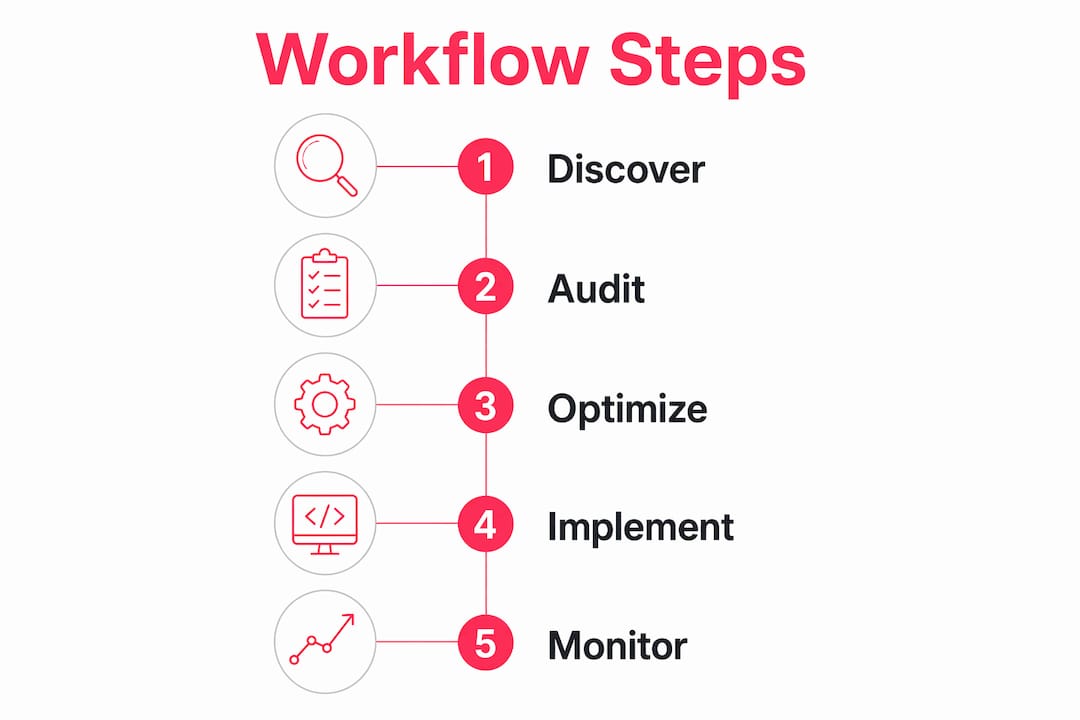
A repeatable workflow for brand engagement follows five distinct stages. Each stage feeds the next. Skipping one creates a gap that compounds over time.
-
Discover and prioritise visibility opportunities. Run automated scheduled agents weekly to scan competitor mentions, AI search results, and knowledge graph entries. These agents generate a ranked list of gaps where your brand is absent or misrepresented. Prioritise by search volume and AI citation frequency.
-
Generate optimised content briefs. Each gap becomes a brief. The brief specifies the target entity, the question the content must answer, the schema type required, and the tone aligned to your brand identity system. Briefs produced this way are faster to approve and faster to execute.
-
Embed entity definitions, summaries, and structured data. Structured data markup using JSON-LD for HowTo, FAQ, and Product schemas is the contract between your content and the machines that read it. Every published asset needs a clear entity definition in the opening paragraph, a concise summary block, and the appropriate schema type applied. This is what makes content citable by AI platforms.
-
Human-in-the-loop review. Automation handles discovery and drafting. A human brand champion reviews for nuance, tone accuracy, and strategic alignment before publication. This step is non-negotiable. AI-generated drafts frequently miss brand voice subtleties that erode trust over time.
-
Publish, monitor, and schedule revision cycles. Publish with tracking parameters in place. Monitor citation share in AI platforms, organic impressions, and branded search volume weekly. Schedule a full content revision cycle every 90 days.
The table below maps each stage to its primary output and the metric that confirms it is working.
| Workflow stage | Primary output | Success metric |
|---|---|---|
| Opportunity discovery | Ranked gap list | Number of new entity gaps identified |
| Content briefing | Approved brief | Brief-to-publication cycle time |
| Entity and schema embedding | Structured asset | Schema validation pass rate |
| Human review | Approved draft | Brand voice QA score |
| Publish and monitor | Live content | Citation share and branded search volume |
Pro Tip: Time your digital PR outreach 3–7 days after social buzz peaks to anchor brand mentions in AI knowledge graphs and build pre-search brand preference.
What are the most common pitfalls in brand enhancement workflows?
The single biggest failure point is treating brand visibility as a project with a start and end date. Visibility is a continuous loop. The moment you stop feeding it, competitors fill the space you vacated.
Several patterns cause workflows to collapse:
- Siloed teams. When content, SEO, and social operate independently, signals contradict each other. AI summarisers read contradiction as low credibility and reduce citation frequency. Integrating brand presence enhancement within content production pipelines creates continuous feedback loops and prevents this waste.
- Manual reporting. Teams that compile visibility reports by hand spend 15–20 hours weekly on data gathering instead of acting on it. That is resource that should be directed at content production and strategic decisions.
- Brand drift. Without a QA rubric applied at every production stage, brand voice shifts gradually. The shift is invisible week to week but significant over a quarter. Regular audits using a documented rubric catch drift before it becomes costly to reverse.
- Algorithm and AI feature changes. Search and AI platforms update their ranking and citation logic frequently. A workflow that does not include a monthly review of AI search feature changes will fall behind without knowing why.
“Visibility efforts must follow a strict build order: Understandability anchors the entity node, Credibility loads proof, then Deliverability activates the entity. Skipping steps causes failure at scale.” — Kalicube Framework for AI-era brand visibility
Cross-functional brand champions are the practical solution to most of these pitfalls. Assign one person per team who owns brand coherence as a responsibility, not a side task. They attend production reviews, apply the QA rubric, and flag drift before it escalates. This structure scales brand identity without creating a bottleneck at the centre.
The ecommerce branding workflow used by high-performing UK retail stores reflects this principle directly. Prerequisite order and regular audits are built into the process from day one.
Which workflow approach suits your team’s maturity?
Not every team needs a fully automated workflow from the start. The right approach depends on team size, technical capability, and how mature your brand identity infrastructure already is.
| Approach | Automation level | Best suited for | Key trade-off |
|---|---|---|---|
| Manual | Low | Small teams, early-stage brands | High precision, low throughput |
| Partially automated | Medium | Growth-stage teams with some tooling | Balanced output, requires oversight |
| Fully automated | High | Enterprise teams with mature brand systems | High throughput, risk of brand drift without QA |
Manual workflows give you full control over every asset. The cost is time. A team of three cannot manually monitor AI citations, produce optimised content, and manage digital PR simultaneously without burning out.
Partially automated workflows use scheduled agents for discovery and reporting while keeping brief creation and review in human hands. This is the most practical starting point for most marketing teams. It captures the efficiency gains from automation without sacrificing the brand nuance that only a human reviewer can protect.
Fully automated workflows suit enterprise brands with mature identity systems, documented rubrics, and dedicated brand champions at every production stage. The throughput is high, but the risk of brand drift increases proportionally. A QA layer is not optional at this level.
The most effective approach blends all three. Automate discovery and reporting. Use partial automation for brief generation. Keep human review as a fixed gate before publication. This blend suits teams at almost any size and scales as the team grows.
For retail brands building on Magento or Shopify, AI-powered workflow integration within the ecommerce platform itself creates a natural home for this blended model.
Key takeaways
A brand presence enhancement workflow succeeds when brand identity infrastructure, AI-ready content, and continuous monitoring operate as a single integrated system rather than separate projects.
| Point | Details |
|---|---|
| Diagnose before acting | Run a full digital audit using the Understandability, Credibility, Deliverability sequence before any workflow begins. |
| Treat identity as infrastructure | Embed creative briefs, approval rubrics, and QA checklists into daily production to prevent brand drift at scale. |
| Automate discovery, not judgement | Use scheduled agents for gap scanning and reporting; keep human review as a fixed gate before publication. |
| Time your digital PR precisely | Launch outreach 3–7 days after social buzz peaks to anchor brand mentions in AI knowledge graphs effectively. |
| Iterate every 90 days | Schedule full content revision cycles quarterly to stay aligned with algorithm and AI feature changes. |
Why most brand workflows fail before they start
Here is what I have seen repeatedly when working with retail and ecommerce brands: the workflow conversation starts at the wrong end. Teams want to talk about tools, posting schedules, and content volume before they have answered the most basic question. Does the machine understand who you are?
AI summarisers and knowledge graphs do not reward effort. They reward clarity. If your brand entity is not cleanly defined, consistently signalled, and backed by credible third-party references, no amount of content production will move the needle. The Kalicube Framework’s build order is not theoretical. It reflects how AI systems actually process brand information.
The second thing I would push back on is the idea that automation replaces judgement. It does not. Automation removes the grunt work so that your best people can focus on the decisions that actually require a brain. Brand voice, strategic framing, and the nuance of how you position against a market shift: these are not tasks you hand to a scheduled agent.
What I find works is treating the workflow as a living document. You build it, you run it, and then you audit it. The brands that build momentum are the ones that schedule that 90-day review without fail, even when things appear to be working. Especially when things appear to be working.
Brand presence enhancement is not a marketing function. It is an operational discipline. The sooner your leadership team treats it that way, the sooner it starts compounding.
— Steve
How Bigeyedeers supports your brand presence workflow
Building a brand presence enhancement workflow is one thing. Embedding it inside a high-performing ecommerce platform is another challenge entirely.
At Bigeyedeers, we design and build Magento and Shopify stores with brand identity systems, AI-ready content structures, and automation workflows built in from the start. Our team in Cardiff and Exeter has over 17 years of experience delivering complex ecommerce solutions for growing and enterprise retail brands. We use Figma for UX planning, Klaviyo for lifecycle marketing, and Klevu for onsite product discovery, creating the infrastructure your brand visibility strategy needs to run continuously. If you want a workflow that compounds rather than stalls, talk to our team about what that looks like for your store.
FAQ
What is a brand presence enhancement workflow?
A brand presence enhancement workflow is a repeatable, structured process that marketing teams use to improve brand visibility, consistency, and citation frequency across search engines, AI platforms, and digital channels.
How much can AI optimisation improve brand visibility?
AI-ready context delivery can increase brand citations by 85% and overall brand presence by 364% in general searches, with targeted entity optimisation boosting ChatGPT visibility by 133%.
How do I prevent brand drift in a large team?
Assign cross-functional brand champions and embed QA rubrics into every production stage. Run a full brand audit every 90 days to catch drift before it compounds across channels.
What schema types matter most for AI citation?
JSON-LD markup for HowTo, FAQ, and Product schemas is the most effective structured data for helping AI platforms and search engines parse and cite your brand content reliably.
How do I choose between manual and automated workflows?
Start with a partially automated approach: use scheduled agents for discovery and reporting, and keep human review as a fixed gate before publication. Scale automation only once your brand identity infrastructure and QA rubrics are fully documented.
Recommended



Adobe Commerce (Magento)
Formerly known as Magento, Adobe Commerce is built for complex catalogues, integrations, and long term growth. We design and develop stable, scalable stores that support demanding eCommerce requirements, including multi-store setups, complex pricing, and Hyva based performance improvements.

Bespoke Build
We design and build custom eCommerce platforms for businesses with complex workflows, integrations, or non standard requirements. Built from scratch around your business needs using Laravel and modern architectures.
Working with brands across the UK from our offices in Cardiff and Exeter, you deal directly with a senior team of designers and developers specialising in Shopify, Magento, WordPress and bespoke eCommerce platforms.
We focus on commercial outcomes. Better conversion rates, strong SEO foundations and eCommerce platforms that continue to improve long after launch.