Why invest in search merchandising for ecommerce growth
TL;DR:
- Search merchandising aligns ecommerce search results with shopper intent and business goals to increase revenue. It involves AI-powered and manual controls to improve relevance, attractiveness, and conversion of high-intent visitors. Effective strategies include regular audits, merchandiser dashboards, personalized filters, and multi-metric performance tracking.
Search merchandising is the practice of shaping ecommerce search results to align shopper intent with business objectives, driving higher conversions and revenue. Known formally as “searchandising,” it sits at the intersection of search relevance and commercial merchandising goals. Retailers who treat their on-site search as a pure IT function are leaving serious money on the table. Searchers make up just 24% of ecommerce traffic but generate 44% of revenue, converting 2.5x better than browsers. That single statistic makes the case for investment before you read another word.
Why invest in search merchandising to grow ecommerce revenue?
Search-driven shoppers are your highest-intent visitors. They arrive knowing what they want, and the quality of your search results determines whether they buy or leave. Treating search as a merchandising channel rather than a backend relevance engine is the shift that separates high-performing stores from average ones.
The revenue case is backed by clear data. Traffic from generative AI sources grew 1,200% year on year with 16% higher conversions than traditional traffic. That growth signals a new wave of high-intent shoppers arriving through AI-powered discovery channels, and your search merchandising layer is what converts them once they land on your site.
Result attractiveness matters as much as relevance. A Constructor study found that improving result attractiveness by one point lifts click-through rates by approximately 4%. Result attractiveness covers product imagery, availability signals, social proof, and pricing presentation. These are merchandising decisions, not search algorithm decisions.
The benefits of search merchandising extend beyond the first click:
- Higher average order value (AOV): Surfacing complementary or higher-margin products in search results nudges shoppers towards larger baskets.
- Repeat purchase behaviour: Personalised discovery builds familiarity and trust, increasing the likelihood of return visits.
- Reduced zero-result pages: Synonym management and typo tolerance keep shoppers in the funnel rather than bouncing to a competitor.
- Campaign alignment: Pinning promoted products or seasonal ranges to relevant search queries ties your search channel directly to marketing campaigns.
Pro Tip: Track your search-to-purchase conversion rate separately from your overall site conversion rate. The gap between the two tells you exactly how much revenue your current search experience is suppressing.
Most ecommerce businesses underestimate this gap. They measure search as a feature rather than a revenue channel, which means they never see the full cost of a poor search experience.
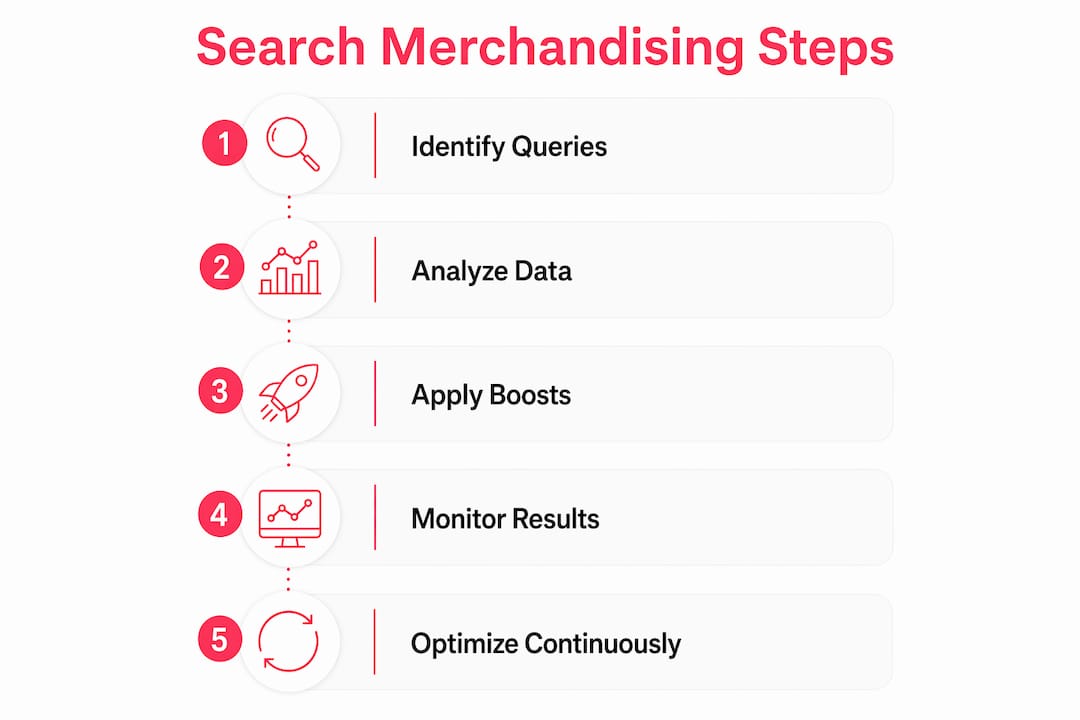
How does search merchandising unify relevance and business goals?
Relevance and merchandising are two different problems. Relevance asks: “Did we return the right products for this query?” Merchandising asks: “Did we return the right products for this query and for our business?” A search engine that answers only the first question is incomplete.
The organisational reality in most ecommerce businesses makes this worse. Search is owned by the technical team, and merchandising is owned by the commercial team. Siloed KPIs between search and merchandising teams cause misalignment that costs revenue. The search team optimises for relevance scores. The merchandising team optimises for margin and sell-through. Neither team is wrong, but without a unified approach, the shopper experience suffers.

Modern searchandising tools resolve this through a combination of AI-powered ranking and manual merchandising controls. The table below shows how static and dynamic approaches differ in practice.
| Approach | How it works | Best used for |
|---|---|---|
| Static rules | Fixed boosts, pins, or buries applied manually | Seasonal promotions, clearance, hero products |
| Dynamic AI ranking | Real-time reranking based on margin, inventory, and behaviour | Everyday search across large catalogues |
| Hybrid | AI baseline with manual overrides for key queries | Most mid-to-large ecommerce operations |
AI-powered ranking adjusts product order in real time based on signals like stock levels, margin targets, and live campaign priorities. A product going out of stock drops automatically. A high-margin alternative rises. This happens without a developer touching a config file.
Merchandiser control over synonyms, boosts, pins, and facets is what turns search from a passive feature into an active revenue tool. When the commercial team can make these changes through an admin dashboard without raising a ticket, the speed of optimisation increases dramatically.
Pro Tip: Start with your top 20 highest-traffic search queries. Map them against your current results and ask: are these the products we most want to sell? If not, you have a merchandising gap, not a search bug.
Search merchandising is best viewed as a retail strategy that integrates shopper intent with merchandising goals and real customer data. It is not a one-time configuration. It is an ongoing commercial discipline.
What practical strategies help you invest effectively in search merchandising?
Effective investment in search merchandising follows a clear sequence. You do not need to overhaul everything at once. Start with the areas that cause the most friction and work outward.
- Audit your zero-result pages. 20–30% of search queries require synonym management or typo tolerance to avoid returning no results. Pull your zero-result logs monthly and treat them as a product gap report, not just a technical error log.
- Give merchandisers dashboard access. Merchandisers empowered with admin dashboard control for synonyms, relevancy tuning, and rules create more effective search-driven revenue. Remove the IT bottleneck from routine search changes.
- Implement dynamic faceted filtering. Facets that adapt to the active query help shoppers narrow results without dead ends. Static facets applied to every category page create friction and irrelevant filter options.
- Layer in personalisation. Returning shoppers benefit from results weighted towards their previous purchase categories. This is not complex to implement with tools like Klevu, which Bigeyedeers uses across Magento and Shopify builds.
- Measure the right metrics. Conversion rate alone misses a large part of the picture.
The metrics that actually prove search merchandising ROI go beyond conversion rate:
| Metric | Why it matters |
|---|---|
| AOV lift from search sessions | Shows whether merchandising is surfacing higher-value products |
| Zero-result rate | Measures synonym and typo coverage gaps |
| Search abandonment rate | Identifies queries where results fail to satisfy intent |
| Repeat purchase rate from search cohorts | Tracks long-term retention value of search-driven customers |
Dynamic faceted filtering and personalised discovery lift average order value and repeat purchase, but require cohort analysis over 90 days to measure accurately. Short-term conversion data alone will undervalue the investment.
Pro Tip: Use Klevu’s analytics dashboard to identify your highest-exit search queries. These are the queries where shoppers searched, saw results, and left without clicking. They are your clearest signal of merchandising failure.
For improving ecommerce conversion rates, search merchandising sits alongside UX improvements and lifecycle marketing as one of the highest-return investments available to a growing retailer.
What are the common pitfalls that undermine search merchandising investment?
Poor search merchandising ROI almost always traces back to the same root causes. Knowing them in advance saves significant time and budget.
The most damaging pitfall is the search versus merchandising silo. The organisational silo between search and merchandising teams causes a missing unified intent alignment that directly suppresses revenue. When these teams report to different directors with different KPIs, no one owns the full shopper journey from query to purchase.
Zero-result logs are routinely ignored. Routing zero-result search logs to buying teams provides demand research rather than just a list of technical bugs to fix. If 500 shoppers searched for a product you do not stock last month, that is a buying signal, not just a search error.
Other common failure points include:
- Static rules that never get updated. A boost rule written for a Christmas promotion left running in march actively harms relevance. Rules need an owner and a review cycle.
- Measuring only conversion rate. Traditional search KPIs miss up to 50% of ROI by ignoring lift in average order value and repeat purchase. Multi-metric tracking is not optional if you want an accurate picture.
- No merchandiser access to the search tool. When every synonym addition requires a developer sprint, the commercial team stops trying. Agility dies in the ticket queue.
- Ignoring mobile search behaviour. Mobile shoppers use shorter, more ambiguous queries. Typo tolerance and synonym coverage matter even more on mobile than on desktop.
“The highest leverage is gained when search and merchandising teams align KPIs and use zero-results logs as demand signals for buying optimisation.” — Alhena AI
The fix is not always a new tool. Often it is a process change: a shared dashboard, a weekly search review meeting, and a clear owner for search merchandising outcomes. Site search intelligence becomes a genuine commercial asset when the right people have access to the right data.
Key takeaways
Search merchandising delivers the highest return when it is treated as a commercial channel, not a technical feature, with unified ownership across search and merchandising teams.
| Point | Details |
|---|---|
| Searchers drive outsized revenue | Search visitors convert 2.5x better than browsers and generate 44% of ecommerce revenue. |
| Result attractiveness drives clicks | Improving product presentation in search results lifts click-through rates by approximately 4% per point. |
| Merchandiser control is critical | Admin dashboard access for synonyms and rules removes IT bottlenecks and speeds up optimisation. |
| Measure beyond conversion rate | AOV lift and repeat purchase data capture up to 50% of ROI that conversion rate alone misses. |
| Zero-result logs are demand signals | Routing these logs to buying teams turns a technical report into a product sourcing opportunity. |
Search merchandising: what I’ve actually seen work
Most ecommerce businesses I speak with have the same blind spot. They invest in paid traffic, email automation, and UX improvements, and then wonder why their conversion rate is still flat. The answer is usually sitting in their search logs.
Search is the highest-intent moment in the entire customer journey. A shopper who types a query into your search bar is telling you exactly what they want to buy. If your results fail them at that moment, no amount of retargeting will recover the sale. I have seen stores with genuinely good products lose customers to weaker competitors simply because their search returned irrelevant results or, worse, nothing at all.
The shift that makes the biggest difference is giving the commercial team ownership of search. Not the IT team. Not the agency. The people who know the catalogue, the margins, and the seasonal priorities. Tools like Klevu make this practical because they put synonym management, boost rules, and facet controls into a dashboard that a merchandiser can use without writing a line of code.
The AI angle is real and it is accelerating. Generative AI traffic is arriving with higher purchase intent than traditional search traffic. If your on-site search cannot handle the queries these shoppers bring, you will convert them at a fraction of their potential value. The businesses that get ahead of this now will have a measurable advantage within 12 months.
Treat search merchandising as a core marketing channel. Give it a budget, an owner, and a set of KPIs that go beyond conversion rate. The data is clear on what it returns.
— Steve
How Bigeyedeers can support your search merchandising investment
Bigeyedeers works with growing and enterprise retail brands on Magento and Shopify builds where search merchandising is built into the commercial strategy from day one, not bolted on afterwards.

We implement Klevu search and merchandising across both platforms, giving your commercial team direct control over synonyms, boost rules, faceted filtering, and personalisation without relying on developer time for routine changes. Our approach connects search performance to the broader ecommerce strategy, including lifecycle marketing with Klaviyo and conversion-focused UX design. If you are ready to treat your search channel as the revenue driver it should be, our ecommerce services cover everything from initial audit through to full platform build and ongoing support. You can also explore our dedicated Shopify agency services or Magento web design for platform-specific solutions.
FAQ
What is search merchandising in ecommerce?
Search merchandising, also called searchandising, is the practice of controlling how products appear in on-site search results to align shopper intent with business goals such as margin, stock levels, and campaigns. It combines search relevance with commercial merchandising decisions.
Why is search merchandising important for conversion rates?
Searchers convert 2.5x better than browsers and generate 44% of ecommerce revenue despite being only 24% of traffic. Optimising search results directly improves the conversion rate of your highest-intent visitors.
What tools are used for search merchandising?
Klevu is a widely used search and merchandising platform that gives merchandisers control over synonyms, boost rules, faceted filtering, and personalisation through an admin dashboard. Bigeyedeers implements Klevu across Magento and Shopify stores.
How do you measure the ROI of search merchandising?
Measure conversion rate from search sessions, AOV lift, zero-result rate, and repeat purchase rate from search cohorts over a 90-day period. Conversion rate alone misses up to 50% of the total ROI.
What causes search merchandising to underperform?
The most common cause is an organisational silo between search and merchandising teams, leading to misaligned KPIs and no unified owner for search outcomes. Static rules that are never updated and lack of merchandiser dashboard access compound the problem.
Recommended



Adobe Commerce (Magento)
Formerly known as Magento, Adobe Commerce is built for complex catalogues, integrations, and long term growth. We design and develop stable, scalable stores that support demanding eCommerce requirements, including multi-store setups, complex pricing, and Hyva based performance improvements.

Bespoke Build
We design and build custom eCommerce platforms for businesses with complex workflows, integrations, or non standard requirements. Built from scratch around your business needs using Laravel and modern architectures.

Working with brands across the UK from our offices in Cardiff and Exeter, you deal directly with a senior team of designers and developers specialising in Shopify, Magento, WordPress and bespoke eCommerce platforms.
We focus on commercial outcomes. Better conversion rates, strong SEO foundations and eCommerce platforms that continue to improve long after launch.