Multi-currency ecommerce: strategies and pitfalls for UK retailers
TL;DR:
- Proper multi-currency ecommerce requires managing local pricing, payment acceptance, and settlement strategies to prevent margin loss and operational chaos.
- Retailers must treat currency support as a deliberate commercial decision, ensuring back-office systems align and risks are mitigated before expansion.
Selling across borders sounds straightforward until you realise that showing a price in euros is about five percent of the actual work. Most UK retailers who bolt on a currency toggle without thinking through the back-office implications end up with margin erosion, reconciliation headaches, and customers who abandon checkout when they spot unexpected conversion fees. This guide cuts through the confusion. We cover what multi-currency ecommerce genuinely means, how the money actually moves, where things go wrong operationally, how FX risk and refunds interact, and how to roll out a currency strategy that holds up at scale.
Table of Contents
- Defining multi-currency ecommerce: more than a currency toggle
- How multi-currency ecommerce works behind the scenes
- Pitfalls and complexities: where multi-currency can go wrong
- FX risk and refund scenarios: protecting margins in practice
- Best-practice rollout: choosing currencies and reviewing performance
- Our perspective: currency is a commercial decision, not a feature
- Ready to build a proper multi-currency setup?
- Frequently asked questions
Key Takeaways
| Point | Details |
|---|---|
| Beyond price display | Multi-currency ecommerce is about true local pricing, handling, and settlement, not just showing different currencies. |
| Margin risks | Poor FX strategies and refund handling can significantly erode profits for global retailers. |
| Deliberate expansion | Start with high-return currencies and adjust based on data, not assumptions. |
| Operational readiness | Prepare your processes and teams for refund scenarios, compliance, and FX reconciliation upfront. |
| Continuous review | Regularly analyse currency performance and adapt your offer to maximise global revenue. |
Defining multi-currency ecommerce: more than a currency toggle
There is a persistent misconception in retail circles that multi-currency ecommerce means updating your product pages to display prices in different currencies. It feels like a front-end problem with a front-end solution. It is not.
True multi-currency ecommerce means showing prices in the shopper’s local currency and enabling payment in that currency, while managing conversion, holding, and settlement behind the scenes. That backend complexity is where the commercial impact is won or lost.
The distinction matters enormously. Consider two approaches:
- Display-only currency conversion: Your store shows a German shopper a price in euros, but the payment gateway charges them in GBP. The shopper sees a conversion fee from their bank, or worse, the displayed price doesn’t match what lands on their statement. Abandoned cart. Negative review.
- True multi-currency checkout: The shopper pays in euros. Your system accepts that payment, holds the euro balance, and settles according to your chosen FX and payout strategy. No surprise fees. Consistent experience.
As Stripe’s research on multicurrency transactions makes clear, coupling customer-facing local pricing with deliberate back-office money-flow design is what separates a revenue-generating international capability from a cosmetic feature that causes reconciliation nightmares.
“Superficial currency selectors create a false sense of globalisation. The customer experience looks localised, but the financial plumbing hasn’t changed. That gap is where revenue leaks.”
The key components of a properly implemented multi-currency setup include:
- Local pricing and checkout: Prices set in, and charged in, the shopper’s currency
- Payment rails: The ability to accept funds across multiple currencies via your payment gateway
- Balance and settlement strategy: Decisions about when and how to convert foreign currency holdings into GBP
- Reconciliation: Your accounting system must track transactions by presentment currency, not just the converted GBP equivalent
For retailers already managing the complexity of multi-store ecommerce, layering in multi-currency is a natural but demanding extension. For those building towards enterprise ecommerce capability, getting this right from the start is far cheaper than retrofitting it later.
How multi-currency ecommerce works behind the scenes
Now that you understand what multi-currency ecommerce entails, let’s demystify the underlying processes that power a seamless international retail experience.
For a UK retailer, the money flow typically involves three distinct stages:
- Accepting payments in multiple currencies: Your payment gateway must be configured to accept and process transactions in each target currency. This is not automatic. Each currency may require separate activation, and some markets require locally licensed payment methods (iDEAL in the Netherlands, for example, or Bancontact in Belgium).
- Holding foreign currency balances: Rather than immediately converting every foreign payment to GBP, many retailers hold balances in the received currency. This reduces conversion frequency and can protect against unfavourable rate movements if timed correctly.
- Settling funds into the right accounts: You decide when to convert, and at what rate, based on your business goals around speed, cost, and flexibility.
Here is a simplified view of how these workflows compare:
| Approach | Speed | Conversion cost | Flexibility | Risk level |
|---|---|---|---|---|
| Auto-convert at point of sale | High | Higher fees | Low | Low |
| Hold balances, batch convert | Medium | Lower fees | Medium | Medium |
| Hold balances, convert on demand | Lower | Potentially lowest | High | Higher |
The right approach depends on your margins, your transaction volumes in each currency, and your treasury management capability. For Magento-powered stores, currency configuration can be handled at the store-view level, meaning you can present fully localised pricing without duplicating your entire catalogue.
Your ecommerce platform, payment gateway, and accounting integration all need to work together. If any of these systems is not aligned, you get data mismatches. Your platform shows one figure, your payment processor holds another, and your accounting software tries to reconcile a third. Not good.

Pro Tip: Before expanding your currency offering, map the full payment journey for each target currency end-to-end. Identify every system that touches the transaction and confirm they each support the currency natively. Assumptions here cost money.
A well-structured multi-region strategy treats currency as one layer of a broader localisation decision, not a standalone feature. The multicurrency payment mechanics only deliver value when the broader regional setup supports them.
Pitfalls and complexities: where multi-currency can go wrong
With the technical underpinnings established, it is crucial to recognise the risks and challenges retailers need to manage when expanding with multi-currency.
The honest truth is that multi-currency adds significant operational complexity, and retailers who treat it as a quick toggle rather than a deliberate build tend to discover the hard way why that matters. Here are the most common pitfalls we see:
- Integration complexity: Each additional currency may require a different local payment method, gateway configuration, or fraud rule. A checkout that works perfectly for GBP transactions may behave inconsistently for currencies it was not properly tested against.
- Accounting and VAT headaches: When you sell in multiple currencies, your accounting system needs to track VAT and GST obligations across different jurisdictions. This is not just a reporting inconvenience. In some territories, non-compliance carries penalties. Managing it manually at scale is a genuine operational risk.
- Pricing inconsistency: If your pricing logic does not account for FX rate movement, a product priced at £100 today might translate to an uncompetitive or margin-destroying price in another currency next month. Static currency conversion without periodic review is a hidden cost centre.
- Customer confusion: Inconsistent currency presentation, such as showing euros on the product page but GBP in the cart, is one of the fastest routes to checkout abandonment. Every touchpoint must reflect the shopper’s currency accurately.
- Regulatory and legal considerations: Some markets have restrictions on how foreign currency transactions can be processed. Cross-border payments into certain regions require compliance checks that go beyond standard payment gateway setup.
“Multi-currency ecommerce done superficially is often worse than not doing it at all. Customers notice the inconsistencies, and the operational fallout undermines the efficiency you were trying to achieve.”
Retailers managing multi-region ecommerce challenges should treat these risks as design constraints, not afterthoughts. Build your currency setup around them from day one.
Pro Tip: Test every refund scenario in your staging environment before going live with a new currency. Refunds are one of the most common sources of unexpected losses in multi-currency setups, and they are far easier to fix before launch than after.
FX risk and refund scenarios: protecting margins in practice
Having explored general operational risks, let’s get specific with currency conversion timing and the refund process, where many retailers lose more than they realise.
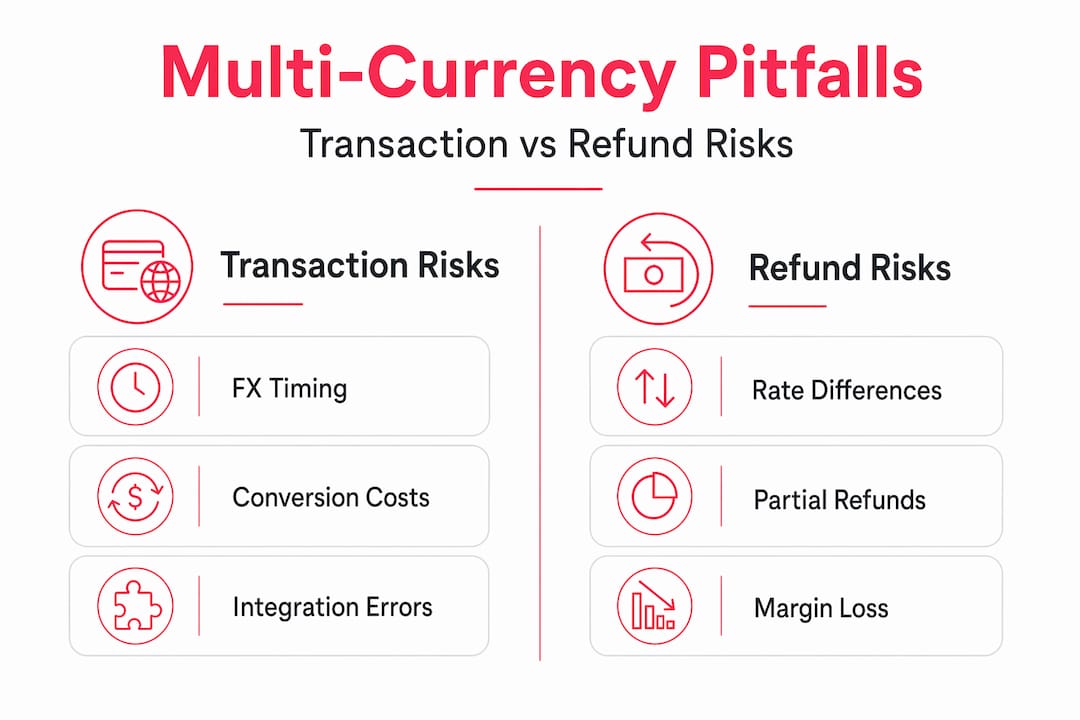
FX risk is not just about the rate you get when a customer pays. It is about the rate you get when you eventually settle, and critically, the rate applied if that customer later requests a refund. These three events can happen at very different times, and each may carry a different rate.
Here is how the refund problem plays out in practice:
- Customer pays in euros at today’s rate. Your system converts (or holds) the funds.
- Customer requests a refund two weeks later. The euro-to-GBP rate has shifted.
- You refund the original euro amount, but the GBP you actually hold has changed in value relative to that refund obligation.
- Net result: You have refunded more in real terms than you received, or your customer has received less. Either way, someone is unhappy, and your margin has taken a hit.
| Refund scenario | Complexity | Margin risk | Recommended approach |
|---|---|---|---|
| Same-currency refund, immediate | Low | Low | Process via original payment method |
| Same-currency refund, delayed | Medium | Medium | Track rate at point of original sale |
| Cross-currency or partial refund | High | High | Audit presentment currency data |
| Partial refund on multi-item order | Very high | High | Line-item currency tracking required |
Edge cases to plan for include refund timing and rate differences, partial refunds across line items priced in different currencies, and ensuring your order management system stores the original presentment currency and amount. Without that data, correct reconciliation is nearly impossible.
For retailers managing ecommerce best practices at scale, a basic safeguard is storing the presentment currency, the amount in that currency, and the exchange rate at the time of transaction alongside every order record. This makes auditing and dispute resolution vastly simpler.
Pro Tip: Build automated alerts into your order management or accounting system to flag exchange rate differences above a set threshold on refunds. Even a one percent drift on high-value orders compounds across thousands of transactions into meaningful margin loss.
The Shopify refunds process and equivalent mechanisms on other platforms each handle multi-currency refunds slightly differently. Know your platform’s default behaviour and configure it deliberately rather than accepting whatever the out-of-the-box logic dictates.
Best-practice rollout: choosing currencies and reviewing performance
Understanding risks and mechanics paves the way to choosing a solid rollout strategy. Here is how leading UK retailers set priorities and measure international currency performance.
The temptation is to launch with every major currency simultaneously and let demand sort itself out. Resist it. Starting with a broad currency basket before your operational processes are proven is one of the fastest ways to create a reconciliation backlog and confuse your customer support team.
Instead, take a data-led approach:
- Analyse traffic and demand first. Before adding a currency, look at which countries are already sending traffic to your store. High-traffic, low-conversion markets are often high-currency candidates because the friction of paying in GBP is suppressing sales.
- Assess operational feasibility by currency. EUR and USD are well-supported by almost every major gateway. Less common currencies may require specialist payment processors or entail higher per-transaction costs that erode the commercial case.
- Model the margin impact before launch. Know your FX cost, gateway fee, and conversion cost for each currency before you commit. Some currencies look commercially attractive until you factor in the full cost stack.
- Review performance regularly. Expert guidance on international currency strategy consistently recommends reviewing order volume, conversion rate, and FX cost by region and currency on a rolling basis, then making active decisions to add or retire currencies based on evidence rather than instinct.
Pro Tip: Keep a core currency basket of three to five currencies that represent your highest-confidence international markets. Master the operations for those before expanding further. Speed to scale is less important than getting the fundamentals right.
For complex platforms, Magento’s capabilities for multi-currency allow for sophisticated price management across store views, including currency-specific rounding rules and localised tax handling, which takes significant operational pressure off your team during expansion.
Our perspective: currency is a commercial decision, not a feature
Here is something we see often. A retailer decides to go multi-currency because a competitor did it. There is no traffic analysis, no FX cost modelling, no refund scenario planning. Just the feature, live, with a currency selector in the header.
Six months later, the finance team is spending hours untangling reconciliation discrepancies. Customer support is fielding complaints about refund amounts not matching expectations. And the FX fees that were never accounted for are quietly eating into margin.
The retailers who get this right treat multi-currency as a commercial decision, not a product feature. They ask hard questions before building: Which currencies actually move the revenue needle? What does our refund profile look like, and how does it change when you add FX rate movement? Can our accounting integration handle presentment currency reporting, or do we need to upgrade it first?
We have worked on international ecommerce builds where the currency question was straightforward because the groundwork had been done. We have also been brought in to fix implementations where it had not. The second scenario is always more expensive and more disruptive.
Our honest advice: take the time to map the full back-office impact of every currency you add. The customer-facing work is the easy part. The commercial value comes from the plumbing working precisely and consistently, every time.
Ready to build a proper multi-currency setup?
If this article has clarified just how much is involved in doing multi-currency ecommerce properly, you are already ahead of most retailers considering international expansion.

At Big Eye Deers, we design, build, and support complex ecommerce platforms for growing and enterprise UK retail brands. Whether you are working on enterprise ecommerce solutions that need to handle multiple currencies across multiple regions, or planning a Magento multi-store build with localised pricing at its core, we bring the technical depth and commercial thinking to make it work. Get in touch with our team to talk through your international strategy and how we can help you build a setup that is robust, scalable, and genuinely profitable.
Frequently asked questions
How does multi-currency checkout increase international sales?
Allowing shoppers to pay in their own currency removes the friction of unexpected conversion fees and builds trust in the checkout experience, which directly lifts conversion rates for cross-border transactions. Familiar pricing in the shopper’s local currency signals a retailer that understands their market.
What is the biggest risk for UK retailers adopting multi-currency ecommerce?
Currency conversion fees and refund management are the most common sources of margin erosion. As FX timing differences show, conversions and refund settlements can occur at different rates, meaning what you received and what you refund may not be equivalent in GBP terms.
Should every retailer offer all currencies from launch?
No. It is far better to launch with a focused set of priority currencies and expand after reviewing demand and operational cost. Expert international strategy consistently recommends a phased approach that reviews FX cost and conversion performance by region before adding new currencies.
How does multi-currency ecommerce affect returns and refunds?
Refunds can be processed at exchange rates that differ from the original transaction rate, particularly when there is a delay between purchase and return. Retailers must store presentment currency data at order level to reconcile correctly and avoid absorbing unexpected losses on delayed or partial refunds.
Recommended



Adobe Commerce (Magento)
Formerly known as Magento, Adobe Commerce is built for complex catalogues, integrations, and long term growth. We design and develop stable, scalable stores that support demanding eCommerce requirements, including multi-store setups, complex pricing, and Hyva based performance improvements.

Bespoke Build
We design and build custom eCommerce platforms for businesses with complex workflows, integrations, or non standard requirements. Built from scratch around your business needs using Laravel and modern architectures.

Working with brands across the UK from our offices in Cardiff and Exeter, you deal directly with a senior team of designers and developers specialising in Shopify, Magento, WordPress and bespoke eCommerce platforms.
We focus on commercial outcomes. Better conversion rates, strong SEO foundations and eCommerce platforms that continue to improve long after launch.