Multi-region ecommerce: benefits, challenges, and strategy
TL;DR:
- Expanding into new markets involves significant complexity beyond simple duplication, impacting infrastructure, operations, and compliance.
- Effective multi-region ecommerce deployment enhances resilience, reduces latency, and meets legal data requirements, but it increases cost and operational challenges.
Expanding into new markets sounds straightforward on paper. Duplicate your store, point a domain at a new region, translate a few product descriptions, and off you go. In reality, that approach leads to slow load times, inconsistent inventory, SEO headaches, and customer experiences that feel second-rate. Multi-region ecommerce is a genuinely complex discipline, one that touches infrastructure, operations, marketing, and compliance simultaneously. This guide breaks down what it actually involves, the architectures you can use, the pitfalls to anticipate, and the practical framework you need to make smart decisions.
Table of Contents
- What multi-region ecommerce really means
- Core architectures for multi-region ecommerce
- Hidden challenges and risks of going multi-region
- Multi-region vs single-region and multi-store: making the right choice
- Practical advice for successful multi-region ecommerce
- Why a stepwise, evidence-based approach wins in multi-region ecommerce
- Ready to expand your ecommerce presence?
- Frequently asked questions
Key Takeaways
| Point | Details |
|---|---|
| Balance resilience and complexity | Multi-region ecommerce increases uptime and local speed, but adds management overhead and costs. |
| Choose architecture wisely | Select active-active, active-passive, or read replica models based on your business’s needs and traffic patterns. |
| Watch for edge case risks | Inventory drift and SEO missteps can occur across regions without careful process and automation. |
| Expand with evidence | Start simple, use analytics, and only scale out multi-region when data and customer experience requires it. |
What multi-region ecommerce really means
Multi-region ecommerce is the practice of deploying your ecommerce infrastructure and customer-facing experiences from multiple geographic locations, rather than a single centralised server or cloud region. Think of it as planting several operational roots across different territories so that each group of shoppers is served from the location physically closest to them.
This matters for three concrete reasons. First, latency: a customer in Sydney loading a store hosted in London will experience measurably slower page speeds, and slower pages convert less. Second, resilience: if your single data centre goes offline, your entire store goes with it. Third, compliance: some jurisdictions require customer data to remain within specific national or regional boundaries, making geographic infrastructure placement a legal necessity, not just a performance preference.
The business drivers behind multi-region deployments typically include shipping zone efficiency, local payment method support, language and currency localisation, and the ability to tailor catalogues to regional demand. As multi-region architecture demonstrates, greater resilience and lower latency come hand in hand with greater cost and operational complexity compared to simpler single-region setups.
“Multi-region boosts resilience and low latency, but introduces cost and operational complexity that single-region setups simply do not carry.”
Here is a quick comparison to ground the discussion:
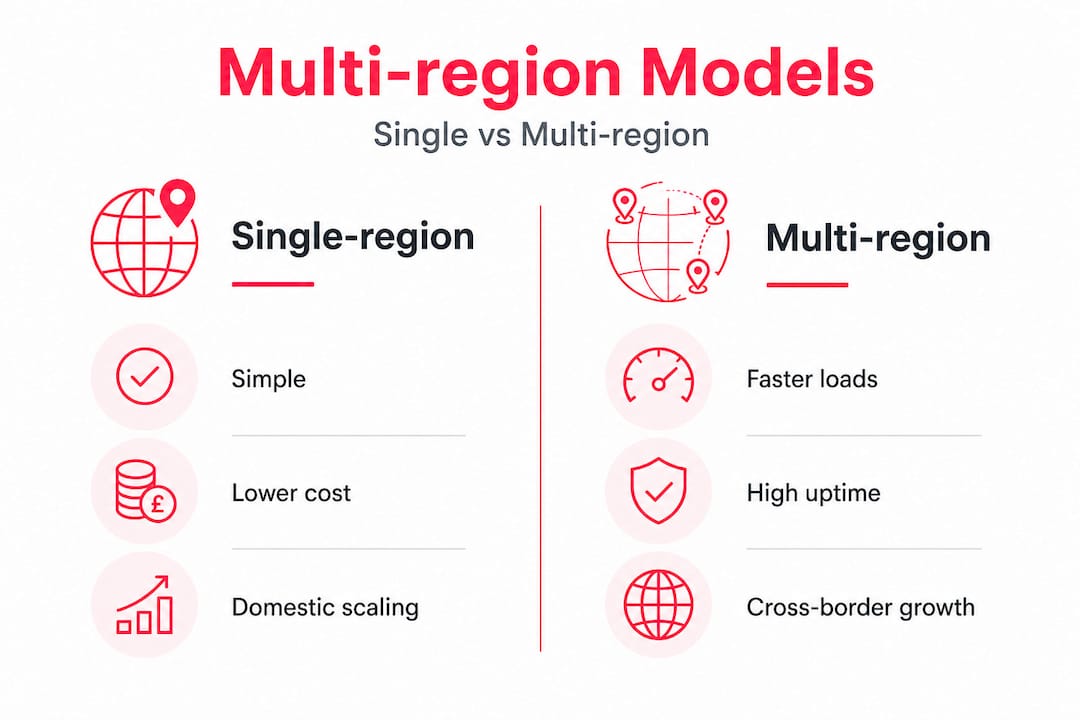
- Single-region: one data centre, simpler ops, lower cost, single point of failure, best for early-stage or domestic-only brands
- Multi-region: distributed infrastructure, lower latency per region, high resilience, significantly higher cost and complexity
- Multi-store ecommerce: separate storefronts for independent markets, not necessarily separate infrastructure regions, strong for distinct brand identities per market
Understanding which of these categories your current setup falls into is the first honest conversation you need to have before any expansion planning begins.
Core architectures for multi-region ecommerce
Once the business case is understood, the next decision is how to deploy. There are three principal architectures used in multi-region ecommerce, and choosing the wrong one for your situation is an expensive mistake.
The three main deployment methodologies are active-active, active-passive, and read replica configurations. Each region handles reads and writes independently in an active-active setup. An active-passive model keeps a primary region live while a secondary region waits on standby for failover. Read replicas place full write capability in a primary region, with secondary regions handling read requests only.
Here is how they compare across the factors that matter most to growing retail brands:
| Architecture | Performance | Failure recovery | Cost | Complexity |
|---|---|---|---|---|
| Active-active | Highest | Instant, no downtime | Highest | Very high |
| Active-passive | Good | Minutes, some disruption | Moderate | High |
| Read replica | Moderate | Writes affected on failure | Lower | Moderate |
Active-active suits brands with very high traffic, genuine global audiences, and an engineering team capable of managing distributed database consistency. Think large enterprise retailers or platforms processing millions of transactions per week. The payoff is real-time redundancy and blazing-fast performance everywhere, but the operational overhead is substantial.

Active-passive is a sensible middle ground for brands that need resilience but cannot justify active-active costs. Your primary region handles everything normally, and if it fails, traffic fails over to the secondary region. There is usually some brief service interruption, measured in seconds to minutes, depending on your failover configuration.
Read replicas work well for catalogue-heavy stores where most visitor traffic is browsing rather than transacting. Reads are fast because they pull from a nearby replica, while writes still go to the primary region. This is a cost-effective way to address local vs global ecommerce latency concerns without the full weight of an active-active deployment.
Pro Tip: Before investing in any of these architectures, ask whether a well-configured global CDN (content delivery network) is sufficient. For many brands selling in new regions, a CDN handles static asset delivery and dramatically reduces perceived load time at a fraction of the cost. Only move to full multi-region infrastructure when dynamic, transactional performance remains slow after CDN implementation.
Hidden challenges and risks of going multi-region
Well-chosen architecture is essential, but even the best technical design faces organisational and operational risks when scaled out. This is where many projects run into trouble, not during the build, but during day-to-day operations.
The most common edge cases in retail at scale include:
- Inventory drift: stock levels updated in one region not reflecting accurately in another during peak traffic, leading to overselling or stock unavailability errors
- Cross-region checkout delays: when the checkout process relies on a central API or payment gateway, network latency between regions can slow the most critical part of the journey
- Database inconsistency: distributed databases require careful conflict resolution logic; without it, product data, pricing, and order records can fall out of sync
- SEO cannibalisation: running near-identical content across multiple regional domains without correct hreflang tags confuses search engines and splits ranking signals, often harming performance in every region
- Security vulnerabilities: shared admin credentials, multi-store management tools, and distributed deployments increase the attack surface; a breach in one region can propagate quickly to others
The security risk deserves particular attention. Multi-region deployments often share administrative access points across infrastructure, and without robust access controls, a compromised credential in one region can expose the entire estate. We always recommend pairing expansion with a thorough review of your ecommerce security risks, including malware monitoring and supply chain attack protection. Equally, your secure cloud hosting choice needs to support region-specific compliance without creating new vulnerabilities.
The operational complexity compounds quickly. A single-region team managing one store handles incidents, deployments, and monitoring in one place. A multi-region team manages multiple environments, each with its own monitoring stack, update schedule, and potential failure points. Without robust cross-region data reconciliation processes and automated alerting, small inconsistencies compound into significant customer-facing problems.
Pro Tip: Audit your hreflang implementation and crawl all regional URLs before launch. Catching SEO cannibalisation or incorrect localisation signals before Google indexes your new regions saves months of remediation work post-launch.
Multi-region vs single-region and multi-store: making the right choice
Understanding viable alternatives is critical. No single model suits every brand, and the wrong choice at the wrong stage of growth wastes significant budget and engineering time.
Here is a structured comparison to help frame your decision:
| Model | Best for | Key strength | Key risk |
|---|---|---|---|
| Single-region | Domestic or early-stage brands | Simplicity, low cost | Single point of failure, latency for international visitors |
| Multi-region | Global brands, high compliance needs | Resilience, low latency everywhere | High cost, operational complexity |
| Multi-store | Independent market identities | Flexible branding and catalogue per market | Duplicated ops effort, needs careful SEO management |
As research comparing deployment models confirms, multi-store setups serve brands that need genuinely independent market experiences, while a single store with built-in internationalisation features suits those wanting unified operations across regions.
To choose the right model, work through these steps:
- Map your current traffic geography. Where are your existing customers located? If 90% are in the UK, multi-region infrastructure is premature.
- Define your compliance requirements. Do GDPR, data residency laws, or local financial regulations require infrastructure in specific locations?
- Assess your peak load profile. Do you experience sharp traffic spikes during regional events like Black Friday? Resilience requirements increase with traffic volatility.
- Calculate the real cost of downtime. If one hour of outage costs your business £50,000 in lost revenue, active-passive or active-active architectures become financially justifiable.
- Evaluate your internal capability. Do you have the engineering team and operational processes to manage multi-region complexity day-to-day?
“The brands that succeed internationally are not necessarily the ones who deployed the most sophisticated infrastructure first. They’re the ones who matched architecture to actual need, then scaled deliberately.”
When to stay with single-region or multi-store strategy: if your international audience is modest, your catalogue is broadly the same across markets, and your primary growth focus is domestic, a well-optimised single-region store with CDN coverage and a localised local vs global decision framework will serve you far better than premature multi-region investment.
Practical advice for successful multi-region ecommerce
To ensure your project delivers business value rather than operational headaches, follow this structured approach when planning your multi-region expansion:
- Start with data, not ambition. Use Google Analytics, your platform’s order reporting, and server logs to understand where international traffic and revenue actually originates. Gut feel is not a foundation for infrastructure investment.
- Deploy a CDN first. As expert guidance from real-world multi-region builds confirms, starting with a CDN for latency resolution before committing to full multi-region architecture is nearly always the smarter sequence. It is cheaper, faster to implement, and often sufficient for brands in early international growth.
- Define your RTO and RPO. Recovery Time Objective (the maximum acceptable downtime) and Recovery Point Objective (the maximum acceptable data loss) are the two metrics that should drive your architecture choice. Be precise about these numbers before selecting a model.
- Localise deliberately. Currency, language, payment methods, and shipping options must be configured per region, not assumed to carry over. Each market has distinct expectations.
- Build monitoring from day one. Multi-region deployments need region-specific uptime monitoring, alerting on data sync failures, and automated health checks. Bolt-on monitoring after launch is always harder than designing it in from the start.
- Test failover before you need it. Simulate a regional outage in a staging environment and verify that your failover process actually works as expected. Many brands discover failover gaps only during real incidents.
- Establish a clear ownership model. Decide upfront who is responsible for each region’s performance, security patching, and content updates. Distributed infrastructure without clear ownership becomes ungovernable quickly.
Pro Tip: Evaluate your geo-distribution of traffic and your outage tolerance before committing to multi-region. Set a threshold, for example, if more than 20% of revenue comes from outside the UK, open the architecture conversation. Let the data, not the competition, drive the timing of your ecommerce success decisions.
Why a stepwise, evidence-based approach wins in multi-region ecommerce
Here is our honest, experience-based take: too many decision-makers treat multi-region ecommerce as an aspiration rather than a calculated response to specific business conditions. It gets sold as a mark of maturity, a signal that a brand has “made it” to the global stage. That framing does real damage.
We have seen brands invest heavily in multi-region architecture when their international traffic was under 5% of total visits. The result? Dramatically higher infrastructure costs, a stretched engineering team managing environments that barely serve any customers, and a distracted focus that slowed down far higher-priority work like conversion optimisation and product catalogue improvements.
The uncomfortable truth is that multi-region complexity can easily outweigh commercial benefit if the business conditions do not genuinely warrant it. Before any infrastructure decision, scrutinise your actual traffic geography, your operational readiness, and your tolerance for the ongoing overhead this model creates.
The most sustainable winners we have worked with started simple. They launched in their core market, used a CDN to manage international latency at low cost, and moved to more sophisticated regional infrastructure only when the data made the case undeniable. That evidence-based, stepwise progression meant every pound spent on infrastructure was justified by actual revenue risk or customer experience necessity.
As the lessons from budget-conscious multi-region deployments make clear, evaluating outage tolerance and traffic geo-distribution before defaulting to multi-region is the mark of a mature technical strategy, not a shortcut. And the right-fit strategy for your brand is the one grounded in your specific commercial reality, not someone else’s architecture diagram.
Start smart. Scale with evidence. That is how you win.
Ready to expand your ecommerce presence?
If this guide has prompted some honest questions about your own platform’s readiness for regional growth, that is exactly the right response. Building out a multi-region strategy requires the right technical foundation and the right partner who understands both the complexity and the commercial stakes.

At Big Eye Deers, we work with UK retail brands to design, build, and support ecommerce platforms ready for growth, whether that means a single-region store optimised for performance or a fully distributed multi-region deployment. Our Shopify specialists and Magento web design teams bring over 17 years of experience to every architecture decision. If you would like to talk through your options with people who have navigated this territory before, meet our team and let’s find the right approach for your brand.
Frequently asked questions
What is the difference between multi-region and multi-store ecommerce?
Multi-region ecommerce refers to distributing your infrastructure across geographic locations for performance and resilience, while multi-store means running separate storefronts for different markets, which may or may not share the same infrastructure. As research on deployment models notes, multi-store suits independent market identities, whereas unified operations often benefit from a single store with internationalisation features built in.
When does a UK retailer need to consider multi-region deployment?
Consider it when a meaningful portion of your revenue comes from international customers, when local compliance requires in-country data storage, or when regional outages must not impact your full customer base. Expert analysis recommends evaluating traffic geo-distribution and outage tolerance rather than defaulting to multi-region.
What architectures are most common for multi-region ecommerce?
The three main models are active-active, active-passive, and read replica configurations. Active-active offers the highest performance and resilience; active-passive balances cost with failover capability; read replicas address latency for browse-heavy stores without full write distribution.
What are typical multi-region ecommerce pitfalls?
Common pitfalls include inventory drift, checkout delays, and SEO cannibalisation caused by poor hreflang implementation, as well as security vulnerabilities introduced by shared credentials or insufficient access controls across distributed environments.
Is multi-region always worth the cost and complexity?
Not always. Brands should start with a CDN to resolve latency before committing to full multi-region infrastructure, and scale only when traffic data, compliance needs, and revenue at risk clearly justify the additional investment and operational overhead.
Recommended



Adobe Commerce (Magento)
Formerly known as Magento, Adobe Commerce is built for complex catalogues, integrations, and long term growth. We design and develop stable, scalable stores that support demanding eCommerce requirements, including multi-store setups, complex pricing, and Hyva based performance improvements.

Bespoke Build
We design and build custom eCommerce platforms for businesses with complex workflows, integrations, or non standard requirements. Built from scratch around your business needs using Laravel and modern architectures.

Working with brands across the UK from our offices in Cardiff and Exeter, you deal directly with a senior team of designers and developers specialising in Shopify, Magento, WordPress and bespoke eCommerce platforms.
We focus on commercial outcomes. Better conversion rates, strong SEO foundations and eCommerce platforms that continue to improve long after launch.