Maximise your UK e-commerce with ERP integration
TL;DR:
- ERP systems unify business operations, enabling real-time inventory, orders, and finance management.
- Successful UK e-commerce brands report significant manual work reduction and revenue growth post-ERP implementation.
- Proper planning, phased deployment, and realistic expectations are crucial to avoid ERP integration failures.
Most UK e-commerce businesses are leaving serious money on the table. They’re running orders through spreadsheets, chasing stock levels manually, and reconciling financials across disconnected tools. Sound familiar? Many UK e-commerce companies have already cut that chaos by integrating ERP systems, saving dozens of hours weekly and unlocking double-digit growth. This guide will show you exactly what ERP integration involves, how UK brands are using it right now, and how to approach implementation without the mistakes that sink most projects.
Table of Contents
- What is ERP and how does it transform e-commerce?
- ERP in action: UK e-commerce success stories
- Choosing the right ERP: modular cloud vs traditional
- Pitfalls and best practices for ERP integration
- Why most UK e-commerce ERP projects fail—and how to do better
- Take your e-commerce further with expert integration
- Frequently asked questions
Key Takeaways
| Point | Details |
|---|---|
| ERP boosts efficiency | ERP integration in e-commerce automates workflows and saves substantial manual hours each week. |
| UK brands grow faster | Case studies show that ERP drives higher order capacity and double-digit sales growth for UK retailers. |
| Cloud ERP is best | Modular, cloud-based ERP solutions suit UK businesses needing scalability and flexibility. |
| Avoid common pitfalls | Success comes from careful architecture, rigorous testing, and conflict management during ERP implementation. |
| Expert guidance matters | Specialist support using Magento or Shopify can help fully leverage ERP for e-commerce growth. |
What is ERP and how does it transform e-commerce?
ERP stands for Enterprise Resource Planning. Don’t let the name put you off. At its core, an ERP system is a single platform that connects your business operations: inventory, orders, finance, purchasing, customer data, and fulfilment, all talking to each other in real time.
For e-commerce operators, that means no more logging into four separate tools to find out whether a product is in stock, whether an invoice has been paid, or whether a return has been processed. Your ecommerce architecture feeds directly into the ERP, and the ERP pushes updates back to your storefront automatically.
A lot of businesses assume ERP is reserved for large corporates with IT departments and six-figure budgets. That’s simply not true anymore. Modern ERP platforms are modular, cloud-based, and priced for growing businesses. In fact, ERP unlocks major efficiency gains for mid-market and scaling e-commerce brands, not just the enterprise tier.
Here’s what a well-integrated ERP actually handles for an e-commerce business:
- Inventory management: Real-time stock levels across warehouses, suppliers, and storefronts
- Order processing: Automated order routing, picking, packing, and despatch notifications
- Financial reconciliation: Sales, returns, VAT, and payment data consolidated without manual entry
- Customer records: Full purchase history, account status, and credit terms in one place
- Supplier management: Purchase orders, lead times, and supplier invoicing tracked centrally
- Reporting and forecasting: Live dashboards showing margin, sell-through rates, and demand patterns
“ERP doesn’t just speed up your existing processes. It exposes the inefficiencies you didn’t even know were there.”
The key distinction between an ERP and a collection of tools like accounting software plus a warehouse management system is integration depth. Individual tools can do their job well in isolation. The problem is the gaps between them. That’s where errors creep in, where hours get lost, and where customer experience suffers.
ERP in action: UK e-commerce success stories
With the core ERP functions explained, it’s helpful to look at how real UK businesses have benefited. The numbers here aren’t hypothetical. They’re from brands that made the leap and tracked the results.
| Brand | ERP platform | Key outcome |
|---|---|---|
| Bliss Direct | Unleashed + integrations | Saves 25 hours weekly, handles 300 orders/day |
| Sam Turner | Cloud ERP | 570% increase in orders, 20% turnover growth |
| Boohoo | NetSuite | 57% reduction in stockouts |
These aren’t outliers. They’re representative of what happens when you replace reactive, manual processes with systems that actually communicate.
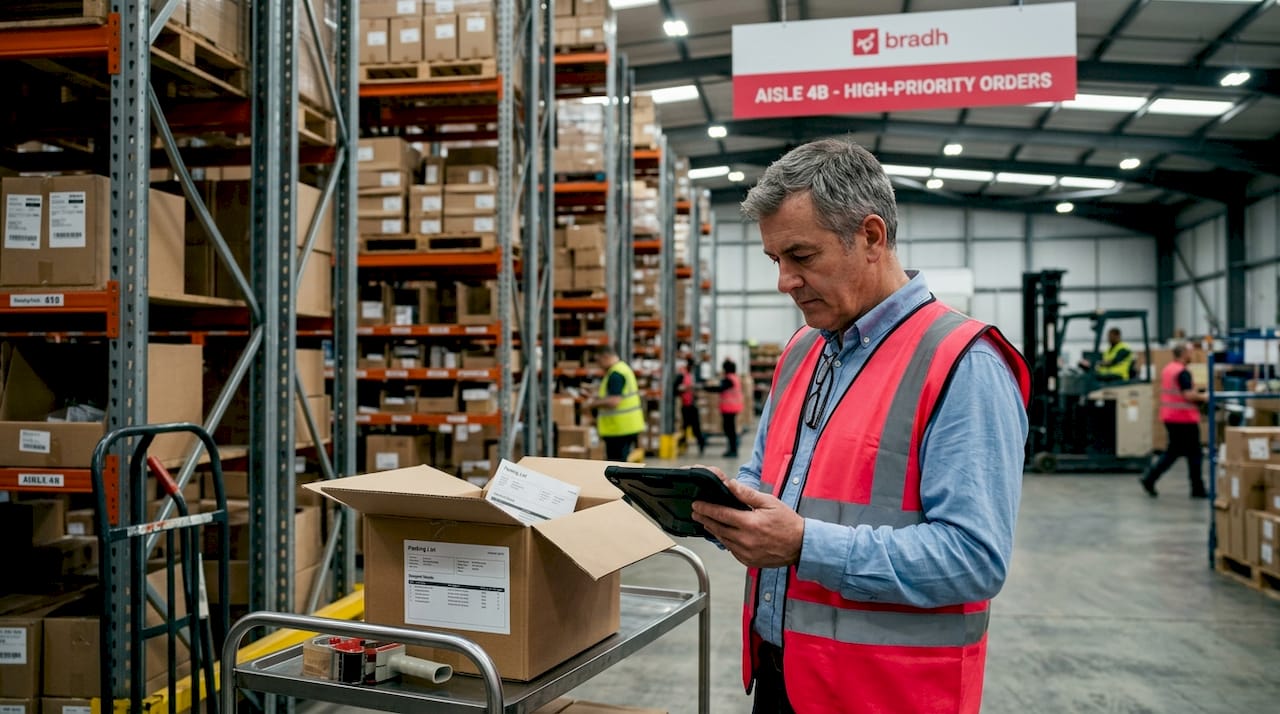
Bliss Direct is a good example to look at closely. Before integration, their team was manually entering orders, cross-referencing stock, and firefighting errors daily. Post-integration, they moved to 300 orders per day without adding headcount. That’s 25 hours of manual work saved every single week. Think about what your team could do with 25 extra hours.
Sam Turner’s story is even more striking. A 570% hike in orders sounds like a marketing win, but the operational backbone that enabled it was ERP. Without that infrastructure in place, that order volume would have broken their fulfilment operation. With it, they absorbed the growth and posted a 20% turnover increase. You can see similar UK retail ERP case studies across a range of sectors, from fashion to home furnishings.
Boohoo’s NetSuite integration tackled a problem every retailer dreads: stockouts. A 57% reduction in stockout incidents means fewer lost sales, fewer frustrated customers, and far less discounting to move aged stock. That’s a direct hit on margin improvement.
The pattern across all three is consistent:
- Reduced manual intervention in day-to-day operations
- Higher order volumes handled by the same or smaller teams
- Better stock accuracy leading to fewer customer service issues
- Revenue growth driven by operational capacity, not just marketing spend
If you’re scaling your enterprise ecommerce solutions and still running operations from spreadsheets, these numbers should feel urgent.
Choosing the right ERP: modular cloud vs traditional
Understanding the impact of ERP is one piece. Making the right choice is equally critical. The ERP market in 2026 broadly splits into two categories: traditional on-premise legacy systems and modern modular cloud-based platforms.
| Factor | Legacy/on-premise ERP | Modular cloud ERP |
|---|---|---|
| Upfront cost | High (licensing + hardware) | Lower (subscription model) |
| Implementation time | 12 to 24 months typical | 3 to 9 months typical |
| Scalability | Limited, costly to expand | Scales with your business |
| Customisation | Deep but expensive | API-first, flexible modules |
| IT dependency | Heavy internal IT required | Managed by vendor |
| Updates | Manual, infrequent | Automatic, continuous |
| Best for | Very large enterprises with complex legacy needs | Growing and mid-market e-commerce brands |
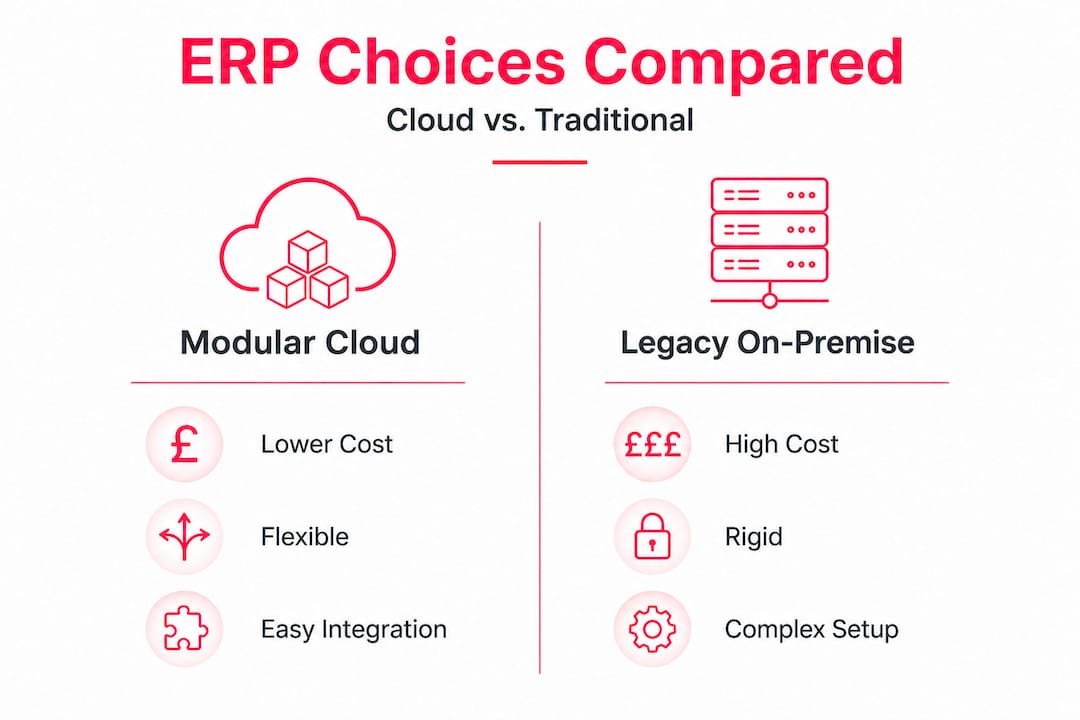
For most UK e-commerce businesses reading this, the choice is clear. Experts recommend modular, cloud-based ERP for scalability and reduced implementation risk. NetSuite and Odoo are the two platforms we see most often deployed successfully with Magento and Shopify stores.
NetSuite suits businesses that need strong financial controls, multi-currency support, and robust reporting from day one. Odoo appeals to businesses that want to build incrementally, starting with, say, inventory and order management, then adding CRM or manufacturing modules as they grow.
Here’s a practical approach to choosing between them:
- Map your current pain points first. Is the issue inventory accuracy, order volume, financial reconciliation, or all three? Your biggest pain point should drive your module prioritisation.
- Assess your integration requirements. Does your ERP need to connect to Magento, Shopify, a third-party logistics provider (3PL), or all of the above? Check native connectors before committing.
- Evaluate your team’s technical capacity. Some platforms require more internal configuration. Be honest about what your team can manage ongoing.
- Request a data migration plan. Any serious ERP vendor should show you, upfront, how your existing product, order, and customer data will be migrated and validated.
- Plan for growth, not just today. The platform that handles your current 500 orders per month needs to handle 5,000 without a full re-implementation.
Look at modular ERP solutions that are designed to integrate natively with your storefront, rather than bolting on via fragile middleware.
Pro Tip: Ask every ERP vendor for a reference customer in a similar vertical and at a similar order volume to yours. A vendor that can’t provide this is a red flag.
Pitfalls and best practices for ERP integration
After exploring which ERP suits your needs, it’s vital to avoid the costly mistakes that derail implementations. And there are a lot of them. The reality is that ERP implementation failure rates remain stubbornly high across the retail industry, often because businesses underestimate the complexity of connecting systems that each have their own data models, update frequencies, and error conditions.
Here’s where projects most often go wrong:
- Skipping integration testing. Testing the ERP in isolation is not enough. You need to test it under realistic load, with real order data, across every integration point simultaneously.
- Ignoring idempotency. Idempotency (the ability of a system to handle the same message being sent twice without creating duplicate records) is essential for any order or stock sync. Without it, a network hiccup can create double orders or incorrect stock counts.
- No conflict resolution strategy. What happens when your Shopify store and your ERP both try to update the same stock record at the same time? You need a defined rule: which system wins, and when.
- Poor data quality at migration. Dirty product data, inconsistent SKUs, or missing customer records will corrupt your ERP from day one. Clean before you migrate, not after.
- Underestimating change management. Your warehouse team, your finance team, and your customer service staff all need training. ERP failure is frequently a people problem, not a technical one.
“The ERP itself rarely fails. It’s the assumptions made during setup that cause the damage.”
There are some non-negotiable best practices we’d recommend to every UK e-commerce operator going into an integration project:
- Define data ownership clearly. For each record type (products, customers, orders, stock), decide which system is the master record.
- Build a rollback plan. If the integration breaks post-launch, how quickly can you revert to manual processes while it’s fixed?
- Use event-driven architecture where possible. Rather than batch syncing data every hour, push changes in near-real-time via webhooks or message queues to reduce lag and error windows.
- Monitor continuously post-launch. Integration errors don’t always surface immediately. Set up alerting so you catch sync failures before customers do.
Common integration pitfalls can be avoided with the right upfront planning. Read ERP implementation guidelines before you start architectural decisions, not after.
Pro Tip: Run a parallel operation period of at least two to four weeks before fully cutting over to the ERP. Keep your old system live, compare outputs, and only decommission it once you’re confident the new system is producing identical results.
Why most UK e-commerce ERP projects fail—and how to do better
We’ve worked with UK e-commerce brands across a wide range of sectors over more than 17 years. The honest answer to why most ERP projects fail isn’t technology. It’s that businesses treat ERP as a software purchase rather than an operational transformation.
There’s a pattern we see repeatedly. A business reaches a point where their current setup can’t cope, usually around 200 to 500 daily orders. They decide to implement an ERP. They pick a platform, sign the contract, and then spend months configuring it to replicate their existing (broken) processes. They go live, the integration doesn’t behave as expected under real load, and then they spend another six months firefighting.
The core mistake is trying to automate chaos rather than fixing it first. If your order management process has workarounds, manual steps, and tribal knowledge baked in, your ERP will faithfully automate all of that mess at scale. Not good.
What the best implementations we’ve seen have in common is a period of deliberate process review before the ERP configuration begins. That means mapping every order touch point, every stock update trigger, every financial posting, and asking: does this step need to exist at all? Often, 30% of manual steps simply disappear when you think them through rigorously.
The second thing high-performing implementations share is phased delivery. Rather than launching everything on one day, they integrate one module at a time: start with inventory sync, stabilise it, then add order management, then financials. This reduces risk dramatically and gives teams time to adapt.
We’d also challenge the assumption that the most feature-rich ERP is the right one. For growing UK retailers, the right ERP is the one your team will actually use correctly. Overly complex platforms often lead to workarounds that recreate the very chaos you were trying to escape.
If you want enterprise retail guidance that goes beyond the vendor sales pitch, focus on fit, phasing, and people, in that order. The technology will follow.
Take your e-commerce further with expert integration
ERP integration is one of the most high-impact projects an e-commerce business can undertake, but it needs to be done right from the start. Getting the architecture, platform choice, and data flows aligned with your storefront is where specialist experience pays for itself many times over.
At Big Eye Deers, we’ve been designing and building complex e-commerce platforms for over 17 years, with deep expertise in Magento web design and Shopify solutions that are built to integrate cleanly with ERP systems including NetSuite, Odoo, and Sage. Whether you’re a growing DTC brand hitting operational limits or a wholesale business managing complex account hierarchies and tiered pricing, we can help you plan and deliver an integration that scales. Start with a conversation about your ecommerce strategy and we’ll tell you honestly where ERP fits into your growth plan.
Frequently asked questions
How does ERP improve order management for UK e-commerce brands?
ERP centralises order processing, removes manual data entry, and significantly increases order capacity. Bliss Direct now handles 300 orders daily and saves 25 hours of manual work every week as a direct result of ERP integration.
Which ERP platforms best suit scalable UK retail e-commerce?
Modular cloud-based ERP platforms like NetSuite and Odoo are the recommended choice for UK retail, offering flexibility, reduced implementation risk, and the ability to scale modules as your business grows.
What are the main risks when integrating ERP with e-commerce sites?
The highest risks come from skipping proper testing, failing to define conflict resolution rules, and poor data architecture at the outset. Implementation failure rates across the retail sector remain high when these fundamentals are overlooked.
Does ERP help reduce inventory errors and stockouts?
Absolutely. Centralised, real-time stock management is one of ERP’s most tangible benefits. Boohoo’s NetSuite integration delivered a 57% reduction in stockouts, directly protecting revenue and improving customer satisfaction.
Recommended



Adobe Commerce (Magento)
Formerly known as Magento, Adobe Commerce is built for complex catalogues, integrations, and long term growth. We design and develop stable, scalable stores that support demanding eCommerce requirements, including multi-store setups, complex pricing, and Hyva based performance improvements.

Bespoke Build
We design and build custom eCommerce platforms for businesses with complex workflows, integrations, or non standard requirements. Built from scratch around your business needs using Laravel and modern architectures.
Working with brands across the UK from our offices in Cardiff and Exeter, you deal directly with a senior team of designers and developers specialising in Shopify, Magento, WordPress and bespoke eCommerce platforms.
We focus on commercial outcomes. Better conversion rates, strong SEO foundations and eCommerce platforms that continue to improve long after launch.