CRO workflow: proven steps for ecommerce growth
TL;DR:
- A structured CRO workflow is essential to sustainably increase ecommerce conversion rates.
- Pre-test audits combining quantitative data and qualitative insights prevent costly mistakes.
- Continuous, data-driven testing and team collaboration build long-term competitive advantage.
You’re pulling in solid traffic, running paid campaigns, and investing in good product photography. Yet your conversion rate stubbornly sits below 2%. Sound familiar? For many UK ecommerce managers, this is a daily frustration. The problem rarely lies in the traffic itself. It lies in the absence of a structured, repeatable process for turning visitors into buyers. This guide walks you through a proven conversion rate optimisation (CRO) workflow, from initial audit to continuous improvement, so you can stop guessing and start growing with confidence.
Table of Contents
- Understanding conversion rate optimisation for UK ecommerce
- Preparing for CRO: What to audit before you test
- Step-by-step: The proven CRO workflow for retail brands
- Common pitfalls and how to avoid them in your workflow
- Measuring results and ensuring continuous improvement
- Our take: The crucial mindset shift for CRO success
- Ready to optimise your conversion workflow?
- Frequently asked questions
Key Takeaways
| Point | Details |
|---|---|
| Industry benchmarks matter | UK ecommerce conversion rates vary—set realistic goals based on your sector and audience. |
| Audit before you test | Proper audits prevent wasted effort and reveal your best opportunities for quick wins. |
| Follow a proven workflow | A repeatable CRO process delivers compounding results and minimises avoidable errors. |
| Prioritise high-impact areas | Focus early efforts on mobile, product, cart, and checkout pages for the biggest gains. |
| Continuous improvement wins | Treat every test as a learning opportunity to build lasting growth and competitive advantage. |
Understanding conversion rate optimisation for UK ecommerce
CRO is the practice of increasing the percentage of website visitors who complete a desired action, whether that’s making a purchase, signing up, or adding to basket. For UK retail brands, it’s one of the highest-leverage activities available because it improves revenue from traffic you’re already paying for.
So where does the UK market sit right now? UK ecommerce conversion rates typically fall between 1.5% and 3.5%, though this varies considerably by sector. Fashion sits at the lower end, while health and beauty often performs above average. The device gap is equally striking: mobile converts at roughly half the rate of desktop, despite mobile accounting for the majority of browsing sessions.
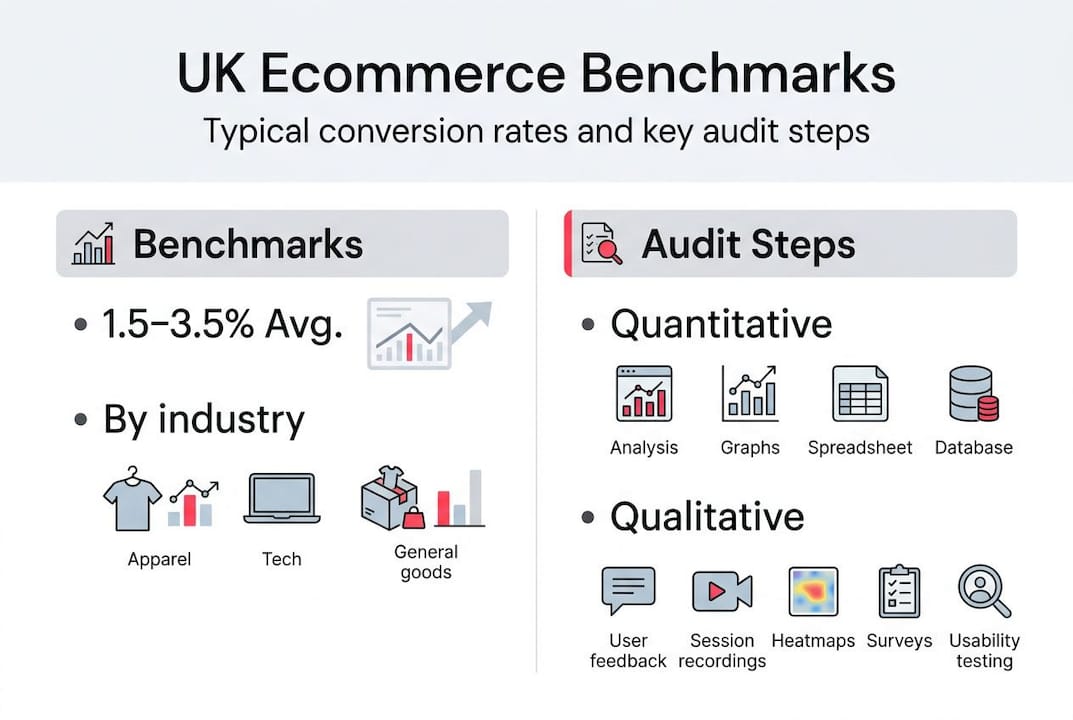
| Industry | Avg. conversion rate | Notes |
|---|---|---|
| Fashion & apparel | 1.0–2.0% | High browse, low intent |
| Health & beauty | 2.5–4.0% | Strong repeat purchase |
| Electronics | 1.5–2.5% | Research-heavy journeys |
| Home & garden | 1.8–3.0% | Seasonal peaks |
| Food & drink | 3.0–5.0% | Subscription boosts rates |
The CRO ROI potential can reach five to fifteen times the investment, but only when there’s sufficient traffic and a robust, repeatable workflow in place. One-off tweaks rarely compound. Copying what a competitor does on their product page ignores the fact that their audience, pricing, and trust signals are entirely different from yours.
Without a structured approach, here’s what typically happens:
- Budget gets wasted on A/B tests that run too short or on low-traffic pages
- Decisions are made on gut feel rather than behavioural data
- Wins are not documented, so lessons evaporate when team members change
- Mobile UX is deprioritised, leaving a significant share of potential revenue on the table
- Momentum stalls because there’s no clear next step after a test ends
A workflow changes all of that. It creates a repeatable engine for improvement rather than a series of disconnected experiments.
Preparing for CRO: What to audit before you test
With a clear understanding of CRO’s importance, it’s time to prepare your site for changes. Jumping straight into testing without auditing first is one of the most common and costly mistakes we see. You need to know where customers are dropping off before you can fix it.

The audit phase combines two types of insight: quantitative and qualitative. Neither is sufficient on its own.
| Tool type | Examples | Best used for |
|---|---|---|
| Quantitative | Google Analytics, heatmaps | Identifying where drop-off happens |
| Qualitative | Surveys, session recordings | Understanding why it happens |
| Combined | Hotjar, Microsoft Clarity | Connecting behaviour to intent |
Following a thorough ecommerce audit before testing is essential to avoid running experiments on pages with insufficient data or overlooking the qualitative signals that explain user frustration.
Here’s a four-step pre-test checklist we recommend:
- Track baseline metrics. Record your current conversion rate, revenue per visitor, bounce rate, and average order value. You can’t measure improvement without a starting point.
- Check page speed and mobile performance. A slow or broken mobile experience will skew every test result. Fix technical issues first.
- Confirm tracking is correctly set up. Broken event tracking or misconfigured goals will produce unreliable data. Audit your analytics setup before running a single experiment.
- Collect recent voice-of-customer data. Exit surveys, post-purchase feedback, and live chat transcripts reveal friction points that analytics alone will never show you.
UK-specific pitfalls are worth calling out here. Many brands ignore common web design mistakes such as missing local payment options like Pay by Bank or Klarna, which UK shoppers increasingly expect at checkout. Testing too soon, before you have statistical significance, is another trap.
Pro Tip: Start your audit with checkout and your highest-traffic landing pages. These areas offer the fastest wins and the clearest data signals.
Step-by-step: The proven CRO workflow for retail brands
You’re ready to optimise. Here’s exactly how successful UK brands run a proper CRO workflow, referencing the standard CRO process used by leading practitioners.
‘Test only what matters. Focus on data-driven hypotheses over gut feel.’
The workflow has six clear stages:
- Define goals and baseline. What does success look like? Set specific, measurable targets. Is it checkout completion rate, add-to-basket rate, or overall revenue per session?
- Gather data. Pull quantitative data from your analytics platform and qualitative data from recordings and surveys. Look for patterns, not isolated incidents.
- Analyse the funnel. Map the full customer journey and identify where the biggest drop-offs occur. A 40% abandonment at the delivery options screen is a clear signal.
- Form data-driven hypotheses using PIE. PIE stands for Potential (how much improvement is possible?), Importance (how much traffic does this page receive?), and Ease (how straightforward is this to implement?). Score each hypothesis across these three dimensions and prioritise the highest scorers.
- Run tests. A/B tests are the standard approach. Ensure each test runs long enough to reach statistical significance, typically at least two weeks and a minimum sample size agreed in advance.
- Implement and iterate. Roll out winners, document everything, and feed learnings back into your next round of hypotheses. This is where urgency tactics and checkout improvements compound over time.
The PIE framework is particularly valuable for teams with limited development resource. It stops you spending three sprints on a low-traffic page when a simple copy change on your product detail page could move the needle significantly faster.
Common pitfalls and how to avoid them in your workflow
Implementing a workflow is just the start. Here are the mistakes we see most often, and how to sidestep each one before they cost you time and budget.
Avoiding the most common CRO pitfalls requires discipline, particularly around qualitative data and traffic thresholds. Here’s what to watch for:
- Blind competitor copying. What works on a competitor’s site reflects their audience, their trust level, and their product mix. Test ideas inspired by competitors, but validate them against your own data.
- Skipping qualitative research. Heatmaps and funnels tell you where people leave. Surveys and session recordings tell you why. Both are essential. Skipping one leaves you solving the wrong problem.
- Testing on low-traffic pages. A test on a page with 200 sessions per month will take six months to reach significance. Focus on getting ecommerce right by concentrating tests where traffic is sufficient.
- Neglecting mobile UX. UK mobile sessions consistently outpace desktop, yet conversion rates lag. If your mobile checkout has more than four steps or requires excessive form-filling, you’re losing sales every day.
- Ignoring checkout localisation. UK shoppers expect familiar payment methods, clear delivery timelines, and trust signals like recognised security badges. Missing these is a silent conversion killer.
The fix for each of these is the same: review your design decisions with fresh eyes and apply the best ecommerce design principles consistently across every device.
Pro Tip: Document every hypothesis, every test result, and every next step in a shared log. Learning compounds. A test that ‘fails’ today often contains the insight that drives a major win six months later.
Measuring results and ensuring continuous improvement
Once you’ve avoided major missteps, it’s time to lock in gains and drive ongoing results. Knowing which metrics to track and how to interpret them is what separates teams that sustain momentum from those that plateau after an initial win.
The core metrics to track after every test:
- Conversion rate (overall and by device)
- Revenue per visitor
- Bounce rate and exit rate on key pages
- Average order value
- Mobile versus desktop split
Here’s a simple post-test tracking template:
| Metric | Baseline | Variant | Winner | Notes |
|---|---|---|---|---|
| Conversion rate | 1.8% | 2.3% | Variant | Checkout button colour change |
| Revenue per visitor | £3.40 | £4.10 | Variant | AOV unchanged |
| Bounce rate | 52% | 49% | Variant | Marginal improvement |
| Mobile conversion | 0.9% | 1.1% | Variant | Further mobile tests queued |
Interpreting results honestly matters. A 0.1% uplift on a low-traffic page is not worth a full rollout. A 0.5% uplift on your most visited product category could mean tens of thousands of pounds in additional annual revenue. Context is everything.
The ongoing improvement cycle follows a simple rhythm:
- Analyse the latest results and update your hypothesis log
- Test the next highest-priority item from your PIE-scored backlog
- Implement winners promptly so gains are not delayed
- Repeat with the knowledge from the previous round informing the next
Building a CRO culture matters as much as the process itself. Celebrate wins publicly within the team, share learnings across departments, and foster an environment where experimentation is expected rather than exceptional. The brands that treat CRO as a permanent discipline, not a quarterly project, are the ones that compound their advantage year on year.
Our take: The crucial mindset shift for CRO success
Having explored tactics, here’s the mindset we believe underpins real CRO success for UK retail brands.
Too many teams fixate on hitting a benchmark. They see 3% as the target and treat anything above it as a pass. But chasing a universal number misses the point entirely. Your audience, your product, and your brand have unique characteristics that no industry average can account for. The most valuable growth strategies for ecommerce brands come from understanding your own customers more deeply with every test cycle.
The retailers we admire most don’t copy their competitors. They run a test, learn something genuine about their audience, and use that knowledge to inform the next hypothesis. A ‘failed’ test that reveals a fundamental misunderstanding about customer intent is worth more than a lucky win that nobody can explain or replicate.
CRO is ultimately a cultural commitment. It requires teams to challenge assumptions, resist the urge to implement changes based on opinion, and stay curious even when results are disappointing. The workflow is just the scaffolding. The real competitive advantage is the compounding knowledge your team builds over time.
Ready to optimise your conversion workflow?
If this workflow feels like the right direction but you’re not sure where to start, we can help. At Big Eye Deers, we work with UK retail brands to audit, design, and build ecommerce experiences that convert. Whether you’re running on Shopify or looking at Magento optimisation, we bring over 17 years of hands-on ecommerce experience to every engagement.

We offer bespoke workflow audits tailored to your platform, your traffic profile, and your commercial goals. From Figma-led UX planning to Klaviyo lifecycle marketing and Klevu search optimisation, our team covers every layer of the conversion stack. If you’re ready to move from guesswork to a structured, scalable process, speak to our team and let’s map out your next steps together.
Frequently asked questions
What is the average ecommerce conversion rate in the UK?
UK ecommerce conversion rates typically sit between 1.5% and 3.5%, though this varies meaningfully by industry and device type. Fashion tends to sit at the lower end, while food and drink often exceeds 3%.
How much ROI can I expect from CRO?
CRO can return five to fifteen times the investment for ecommerce brands, provided there is sufficient traffic and a systematic, data-driven process in place rather than ad hoc testing.
Which step in the CRO workflow has the most impact?
Prioritising high-traffic pages and checkout flows consistently delivers the fastest and most measurable wins for UK retail sites, particularly when mobile UX issues are addressed at the same time.
How can I avoid CRO mistakes in my ecommerce store?
Audit your current customer journey thoroughly, combine quantitative analytics with qualitative feedback, and resist copying competitors without testing against your own audience data first.
Is mobile conversion rate really lower than desktop?
Yes. UK mobile conversion rates are roughly half those achieved on desktop, which makes mobile UX a non-negotiable priority in any serious CRO programme.
Recommended



Adobe Commerce (Magento)
Formerly known as Magento, Adobe Commerce is built for complex catalogues, integrations, and long term growth. We design and develop stable, scalable stores that support demanding eCommerce requirements, including multi-store setups, complex pricing, and Hyva based performance improvements.

Bespoke Build
We design and build custom eCommerce platforms for businesses with complex workflows, integrations, or non standard requirements. Built from scratch around your business needs using Laravel and modern architectures.

Working with brands across the UK from our offices in Cardiff and Exeter, you deal directly with a senior team of designers and developers specialising in Shopify, Magento, WordPress and bespoke eCommerce platforms.
We focus on commercial outcomes. Better conversion rates, strong SEO foundations and eCommerce platforms that continue to improve long after launch.