What is dynamic merchandising in ecommerce: 2026 guide
Dynamic merchandising is the practice of continuously adapting how products are presented on an ecommerce store using real-time data, AI, and behavioural signals. Rather than fixing a layout and leaving it untouched, the approach adjusts product placement, category sorting, and recommendations on the fly, responding to what individual shoppers are doing right now. It is the online equivalent of a shop assistant who rearranges the shelves mid-shift based on what customers are actually picking up.
At its core, dynamic merchandising replaces gut instinct and static planograms with automated, data-driven decisions. The key components are:
- Real-time behavioural data: browsing patterns, scroll depth, click sequences, and purchase history
- Predictive analytics: forecasting which products a shopper is most likely to buy next
- AI and machine learning: processing hundreds of signals per session to rank and surface products automatically
- Personalised product placement: showing each visitor a category page or search result tuned to their intent
- Dynamic cross-selling and bundling: surfacing complementary items at the moment they are most relevant
- Inventory-aware sorting: suppressing out-of-stock or low-margin SKUs without manual intervention
The contrast with traditional static merchandising is stark. A fixed layout, designed months in advance and reviewed once a season, cannot respond to a viral product moment or a sudden shift in demand. Predictive analytics replaces those static planograms, which often went unchanged for up to a year, with layouts that update continuously based on current customer intent and stock levels.
How merchandising evolved from static layouts to real-time adaptation
Understanding where dynamic merchandising came from makes it far easier to deploy well. The shift did not happen overnight; it followed a clear technological progression.
-
Fixed planograms and intuition (pre-2000s). Physical retail relied on planograms: printed shelf maps designed by category managers using last season’s sales data. Online stores inherited the same logic, with product grids set manually and reviewed quarterly at best.
-
Early digital catalogues (2000–2010). The first ecommerce platforms let retailers sort products by price or newness. Personalisation was limited to broad segments, and category pages looked identical to every visitor.
-
Rule-based merchandising (2010–2015). Platforms introduced manual boosting and pinning rules. Merchandisers could promote a product to the top of a category or suppress clearance items, but every rule required a human to write and maintain it.
-
A/B testing and analytics (2015–2018). Tools like Google Analytics and on-site testing platforms gave retailers conversion data at the page level. Decisions improved, but the process was still slow and retrospective.
-
Machine learning enters the stack (2018–2022). Search and recommendation engines began processing behavioural signals at scale. Platforms including Shopify Plus and BigCommerce Enterprise started embedding lightweight ranking models natively, while specialist tools handled more complex use cases.
-
AI-driven dynamic merchandising (2022–present). The current generation processes over 200 behavioural signals per customer session, including browsing velocity, price-point interactions, and cross-device journeys. Category pages, search results, and recommendation panels now update in real time for each visitor.
-
Agentic merchandising (emerging in 2026). The next step is AI systems that autonomously manage inventory display, suppress low-margin SKUs, and update storefronts based on business goals, with minimal human input required.
Consumer expectations drove much of this acceleration. Shoppers accustomed to highly personalised feeds on social platforms began expecting the same relevance from retail sites. Competition from large marketplaces, which had invested heavily in recommendation engines for years, pushed mid-market retailers to close the gap or lose ground.

Why dynamic merchandising is essential for ecommerce success
The commercial case is straightforward. Stores implementing predictive merchandising algorithms experienced an average sales increase of 289%, outperforming traditional static layouts by a significant margin, according to a study by E-Commerce Intelligence Labs covering 47,000 online stores. That figure is not an outlier; the same research found conversion rates increasing by an average of 156%, time-on-site improving by 89%, and product discovery rates rising 267%.
The benefits of dynamic merchandising extend well beyond headline conversion numbers:
- Higher average order value (AOV): personalised cross-sell and upsell recommendations surface products a shopper is genuinely likely to add, rather than generic “customers also bought” noise.
- Improved product discovery: shoppers find relevant items faster, reducing the friction that causes abandonment on deep catalogues.
- Reduced manual workload: automated sorting and suppression rules free merchandising teams from repetitive tasks, letting them focus on strategy.
- Inventory efficiency: real-time stock-aware ranking prevents prime display space being wasted on items that are out of stock or nearly depleted.
- Scalable personalisation: the approach scales to thousands of SKUs and millions of sessions without requiring a proportional increase in headcount.
The competitive reality in 2026 is blunt: the transition to dynamic merchandising is becoming table stakes for online retail. Brands that treat it as an experimental tactic rather than a core revenue driver are already ceding ground to competitors who have automated what used to take a team of merchandisers a week to configure.
Retailers should also consider the importance of analytics in underpinning these decisions. Without clean, reliable data flowing into your merchandising layer, even the best AI engine will make poor recommendations.
How AI and personalisation power dynamic product presentation
AI is not a feature bolted onto merchandising; it is the mechanism that makes dynamic adaptation possible at scale. The practical architecture breaks into three layers.

Predictive ranking reorders category pages and search results based on conversion probability, margin, and stock depth for each individual visitor. A shopper who has been browsing running shoes sees a very different category sort than one who arrived via a search for trail boots, even if they land on the same URL.
Behavioural personalisation goes further, using machine learning models trained on browsing velocity, scroll patterns, and cross-device journeys to infer intent in real time. Platforms like Shopify Plus, BigCommerce Enterprise, and WooCommerce, when paired with specialist tools, use this layer to tailor recommendation panels and homepage content to individual sessions rather than broad demographic segments. Brands using these platforms have reported closing revenue gaps of up to 18% on category pages through AI-driven automation alone.
Demand forecasting feeds historical sales data, seasonal signals, and external trend data back into the merchandising layer to recommend which products to promote before demand peaks, not after. This is where the proactive character of dynamic merchandising becomes most visible.
AI-powered features that directly support dynamic assortment and pricing include:
- Automated collection sorting by predicted conversion rate
- Real-time suppression of low-margin or out-of-stock SKUs
- Personalised recommendation panels on product detail pages
- Dynamic bundling based on co-purchase probability
- Price and promotion targeting by customer segment
Visual merchandising is also evolving rapidly. 3D and AR content significantly increases product conversion rates compared to static images, with over 60% of customers preferring brands that offer AR experiences. AI is beginning to optimise which product imagery, colour schemes, and layout configurations to show each visitor, moving well beyond text-based recommendations. For a deeper look at how AI fits into platform workflows, the Bigeyedeers guide on AI in Magento and Shopify is worth reading alongside this.
Practical strategies for implementing dynamic merchandising
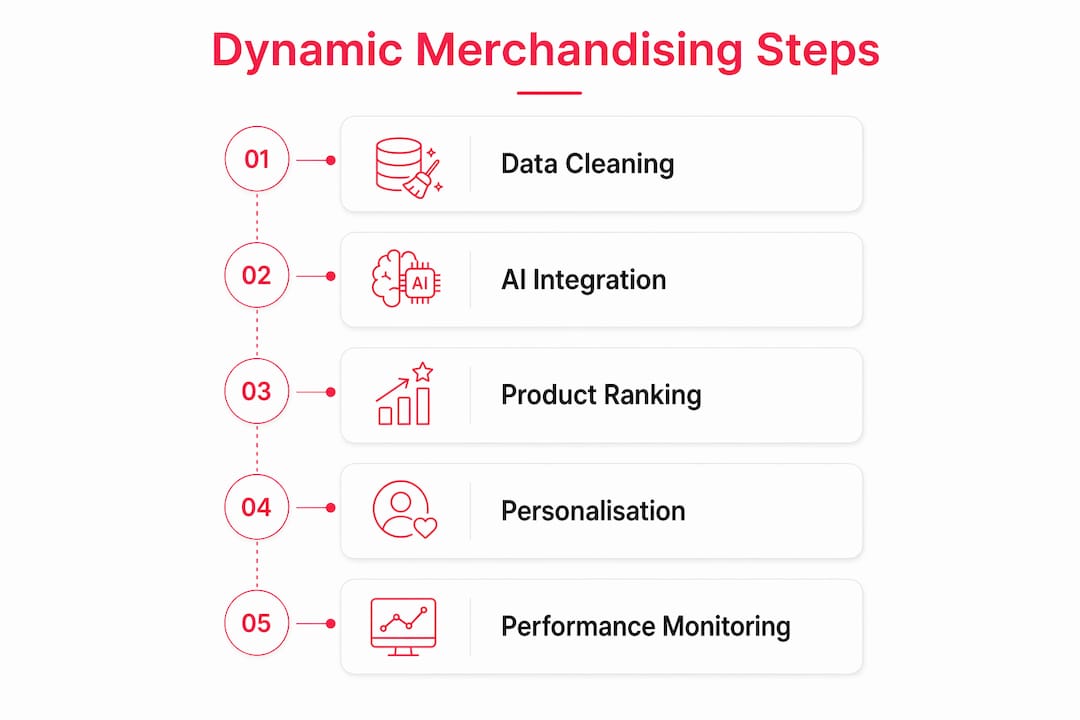
Getting dynamic merchandising working in practice requires more than switching on an AI tool. The tactics below cover the full implementation picture, from data foundations to KPI monitoring.
Core tactics:
- Dynamic product sorting: configure your platform or specialist tool to rank category pages by predicted conversion probability, not just manual sort order or newness.
- Personalised cross-selling: use behavioural co-purchase data to surface complementary products at the cart and product detail page level.
- Dynamic bundling: let the AI identify which product combinations drive the highest AOV and surface those bundles automatically.
- Inventory-aware display: set suppression rules so products below a stock threshold drop out of prime positions without manual intervention.
- Seasonal and trend-based boosting: use demand forecasting to promote products ahead of peak demand, not reactively.
Software tools in common use:
| Tool | Primary function | Platform compatibility |
|---|---|---|
| Klevu | On-site search and category merchandising with AI ranking | Shopify, Magento, BigCommerce |
| Bloomreach | Enterprise search, content, and personalisation | Headless and platform-agnostic |
| Klaviyo | Lifecycle email and SMS with behavioural segmentation | Shopify, WooCommerce, BigCommerce |
| Shopify Plus | Native AI product recommendations and collection sorting | Shopify ecosystem |
| BigCommerce Enterprise | Built-in merchandising rules and third-party AI integrations | BigCommerce ecosystem |
| WooCommerce | Extensible via plugins for AI search and recommendations | WordPress ecosystem |
At Bigeyedeers, we use Klevu search and merchandising directly within client builds to improve onsite product discovery, and Klaviyo for lifecycle marketing that feeds behavioural data back into the personalisation layer.
Catalogue hygiene is non-negotiable. Poor catalogue hygiene undermines machine learning accuracy and rankings. Accurate categorisation, consistent attribute data, and up-to-date stock information are prerequisites, not nice-to-haves. An AI engine trained on messy data will confidently surface the wrong products.
Balance manual rules with AI autonomy. Integrating manual rules sparingly while relying on autonomous AI optimises conversion by adapting to individual shopper behaviour. Pin your top three hero products for a campaign launch, then let the AI handle the rest of the category.
KPIs to monitor:
- Conversion rate by category page
- AOV on sessions with AI-driven recommendations
- Product discovery rate (items purchased that were not in the initial search)
- Time on site and pages per session
- Out-of-stock impression rate
Common roadblocks in dynamic merchandising and how to overcome them
Most retailers who underperform with dynamic merchandising are not using bad tools. They are using good tools on a weak foundation, or fighting the AI with too many manual overrides.
Data quality problems are the most common root cause. Without accurate categorisation and reliable stock data, even advanced AI tools fail to deliver useful results. Before enabling any AI merchandising layer, audit your product catalogue for missing attributes, duplicate entries, and stale inventory figures. This is unglamorous work, but it determines whether the AI learns from signal or noise.
Over-reliance on manual rules is the second major trap. Merchandising teams often carry habits from the static era, pinning dozens of products and writing complex boost rules that effectively prevent the AI from learning. The result is a system that is neither fully manual nor fully intelligent. Treat manual rules as exceptions for genuine business constraints (a brand partnership, a compliance requirement) rather than as the default configuration.
Technical integration gaps slow down many implementations. Connecting a merchandising tool to your platform’s product catalogue, inventory system, and customer data platform requires clean API work and ongoing maintenance. Misaligned data schemas between systems are a frequent cause of stale recommendations appearing on live category pages.
Organisational change is underestimated. Merchandising teams need to shift from configuring layouts to interpreting AI outputs and setting guardrails. That is a different skill set, and it requires training and clear ownership of the new workflow.
Pro Tip: Start with a single high-traffic category as your AI pilot. Measure conversion rate and AOV against a manually managed control category for four weeks before rolling out further. This gives you clean evidence to build internal confidence and identify any data quality issues before they affect your entire catalogue.
The ecommerce automation context matters here too. Dynamic merchandising sits within a broader automation strategy, and the teams that succeed treat it as a system to govern, not a switch to flip.
What the evidence says about dynamic merchandising effectiveness
The performance data available for 2026 is compelling, and it points in a consistent direction: retailers who commit to AI-driven dynamic merchandising see measurable gains across multiple KPIs simultaneously.
| Metric | Improvement reported | Source |
|---|---|---|
| Average sales uplift | 289% | E-Commerce Intelligence Labs (47,000 stores) |
| Conversion rate increase | 156% | E-Commerce Intelligence Labs |
| Time on site improvement | 89% | E-Commerce Intelligence Labs |
| Product discovery rate | 267% | E-Commerce Intelligence Labs |
| Revenue gap closed on category pages | Up to 18% | Shopify Plus, BigCommerce, WooCommerce brands |
These figures come from a study covering 47,000 online stores, which gives the findings more weight than a single case study. The 289% sales lift figure in particular reflects the cumulative effect of better product discovery, higher AOV from personalised cross-selling, and improved conversion from relevant category sorting working together.
Looking ahead, the most significant trend is agentic merchandising: AI systems that autonomously manage inventory display, suppress low-margin SKUs, and update storefronts based on business goals without constant human input. This is not a distant prospect. Several enterprise platforms are already piloting autonomous merchandising agents that handle collection management end-to-end, flagging only genuine exceptions for human review.
Immersive visual experiences are the other major frontier. As 3D and AR content becomes more accessible to mid-market retailers, the combination of personalised product ranking and interactive product visualisation will create a qualitatively different shopping experience from anything a static layout could deliver. Retailers who have already invested in AI-driven ecommerce strategies are better positioned to adopt these capabilities as they mature.
Key takeaways
Dynamic merchandising, when built on clean catalogue data and governed AI automation, is the most direct lever ecommerce retailers have for improving conversion rates, AOV, and product discovery simultaneously.
| Point | Details |
|---|---|
| AI is the engine, data is the fuel | Poor catalogue hygiene undermines AI accuracy; clean product data is a prerequisite for effective dynamic merchandising. |
| Performance gains are measurable | Retailers adopting predictive merchandising report a 156% average conversion rate increase and a 289% average sales uplift. |
| Manual rules should be minimal | Sparse manual overrides let AI systems learn from shopper behaviour; excessive pinning prevents effective optimisation. |
| Agentic merchandising is arriving | AI systems that autonomously manage storefronts with minimal human input are already in pilot across enterprise platforms. |
| Start with one category | Piloting on a single high-traffic category before full rollout reduces risk and surfaces data quality issues early. |
Ready to build a dynamic merchandising strategy that actually works?
At Bigeyedeers, we have spent over 17 years building ecommerce platforms that perform under real commercial pressure. We integrate Klevu for on-site search and merchandising, Klaviyo for behavioural lifecycle marketing, and we build on Magento and Shopify with the architecture to support AI-driven product discovery at scale.

If your category pages are still running on manual sort rules and gut instinct, this is your heads-up that the gap to AI-managed competitors is widening. Whether you are on Magento or Shopify, we can help you build the data foundation and tool stack to make dynamic merchandising work properly, not just in theory.
Get in touch with the Bigeyedeers team to talk through where your merchandising setup stands and what a realistic improvement plan looks like.
Recommended



Adobe Commerce (Magento)
Formerly known as Magento, Adobe Commerce is built for complex catalogues, integrations, and long term growth. We design and develop stable, scalable stores that support demanding eCommerce requirements, including multi-store setups, complex pricing, and Hyva based performance improvements.

Bespoke Build
We design and build custom eCommerce platforms for businesses with complex workflows, integrations, or non standard requirements. Built from scratch around your business needs using Laravel and modern architectures.

Working with brands across the UK from our offices in Cardiff and Exeter, you deal directly with a senior team of designers and developers specialising in Shopify, Magento, WordPress and bespoke eCommerce platforms.
We focus on commercial outcomes. Better conversion rates, strong SEO foundations and eCommerce platforms that continue to improve long after launch.