Choose the right local vs global ecommerce strategy

Global ecommerce sales are projected to reach $6.88 trillion in 2026, a staggering figure that highlights unprecedented opportunities for UK retailers. Yet many ecommerce business owners face a critical dilemma: should they concentrate on strengthening their position in the familiar UK market, or pursue ambitious international expansion? This guide clarifies the strategic trade-offs, operational realities, and platform capabilities that determine whether a local or global ecommerce approach aligns with your business goals and readiness.
Table of Contents
- Introduction To Local And Global Ecommerce Strategies
- Key Differences Between Local And Global Ecommerce
- Common Misconceptions About Global Ecommerce
- Operational And Logistical Considerations
- Cultural, Regulatory, And Compliance Challenges
- Comparing Market Trends And Revenue Implications
- Platform-Specific Implementation Insights For Magento And Shopify
- Practical Framework To Decide Between Local And Global Strategies
- Conclusion And Actionable Next Steps
- How Big Eye Deers Can Support Your Local Or Global Ecommerce Journey
Key takeaways
| Point | Details |
|---|---|
| Local ecommerce offers operational simplicity but constrains growth ceiling | Focusing on UK or regional markets reduces logistics complexity and compliance burdens, yet limits revenue potential compared to international markets. |
| Global ecommerce unlocks larger markets at the cost of operational complexity | Targeting multiple countries multiplies revenue opportunities but demands sophisticated logistics, localisation, and regulatory navigation. |
| Platform capabilities and operational readiness determine strategy viability | Magento and Shopify features support multi-market operations, but success requires matching platform capabilities to your team’s capacity and financial resources. |
| Common misconceptions can derail strategic decisions | Global expansion is accessible to SMEs with proper planning, whilst profitable local growth remains viable for many UK businesses. |
| A practical framework guides the right choice for your business | Assessing market signals, operational readiness, financial capacity, and strategic alignment reveals the optimal path forward. |
Introduction to local and global ecommerce strategies
Understanding the fundamental distinction between local and global ecommerce strategies establishes the foundation for informed decision-making. Local ecommerce focuses sales efforts within the UK or nearby regional markets, prioritising deep market penetration over geographic breadth. Global ecommerce targets multiple international markets beyond the UK, pursuing revenue growth through geographic diversification.
The UK ecommerce market is £286 billion by 2025, with 28% of retail sales occurring online. This mature market offers substantial opportunity for retailers who excel at serving UK consumers. Simultaneously, global ecommerce presents compelling growth prospects, with the 2026 global ecommerce strategic playbook projecting unprecedented international expansion.
The choice between these strategies is not binary. Many successful UK retailers begin locally, building operational excellence and brand strength before expanding internationally. Others identify niche global demand early and pursue international markets from launch. Custom ecommerce UK retail brands increasingly leverage sophisticated platforms to support both approaches simultaneously through multi-store configurations.
Key considerations include:
- Market maturity and competitive intensity in target regions
- Product-market fit across different cultural contexts
- Operational capacity to manage increased complexity
- Financial resources for sustained market entry investment
- Platform capabilities supporting multi-market requirements
Recognising these definitions and contextual factors enables business owners to evaluate strategic options against their specific circumstances rather than following generic advice.
Key differences between local and global ecommerce
Operational, cultural, and regulatory differences create distinct challenges for local versus global ecommerce strategies. Understanding these variations helps business owners anticipate resource requirements and complexity levels.
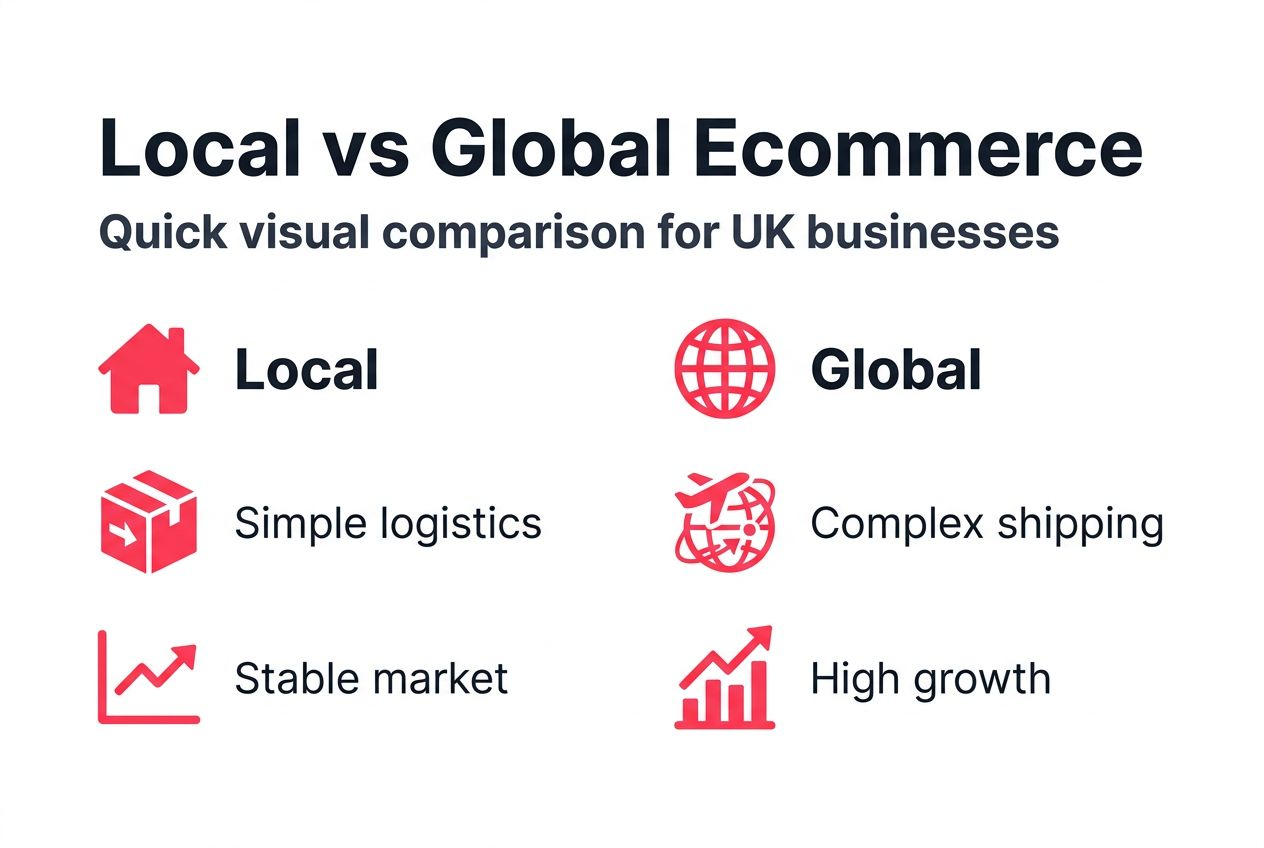
Logistics complexity escalates dramatically with global expansion. International shipping introduces customs clearance, longer transit times, and higher costs. Returns management becomes exponentially more complicated when products cross borders. Local ecommerce benefits from predictable domestic shipping networks and straightforward return processes.

Cultural differences profoundly impact marketing effectiveness and product reception. What resonates with UK consumers may confuse or offend international audiences. Product descriptions, imagery, sizing standards, and even colour preferences vary across markets. Global ecommerce expansion requires significant investment in localisation beyond simple translation.
Regulatory and compliance hurdles multiply internationally. Each market introduces unique VAT or sales tax requirements, consumer protection laws, and data privacy regulations. GDPR compliance for UK businesses extends to international customer data, whilst additional regulations apply in target markets. Payment processing standards and preferred methods vary significantly across regions.
Both Magento and Shopify offer robust multi-market support features. Magento’s enterprise-grade multi-store capabilities enable sophisticated market segmentation with shared backend systems. Shopify’s streamlined multi-currency and international domain features simplify global expansion for growing businesses. Custom ecommerce UK retail brands leverage these platform capabilities to manage complexity efficiently.
Critical operational differences include:
- Shipping costs typically 2-4x higher for international versus domestic
- Payment processing fees varying by market and currency
- Customer service requiring multilingual support and extended hours
- Inventory management across multiple fulfilment locations
- Marketing spend distributed across diverse channels and platforms
Pro tip: Before committing to global expansion, test international demand through marketplace platforms like Amazon or eBay international sites. This validates market interest with minimal infrastructure investment, providing data to inform your platform expansion strategy.
Financial implications extend beyond direct costs. Working capital requirements increase substantially to fund inventory across markets and longer payment cycles. Currency fluctuation risks can erode margins unexpectedly. Local strategies maintain simpler financial planning and more predictable cash flow patterns.
Common misconceptions about global ecommerce
Several persistent myths about global ecommerce mislead UK business owners, creating unrealistic expectations or missed opportunities. Addressing these misconceptions enables clearer strategic thinking.
The belief that global ecommerce exclusively suits large enterprises prevents many capable SMEs from exploring international opportunities. Small and medium UK businesses successfully expand globally by carefully assessing operational capacity and market demand. Platform tools and third-party logistics providers democratise global commerce capabilities previously available only to major retailers.
Another common fallacy suggests global expansion guarantees immediate profit growth. Reality proves more nuanced. Market entry costs, localisation investments, and learning curves often create 12-18 month payback periods. Successful global strategies require patient capital and realistic timeline expectations. Local market mastery sometimes generates superior returns with lower risk.
Many business owners underestimate cultural adaptation requirements, assuming products and marketing translate seamlessly across borders. Cultural missteps damage brand perception and waste marketing spend. Even within English-speaking markets, messaging that resonates in the UK may fall flat in the US or Australia.
Conversely, some retailers dismiss local markets as too constrained for meaningful growth. The UK’s £286 billion ecommerce market offers substantial headroom for businesses achieving deeper market penetration, expanding product ranges, or improving customer lifetime value. Local dominance creates defensible competitive positions and strong cash flow funding future expansion.
Key misconceptions to avoid:
- Global expansion requires massive upfront technology investment (modern platforms enable incremental scaling)
- International customers expect identical experiences to domestic shoppers (localisation drives conversion)
- Language translation alone suffices for market entry (cultural adaptation goes far beyond words)
- Local markets mature too quickly to sustain growth (innovation and customer experience improvements unlock ongoing opportunity)
- Platform choice locks businesses into single-market strategies (both Magento and Shopify support strategic pivots)
“The biggest mistake we see is businesses treating global expansion as a technology problem rather than a strategic business decision requiring operational readiness across logistics, compliance, marketing, and customer service.”
Understanding these realities helps business owners approach the local versus global decision with appropriate expectations and preparation.
Operational and logistical considerations
Operational excellence determines ecommerce success regardless of geographic strategy, but global expansion magnifies logistics and supply chain complexity exponentially.
Reliable logistics and transparent inventory management form the foundation of customer trust. UK consumers increasingly expect precise delivery timeframes and real-time tracking. Operational excellence, including logistics reliability and fast fulfilment, proves critical for 2026 ecommerce success. International customers hold similar expectations whilst tolerating longer transit times for cross-border orders.
Consumer demand for delivery certainty and sustainable shipping practices intensifies pressure on ecommerce operations. Carbon-neutral shipping options, recyclable packaging, and transparent supply chain practices influence purchasing decisions. UK ecommerce consumer trends in 2026 emphasise sustainability alongside speed and reliability.
Financial challenges multiply with geographic expansion. VAT registration requirements vary by country, each with distinct thresholds and filing procedures. Customs duties add costs and administrative burden. Currency exchange rate fluctuations create margin volatility requiring hedging strategies or dynamic pricing. Payment processing costs increase with international transactions and multiple currency handling.
Platform capabilities directly influence fulfilment efficiency and customer experience quality. Magento’s advanced inventory management supports complex multi-warehouse operations and sophisticated allocation rules. Shopify’s streamlined interface simplifies international selling but may require third-party apps for enterprise-scale complexity. Choosing the ecommerce website launch checklist appropriate to your operational model prevents costly rebuilds.
Critical operational factors include:
- Fulfilment location strategy (centralised UK warehouse versus distributed international facilities)
- Returns processing capability across markets
- Customer service infrastructure supporting multiple time zones and languages
- Technology integration connecting platforms with logistics providers and ERPs
- Quality control processes ensuring consistent product standards globally
Pro tip: Operational readiness testing through pilot programmes in one international market reveals capability gaps before full-scale expansion. Select a market with cultural and regulatory similarity to the UK, such as Ireland or certain European countries, to minimise initial complexity whilst validating operational processes.
Local strategies benefit from established UK logistics networks, predictable costs, and simplified compliance. This operational simplicity enables leaner teams and faster iteration cycles. Global ambitions demand operational maturity, documented processes, and systems capable of managing increased complexity without proportional headcount growth.
Cultural, regulatory, and compliance challenges
Successful international ecommerce requires navigating cultural nuances and regulatory frameworks that vary dramatically across markets.
Adapting marketing and product presentation to local cultures extends far beyond language translation. Visual preferences, persuasive messaging techniques, and trusted payment methods differ significantly across regions. Colour symbolism, imagery styles, and even website layout conventions vary culturally. Investment in proper localisation distinguishes successful global retailers from those struggling with poor conversion rates despite strong traffic.
GDPR compliance applies to UK businesses processing EU customer data, creating baseline privacy requirements. Additional regulations apply in other markets, including CCPA in California and varying data protection laws globally. VAT registration thresholds differ by country, requiring businesses to monitor sales volumes and register appropriately. Customs regulations for product categories vary, with some items requiring special permits or facing import restrictions.
Financial and compliance complexity, including VAT/GST registration, GDPR adherence, and customs regulations, often erodes margins by up to 5%. This margin compression demands higher volumes or premium pricing to maintain profitability. Businesses underestimating compliance costs frequently discover international expansion less profitable than projections suggested.
Case examples illustrate the importance of cultural and regulatory preparation. A UK fashion retailer expanding to Germany without adapting size charts to European standards experienced high return rates and customer dissatisfaction. Another business launched in France without proper VAT registration, facing penalties and forced sales suspension. Conversely, a UK beauty brand investing in French-native customer service and localised product descriptions achieved conversion rates matching their domestic site.
Compliance planning essentials include:
- Legal entity requirements for trading in target markets
- Product certification and labelling standards
- Consumer protection laws affecting return policies and warranties
- Advertising regulations restricting claims or requiring disclosures
- Accessibility standards for websites serving certain markets
Planning for compliance as a core component of market entry strategy prevents costly delays, penalties, and reputation damage. Businesses treating regulatory requirements as afterthoughts frequently face launch postponements or emergency remediation expenses.
Comparing market trends and revenue implications
Data-driven analysis of growth opportunities and financial trade-offs clarifies the strategic calculus between local and global approaches.
Cross-border ecommerce sales are expected to grow twice as fast as domestic ecommerce until 2030, highlighting the velocity of international opportunity. However, faster growth comes with higher operational costs and complexity. Domestic UK ecommerce continues expanding steadily, offering reliable growth with operational simplicity.
Revenue share expectations reveal ambitious international plans amongst ecommerce leaders. 42.5% of ecommerce leaders expect 21-30% of their revenue to come from international sales in 2026. This substantial international contribution reflects both opportunity and competitive pressure to expand globally.
The UK market’s maturity creates a strong foundation for local focus or a launch pad for global expansion. Britain’s geographic position, language advantages, and established logistics infrastructure position UK retailers favourably for European and broader international expansion. Yet domestic market sophistication enables profitable growth through customer experience excellence and operational efficiency.
| Metric | Local (UK) Strategy | Global Strategy |
|---|---|---|
| Annual growth rate | 8-12% steady | 18-25% but volatile |
| Gross margin impact | Baseline | -3% to -8% from compliance and logistics |
| Customer acquisition cost | £25-45 | £60-120 (varies by market) |
| Operational complexity | Low | High (3-5x resource requirements) |
| Time to profitability | 6-12 months | 12-24 months |
| Market ceiling | £286B UK market | £6.88T global market |
Cost-benefit analysis requires honest assessment of capabilities and resources. Global expansion delivers growth but demands investment in systems, people, and working capital. Local optimisation generates strong returns when execution excellence creates competitive advantages.
Strategic considerations include:
- Market saturation levels in UK versus target international markets
- Competitive intensity and differentiation opportunities
- Brand strength and awareness in potential expansion markets
- Product-market fit evidence from existing international customer inquiries
- Financial capacity to sustain market entry investment periods
Balancing growth ambitions with operational realities and financial constraints determines the optimal timing and approach for international expansion versus local market development.
Platform-specific implementation insights for Magento and Shopify
Magento and Shopify offer distinct capabilities supporting local and global ecommerce strategies, with important implications for implementation complexity and operational flexibility.
Magento’s multi-store architecture enables sophisticated market segmentation whilst maintaining centralised administration. A single Magento installation can power separate storefronts for UK, European, and other markets, each with localised catalogues, pricing, and content. Deep ERP integration capabilities support complex inventory allocation and order routing rules. This enterprise-grade functionality serves businesses managing diverse market requirements or B2B alongside DTC operations.
Shopify’s streamlined approach simplifies international selling through built-in multi-currency support and international domain features. Shopify Markets enables businesses to manage multiple countries from one admin interface, handling currency conversion and localised checkout experiences. The extensive app ecosystem provides solutions for specific market requirements without custom development.
Strategic platform planning prevents costly migrations or operational constraints. Businesses anticipating complex multi-market requirements benefit from Magento’s flexibility, despite higher implementation costs. Those prioritising speed to market and operational simplicity often find Shopify’s capabilities sufficient, particularly for DTC brands without extensive B2B requirements.
Platform choice affects operational scalability:
- Magento supports unlimited products, complex attribute sets, and sophisticated pricing rules across markets
- Shopify’s performance remains consistent regardless of scale but may require workarounds for highly complex catalogue requirements
- Both platforms integrate with leading global logistics and payment providers
- Multi-store ecommerce UK implementations require careful planning regardless of platform choice
User experience consistency across markets demands thoughtful design systems and content management. Magento’s theming capabilities enable market-specific design variations whilst maintaining brand coherence. Shopify’s theme structure supports similar flexibility with simpler implementation.
Leveraging platform features aligned with business goals and operational capacity maximises return on technology investment whilst supporting strategic flexibility as market conditions evolve.
Practical framework to decide between local and global strategies
A structured decision framework transforms abstract strategy questions into concrete assessments guiding optimal ecommerce approach selection.
Step one evaluates market demand signals indicating international opportunity or local growth potential. Analyse website analytics for geographic traffic sources and conversion patterns. International traffic exceeding 15% with reasonable conversion rates suggests untapped demand. Customer inquiries from specific countries reveal markets where your products resonate. Conversely, strong UK traffic growth with improving conversion indicates local optimisation opportunities.
Step two assesses operational readiness across critical capabilities. Audit logistics capacity for international shipping and returns processing. Evaluate team expertise in managing compliance requirements and localised marketing. Review technology infrastructure supporting multi-market operations. Honest capability assessment prevents overextension into complexity exceeding current organisational maturity.
Step three examines financial capacity for market entry and sustained investment. International expansion typically requires 12-18 months before profitability. Budget for localisation, compliance setup, market-specific marketing, and working capital increases. Essential ecommerce website must-haves include platform capabilities supporting chosen strategy without requiring immediate rebuilds.
Step four aligns strategy selection with long-term business objectives. Consider whether geographic diversification or market depth better serves vision and values. Evaluate risk tolerance for complexity and investment. Assess competitive positioning benefits from international presence versus local dominance.
Practical decision steps:
- Quantify international demand through traffic analysis and customer inquiry tracking
- Score operational readiness across logistics, compliance, technology, and team capabilities (1-10 scale)
- Model financial requirements and timeline to profitability for target markets
- Map strategic options against 3-5 year business vision and risk parameters
- Validate assumptions through pilot programmes or marketplace testing before full platform commitment
Pro tip: Consult ecommerce platform specialists early in strategic planning to understand technology implications and costs for different approaches. Ecommerce website launch checklist conversations reveal capability gaps and prevent expensive rebuilds when strategy evolves.
The framework outputs a clear recommendation: pursue local optimisation, test international waters through marketplaces, or commit to multi-market platform development. Revisit the assessment annually as capabilities mature and market conditions shift.
Conclusion and actionable next steps
Local and global ecommerce strategies each offer distinct opportunities and challenges for UK businesses. Local focus delivers operational simplicity, predictable costs, and deep market expertise within a substantial £286 billion UK market. Global expansion unlocks exponentially larger markets but demands sophisticated operational capabilities, cultural adaptation, and sustained investment.
Operational readiness and platform alignment emerge as critical success factors regardless of geographic strategy. Businesses lacking logistics maturity, compliance expertise, or financial reserves should strengthen capabilities before international expansion. Those demonstrating strong operational fundamentals can confidently pursue global opportunities when market signals justify the investment.
Apply the four-step decision framework to assess your specific situation objectively. Evaluate international demand signals, audit operational readiness, model financial requirements, and align choices with strategic objectives. This structured approach replaces guesswork with data-driven decision-making.
The UK market’s strength and global ambitions need not conflict. Many successful retailers build domestic excellence before expanding internationally, using local profits to fund market entry. Others identify global niches from launch, accepting complexity in exchange for first-mover advantages.
Start with a rigorous readiness assessment and incremental approach. Test assumptions through pilot programmes or marketplace experiments before committing to full multi-market platform development. This measured progression builds capabilities whilst managing risk, creating sustainable foundations for long-term ecommerce growth.
How Big Eye Deers can support your local or global ecommerce journey
Navigating local versus global ecommerce decisions requires both strategic clarity and technical expertise. Big Eye Deers brings 17 years of experience designing, building, and supporting high-performing Magento and Shopify stores for UK retailers pursuing diverse market strategies.
Our team understands the operational realities and platform capabilities determining local and global strategy success. We deliver customised solutions matching your readiness level and business objectives, whether that means optimising UK market performance or building sophisticated multi-store infrastructures for international expansion.
From initial strategy consultation through platform development and ongoing support, we help UK ecommerce businesses make confident decisions backed by technical expertise and market knowledge. Our Magento multi-store capabilities and Shopify international implementations seamlessly integrate platform features with your operational model. Meet the team supporting growing retail brands across local and global markets, or explore our Magento web design and Shopify agency UK services to understand how we can support your ecommerce ambitions.
Frequently asked questions
What are the main differences between local and global ecommerce strategies?
Local ecommerce targets the UK or nearby regional markets, offering simpler logistics, straightforward compliance, and deeper market focus. Global ecommerce pursues multiple international markets, introducing complex shipping and customs requirements, diverse regulatory frameworks, and significant localisation needs. The primary trade-off balances operational simplicity and lower costs against larger market access and growth potential.
How do I know if my ecommerce business is ready for global expansion?
Assess international website traffic levels, aiming for at least 15% from target markets with reasonable conversion rates. Evaluate operational capabilities including logistics infrastructure, compliance expertise, and multilingual customer service capacity. Ensure financial reserves cover 12-18 months of market entry investment before profitability. Align expansion timing with long-term strategic objectives rather than pursuing growth for its own sake.
Can small UK ecommerce businesses succeed with global strategies?
Global ecommerce is accessible to SMEs with proper planning and realistic readiness assessment. Many small and medium UK businesses expand internationally by carefully evaluating operational capacity and market demand before committing resources. Modern platform tools and third-party logistics providers democratise capabilities previously exclusive to large enterprises. Success depends on matching ambition to operational maturity and financial capacity, not simply business size.
What platform features support multi-market ecommerce on Magento and Shopify?
Magento offers enterprise-grade multi-store configurations, sophisticated ERP integrations, and flexible catalogue management supporting complex international requirements. These capabilities suit businesses managing diverse market needs or combining B2B with DTC operations. Shopify provides streamlined multi-currency support, international domains, and extensive localisation apps delivering simpler implementation for growing DTC brands. Both platforms integrate with leading global payment processors and logistics providers, enabling international operations when properly configured.
Recommended


Adobe Commerce (Magento)
Formerly known as Magento, Adobe Commerce is built for complex catalogues, integrations, and long term growth. We design and develop stable, scalable stores that support demanding eCommerce requirements, including multi-store setups, complex pricing, and Hyva based performance improvements.

Bespoke Build
We design and build custom eCommerce platforms for businesses with complex workflows, integrations, or non standard requirements. Built from scratch around your business needs using Laravel and modern architectures.

Working with brands across the UK from our offices in Cardiff and Exeter, you deal directly with a senior team of designers and developers specialising in Shopify, Magento, WordPress and bespoke eCommerce platforms.
We focus on commercial outcomes. Better conversion rates, strong SEO foundations and eCommerce platforms that continue to improve long after launch.