What is custom CMS? 25% higher conversions UK 2026

Many UK ecommerce managers assume custom content management systems are exclusively for enterprise budgets. That’s outdated thinking. Modular development reduces custom CMS build time by up to 35%, making tailored solutions accessible to growing online stores. This article explains what custom CMS means for your Magento or Shopify platform, how it works, and why UK retailers are seeing measurable results from bespoke content management.
Table of Contents
- Understanding Custom CMS: Definition And Core Functions
- How Custom CMS Works With Magento And Shopify
- Key Benefits: Performance, User Experience, And Scalability
- Common Misconceptions About Custom CMS
- Comparison: Custom CMS Vs Off-The-Shelf Ecommerce CMS
- Practical Considerations And Decision Criteria For UK Ecommerce Businesses
- Case Studies: Custom CMS Impact On UK Ecommerce Businesses
- Future-Proofing Your Ecommerce Platform With Custom CMS
- Partner With Big Eye Deers For Bespoke Magento And Shopify Solutions
- Frequently Asked Questions
Key takeaways
| Point | Details |
|---|---|
| Custom CMS definition | Bespoke software built for unique business requirements, offering complete control over content workflows and backend automation. |
| Magento and Shopify integration | Connects via APIs to support personalised catalogues, tiered pricing, and multi-store configurations seamlessly. |
| Performance benefits | UK implementations show 25% conversion rate increases through faster load times and tailored user journeys. |
| Cost accessibility | Modular approaches reduce upfront investment and build time, making custom CMS viable for SMEs. |
| Scalability advantage | Supports growth from small operation to enterprise with flexible architecture and advanced ecommerce features. |
Understanding custom CMS: definition and core functions
Custom CMS enables bespoke content management tailored to unique business needs, unlike prebuilt systems that force you into fixed templates. You get software built specifically for your operational workflows, customer journeys, and backend processes.
This approach gives complete control over how content is created, approved, and published across your ecommerce platform. For Shopify and Magento ecommerce solutions, it means managing complex features like tiered pricing structures, account hierarchies, and multi-store catalogues without plugin limitations.
The core functions include:
- Content workflow automation matching your team’s approval processes and publishing schedules
- API integrations connecting Magento or Shopify with ERP systems, marketing platforms, and analytics tools
- Custom user interface designed around your staff’s actual working patterns and efficiency needs
- Advanced ecommerce features like personalised product displays, dynamic pricing, and complex B2B catalogues
- Scalable architecture supporting business growth without platform migrations or rebuilds
Off-the-shelf CMS platforms offer speed and lower initial costs. Custom CMS delivers flexibility, bespoke user experience, and long-term scalability. The difference matters most when your business model doesn’t fit standard templates or when you need specific integrations that plugins can’t provide reliably.
How custom CMS works with Magento and Shopify
Custom CMS integration supports advanced personalisation and multi-store setups for Magento and Shopify through API connections that enable seamless data exchange. Your custom system communicates with the ecommerce platform’s backend, pushing and pulling product information, customer data, and order details in real time.
For Magento users, this means managing customised product catalogues across multiple stores whilst maintaining centralised control. You can implement tiered pricing models that adjust automatically based on customer groups, order volumes, or wholesale agreements. The benefits of Magento ecommerce platform expand significantly when paired with bespoke content management.
Shopify integration works similarly, with custom CMS handling complex content workflows whilst Shopify manages transactions and inventory. This separation allows you to build sophisticated content strategies without compromising checkout performance or payment security.
Practical applications include:
- Dynamic content delivery serving personalised product recommendations based on browsing history and purchase patterns
- Backend workflow automation connecting marketing platforms like Klaviyo for lifecycle campaigns without manual data transfers
- Multi-store management controlling content variations across regional sites from a single interface
- ERP integration synchronising stock levels, pricing updates, and customer records automatically
- Custom dashboard interfaces showing relevant metrics for different team roles and responsibilities
This deep integration improves operational efficiency by eliminating manual data entry and reducing errors. Customer engagement increases because you can deliver truly personalised experiences that generic CMS platforms struggle to support. Magento and Shopify ecommerce agency specialists build these integrations to work reliably under peak loads whilst maintaining security standards.
Key benefits: performance, user experience, and scalability
Custom CMS reduces page load times by serving optimised content structures designed specifically for your product catalogue and site architecture. Faster pages directly boost conversion rates and improve search rankings. Magento custom CMS implementations led to 25% increase in conversion rates for UK online stores by combining speed improvements with personalised shopping journeys.

Personalised experiences drive repeat purchases. When your CMS knows customer preferences, purchase history, and browsing patterns, you can show relevant products and content automatically. This level of customisation increases average order values and customer satisfaction scores measurably.
Scalability becomes straightforward with modular architecture. You start with essential features and add capabilities as your business grows. Moving from SME to enterprise doesn’t require platform changes or painful migrations. The system expands to support increased traffic, additional stores, and complex B2B requirements without performance degradation.
Pro Tip: Involve UX experts during the planning phase, not after development starts. Early wireframing in tools like Figma ensures your custom CMS meets actual user expectations and working patterns from day one.
Additional measurable advantages:
- Backend stability supporting advanced ecommerce features without plugin conflicts or security vulnerabilities
- Better mobile performance through optimised content delivery and progressive web application capabilities
- Improved Magento site speed when combined with modern frontend technologies like Hyvä
- Reduced operational costs from automated workflows replacing manual processes
- Competitive differentiation through unique features competitors using standard CMS cannot replicate
The custom web application benefits extend beyond ecommerce into order management, customer service systems, and supplier portals. Everything connects through your custom CMS, creating a unified platform for business operations.
Common misconceptions about custom CMS
- Custom CMS costs prohibitively for SMEs. Modular development techniques and phased builds reduce cost and build time for SMEs by delivering essential features first. You spread investment over time whilst gaining immediate benefits from priority capabilities.
- Custom CMS takes too long to deliver value. Phased approaches can reduce implementation time by 35% compared to traditional waterfall projects. You launch core features quickly, then add advanced capabilities based on proven user needs and business performance.
- Off-the-shelf CMS suits all ecommerce requirements. Standard platforms work well for simple catalogues and straightforward workflows. Complex B2B models, multi-tier pricing, or unique customer journeys often require workarounds that become expensive and fragile over time.
- Maintenance costs spiral out of control. Properly built custom CMS actually reduces long-term costs by eliminating subscription fees for multiple plugins and reducing technical debt from incompatible extensions.
- You lose platform updates and security patches. Quality custom ecommerce benefits for UK retail include ongoing support that applies security updates and platform improvements without disrupting custom features.
Pro Tip: When evaluating providers, ask specifically about modular development capabilities and phased delivery approaches. Agencies offering these methods can make custom CMS accessible to businesses of any size.
Total cost of ownership matters more than initial build costs. Calculate the five-year expense of plugin subscriptions, workaround development, and lost conversion opportunities from limited personalisation. Custom CMS often proves more economical when you account for business growth and evolving requirements.
Comparison: custom CMS vs off-the-shelf ecommerce CMS
| Feature | Custom CMS | Off-the-Shelf CMS |
|---|---|---|
| Flexibility | Complete control over features, workflows, and interfaces | Limited to platform capabilities and available plugins |
| Implementation time | 3-6 months with phased approach | 2-4 weeks for basic setup |
| Initial cost | £15,000-£75,000 depending on complexity | £500-£5,000 plus monthly fees |
| Ongoing costs | Hosting and support (£200-£1,000/month) | Plugin subscriptions and platform fees (£300-£2,000/month) |
| Scalability | Grows seamlessly with business needs | Often requires platform migration at scale |
| Personalisation | Unlimited customisation of user journeys | Template-based with limited variation |
| Integration depth | Direct API connections tailored to systems | Dependent on plugin availability and compatibility |
| Maintenance | Managed updates preserving custom features | Plugin conflicts and compatibility issues common |
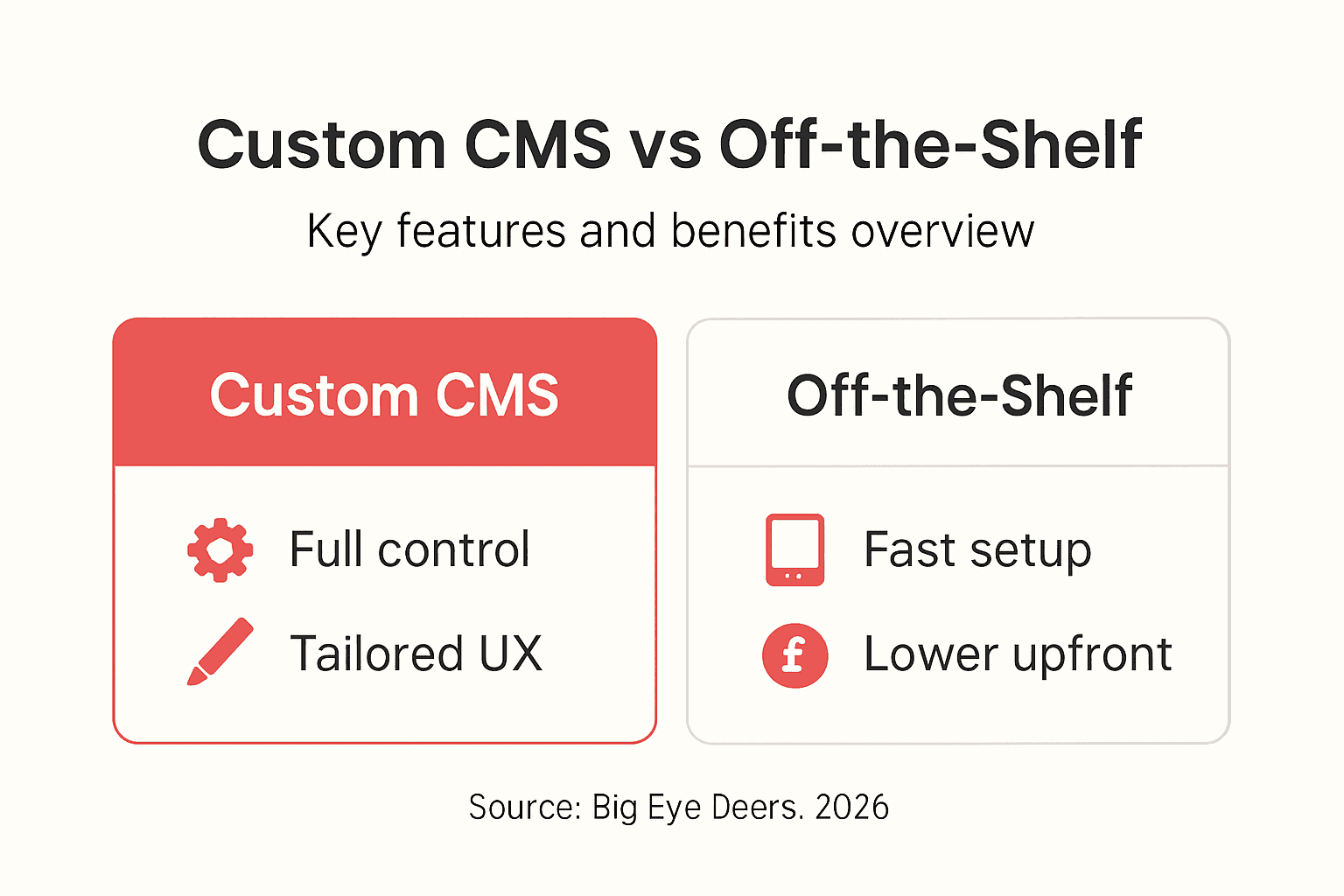
Off-the-shelf platforms excel at speed and simplicity. You get proven functionality immediately with lower technical risk. They suit businesses with straightforward catalogues, standard workflows, and limited integration requirements.
Custom CMS makes sense when your business model doesn’t fit standard templates. Magento enterprise versus community editions shows similar decision points around complexity and scale.
Long-term costs deserve careful analysis. Off-the-shelf platforms appear cheaper initially, but subscription fees, plugin costs, and custom development workarounds accumulate. Five-year total ownership costs often favour custom solutions for growing businesses with specific requirements.
Ideal use cases vary significantly. Small retailers launching their first online store benefit from off-the-shelf speed and lower risk. Established businesses with complex B2B models, multi-store operations, or unique customer journeys see better returns from custom development.
Practical considerations and decision criteria for UK ecommerce businesses
Assess your business complexity honestly before committing to custom CMS. Simple product catalogues with straightforward pricing rarely justify bespoke development. Complex B2B models, wholesale operations, or multi-tier pricing structures benefit significantly from tailored solutions.
Integration requirements matter enormously. List every system your ecommerce platform must connect with: ERP, warehouse management, marketing automation, customer service platforms, and analytics tools. Count how many workarounds or manual processes you currently use. High integration needs favour custom CMS.
Budget planning should cover three areas:
- Development costs including discovery, design, build, and testing phases
- Ongoing maintenance and hosting expenses for reliable performance and security
- Long-term ROI comparing current conversion rates and operational costs against projected improvements
Scalability needs extend beyond current requirements. Consider your three-year growth plans. Will you add stores, expand into B2B, or need advanced personalisation? Custom CMS makes sense when you know you’ll outgrow standard platforms soon.
Vendor evaluation focuses on proven experience with your specific ecommerce platform. Check their Magento and Shopify portfolio, ask about similar projects in your industry, and verify ongoing support capabilities. The criteria for custom ecommerce selection includes technical expertise, communication quality, and support responsiveness.
Pilot features before full deployment whenever possible. Build and test core functionality with real users first. This validates assumptions, identifies improvements, and builds confidence before investing in complete implementation.
Case studies: custom CMS impact on UK ecommerce businesses
A UK fashion retailer implemented custom CMS on Magento and saw conversion rates increase by 25% within six months. The bespoke system enabled personalised product recommendations based on style preferences and browsing behaviour, whilst managing complex seasonal catalogues across multiple stores efficiently.
Operational efficiencies came from integrated ERP and marketing automation. Stock levels synchronised automatically, preventing overselling. Customer data flowed into Klaviyo for lifecycle campaigns without manual exports. The retailer reduced administrative time by 40% whilst improving data accuracy.
A B2B supplier using Shopify added custom CMS to manage account hierarchies and tiered pricing. Average order values increased 18% because sales teams could configure customer-specific catalogues and pricing rules quickly. Repeat purchase rates improved as buyers found relevant products faster through personalised navigation.
Key results reported across implementations:
- Faster time to market for new product lines through streamlined content workflows
- Higher customer satisfaction scores from personalised shopping experiences
- Reduced cart abandonment through optimised checkout processes
- Better inventory management from real-time ERP integration
- Increased mobile conversions from progressive web application capabilities
“Our custom CMS transformed how we manage seasonal collections across six stores. What took our team days now happens in hours, and our customers see exactly the products they want. The agility and precision wouldn’t be possible with our old platform.”
These custom CMS success stories demonstrate practical value beyond theoretical benefits. The measurable improvements in conversion, efficiency, and customer engagement justify investment for businesses with suitable complexity and growth ambitions.
Future-proofing your ecommerce platform with custom CMS
Custom CMS supports headless commerce architecture, separating content management from presentation layers. This flexibility enables you to deliver consistent experiences across web, mobile apps, voice assistants, and future channels without rebuilding your entire platform.
Progressive web applications become straightforward with custom CMS controlling content delivery. You provide app-like experiences on mobile browsers with offline capabilities, push notifications, and fast loading. The progressive web applications and ecommerce combination drives mobile conversion rates significantly higher than traditional responsive sites.
Site resilience improves under peak traffic loads because custom architecture optimises specifically for your catalogue size and user patterns. Generic CMS platforms struggle during sales events when thousands of shoppers browse simultaneously. Bespoke systems handle these loads smoothly through tailored caching and database optimisation.
Adaptation speed matters in competitive markets. When customer behaviour shifts or new technologies emerge, you modify your custom CMS quickly. Off-the-shelf platforms wait for vendor updates or plugin developers to catch up. This agility maintains your competitive advantage.
Future capabilities to consider:
- AI-powered personalisation using machine learning to predict customer preferences and optimise product displays
- Voice commerce integration allowing customers to browse and purchase through smart speakers
- Augmented reality features showing products in customer environments before purchase
- Advanced analytics providing deeper insights into customer journeys and conversion patterns
- Expanded marketplace integrations connecting your platform with emerging sales channels automatically
The dynamic ecommerce landscape demands platforms that evolve with your business and market conditions. Custom CMS provides the foundation for continuous improvement and innovation that standard systems cannot match.
Partner with Big Eye Deers for bespoke Magento and Shopify solutions
Ready to explore how custom CMS can transform your ecommerce performance? Big Eye Deers specialises in tailored content management for Magento and Shopify platforms, delivering modular solutions that fit UK retailers of any size.
Our expert team brings over 17 years of ecommerce experience, building complex B2B systems, multi-store platforms, and personalised shopping journeys. We’ve helped UK retailers achieve measurable improvements in conversion rates, operational efficiency, and customer satisfaction through bespoke development.
We combine custom CMS with proven technologies like Hyvä frontends, Klaviyo marketing automation, and Klevu search to create complete ecommerce solutions. Our Magento web design services and Shopify design and development services deliver platforms that are secure, performant, and built for long-term growth.
Contact us to discuss your custom CMS requirements and discover how bespoke solutions can enhance your Magento or Shopify platform.
Frequently asked questions
What are the main differences between custom CMS and off-the-shelf CMS?
Custom CMS offers bespoke features tailored exactly to your business workflows, complete control over user interfaces, and unlimited scalability. Off-the-shelf CMS provides faster deployment with proven functionality but limits you to template-based designs and available plugins. Custom solutions typically cost more upfront but avoid long-term constraints and subscription fees.
Is custom CMS suitable for small UK ecommerce businesses?
Modular development approaches make custom CMS accessible and cost-effective for SMEs by delivering essential features first and spreading investment over time. Phased implementation reduces time to market and initial costs significantly. Growing businesses with specific requirements or complex integrations often find custom CMS more economical than accumulating plugin subscriptions and workarounds.
How does custom CMS improve ecommerce conversion rates?
Custom CMS enables personalised user journeys showing relevant products based on browsing history and preferences, whilst optimised content delivery reduces page load times. Real UK implementations show up to 25% conversion rate improvements from combining faster performance with tailored shopping experiences. Better mobile experiences and streamlined checkout processes also contribute to higher conversions.
What factors should UK ecommerce businesses consider when choosing a custom CMS?
Evaluate integration requirements with your current ecommerce platform, ERP, marketing tools, and other business systems first. Assess scalability needs for future growth including multi-store operations and B2B capabilities. Choose vendors with proven Magento and Shopify expertise in your industry, verify their ongoing support offerings, and request case studies showing measurable results. Calculate five-year total ownership costs including development, maintenance, and projected ROI from improved performance.
Recommended



Adobe Commerce (Magento)
Formerly known as Magento, Adobe Commerce is built for complex catalogues, integrations, and long term growth. We design and develop stable, scalable stores that support demanding eCommerce requirements, including multi-store setups, complex pricing, and Hyva based performance improvements.

Bespoke Build
We design and build custom eCommerce platforms for businesses with complex workflows, integrations, or non standard requirements. Built from scratch around your business needs using Laravel and modern architectures.
Working with brands across the UK from our offices in Cardiff and Exeter, you deal directly with a senior team of designers and developers specialising in Shopify, Magento, WordPress and bespoke eCommerce platforms.
We focus on commercial outcomes. Better conversion rates, strong SEO foundations and eCommerce platforms that continue to improve long after launch.