How to Plan Ecommerce Project for Magento & Shopify Success

Setting out on a Magento or Shopify project often feels complicated without a clear plan or shared goals. For Ecommerce Managers at growing British retail brands, every project decision can affect growth and customer satisfaction. By focusing on defining clear and measurable ecommerce goals, you shape every stage of your store’s development, improve collaboration among stakeholders, and lay the groundwork for genuine business impact.
Table of Contents
- Step 1: Define Ecommerce Goals And Requirements
- Step 2: Assess Platform Options And Integrations
- Step 3: Map User Journeys And Key Site Features
- Step 4: Develop Technical And Design Specifications
- Step 5: Evaluate Risk, Security, And Compliance
- Step 6: Validate Project Plan With Stakeholders
Quick Summary
| Key Point | Explanation |
|---|---|
| 1. Define clear ecommerce goals | Establish measurable objectives that guide your platform implementation and align with your business vision for success. |
| 2. Assess platform options thoroughly | Evaluate choices like Magento and Shopify against specific business needs, including features, costs, and integration potential. |
| 3. Map user journeys comprehensively | Create detailed blueprints of customer interactions to enhance the shopping experience while reducing friction points. |
| 4. Develop precise specifications | Document detailed technical and design requirements to ensure alignment with business objectives throughout implementation. |
| 5. Validate plans with stakeholders | Engage stakeholders in discussions about project objectives and risks to foster commitment and shared understanding of the ecommerce strategy. |
Step 1: Define Ecommerce Goals and Requirements
Defining clear and measurable goals forms the strategic foundation for your ecommerce project success. By establishing precise objectives, you create a roadmap that guides your Magento or Shopify implementation and ensures every development decision aligns with your business vision.
Starting with precise ecommerce goals requires understanding your specific business needs. Begin by mapping out key performance indicators that matter most to your online store: revenue targets, customer acquisition rates, average order value, conversion percentages, and growth projections. These metrics will help you design a purpose built ecommerce platform that delivers measurable results.
Your requirements gathering should cover multiple dimensions beyond pure financial metrics. Consider aspects like product catalogue complexity, customer segmentation needs, integration requirements with existing systems, scalability expectations, and specific feature requirements unique to your business model. By documenting these comprehensive requirements early, you minimise potential roadblocks during platform development and ensure your chosen solution genuinely supports your strategic objectives.
Refer to this summary of essential ecommerce project requirements and their impact:
| Requirement Dimension | Why It Matters | Potential Impact |
|---|---|---|
| Product Catalogue Scale | Determines platform and architecture | Influences site structure and load speed |
| Customer Segmentation | Targets offers to user groups | Drives conversion and retention |
| Integration Complexity | Links with other business systems | Streamlines operations and reporting |
| Scalability Planning | Prepares for business growth | Avoids future redevelopment costs |
| Unique Feature Needs | Supports differentiating functionality | Enhances brand and customer loyalty |
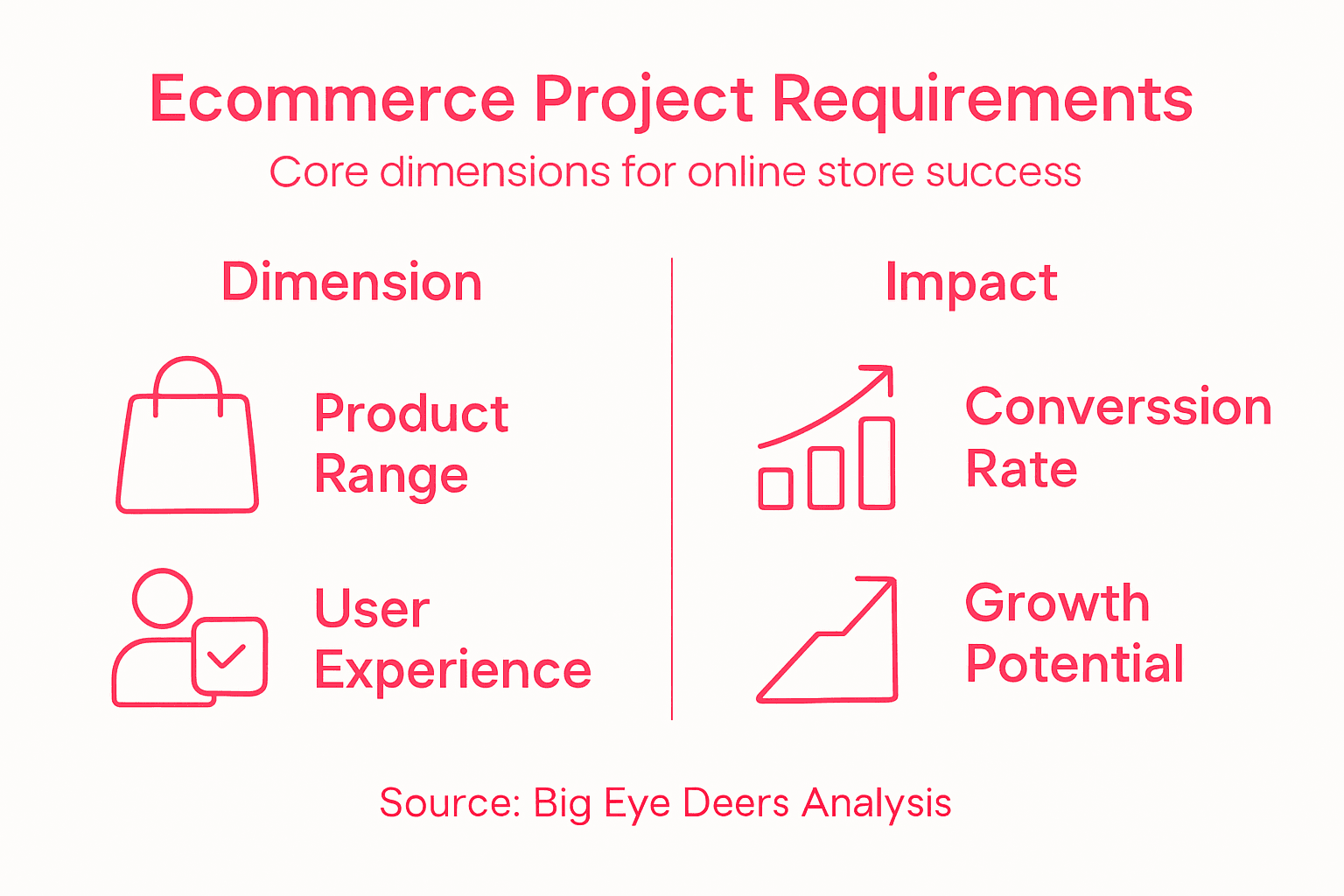
Practical Advice: Create a detailed requirements spreadsheet with columns for goal type, specific metric, current performance, and target performance to track your progress systematically.
Step 2: Assess Platform Options and Integrations
Selecting the right ecommerce platform represents a pivotal decision that will shape your online store’s performance, scalability, and growth potential. Your platform choice must align perfectly with your business model, technical requirements, and long-term strategic objectives.
In evaluating Magento and Shopify options, consider critical factors like total cost of ownership, technical complexity, customisation capabilities, and integration potential. Enterprise ecommerce solutions require deep analysis of features such as product catalogue management, customer segmentation tools, payment gateway compatibility, shipping module flexibility, and scalability across multiple sales channels.
Your assessment should include a comprehensive comparison matrix that evaluates each platform against your specific business requirements. Examine aspects like user experience, backend administrative functionality, mobile responsiveness, security features, and potential third party integrations. Pay special attention to your specific industry needs whether you operate in B2B, B2C, or hybrid commerce models. Evaluate how each platform handles unique requirements like complex pricing structures, bulk ordering capabilities, or specialised product configurations.

Practical Advice: Create a detailed scoring spreadsheet that ranks potential platforms against your specific business criteria, assigning weighted scores to help objectify your platform selection process.
Here’s a comparison highlighting key differences between Magento and Shopify for ecommerce projects:
| Criterion | Magento | Shopify |
|---|---|---|
| Hosting Requirements | Requires own hosting and management | Hosted by Shopify, hassle-free |
| Customisation Flexibility | Highly customisable, developer-focused | Limited but user-friendly customisation |
| Best for Business Types | Large, complex catalogue businesses | Small to medium retailers |
| Scalability | Excellent with advanced configuration | Scales well but less flexible |
| Maintenance Needs | High, ongoing technical oversight | Low, managed via SaaS model |
| Integration Options | Extensive integrations, open-source | App store, easy plug-and-play |
Step 3: Map User Journeys and Key Site Features
Mapping user journeys is a critical strategic process that transforms your understanding of how customers interact with your online store. By meticulously documenting each potential path a customer might take from initial landing to final purchase, you create a comprehensive blueprint for an intuitive and conversion-focused ecommerce experience.
Begin by identifying primary user personas and their unique navigation patterns. User experience techniques help visualise how different customer segments might interact with your site. Create detailed flowcharts that track every potential interaction point customer might encounter purchasing, including homepage browsing, product searches, category navigation, product detail pages, cart interactions, checkout processes, and post purchase follow up.
Your user journey mapping should incorporate both desktop and mobile experiences, ensuring seamless functionality across all devices. Consider developing multiple journey maps for different customer segments such as first time buyers, returning customers, wholesale clients, or specialised product purchasers. Pay close attention to potential friction points where customers might abandon their journey and design intuitive solutions to minimise drop off rates. Capture both emotional and functional aspects of the customer experience, understanding not just what actions customers take but how they feel during each interaction.
Practical Advice: Validate your user journey maps through actual user testing, observing real customers navigate your prototype to identify unexpected challenges and refinement opportunities.
Step 4: Develop Technical and Design Specifications
Developing comprehensive technical and design specifications transforms your ecommerce vision from abstract concept to actionable blueprint. This critical stage bridges the gap between strategic planning and actual implementation, ensuring every technical requirement and design element aligns precisely with your business objectives.
Your specification document should provide granular details covering both frontend and backend requirements. Reach conversion goals by meticulously outlining user interface design principles, responsive layout requirements, interaction patterns, and performance benchmarks. Create detailed wireframes and interaction diagrams that map out exact user flows, specifying pixel perfect design elements, colour palettes, typography standards, and interactive component behaviours across different device types and screen resolutions.
Technical specifications must comprehensively document system architecture, integration requirements, performance expectations, and security protocols. Include detailed descriptions of required APIs, database structures, payment gateway configurations, inventory management protocols, and third party system integrations. Specify exact performance metrics such as page load times, transaction processing speeds, concurrent user handling capabilities, and scalability requirements. Ensure your specifications provide clear guidance for developers while maintaining enough flexibility to accommodate innovative solutions and potential future enhancements.
Practical Advice: Collaborate closely with both design and development teams during specification creation to ensure technical feasibility matches creative vision.
Step 5: Evaluate Risk, Security, and Compliance
Evaluating security risks and ensuring robust compliance represents a critical safeguard for your ecommerce platform. This comprehensive assessment protects not just your technological infrastructure but your entire business reputation and customer trust.
Ecommerce security measures are fundamental to protecting sensitive customer data and preventing potential cyber threats. Your risk evaluation must encompass multiple layers including technological vulnerabilities, payment processing security, data protection protocols, and regulatory compliance standards specific to the United Kingdom. Conduct a thorough security audit that examines potential breach points such as payment gateways, customer authentication processes, database protection mechanisms, and third party integration vulnerabilities.
Implement a multilayered security strategy that goes beyond basic protection mechanisms. This includes deploying advanced encryption technologies, implementing multi factor authentication, establishing secure payment processing protocols, maintaining rigorous data protection practices, and ensuring compliance with regulations such as General Data Protection Regulation and Payment Card Industry Data Security Standard. Regular vulnerability assessments, penetration testing, and continuous monitoring will help identify and mitigate potential security risks before they can impact your business operations.
Practical Advice: Engage specialised cybersecurity professionals to conduct comprehensive security audits and provide expert recommendations tailored to your specific ecommerce platform.
Step 6: Validate Project Plan with Stakeholders
Validating your project plan with stakeholders transforms theoretical strategy into a collaborative roadmap that aligns organisational expectations and resources. This critical step ensures every key decision maker understands and supports your ecommerce implementation vision.
Project charter development provides the foundation for transparent communication and shared understanding. Convene a comprehensive stakeholder workshop where you present detailed project objectives, anticipated timelines, resource allocations, potential risks, and expected outcomes. Create a structured presentation that breaks down technical complexities into clear, digestible segments that resonate with both technical and non technical team members.
Ensure stakeholder validation includes thorough discussion of potential challenges, alternative approaches, and mitigation strategies. Encourage open dialogue that allows participants to provide candid feedback, raise concerns, and contribute insights from their unique perspectives. Document all discussions, consensus points, and potential divergences meticulously. This approach not only validates your project plan but also builds collective ownership and commitment across different organisational departments and external partners.
Practical Advice: Prepare a comprehensive stakeholder feedback matrix that tracks individual comments, organisational concerns, and proposed resolutions to demonstrate responsive project management.
Elevate Your Ecommerce Project Planning to Achieve Magento and Shopify Success
Planning an ecommerce project can seem complex when faced with defining goals, assessing platforms, mapping user journeys, and ensuring robust security. The article highlights critical challenges such as aligning your platform choice with business needs, tailoring customer experiences, and safeguarding sensitive data. At Big Eye Deers, we understand these pain points deeply and specialise in delivering Magento and Shopify solutions designed to meet your unique operational demands and growth aspirations.
Our approach centres on:
- Comprehensive user journey design using Figma to ensure clear navigation and maximum conversion
- Seamless integration of advanced B2B features like tiered pricing and account hierarchies
- Proactive security measures with Sansec to protect your store and customer data
Discover how our expert team can transform your ecommerce vision into a secure, high-performing platform built for long-term success. Explore our services and start planning a future-proof online store today.

Get ahead by partnering with Big Eye Deers. Visit Big Eye Deers now to access tailored expertise that brings your Magento or Shopify ecommerce project to life and secures your online growth.
Frequently Asked Questions
What are the key steps to planning an ecommerce project for Magento or Shopify?
To successfully plan an ecommerce project, begin by defining clear goals and requirements. Then, assess platform options, map user journeys, develop technical specifications, evaluate security measures, and validate your project plan with stakeholders.
How can I define effective ecommerce goals for my project?
To define effective ecommerce goals, identify key performance indicators such as revenue targets and conversion rates. Create a requirements spreadsheet to track your current and target performance, ensuring your goals are specific and measurable.
What should I consider when selecting between Magento and Shopify?
When selecting a platform, evaluate factors such as customisation flexibility, total cost of ownership, and integration capabilities with existing systems. Develop a scoring matrix to objectively compare each platform against your specific business criteria.
How do I create a user journey map for my ecommerce site?
To create a user journey map, identify your primary user personas and document their potential paths through your site. Use flowcharts to track interactions from landing on the homepage to completing a purchase, noting any friction points that could lead to abandonment.
What security measures should I implement for my ecommerce platform?
Implement a multilayered security strategy including encryption, multi-factor authentication, and secure payment processes. Conduct regular security audits and penetration testing to identify vulnerabilities and protect sensitive customer data.
How can I get stakeholder buy-in for my ecommerce project plan?
To gain stakeholder buy-in, organise a workshop to present your project objectives, timelines, and potential risks. Encourage open dialogue and document feedback systematically to ensure everyone’s concerns are addressed and supported.
Recommended



Adobe Commerce (Magento)
Formerly known as Magento, Adobe Commerce is built for complex catalogues, integrations, and long term growth. We design and develop stable, scalable stores that support demanding eCommerce requirements, including multi-store setups, complex pricing, and Hyva based performance improvements.

Bespoke Build
We design and build custom eCommerce platforms for businesses with complex workflows, integrations, or non standard requirements. Built from scratch around your business needs using Laravel and modern architectures.
Working with brands across the UK from our offices in Cardiff and Exeter, you deal directly with a senior team of designers and developers specialising in Shopify, Magento, WordPress and bespoke eCommerce platforms.
We focus on commercial outcomes. Better conversion rates, strong SEO foundations and eCommerce platforms that continue to improve long after launch.