Enterprise Ecommerce Solutions: Powering UK Retail Growth

More than 80 percent of British retailers say their ecommerce systems limit B2B growth and efficiency. For Ecommerce Managers leading major UK brands, these challenges can stall expansion and complicate workflows across multiple channels. Understanding what truly defines an enterprise ecommerce solution can help your team cut costs, manage risk, and uncover platform capabilities that transform how you serve British buyers and business partners.
Table of Contents
- Enterprise Ecommerce Solutions Defined
- Types And Platform Choices Explained
- Key Features: Integration, Scalability, B2B Support
- Implementation Essentials For UK Retailers
- Managing Risks, Costs, And Compliance Issues
Key Takeaways
| Point | Details |
|---|---|
| Enterprise Ecommerce Solutions | They are designed for large-scale operations, enabling strategic management of transaction volumes and ensuring scalability and compliance. |
| Types of Platforms | Options include Open Source, Commercial Enterprise, and Custom-Built Platforms, each tailored to different business needs and capacities. |
| Key Features | Essential capabilities include seamless integration, robust scalability, and comprehensive B2B support to foster strategic growth. |
| Implementation Considerations | Effective implementations require thorough requirements gathering and a focus on compliance with regulations like GDPR to mitigate risk. |
Enterprise Ecommerce Solutions Defined
Enterprise Ecommerce Solutions represent comprehensive digital commerce platforms designed to support large-scale retail operations with advanced technological capabilities. These sophisticated systems go far beyond basic online shopping websites, offering integrated approaches to managing complex business processes across multiple channels and markets.
At its core, enterprise ecommerce solutions enable businesses to manage transaction volumes strategically while maintaining scalability, compliance, and operational efficiency. These platforms typically incorporate several critical components including robust web frameworks, sophisticated content management systems, advanced payment processing, inventory management, customer relationship management tools, and seamless integrations with existing business software.
Key characteristics of enterprise ecommerce solutions often include:
- Ability to handle high transaction volumes
- Multi-store and multi-currency support
- Advanced security and compliance features
- Customisable product catalogues
- Complex pricing and customer segmentation capabilities
- Comprehensive reporting and analytics tools
Pro tip: When evaluating enterprise ecommerce solutions, prioritise platforms that offer flexible architecture and scalable infrastructure to support your long-term business growth strategies.
Types and Platform Choices Explained
Enterprise ecommerce platforms are not one-size-fits-all solutions, but rather complex ecosystems with diverse architectures tailored to specific business requirements. The primary types of enterprise ecommerce solutions include Open Source Platforms, Commercial Enterprise Solutions, and Custom-Built Platforms, each offering unique advantages for UK retail organisations.
Open Source Platforms like Magento Open Source provide maximum flexibility and customisation, allowing businesses to modify core ecommerce functionality without substantial licensing fees. These platforms are particularly attractive for businesses wanting granular control over their digital infrastructure. Commercial Enterprise Solutions such as Adobe Commerce and Salesforce Commerce Cloud offer robust, pre-configured features with comprehensive support structures, ideal for organisations requiring immediate scalability and minimal technical management.
Key considerations when selecting an enterprise ecommerce platform include:
- Total cost of ownership
- Scalability potential
- Integration capabilities
- Customisation requirements
- Security and compliance features
- Performance and hosting options
Custom-built platforms represent the most advanced solution, where businesses work with specialised agencies to develop bespoke ecommerce ecosystems precisely aligned with their unique operational needs. These solutions offer unparalleled flexibility but require significant investment in development and ongoing maintenance.

Below is a comparison of the main types of enterprise ecommerce solutions and their ideal business scenarios:
| Platform Type | Best For | Key Advantage |
|---|---|---|
| Open Source Platform | Highly customised requirements | Maximum flexibility |
| Commercial Enterprise | Rapid deployment, strong support | Scalable & reliable |
| Custom-Built Platform | Bespoke business models | Tailored fit |
Pro tip: Conduct a thorough audit of your current business processes and future growth projections before selecting an enterprise ecommerce platform to ensure optimal long-term alignment.
Key Features: Integration, Scalability, B2B Support
Enterprise ecommerce solutions demand sophisticated capabilities that extend far beyond basic transactional platforms. The core requirements for modern UK retailers revolve around three critical dimensions: seamless integration, robust scalability, and comprehensive B2B support, which collectively determine a platform’s ability to drive strategic business growth.
Integration remains paramount, with platforms needing to connect multiple business systems effortlessly through advanced API architectures. This means creating fluid connections between ecommerce platforms, enterprise resource planning (ERP) systems, customer relationship management (CRM) tools, inventory management solutions, and marketing automation technologies. Sophisticated integration capabilities allow businesses to synchronise data across different systems, enabling real-time inventory tracking, automated order processing, and personalised customer experiences.
Key integration and scalability features include:
- Seamless API connectivity
- Multi-store management capabilities
- Flexible pricing configuration
- Advanced security protocols
- Automated inventory synchronisation
- Customisable workflow automation
B2B support represents another crucial element, especially for enterprises operating complex sales models. Advanced platforms must offer nuanced features such as:
- Personalised pricing structures
- Account-specific catalogues
- Custom payment terms
- Bulk ordering functionality
- Hierarchical account management
- Advanced quote and negotiation tools
Pro tip: Prioritise enterprise ecommerce platforms that offer modular architectures, allowing you to incrementally add capabilities without complete system overhauls.
The table below highlights how core integration, scalability, and B2B features impact UK retailers:
| Feature | Business Impact | Typical Use Case |
|---|---|---|
| Seamless Integration | Reduced manual data entry, efficiency | Automated order processing |
| Scalable Architecture | Supports growth without downtime | Peak season traffic spikes |
| B2B Support Tools | Enables complex sales relationships | Tiered pricing for clients |
Implementation Essentials for UK Retailers
Successful enterprise ecommerce implementation requires a strategic, multifaceted approach tailored specifically to the unique challenges of UK retail markets. The process encompasses much more than simply selecting a technology platform; it demands a comprehensive methodology that integrates technological capabilities with business objectives.
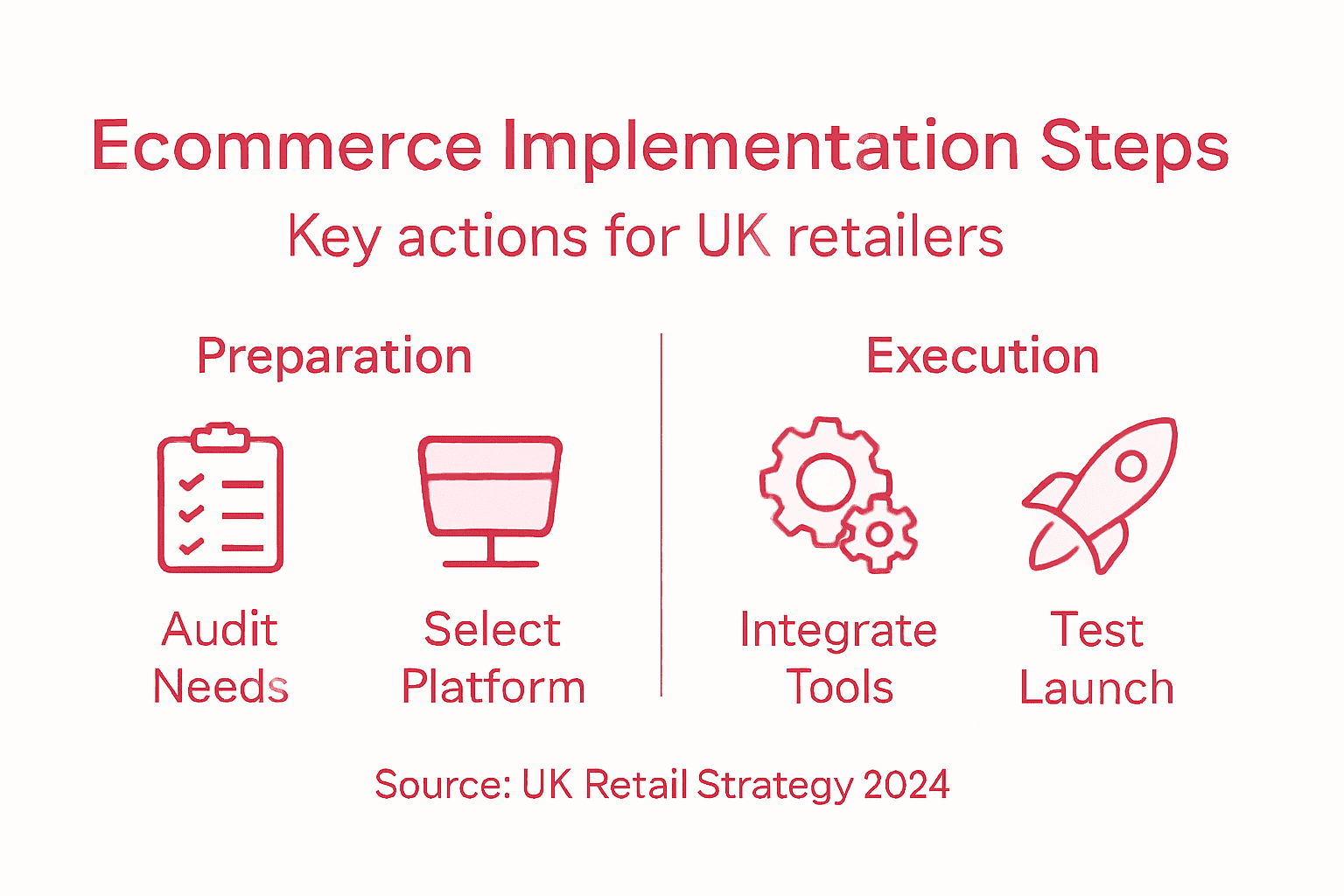
The implementation journey begins with meticulous requirements gathering, which involves conducting thorough competitor analysis, mapping existing business processes, and identifying specific operational needs. This initial phase is crucial for developing a robust business case that aligns technological investments with strategic growth objectives. Retailers must consider multiple dimensions including user experience design, payment infrastructure, inventory management systems, and compliance requirements specific to UK digital commerce regulations.
Key implementation stages include:
- Comprehensive requirements assessment
- Platform selection and customisation
- Technical infrastructure preparation
- Data migration and system integration
- Extensive testing and quality assurance
- Phased deployment strategy
Compliance represents another critical implementation consideration, particularly around data protection and security. UK retailers must ensure their chosen enterprise ecommerce solution adheres to GDPR regulations, implements robust security protocols, and provides transparent mechanisms for customer data management. This involves selecting platforms with built-in compliance features, implementing advanced authentication methods, and establishing clear data handling procedures.
Pro tip: Engage a specialised ecommerce implementation partner who understands both technological nuances and UK retail market complexities to streamline your digital transformation process.
Managing Risks, Costs, and Compliance Issues
Enterprise ecommerce platforms in the United Kingdom face an increasingly complex landscape of regulatory challenges and financial risks that demand strategic and proactive management. Compliance costs represent a significant operational consideration for retailers, requiring substantial investment in technology, training, and systematic risk mitigation strategies.
The primary risk domains for UK ecommerce enterprises encompass multiple critical areas, including data protection, cybersecurity, financial transactions, and consumer privacy. Key regulatory frameworks such as GDPR, Payment Card Industry Data Security Standard (PCI DSS), and emerging digital commerce regulations create a multifaceted compliance environment that demands continuous monitoring and adaptive strategies. Businesses must develop robust mechanisms to:
- Protect customer personal and financial data
- Implement advanced fraud prevention technologies
- Maintain transparent data handling practices
- Ensure secure payment processing systems
- Conduct regular security audits
- Update compliance protocols proactively
Financial risks extend beyond direct regulatory compliance costs. UK retailers must carefully balance technological investments with potential returns, understanding that enterprise ecommerce solutions require substantial upfront and ongoing expenditures. This includes infrastructure development, security implementations, staff training, and continuous platform upgrades. Organisations must develop comprehensive financial models that accurately forecast both short-term implementation expenses and long-term operational efficiencies.
Pro tip: Allocate approximately 15-20% of your total digital transformation budget specifically for compliance and risk management initiatives to ensure sustainable and secure ecommerce operations.
Unlock Enterprise Ecommerce Success With Big Eye Deers
UK retailers face critical challenges such as seamless integration, scalable architecture, and tailored B2B support when choosing enterprise ecommerce solutions. The need to handle complex pricing, multi-store management, and compliance demands a partner who understands these pain points deeply and can deliver customised, future-proof platforms that drive growth reliably.
Big Eye Deers combines over 17 years of experience with expertise in Magento Open Source and Adobe Commerce to design, build, and support ecommerce systems addressing exactly these issues. From advanced ERP integrations and personalised account hierarchies to performance-focused frontends using Hyvä, we create secure, scalable solutions that align with your strategic goals and compliance requirements. Explore how we bring clarity and control to your digital transformation journey.
Are you ready to overcome enterprise ecommerce complexities and accelerate your UK retail growth today
Discover the difference with Big Eye Deers where your business needs guide bespoke ecommerce design and development. Visit our homepage and let us help you build an ecommerce platform that scales with your ambitions and secures lasting success.
Frequently Asked Questions
What are enterprise ecommerce solutions?
Enterprise ecommerce solutions are comprehensive digital commerce platforms designed for large-scale retail operations, offering advanced capabilities for managing complex business processes across multiple channels and markets.
What types of enterprise ecommerce platforms are available?
The main types include Open Source Platforms, such as Magento Open Source; Commercial Enterprise Solutions, like Adobe Commerce; and Custom-Built Platforms, which are tailored specifically to unique business needs.
How do I choose the right enterprise ecommerce platform for my business?
When selecting an enterprise ecommerce platform, consider factors such as total cost of ownership, scalability potential, integration capabilities, customisation requirements, and security features to ensure it aligns with your business goals.
What key features should I look for in an enterprise ecommerce solution?
Look for features including seamless API integration, multi-store management, flexible pricing configurations, advanced security protocols, and comprehensive B2B support tools to enhance operational efficiency and customer engagement.
Recommended



Adobe Commerce (Magento)
Formerly known as Magento, Adobe Commerce is built for complex catalogues, integrations, and long term growth. We design and develop stable, scalable stores that support demanding eCommerce requirements, including multi-store setups, complex pricing, and Hyva based performance improvements.

Bespoke Build
We design and build custom eCommerce platforms for businesses with complex workflows, integrations, or non standard requirements. Built from scratch around your business needs using Laravel and modern architectures.
Working with brands across the UK from our offices in Cardiff and Exeter, you deal directly with a senior team of designers and developers specialising in Shopify, Magento, WordPress and bespoke eCommerce platforms.
We focus on commercial outcomes. Better conversion rates, strong SEO foundations and eCommerce platforms that continue to improve long after launch.