Enterprise Ecommerce: Empowering Scalable Online Growth

Most British brands face a digital landscape where over 80 percent of large organisations demand ecommerce platforms that outpace traditional setups. Competing in this environment means dealing with complex sales channels and fierce expectations for seamless online experiences. Understanding what truly sets enterprise ecommerce apart can help British businesses avoid costly mistakes and make smarter decisions as online growth accelerates.
Table of Contents
- Defining Enterprise Ecommerce for Modern Brands
- Comparing Enterprise and Standard Ecommerce Solutions
- Key Features and Platform Considerations
- Integration, Scalability, and Security Requirements
- Common Challenges and How to Avoid Them
Key Takeaways
| Point | Details |
|---|---|
| Enterprise Ecommerce Definition | Enterprise ecommerce platforms are sophisticated solutions designed for scalability, complex integrations, and high transaction volumes, offering features beyond simple online sales. |
| Comparison to Standard Solutions | Enterprise ecommerce surpasses standard solutions with advanced functionalities, making them suitable for large organisations with intricate operational needs. |
| Key Features | Essential features include multi-channel sales, advanced inventory management, and robust API integration, supporting seamless business operations. |
| Strategic Planning for Success | Prioritising platform flexibility and conducting thorough audits of business requirements are crucial for selecting the right ecommerce solution that supports long-term growth. |
Defining Enterprise Ecommerce for Modern Brands
Enterprise ecommerce represents a sophisticated digital strategy for organisations seeking scalable, robust online sales infrastructures. Unlike traditional retail platforms, enterprise ecommerce solutions are designed to manage complex business requirements, high transaction volumes, and intricate digital ecosystems. These platforms go far beyond simple online shops, providing comprehensive technological frameworks that integrate advanced features like multi-channel sales, sophisticated inventory management, and personalised customer experiences.
Modern enterprise ecommerce platforms leverage cutting-edge cloud technologies to deliver unprecedented performance and flexibility. Advanced cloud SaaS databases now enable businesses to scale their online operations seamlessly, offering enhanced security, cost-efficiency, and real-time performance monitoring. This technological evolution allows brands to handle massive traffic spikes, integrate complex backend systems, and provide personalised shopping experiences across multiple digital touchpoints.
The core characteristics of enterprise ecommerce include comprehensive integration capabilities, robust security protocols, and advanced analytics. Successful platforms support multiple sales channels including web, mobile, social media, and emerging digital marketplaces. They offer sophisticated features like:
- Granular customer segmentation
- Advanced pricing and promotional engines
- Complex product configuration options
- Integrated customer relationship management
- Global payment and shipping integrations
- Detailed performance and conversion tracking
Pro Tip for Enterprise Success: Prioritise platform flexibility and scalability over immediate cost considerations. A modular ecommerce solution that can evolve with your business model will provide substantially greater long-term value than a rigid, cheaper alternative.
Comparing Enterprise and Standard Ecommerce Solutions
Standard and enterprise ecommerce solutions differ fundamentally in their technological sophistication, scalability, and business capabilities. Standard ecommerce platforms typically serve small to medium-sized businesses with basic online selling requirements, offering straightforward product listings, simple payment integrations, and limited customisation options. These solutions prioritise ease of setup and affordability over advanced enterprise-level functionalities.

Comparative platform analysis reveals critical distinctions between standard and enterprise ecommerce solutions across multiple dimensions. Enterprise platforms excel in areas like multi-language support, advanced SEO capabilities, robust API integrations, and complex configuration possibilities. They provide sophisticated features that enable businesses to manage intricate sales processes, implement personalised marketing strategies, and handle high-volume transactions with exceptional performance and reliability.
Key differences between standard and enterprise ecommerce solutions include:
Here is a concise comparison of standard and enterprise ecommerce platforms:
| Capability | Standard Ecommerce | Enterprise Ecommerce |
|---|---|---|
| Target Business | Small–medium enterprises | Large brands and organisations |
| Customisation Depth | Basic, limited options | Highly bespoke, modular |
| System Integration | Minimal, few connections | Complex, many systems linked |
| Data Security | Basic protection | Strong, multi-layered |
| Global Support | Limited regions | Multinational, multi-language |
| Analytics Tools | Basic reporting | Advanced, real-time insights |
- Scalability: Enterprise solutions support exponential growth
- Customisation: Advanced platforms offer deep technical customisation
- Integration: Comprehensive backend and third-party system connections
- Performance: Higher transaction processing speeds and reliability
- Security: Advanced authentication and data protection mechanisms
- Analytics: Detailed, granular reporting and business intelligence tools
Pro Tip for Solution Selection: Conduct a thorough audit of your current and projected business requirements before selecting an ecommerce platform. A solution that matches your specific operational complexity will provide more long-term value than a generic, one-size-fits-all approach.
Key Features and Platform Considerations
Enterprise ecommerce platforms represent sophisticated technological ecosystems designed to address complex business requirements beyond simple online selling. These comprehensive solutions integrate multiple critical business functions, enabling organisations to manage intricate digital operations with unprecedented flexibility and efficiency. The technological infrastructure supporting modern enterprise ecommerce goes far beyond basic transactional capabilities, offering robust frameworks for strategic business growth.
Comprehensive platform evaluations reveal multiple critical considerations when selecting an enterprise ecommerce solution. Advanced platforms must demonstrate exceptional capabilities across several key dimensions, including international expansion support, seamless omnichannel integration, centralised management tools, and sophisticated merchant support programmes. These platforms must provide businesses with adaptable technological infrastructure that can rapidly evolve alongside changing market dynamics and organisational strategies.
Essential platform considerations include:
To better understand the key business impacts of enterprise ecommerce features, review the summary below:
| Feature | Description | Business Benefit |
|---|---|---|
| Multi-channel Sales | Sell across web, mobile, social, etc. | Increases audience reach |
| Advanced Inventory Management | Smart stock tracking and automation | Minimises stockouts, speeds fulfilment |
| Personalised Customer Experience | Tailored offers based on user data | Boosts conversion and loyalty |
| Robust API Integration | Connects diverse business systems | Streamlines operations |
| Modular Architecture | Easily add or remove platform functions | Enables scalability and agility |
- Architectural Flexibility: Ability to customise and extend platform functionality
- Scalability: Supporting exponential growth without performance degradation
- Integration Capabilities: Seamless connections with existing business systems
- Security Protocols: Advanced data protection and compliance mechanisms
- Performance Metrics: High-speed transaction processing and minimal latency
- Reporting Tools: Comprehensive analytics and business intelligence dashboards
Pro Tip for Platform Selection: Prioritise platforms offering modular architecture and extensive API support, enabling future technological adaptations without complete system replacements. A forward-thinking approach ensures long-term technological relevance and minimises potential disruption to business operations.
Integration, Scalability, and Security Requirements
Enterprise ecommerce platforms demand sophisticated technological architectures that seamlessly integrate complex business systems while maintaining robust security and exceptional scalability. The intricate landscape of modern digital commerce requires organisations to develop comprehensive strategies that address multiple technological and operational challenges simultaneously, ensuring smooth, secure, and adaptable online business environments.
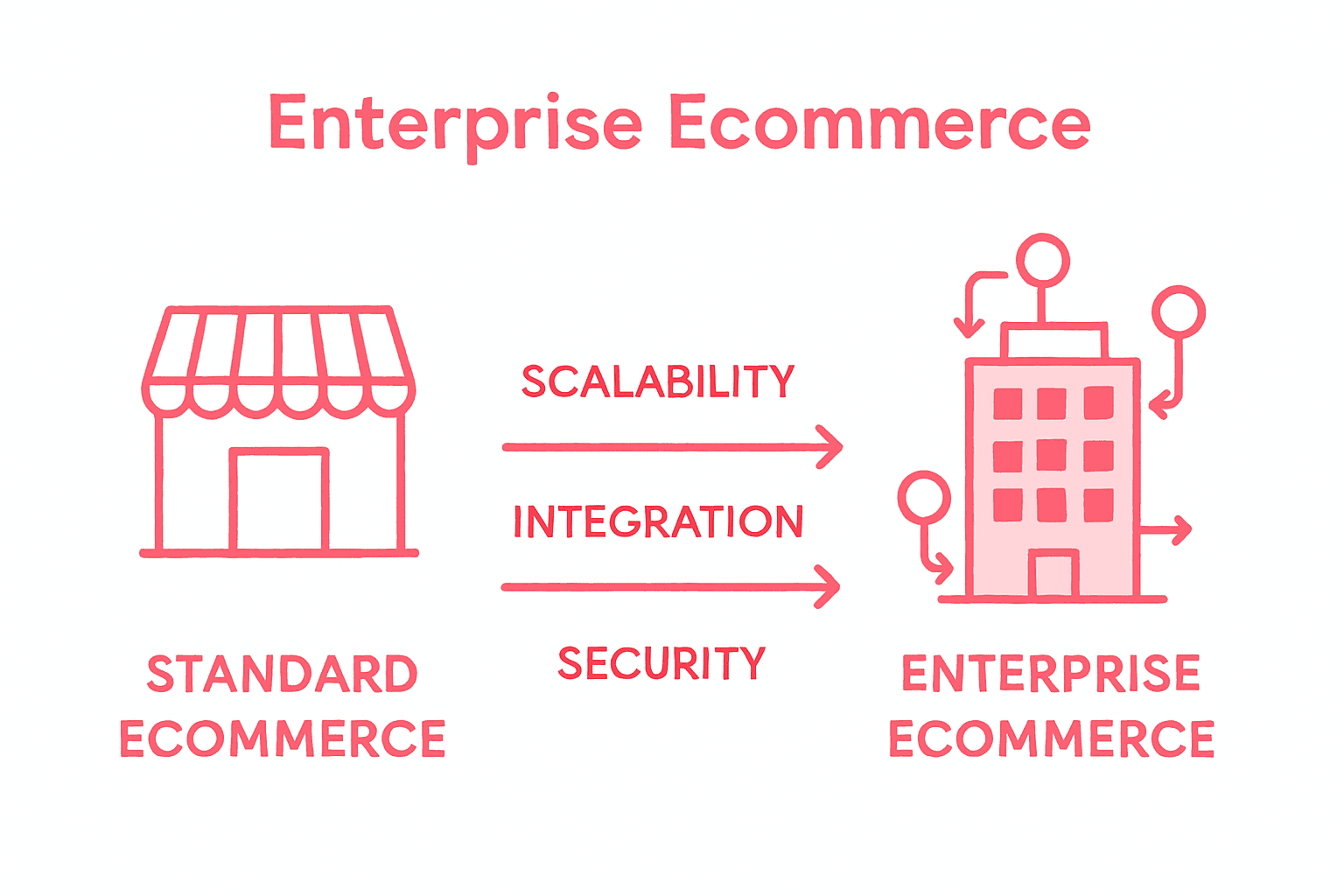
Architectural challenges in enterprise systems highlight the critical importance of developing seamless integration frameworks between enterprise resource planning (ERP) applications and ecommerce platforms. These integrations are fundamental to achieving operational efficiency, enabling real-time data synchronisation, and providing holistic visibility across different business functions. Successful implementation requires meticulous planning, advanced technological infrastructure, and a strategic approach to system connectivity.
Key considerations for enterprise ecommerce integration include:
- System Compatibility: Ensuring smooth communication between different technological platforms
- Data Synchronisation: Real-time updates across multiple business systems
- Performance Optimization: Maintaining high-speed transactions and minimal latency
- Scalable Architecture: Supporting exponential growth without compromising system performance
- Advanced Security Protocols: Implementing multi-layered protection mechanisms
- Compliance Management: Adhering to international data protection regulations
Pro Tip for Technical Integration: Invest in middleware solutions that offer flexible API connections and robust data mapping capabilities. These technologies can significantly reduce implementation complexity and provide more agile, future-proof integration strategies for enterprise ecommerce platforms.
Common Challenges and How to Avoid Them
Enterprise ecommerce implementations frequently encounter complex technological and operational challenges that can significantly impede digital transformation efforts. These obstacles range from technical integration difficulties to strategic alignment issues, requiring sophisticated approaches that go beyond traditional problem-solving methodologies. Understanding and anticipating these challenges is crucial for organisations seeking to develop robust, scalable online business ecosystems.
Advanced integration strategies reveal multiple critical challenges businesses encounter when developing enterprise ecommerce platforms. System compatibility, data consistency, and scalability emerge as primary concerns that demand strategic interventions. Successful organisations approach these challenges through comprehensive planning, leveraging middleware technologies, implementing robust synchronisation processes, and maintaining flexible architectural frameworks that can adapt to evolving technological landscapes.
Common enterprise ecommerce challenges and mitigation strategies include:
- Integration Complexity: Develop comprehensive middleware solutions
- Data Synchronisation: Implement real-time data mapping technologies
- Performance Bottlenecks: Utilise cloud-based scalable infrastructure
- Security Vulnerabilities: Adopt multi-layered protection mechanisms
- Legacy System Limitations: Create modular, adaptable architectural approaches
- User Experience Inconsistencies: Standardise interface design across platforms
Pro Tip for Challenge Management: Conduct regular technological audits and maintain a proactive approach to system evolution. Continuously reassess your technological infrastructure to identify potential integration challenges before they become critical operational impediments.
Elevate Your Enterprise Ecommerce with Big Eye Deers
Navigating the complexities of enterprise ecommerce demands more than just a platform. It requires scalable architectures, seamless integration, and a partner who understands the urgency of robust, secure, and flexible solutions. If your business seeks to overcome challenges like integration complexity, data synchronisation, and performance bottlenecks, then expert web design and development tailored for enterprise growth is essential. Big Eye Deers combines over 17 years of expertise with deep knowledge of platforms like Magento and Shopify to deliver customised, scalable ecommerce solutions that empower your brand to grow confidently.

Discover how our bespoke ecommerce web design and development can transform your online presence. Visit Big Eye Deers today to explore our services and client success stories. Take the next step now and partner with a premium digital agency ready to elevate your scalable online growth with secure, high-performance ecommerce platforms crafted for modern brands.
Learn more about how our eCommerce web design and web development consulting services align perfectly with your enterprise ecommerce ambitions.
Frequently Asked Questions
What defines enterprise ecommerce solutions?
Enterprise ecommerce solutions are sophisticated digital platforms designed to facilitate scalable, robust online sales infrastructures for large organisations. They handle complex business requirements, high transaction volumes, and intricate digital ecosystems, providing advanced features like multi-channel sales and personalised customer experiences.
How do enterprise ecommerce platforms compare to standard ecommerce solutions?
Enterprise ecommerce platforms differ significantly from standard solutions in terms of technological sophistication, scalability, and capabilities. While standard platforms serve small to medium-sized businesses with basic functionalities, enterprise solutions support intricate sales processes, advanced customisation, and integration of multiple systems for high-volume transactions.
What are key features to consider when selecting an enterprise ecommerce platform?
When selecting an enterprise ecommerce platform, consider features such as multi-channel sales capabilities, advanced inventory management, personalised customer experiences, robust API integration, and modular architecture. These features ensure flexibility, scalability, and efficiency in managing digital operations.
What common challenges do businesses face with enterprise ecommerce implementations?
Common challenges include integration complexity, data synchronisation issues, performance bottlenecks, security vulnerabilities, and inconsistencies in user experience. To mitigate these challenges, businesses should invest in middleware solutions, implement real-time data mapping technologies, and conduct regular technological audits.
Recommended



Adobe Commerce (Magento)
Formerly known as Magento, Adobe Commerce is built for complex catalogues, integrations, and long term growth. We design and develop stable, scalable stores that support demanding eCommerce requirements, including multi-store setups, complex pricing, and Hyva based performance improvements.

Bespoke Build
We design and build custom eCommerce platforms for businesses with complex workflows, integrations, or non standard requirements. Built from scratch around your business needs using Laravel and modern architectures.
Working with brands across the UK from our offices in Cardiff and Exeter, you deal directly with a senior team of designers and developers specialising in Shopify, Magento, WordPress and bespoke eCommerce platforms.
We focus on commercial outcomes. Better conversion rates, strong SEO foundations and eCommerce platforms that continue to improve long after launch.