Why robust web hosting matters for eCommerce growth
TL;DR:
- Robust web hosting ensures reliable, secure, high-performance servers that keep websites fast and accessible.
- Choosing the right hosting impacts page speed, uptime, security, SEO rankings, and revenue significantly.
Robust web hosting is defined as reliable, secure, high-performance server infrastructure that keeps your website fast, accessible, and protected at all times. For businesses and eCommerce entrepreneurs, it is the single most consequential technical decision you make. Your hosting choice directly affects page speed, uptime, security, SEO rankings, and ultimately, revenue. Each extra second of page load reduces conversion rates by approximately 2.11%, and a one-second delay alone can lower total conversions by 7%. That is not a marginal risk. That is money leaving your store every day you ignore it.
Why robust web hosting matters for site performance
Your hosting infrastructure is the foundation beneath every performance metric your site produces. Time to First Byte (TTFB), Largest Contentful Paint (LCP), and overall page load speed all trace back to server quality before a single line of your code is evaluated.
The numbers here are stark. The median TTFB for top-performing pages is 198ms, while budget shared hosting regularly exceeds 1,300ms. Google’s threshold for a “good” LCP score is 2.5 seconds, and servers responding slower than 800ms typically fail that benchmark outright. Failing Core Web Vitals is not just a user experience problem. It is a direct SEO penalty.
Uptime guarantees matter just as much as raw speed. Quality hosting providers offer 99.9% uptime or better, which translates to less than nine hours of downtime per year. Anything below that and you are gambling with customer trust and search engine crawl budgets simultaneously.
Shared vs. VPS vs. managed cloud: a performance comparison
| Hosting Type | Typical TTFB | Uptime Guarantee | Best For |
|---|---|---|---|
| Shared Hosting | 800ms–1,300ms | 99.5% | Personal blogs, low-traffic sites |
| Unmanaged VPS | 200ms–500ms | 99.9% | Developers with server expertise |
| Managed VPS | 150ms–400ms | 99.9% | Growing SMBs, mid-size eCommerce |
| Managed Cloud | Under 200ms | 99.99% | High-traffic stores, enterprise retail |
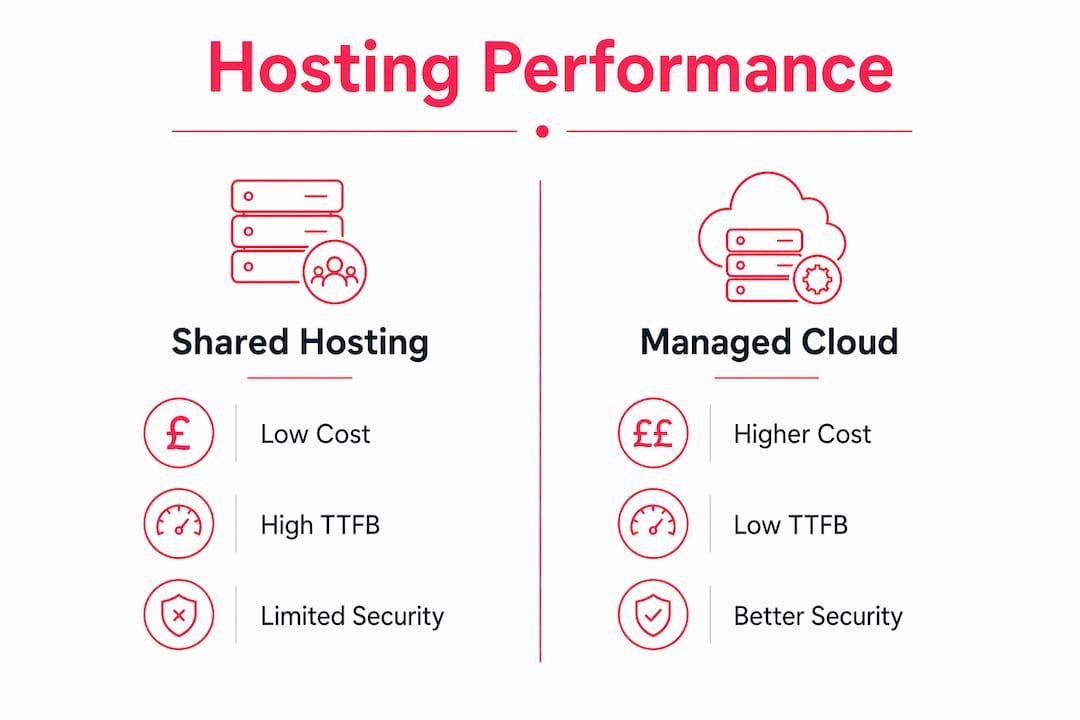
Managed cloud hosting, offered by providers such as AWS, Google Cloud, and platform-specific solutions, consistently delivers the fastest response times and the highest availability. For Magento or Shopify stores processing hundreds of orders daily, the performance gap between shared and managed cloud is not theoretical. It shows up in your conversion data.
Pro Tip: Set up server-side monitoring using a tool like New Relic or Datadog to catch TTFB spikes before they compound into ranking drops. Latency issues at the server level are invisible to standard front-end performance audits.
Does web hosting affect your security and SEO rankings?
Yes, and in 2026 the relationship between hosting security and search visibility is more direct than ever. Hosting security is now a mandatory SEO factor; insecure sites risk removal from search results due to malware or unsafe data handling. Google can blacklist an unsafe website and remove it from results almost instantly. That is a catastrophic outcome for any eCommerce business.
Cheap or unmanaged hosting typically lacks the security layers that modern online stores require. Without SSL certificates, active firewalls, malware scanning, and daily backups, your store is exposed. The cost of a breach extends well beyond the technical fix. Customer trust, brand reputation, and compliance obligations all take damage that takes months to repair.
Managed hosting services include maintenance, security updates, and backups, removing the operational burden from your team. For eCommerce businesses handling payment data, that is not a luxury. It is a baseline requirement.
Must-have security features in quality hosting (2026)
- SSL certificate with automatic renewal and HTTPS enforcement across all pages
- Web application firewall (WAF) to block SQL injection, XSS, and brute-force attacks
- Daily automated backups with off-site storage and one-click restore
- Malware scanning and removal with real-time alerting
- DDoS protection at the network level
- Two-factor authentication for server and control panel access
- PCI DSS compliance support for stores processing card payments
If your current hosting provider cannot confirm all of the above, that is a gap worth addressing now. For Magento stores in particular, tools like Sansec provide proactive malware detection and supply chain attack prevention that sit on top of your hosting layer. You can read more about securing your online store in our dedicated 2026 guide.
Pro Tip: Ask your hosting provider for their incident response SLA before you sign. A provider that cannot tell you how quickly they respond to a malware detection is not a provider you want protecting your store.
How does hosting scalability support business growth?
Scalability in hosting is the ability to increase server resources, CPU, RAM, and bandwidth, in response to traffic growth without taking your site offline or degrading performance. For eCommerce businesses, this matters most during peak periods: Black Friday, product launches, and seasonal sales campaigns.

Small to medium businesses lose an average of $20,000 annually due to downtime-related costs, including lost revenue and customer churn. Critically, 15–25% of customers who switch to a competitor during an outage do not return after recovery. That is not a recoverable loss. It is permanent attrition.
Reliable hosting uses redundancy, including multiple network paths and RAID storage, to prevent single points of failure. This turns what would be a multi-hour outage into a minor incident measured in seconds. The architecture matters: cloud hosting distributes load across multiple servers, while a single-server VPS carries more risk during hardware failure.
There is also an SEO dimension to downtime that most business owners miss. Frequent server errors cause search engines to reduce crawl frequency, delaying the indexing of new content regardless of how well-optimised that content is. If your hosting goes down regularly, Google notices before you do.
Scalability and reliability features to look for
- Auto-scaling that adds resources automatically during traffic spikes without manual intervention
- Load balancing to distribute requests across multiple servers and prevent bottlenecks
- Redundant network connections with automatic failover to a secondary path
- RAID storage or equivalent to protect against data loss from hardware failure
- Staging environments so you can test updates without risking live store performance
- Managed backups with defined recovery time objectives (RTOs) and recovery point objectives (RPOs)
- Resource isolation that prevents other accounts from affecting your server performance
Managed hosting removes the operational overhead of maintaining these systems yourself. For most eCommerce entrepreneurs, that trade-off is straightforward: pay a managed provider to handle infrastructure, and focus your energy on growing the business.
Comparing hosting types: which is right for your business?
Choosing the right hosting type is one of the most consequential decisions in your eCommerce setup. The wrong choice does not just slow your site. It creates security gaps, limits your growth ceiling, and generates hidden costs that erode your margins over time.
Business owners frequently prioritise low hosting cost over performance, underestimating the hidden costs of self-managed security and backups. An unmanaged VPS at £10 per month sounds attractive until you factor in the developer time required to apply security patches, configure firewalls, and restore from backup after an incident.
The “noisy neighbour” problem on shared hosting is a real and underappreciated risk. Infrastructure overcrowding on shared hosting causes unpredictable performance issues even when your own site is fully optimised. Another account on the same server consuming excessive CPU directly spikes your TTFB, and you have no control over it.
| Hosting Type | Monthly Cost (approx.) | Security Level | Scalability | Recommended For |
|---|---|---|---|---|
| Shared | £3–£15 | Low | None | Starter sites only |
| Unmanaged VPS | £10–£60 | Medium (DIY) | Manual | Developers with server skills |
| Managed VPS | £30–£150 | High | Limited auto-scale | Growing eCommerce SMBs |
| Dedicated Server | £80–£300+ | High | Hardware-limited | Large catalogues, high traffic |
| Managed Cloud | £50–£500+ | Very High | Full auto-scale | Enterprise, high-growth stores |
For Magento and Shopify stores, managed cloud hosting is the standard we recommend. The cloud hosting advantages for eCommerce include automatic security updates, scalable infrastructure, and managed backups that remove the risk of human error from your hosting operations.
Pro Tip: Always check renewal pricing before committing to a hosting plan. Many providers offer introductory rates that double or triple at renewal. Scrutinise the contract terms, support response times, and whether support is included or charged separately.
Key takeaways
Reliable, secure, and scalable hosting is the non-negotiable foundation of any eCommerce business that intends to grow, rank, and retain customers.
| Point | Details |
|---|---|
| Performance starts at the server | TTFB and LCP scores are determined by hosting quality before any front-end optimisation takes effect. |
| Security is an SEO factor | Insecure hosting can trigger Google blacklisting, removing your store from search results instantly. |
| Downtime has permanent costs | Up to 25% of customers lost during an outage do not return, making reliability a revenue issue. |
| Managed hosting reduces risk | Providers that handle patching, backups, and monitoring remove the most common sources of business disruption. |
| Shared hosting has a ceiling | Noisy neighbour effects make shared hosting unsuitable for any store where performance and SEO matter. |
The hidden cost of treating hosting as an afterthought
I have seen this pattern more times than I can count. A business invests heavily in design, product photography, and paid media, then hosts the whole thing on a £5-per-month shared plan. The site looks great. It just does not perform, does not rank, and goes down at the worst possible moments.
The uncomfortable truth is that hosting is not a commodity decision. The difference between a managed cloud environment and a budget shared host is not just speed. It is the difference between a business that can scale and one that hits a ceiling it cannot diagnose.
What I find most telling is the SEO impact. Most business owners think about hosting in terms of uptime. They do not think about crawl budget. When your server throws frequent errors, Google quietly reduces how often it visits your site. Your new products, your updated category pages, your blog content: all of it sits unindexed for longer than it should. That is a compounding disadvantage that takes months to recover from.
My practical advice: treat your hosting budget as part of your infrastructure investment, not your cost-cutting target. Managed VPS or managed cloud hosting for a growing eCommerce store typically costs between £50 and £200 per month. Set against the cost of a single day’s lost revenue during a peak period, that figure looks very different.
Watch the emerging shift towards edge computing and distributed hosting architectures. Providers like Cloudflare and Fastly are moving compute closer to the end user, reducing latency at a network level rather than just a server level. That is the direction performance-focused eCommerce is heading, and it is worth factoring into your next hosting review.
— Steve
How Bigeyedeers can help you get hosting right
At Bigeyedeers, we have spent over 17 years building and supporting high-performing Magento and Shopify stores for growing and enterprise retail brands. Hosting strategy is central to everything we do, because we know that the best-designed store in the world underperforms on the wrong infrastructure.

Whether you are planning a new Magento build, migrating from an underperforming host, or reviewing your current setup for security and scalability gaps, we can help. Our team advises on managed hosting configurations, implements Sansec for proactive malware detection, and builds stores that are architected for performance from the ground up. Explore our Magento eCommerce design services or take a look at our Shopify development work to see how we approach hosting and performance together.
FAQ
What is robust web hosting?
Robust web hosting is reliable, secure, high-performance server infrastructure that delivers consistent uptime, fast response times, and active security protection. It is the technical foundation that keeps a business website accessible, fast, and safe.
How does hosting affect SEO rankings?
Hosting affects SEO through page speed, uptime, and security. Frequent server errors reduce crawl frequency, delaying content indexing, while insecure hosting can trigger Google blacklisting and remove a site from search results entirely.
What is the difference between managed and unmanaged hosting?
Managed hosting includes security patching, backups, and monitoring handled by the provider. Unmanaged hosting requires you to configure and maintain all of that yourself, which carries significant risk for businesses without dedicated server expertise.
How much does downtime actually cost a small business?
SMBs lose an average of $20,000 annually from downtime-related costs, including lost sales and customer churn. A portion of those customers do not return after an outage, making reliability a direct revenue concern.
Is shared hosting ever suitable for eCommerce?
Shared hosting is not recommended for active eCommerce stores. Noisy neighbour effects cause unpredictable TTFB spikes, and the security controls are insufficient for stores handling customer payment data. Managed VPS or managed cloud hosting is the appropriate starting point for any store taking orders.
Recommended



Adobe Commerce (Magento)
Formerly known as Magento, Adobe Commerce is built for complex catalogues, integrations, and long term growth. We design and develop stable, scalable stores that support demanding eCommerce requirements, including multi-store setups, complex pricing, and Hyva based performance improvements.

Bespoke Build
We design and build custom eCommerce platforms for businesses with complex workflows, integrations, or non standard requirements. Built from scratch around your business needs using Laravel and modern architectures.

Working with brands across the UK from our offices in Cardiff and Exeter, you deal directly with a senior team of designers and developers specialising in Shopify, Magento, WordPress and bespoke eCommerce platforms.
We focus on commercial outcomes. Better conversion rates, strong SEO foundations and eCommerce platforms that continue to improve long after launch.