Why monitor website performance: boost UK e-commerce results
TL;DR:
- Slow website performance causes significant revenue losses for UK e-commerce businesses.
- Monitoring key metrics like speed, uptime, and mobile responsiveness is essential for growth.
- Ongoing performance management builds customer trust, loyalty, and boosts sales long-term.
A few extra seconds of loading time sounds harmless. But for UK e-commerce businesses, those seconds are costing real money. £38 billion in lost sales were attributed to abandoned baskets in 2024 alone, with slow performance a leading cause. Many store owners assume their site is “fine” because it loads eventually, or because they haven’t received complaints. That assumption is dangerous. This guide will walk you through what website performance really means, how it hits your revenue, how to monitor it properly, and how to turn those insights into lasting commercial growth.
Table of Contents
- What website performance means for UK e-commerce
- How poor website performance affects your bottom line
- How to monitor and measure your website’s performance
- Turning performance gains into customer loyalty and sales growth
- What most UK e-commerce owners miss about website performance
- Take performance further with expert support
- Frequently asked questions
Key Takeaways
| Point | Details |
|---|---|
| Performance equals revenue | Slow websites lose sales and frustrate customers, hurting your bottom line. |
| Monitor regularly | Consistent tracking helps you catch issues early and improve user experience. |
| Small gains add up | Even minor speed improvements can mean major sales wins over time. |
| Customer loyalty grows | Fast, smooth sites keep users returning and boost long-term value. |
What website performance means for UK e-commerce
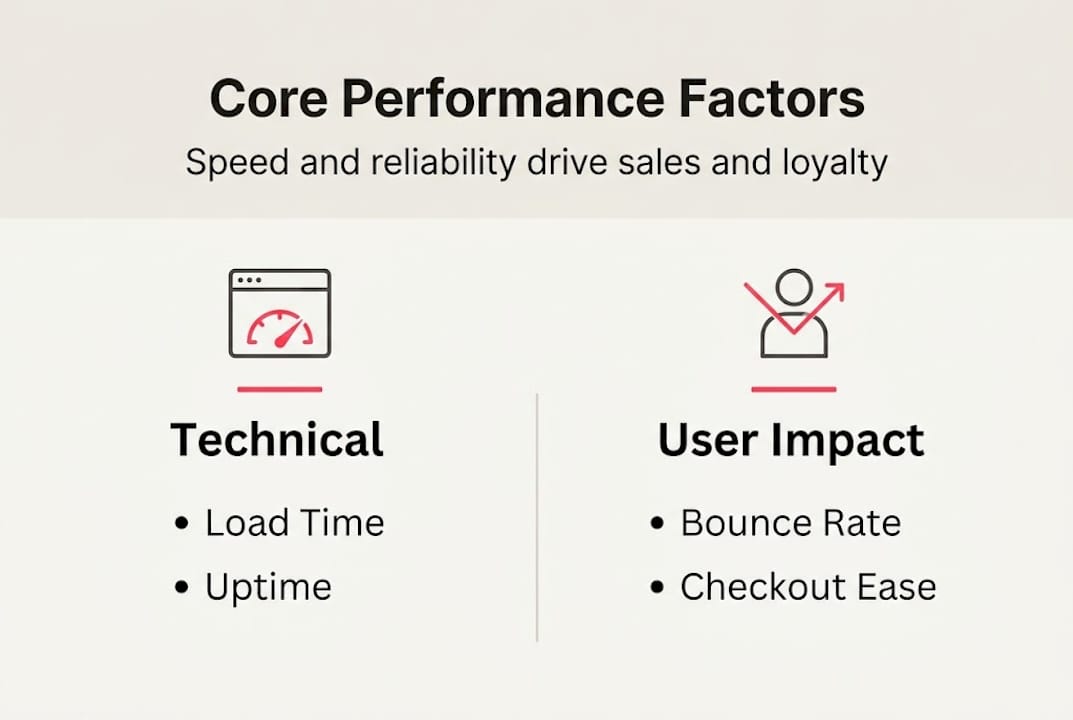
When most people hear “website performance,” they think of speed. How fast does the homepage load? That matters enormously, but it’s only part of the picture. True website performance covers four interconnected pillars: speed, uptime, mobile responsiveness, and reliability under load. Ignore any one of them and you’re leaving money on the table.
Speed is the most visible factor. It covers how quickly pages render, how fast images load, and how snappy the checkout feels. Uptime is whether your site is actually live and accessible. Even 99% uptime means roughly 87 hours of downtime per year, which is significant during peak trading periods. Mobile responsiveness determines how well your store performs on smartphones and tablets, where a growing share of UK shoppers now browse and buy. Reliability under load is how your site holds up during traffic spikes, such as Black Friday or a successful email campaign.
Here’s a quick look at typical performance benchmarks for UK e-commerce stores:
| Metric | Poor | Acceptable | Strong |
|---|---|---|---|
| Page load time | Over 5 seconds | 3 to 5 seconds | Under 3 seconds |
| Time to first byte (TTFB) | Over 800ms | 400 to 800ms | Under 400ms |
| Uptime | Below 99% | 99% to 99.9% | 99.9% or above |
| Mobile score (Lighthouse) | Below 50 | 50 to 79 | 80 or above |
| Core Web Vitals (LCP) | Over 4 seconds | 2.5 to 4 seconds | Under 2.5 seconds |
Many UK shops focus on homepage speed and overlook the metrics that matter most at the point of purchase. The metrics most commonly missed include:
- Largest Contentful Paint (LCP): How long before the main content is visible
- Cumulative Layout Shift (CLS): Whether page elements jump around as the page loads
- Interaction to Next Paint (INP): How quickly the page responds to a user’s click or tap
- Server response time: How fast your hosting infrastructure responds
- Third-party script load times: Tracking pixels, chat widgets, and review tools all add weight
As site speed and lost sales data consistently shows, even a one-second delay in page load can reduce conversions by up to 7%. That’s not a rounding error. For a store turning over £500,000 a year, that’s £35,000 gone.
A one-second delay can cut conversions by 7%. For most UK e-commerce businesses, that’s not a technical problem. It’s a revenue problem.
How poor website performance affects your bottom line
Now that you grasp what performance means, see how it directly impacts your revenue and sales.
The chain reaction is straightforward but brutal. A slow site tests user patience. Impatient users leave. Abandoned sessions mean lost orders. Lost orders compound over time into a serious revenue shortfall. 88% of UK shoppers abandon sites that take over 10 seconds to load. That’s not a fringe behaviour. That’s the majority of your potential customers walking out the door.

Here’s how performance improvements translate into measurable gains:
| Scenario | Before optimisation | After optimisation |
|---|---|---|
| Average load time | 7 seconds | 2.5 seconds |
| Bounce rate | 68% | 41% |
| Conversion rate | 1.1% | 2.4% |
| Monthly revenue (est.) | £18,000 | £39,000 |
Those numbers aren’t theoretical. They reflect the kind of results we see when stores move from sluggish to performant. The sequence plays out like this:
- Slow load time frustrates visitors before they’ve seen a single product
- High bounce rate signals to Google that your site isn’t worth ranking
- Lower organic visibility reduces incoming traffic
- Fewer sessions means fewer opportunities to convert
- Reduced revenue makes it harder to invest in further improvements
It’s a downward spiral that’s surprisingly easy to fall into and harder to climb out of without deliberate action. Bounce rate is particularly damaging because it compounds. A high bounce rate suppresses your SEO rankings, which reduces traffic, which reduces sales, which reduces your ability to fund improvements.
Pro Tip: Segment your analytics by page load time bracket. Compare the conversion rate of sessions where your site loaded in under 2 seconds versus sessions over 5 seconds. The gap will likely shock you, and it gives you a concrete revenue figure to justify investment in performance work. Understanding urgency and conversions is also worth exploring alongside this, as fast-loading pages amplify the effect of urgency-driven tactics.
How to monitor and measure your website’s performance
Understanding the cost of poor performance means the next step is to monitor regularly. Here’s how:
Monitoring doesn’t have to be complicated, but it does need to be consistent. Tracking website metrics helps retailers spot problems before they cost sales. The key is knowing which metrics to watch and having the right tools in place to surface them clearly.
The four metrics every UK e-commerce owner should track are:
- Page load speed across your most visited pages, especially product and checkout pages
- Uptime and downtime events, with alerts so you know the moment something goes wrong
- Core Web Vitals as reported in Google Search Console, which directly influences your search rankings
- Conversion rate by device, so you can spot if mobile users are underperforming compared to desktop
Here are the tools we recommend for UK e-commerce stores:
- Google Search Console for Core Web Vitals, crawl errors, and mobile usability issues. Free and essential.
- Google PageSpeed Insights for on-demand speed audits with specific recommendations.
- GTmetrix for detailed waterfall analysis showing exactly which assets are slowing your site down.
- UptimeRobot or Pingdom for real-time uptime monitoring with email or SMS alerts.
- Hotjar or Microsoft Clarity for session recordings and heatmaps that reveal how users actually behave on slow pages.
Getting started is simpler than most owners expect. Follow these steps:
- Set up Google Search Console and verify your domain if you haven’t already
- Run a PageSpeed Insights audit on your homepage, a category page, and your checkout page
- Configure uptime monitoring with alerts to your mobile phone
- Review your Core Web Vitals report monthly
- Cross-reference speed data with your conversion analytics quarterly
For a more structured approach, auditing website performance thoroughly is a smart starting point, and using analytics tools effectively will help you interpret what the numbers are actually telling you.
Pro Tip: Don’t look at metrics in isolation. A slow load time combined with a high bounce rate on mobile is a far stronger signal than either metric alone. Combining data points gives you a prioritised action list rather than a vague to-do.
Turning performance gains into customer loyalty and sales growth
Now you’re monitoring your site, here’s how to use those insights for lasting loyalty and higher sales.
Performance improvements don’t just reduce abandonment. They build trust. A site that loads quickly, responds instantly, and never crashes signals reliability. That reliability is what turns a first-time buyer into a repeat customer. Improved site performance drives repeat customers and sales, and the compounding effect over time is significant.
Here’s what consistent performance monitoring delivers for customer experience:
- Faster checkout experiences reduce friction at the most critical point in the buying journey
- Stable page layouts (low CLS scores) prevent accidental taps and frustrating mis-clicks on mobile
- Quick-loading product images let customers make confident buying decisions without waiting
- Reliable uptime during campaigns ensures your paid media spend isn’t wasted on a site that’s down
- Consistent mobile performance captures the growing share of UK shoppers buying on smartphones
Real gains come when you act on what monitoring reveals. One UK retailer we worked with reduced their average load time from 6.2 seconds to 1.9 seconds. Their mobile conversion rate increased by 38% within 90 days. That wasn’t magic. It was the result of identifying specific bottlenecks through monitoring and fixing them methodically.
The loyalty angle is often underestimated. Shoppers remember bad experiences far longer than good ones. A site that crashed during a sale, or took ages to load on a phone, creates a negative association that’s hard to shift. Conversely, a smooth, fast experience builds quiet confidence. Customers return because it just works.
For practical inspiration, UX improvement examples show how performance and design work together, and these ecommerce design tips are worth reviewing alongside your monitoring data.
Pro Tip: When you achieve an early performance win, such as cutting load time by 2 seconds, document the before-and-after conversion data and share it internally. It builds the case for continued investment and creates a performance-first culture within your team.
What most UK e-commerce owners miss about website performance
Here’s the uncomfortable truth we see repeatedly: most e-commerce owners treat performance as a project with an end date. They commission a redesign, the new site launches fast, and everyone moves on. Six months later, new plugins have been added, the product catalogue has grown, and third-party scripts have multiplied. The site is slow again. Nobody noticed because nobody was watching.
Performance is not a destination. It’s an ongoing discipline. The stores that consistently outperform their competitors aren’t necessarily the ones with the biggest budgets. They’re the ones that have built monitoring into their regular operations, the same way they review sales data or manage stock levels.
We’ve seen this shift make a real difference for growing UK retailers. Staying across 2026 development trends matters, but the fundamentals of speed, uptime, and responsiveness remain the foundation everything else is built on. Build a performance culture in your team, and the gains compound year on year.
Take performance further with expert support
If reading this has surfaced questions about where your own site stands, that’s a good sign. Awareness is the first step. The next is knowing what to do about it.

At Big Eye Deers, we work with UK e-commerce businesses on Shopify e-commerce services and Magento web design that are built with performance at their core, not bolted on afterwards. Whether you need a full performance audit, ongoing monitoring support, or a platform upgrade that’s built to last, we can help. Meet our e-commerce experts and find out how we approach performance as a long-term commercial strategy, not a one-off fix.
Frequently asked questions
What is included in website performance monitoring?
Performance monitoring tracks speed, uptime, responsiveness, and user behaviour, helping you spot problems early before they affect sales. It typically covers Core Web Vitals, server response times, and conversion data across devices.
How often should I check my e-commerce website’s performance?
Weekly checks are ideal for most UK stores, with immediate reviews triggered after any major update, new feature launch, or marketing campaign. Automated uptime monitoring should run continuously in the background.
What are the first steps if my site is slow?
Run a PageSpeed Insights audit on your key pages, then identify the specific bottlenecks causing high abandonment rates. Prioritise fixes that affect the checkout and product pages first, as these have the most direct impact on conversions.
Will improved speed really boost my sales?
Yes. Faster sites reduce abandonment, improve search rankings, and build the trust that leads to repeat customers and sales. The conversion rate improvements from speed optimisation are well documented and consistently significant.
Recommended



Adobe Commerce (Magento)
Formerly known as Magento, Adobe Commerce is built for complex catalogues, integrations, and long term growth. We design and develop stable, scalable stores that support demanding eCommerce requirements, including multi-store setups, complex pricing, and Hyva based performance improvements.

Bespoke Build
We design and build custom eCommerce platforms for businesses with complex workflows, integrations, or non standard requirements. Built from scratch around your business needs using Laravel and modern architectures.

Working with brands across the UK from our offices in Cardiff and Exeter, you deal directly with a senior team of designers and developers specialising in Shopify, Magento, WordPress and bespoke eCommerce platforms.
We focus on commercial outcomes. Better conversion rates, strong SEO foundations and eCommerce platforms that continue to improve long after launch.