Why Invest in Scalable Ecommerce for Retail Success

Finding the right solution to handle rapid growth can feel overwhelming for British retail businesses. Scalability is more than just technical infrastructure, it is a holistic framework shaping performance, adaptability, and operational success. By focusing on flexible architecture and performance consistency, this guide helps Ecommerce directors navigate common myths and select Magento or Shopify solutions that deliver robust growth and security for demanding online stores.
Table of Contents
- Scalable Ecommerce Defined And Common Myths
- Types Of Scalable Ecommerce Solutions
- Core Features Supporting Growth
- Security, Compliance, And Performance Risks
- Evaluating Roi And Long-Term Impact
Key Takeaways
| Point | Details |
|---|---|
| Scalable Ecommerce Framework | Scalable ecommerce is a holistic approach that combines technology, strategy, and operational readiness for growth. |
| Common Myths Debunked | Scalability is not ensured by expensive infrastructure or a one-off implementation; it requires ongoing optimisation. |
| Core Features for Growth | Key features like performance optimisation and automated inventory management are essential for sustainable growth. |
| Security and Compliance Risks | Businesses must adopt proactive strategies for security and compliance to mitigate risks associated with digital transactions. |
Scalable Ecommerce Defined and Common Myths
Scalable ecommerce is not merely an operational strategy but a critical framework that enables online retail businesses to grow efficiently and adapt to changing market dynamics. At its core, scalability represents a digital infrastructure’s ability to handle increasing transactions, user traffic, and product complexity without compromising performance or customer experience.
Understanding scalable ecommerce involves recognising several key characteristics:
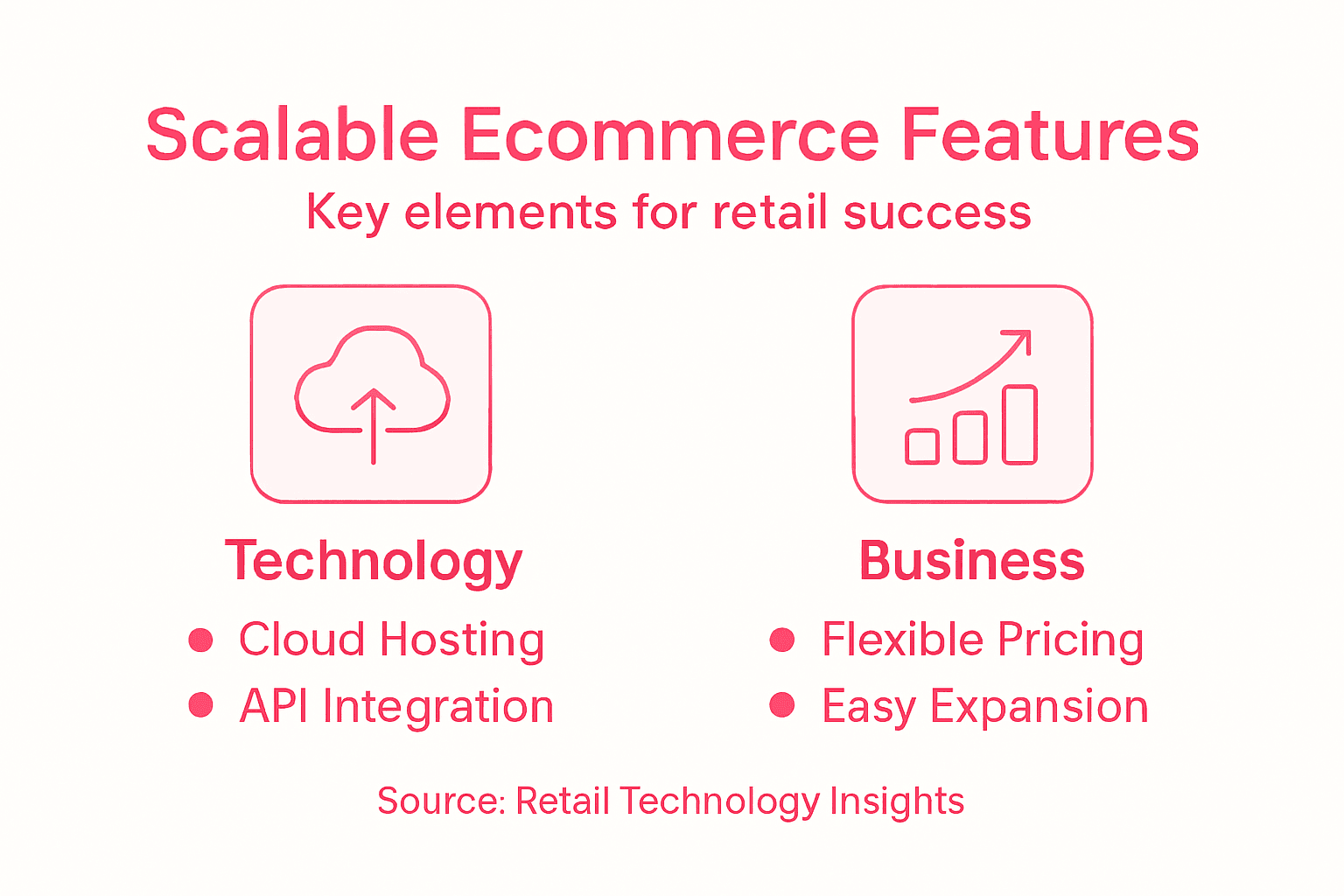
- Flexible Architecture: Systems that can expand computational resources dynamically
- Performance Consistency: Maintaining site speed and reliability during traffic spikes
- Integration Capabilities: Seamless connections with multiple business systems
- Cost-Effective Growth: Minimising infrastructure investments while supporting expansion
Many retailers misunderstand scalability, believing it’s solely about technical infrastructure. However, comprehensive ecommerce evolution frameworks reveal it’s a holistic approach encompassing technology, strategy, and operational readiness.
Common myths about scalable ecommerce often prevent businesses from making informed decisions. These misconceptions include:
- Believing expensive infrastructure guarantees scalability
- Assuming all platforms offer equal scaling capabilities
- Thinking scalability is a one-time implementation
- Overlooking the importance of ongoing system optimisation
Successful scalable ecommerce requires continuous investment in technological adaptability, user experience, and strategic planning. Businesses must view their digital infrastructure as a living ecosystem that evolves with market demands and technological advancements.
Pro tip: Regularly audit your ecommerce platform’s performance metrics and integration capabilities to ensure true scalability.
Types of Scalable Ecommerce Solutions
Scalable ecommerce solutions represent a diverse ecosystem of technological approaches designed to support online retail growth. These solutions enable businesses to expand their digital infrastructure dynamically, accommodating increased transaction volumes, user traffic, and evolving market requirements without compromising system performance.
Ecommerce infrastructure strategies typically encompass several critical technological frameworks:
- Cloud-Based Solutions: Flexible hosting environments that automatically scale computational resources
- Modular Architecture: Adaptable systems allowing independent component upgrades
- Microservices Platforms: Decentralised service configurations supporting granular scalability
- Headless Commerce: Separation of frontend and backend systems for enhanced flexibility
Enterprise-level ecommerce solutions can be categorised into distinct approaches:
The table below provides a concise comparison of scalable ecommerce solution types and their typical benefits:
| Solution Type | Scalability Approach | Business Benefit |
|---|---|---|
| Platform-as-a-Service | Built-in resource expansion | Rapid deployment, minimal setup |
| Custom-Built | Tailored system enhancements | Maximum fit, flexible scaling |
| Hybrid | Combined technologies | Balanced performance, adaptability |
- Platform-as-a-Service (PaaS): Pre-configured environments with built-in scalability features
- Custom-Built Solutions: Bespoke infrastructures tailored to specific business requirements
- Hybrid Approaches: Combining multiple technological frameworks for optimised performance
Key technological components that enable scalable ecommerce include:
- Content Delivery Networks (CDNs)
- Elastic Cloud Computing
- Advanced Caching Mechanisms
- Robust API Integration Capabilities
- Automated Load Balancing Systems
Successful implementation requires strategic alignment between technological infrastructure and business objectives. Retailers must carefully evaluate their specific growth trajectories, anticipated transaction volumes, and long-term digital transformation goals when selecting scalable ecommerce solutions.

Pro tip: Conduct comprehensive performance testing and benchmark your chosen ecommerce infrastructure against projected growth scenarios to ensure genuine scalability.
Core Features Supporting Growth
Scalable ecommerce platforms require a comprehensive set of core features that enable businesses to expand operations efficiently and maintain robust performance under increasing market demands. Application engineering strategies highlight the critical importance of building flexible technological foundations that can adapt to evolving business requirements.
Key core features supporting sustainable ecommerce growth include:
- Performance Optimisation: Ensuring consistent website responsiveness during high-traffic periods
- Automated Inventory Management: Real-time stock tracking and synchronisation across multiple sales channels
- Advanced Analytics: Comprehensive reporting tools for data-driven decision-making
- Flexible Payment Integrations: Support for multiple payment methods and international transactions
- Robust Security Protocols: Protection against cyber threats and data breaches
For UK-based retailers, specific growth-enabling features are particularly crucial:
- GDPR Compliance: Ensuring data protection and privacy regulations are met
- Local Shipping Integrations: Seamless connections with UK-based logistics providers
- Multi-Currency Support: Enabling international sales and transactions
- Tax Calculation Automation: Precise tax management across different regions
Technological infrastructure plays a pivotal role in supporting scalable growth. Cloud computing, artificial intelligence, and advanced automation technologies provide the underlying framework that enables businesses to expand their digital capabilities dynamically.
Here is a summary of key features enabling scalable ecommerce growth and their effects on retail businesses:
| Feature | How It Works | Business Impact |
|---|---|---|
| Performance Optimisation | Maintains website responsiveness | Prevents customer drop-offs |
| Automated Inventory | Syncs stock across channels | Reduces overselling risk |
| Advanced Analytics | Tracks user behaviours | Enables evidence-based decisions |
| Flexible Payments | Supports multiple methods | Attracts wider audience |
| Robust Security | Protects data and transactions | Builds customer trust |
Successful scalability is not just about technology, but about creating a flexible ecosystem that can evolve with your business needs.
Businesses must approach scalability holistically, considering not just technological capabilities but also operational flexibility, customer experience, and long-term strategic objectives.
Pro tip: Conduct regular infrastructure audits and invest in modular technologies that allow incremental upgrades without complete system overhauls.
Security, Compliance, and Performance Risks
Ecommerce businesses face a complex landscape of security challenges that can potentially undermine their entire digital infrastructure. Cybersecurity challenges for UK businesses reveal a stark reality where online retailers are prime targets for sophisticated digital threats that can compromise customer data, financial systems, and brand reputation.
Primary security and performance risks include:
- Phishing Attacks: Sophisticated attempts to steal sensitive customer information
- Malware Infiltration: Potential system-wide compromises through vulnerable entry points
- Distributed Denial of Service (DDoS): Attacks designed to overwhelm website infrastructure
- Payment Gateway Vulnerabilities: Potential points of financial transaction interception
- Data Encryption Weaknesses: Risks associated with inadequate data protection mechanisms
Compliance represents another critical dimension of risk management for UK ecommerce platforms:
- GDPR Compliance: Mandatory data protection requirements
- Payment Card Industry (PCI) Standards: Strict security protocols for financial transactions
- Age Verification Regulations: Legal requirements for age-restricted product sales
- Consumer Rights Protection: Ensuring transparent digital transaction practices
Performance risks can emerge from multiple technological and operational vulnerabilities:
- Inadequate server infrastructure
- Poor content delivery network (CDN) configuration
- Inefficient database management
- Suboptimal caching strategies
- Unoptimised front-end rendering
Security is not a destination but a continuous journey of adaptation and improvement.
Businesses must adopt a proactive, multi-layered approach to mitigating these risks, integrating advanced security technologies, regular system audits, and comprehensive staff training programmes.
Pro tip: Implement a quarterly security assessment and maintain a dedicated cybersecurity incident response plan to rapidly address potential vulnerabilities.
Evaluating ROI and Long-Term Impact
Investing in scalable ecommerce solutions requires a comprehensive understanding of long-term financial and strategic implications. Strategic scalability investments demonstrate that businesses can achieve substantial returns by adopting flexible technological frameworks that support continuous growth and adaptation.
Key metrics for evaluating ecommerce platform ROI include:
- Customer Acquisition Cost (CAC): Reducing expenses through efficient digital infrastructure
- Conversion Rate Improvements: Tracking performance enhancements post-implementation
- Operational Efficiency Gains: Measuring productivity and resource utilisation
- Revenue Per User: Assessing platform’s capacity to support increased transactions
- Technology Investment Recovery: Calculating time required to recoup initial platform costs
Long-term impact considerations encompass multiple strategic dimensions:
- Market Expansion Potential: Ability to enter new geographical or product markets
- Technological Adaptability: Platform’s flexibility in integrating emerging technologies
- Competitive Positioning: Maintaining technological edge against industry competitors
- Scalability Cost Efficiency: Minimising incremental infrastructure investments
Financial evaluation requires a holistic approach that extends beyond immediate monetary returns:
- Total cost of ownership analysis
- Predictive performance modelling
- Risk mitigation potential
- Future technological compatibility
- Strategic growth alignment
Successful ROI measurement transcends immediate financial metrics and considers long-term strategic value.
Businesses must develop nuanced evaluation frameworks that balance quantitative financial indicators with qualitative strategic potential, recognising that technological investments are fundamentally about future-proofing organisational capabilities.
Pro tip: Develop a comprehensive ROI assessment model that includes both tangible financial metrics and strategic growth potential to make informed scalability investments.
Unlock Your Retail Growth with Scalable Ecommerce Solutions
The article highlights the critical challenge many retailers face: building a scalable ecommerce platform that supports steady growth without sacrificing performance, security, or customer experience. With common misconceptions surrounding scalability and the need for flexible, cost-effective frameworks, your ecommerce growth depends on partnering with experts who understand how to align technology with your business goals. Key pain points such as maintaining site responsiveness during traffic surges, integrating complex catalogues, and ensuring GDPR compliance are all part of successful scalable ecommerce.
Big Eye Deers is a UK-based ecommerce agency specialising in delivering high-performing, scalable online stores tailored to your unique needs. With deep expertise in Magento Open Source, Adobe Commerce, and Shopify, we design and build platforms that accommodate tiered pricing, account hierarchies, ERP integrations, and multi-store setups—perfect for retailers aiming to grow across both DTC and wholesale channels. Our comprehensive approach covers UX design, performance optimisation, security monitoring, and lifecycle marketing so that your platform evolves seamlessly as your business expands. Discover how we can help you create a flexible and robust ecommerce ecosystem by visiting Big Eye Deers.

Ready to invest in ecommerce that truly scales with your ambition Explore our expert services and take the first step towards long-term retail success. Visit our website to learn more about how we combine technology and strategy for sustainable growth. Let us tailor a solution that safeguards your platform against security risks while maximising performance during peak demand periods. Contact Big Eye Deers today and future-proof your ecommerce journey.
Frequently Asked Questions
What is scalable ecommerce?
Scalable ecommerce refers to an online retail framework that can efficiently manage increasing transaction volumes, user traffic, and product complexity without sacrificing performance or customer experience.
Why is it important for a retail business to invest in scalable ecommerce solutions?
Investing in scalable ecommerce solutions allows retail businesses to grow flexibly and adapt to changing market demands, thereby improving operational efficiency, customer satisfaction, and overall competitive positioning.
What are the common myths about scalable ecommerce?
Some common myths include the belief that expensive infrastructure guarantees scalability, that all platforms are equally effective for scaling, and that scalability is a one-time implementation rather than an ongoing process.
How can businesses evaluate the ROI from scalable ecommerce investments?
Businesses can evaluate ROI by reviewing metrics such as Customer Acquisition Cost (CAC), conversion rate improvements, operational efficiency gains, and overall revenue per user, alongside long-term strategic considerations like market expansion potential.
Recommended


Adobe Commerce (Magento)
Formerly known as Magento, Adobe Commerce is built for complex catalogues, integrations, and long term growth. We design and develop stable, scalable stores that support demanding eCommerce requirements, including multi-store setups, complex pricing, and Hyva based performance improvements.

Bespoke Build
We design and build custom eCommerce platforms for businesses with complex workflows, integrations, or non standard requirements. Built from scratch around your business needs using Laravel and modern architectures.
Working with brands across the UK from our offices in Cardiff and Exeter, you deal directly with a senior team of designers and developers specialising in Shopify, Magento, WordPress and bespoke eCommerce platforms.
We focus on commercial outcomes. Better conversion rates, strong SEO foundations and eCommerce platforms that continue to improve long after launch.