Ecommerce UX: Boosting Sales and Customer Loyalty

Nearly 90 percent of British online shoppers will abandon a purchase if the user experience is clumsy or confusing. For ecommerce managers at retail brands in the United Kingdom, delivering a smooth, memorable journey is no longer optional. The way a store looks and works shapes every customer decision. With bespoke Magento solutions, your brand can create frictionless experiences that turn visitors into loyal buyers and set your business apart from competitors.
Table of Contents
- Defining Ecommerce UX for Retail Brands
- Key UX Elements In Magento And Shopify
- How UX Drives Conversion And Retention
- Addressing Common UK Ecommerce Pitfalls
- Measuring And Improving Online Store UX
Key Takeaways
| Point | Details |
|---|---|
| Ecommerce UX is Vital for Customer Loyalty | Creating engaging digital journeys is essential for transforming browsers into loyal customers by ensuring seamless navigation and emotional connectivity. |
| Invest in User Research and Testing | Retail brands should conduct regular user testing and gather feedback to identify friction points, allowing for continuous improvements in UX. |
| Address Common Pitfalls | UK ecommerce brands must tackle issues such as poor SEO, ineffective stock management, and regulatory compliance to enhance performance and trust. |
| Leverage Analytics for Continuous Improvement | Employ advanced analytics and user behaviour tracking to refine digital experiences and adapt to evolving consumer preferences. |
Defining Ecommerce UX for Retail Brands
Ecommerce User Experience (UX) represents the comprehensive digital interaction between a customer and an online retail platform. It encompasses every touchpoint, visual design, functionality, and emotional response a customer experiences while navigating an online store. At its core, ecommerce UX is about creating seamless, intuitive, and engaging digital journeys that transform casual browsers into loyal customers.
The strategic significance of UX extends far beyond aesthetic considerations. Retail brands must carefully align their digital experiences with core brand values and customer expectations, understanding that every interaction shapes customer perception. This means designing interfaces that are not just visually appealing, but psychologically resonant. Successful ecommerce UX integrates visual design, interaction patterns, performance, and emotional connectivity to create memorable shopping experiences.
Effective ecommerce UX strategy involves several critical components:
- Intuitive navigation structures
- Clear product information presentation
- Streamlined checkout processes
- Responsive design across devices
- Personalised user journeys
- Fast page loading times
- Transparent pricing and shipping information
Understanding user behaviour requires deep insights into how customers interact with digital platforms. Retail brands must invest in user research, conduct usability testing, and continuously iterate their design to meet evolving customer expectations. This means tracking metrics like conversion rates, bounce rates, and user engagement to refine the digital experience continuously.
Pro tip: Conduct regular user testing and gather qualitative feedback to identify friction points in your ecommerce experience, allowing for data-driven UX improvements.
Key UX Elements in Magento and Shopify
Magento and Shopify represent two powerful ecommerce platforms with distinct user experience (UX) capabilities that enable retail brands to create sophisticated digital shopping environments. Each platform offers unique design and functionality features that significantly impact customer interaction and conversion potential. Understanding these platforms’ core UX elements becomes crucial for businesses seeking to optimise their online retail strategies.
Comparative UX optimisation strategies demonstrate that both platforms require tailored frontend and backend improvements to enhance user engagement. These improvements focus on critical areas such as page load performance, intuitive navigation, and seamless checkout processes. Magento, with its robust open-source architecture, provides extensive customisation opportunities, while Shopify offers streamlined, user-friendly interfaces that reduce development complexity.
Key UX elements across these platforms include:
- Responsive mobile design
- Personalised product recommendations
- Simplified navigation menus
- Fast page loading speeds
- Secure and straightforward checkout processes
- High-quality product imagery
- Clear pricing and shipping information
- Integrated customer review systems
Successful implementation requires continuous monitoring and iterative improvements. Retail brands must leverage analytics, conduct user testing, and remain adaptable to changing customer expectations. This approach ensures that the digital shopping experience remains engaging, efficient, and aligned with evolving consumer preferences.
Here’s how Magento and Shopify UX core strengths compare for retailers:
| UX Aspect | Magento Strength | Shopify Strength |
|---|---|---|
| Customisation | Highly flexible, code-level changes | Easy theme edits, extensive app store |
| Scalability | Supports large inventories, growth | Suited for rapid scaling, multichannel |
| User Onboarding | Requires technical expertise | Intuitive, beginner-friendly |
| Checkout Optimisation | Advanced features, third-party options | Streamlined, optimised flow out of the box |
| Integrations | Wide variety, suited to complex needs | Extensive, plug-and-play integrations |
Pro tip: Regularly audit your ecommerce platform’s performance metrics and conduct user experience testing to identify and address potential friction points in the customer journey.
How UX Drives Conversion and Retention
User experience (UX) has transformed from a design consideration to a critical business strategy that directly impacts an organisation’s financial performance. Modern consumers expect seamless, intuitive digital interactions that not only meet their immediate needs but also create emotional connections with brands. Innovative UX design plays a pivotal role in building customer trust and reducing potential abandonment points throughout the purchasing journey.

The psychological principles underlying effective UX design are complex yet fundamental. By reducing cognitive load and creating clear, predictable navigation paths, businesses can significantly decrease user friction and enhance conversion potential. This approach goes beyond aesthetic considerations, focusing on creating intuitive experiences that guide customers effortlessly from initial interest to final purchase. The most successful ecommerce platforms understand that every interaction represents an opportunity to build trust, demonstrate value, and cultivate long-term customer loyalty.
Key strategies for driving conversion and retention through UX include:
- Simplifying complex decision-making processes
- Providing transparent and easily accessible information
- Creating personalised user journeys
- Implementing responsive design across devices
- Utilising progressive disclosure techniques
- Developing clear and concise call-to-action elements
- Maintaining consistent visual and interaction design
- Offering multiple support and communication channels
Successful UX implementation requires continuous refinement and data-driven insights. Retail brands must invest in comprehensive user research, conduct regular usability testing, and remain agile in responding to evolving customer expectations. This approach transforms UX from a static design element into a dynamic, strategic business tool that directly influences revenue and customer satisfaction.
Pro tip: Implement continuous user feedback loops and conduct regular A/B testing to systematically identify and eliminate potential friction points in your digital customer experience.
Addressing Common UK Ecommerce Pitfalls
The United Kingdom’s ecommerce landscape presents unique challenges for online retailers, with numerous potential pitfalls that can significantly undermine business performance and growth. Understanding the specific regulatory and strategic challenges facing UK digital commerce has become increasingly critical for maintaining competitive advantage.
One of the most prevalent issues facing UK ecommerce brands is the underinvestment in foundational digital strategies. Many businesses approach online retail with unrealistic expectations, failing to integrate comprehensive search engine optimisation (SEO) techniques during initial website development. This oversight creates long-term obstacles in generating organic traffic and establishing sustainable digital presence. The consequences extend beyond mere visibility challenges and directly impact revenue potential and market positioning.
Key pitfalls UK ecommerce businesses must proactively address include:
- Poor SEO implementation and organic search strategies
- Inadequate logistics and stock management systems
- Weak social media engagement approaches
- Limited understanding of digital marketing channels
- Inconsistent customer experience across platforms
- Insufficient data analytics and performance tracking
- Complex or unclear website navigation structures
- Lack of mobile responsiveness
Moreover, regulatory compliance has become increasingly complex for online retailers. The emerging Digital Markets, Competition and Consumers Act introduces stringent requirements around transparent pricing, review authenticity, and consumer protection. Businesses must remain vigilant in understanding and implementing these evolving legal standards to maintain customer trust and avoid potential financial penalties.
Below is a summary of common UK ecommerce pitfalls and their long-term business implications:
| Pitfall | Business Impact | Mitigation Strategy |
|---|---|---|
| Weak SEO foundations | Reduced organic traffic and lower rankings | Implement SEO during site development |
| Poor stock management | Missed sales, customer frustration | Integrate robust inventory systems |
| Inconsistent CX across platforms | Erodes trust, increases bounce rates | Standardise design and messaging |
| Regulatory non-compliance | Risk of fines, loss of reputation | Regular legal audits and staff training |
Pro tip: Conduct a comprehensive digital audit every six months to identify potential compliance gaps and strategically refine your ecommerce platform’s performance and user experience.
Measuring and Improving Online Store UX
Measuring user experience (UX) is a nuanced discipline that demands sophisticated approaches combining quantitative and qualitative methodologies. Advanced UX measurement practices utilise systematic research techniques and validated survey scales to generate robust insights into digital interaction quality. Understanding these measurement strategies enables ecommerce businesses to transform subjective user experiences into concrete, actionable data points.
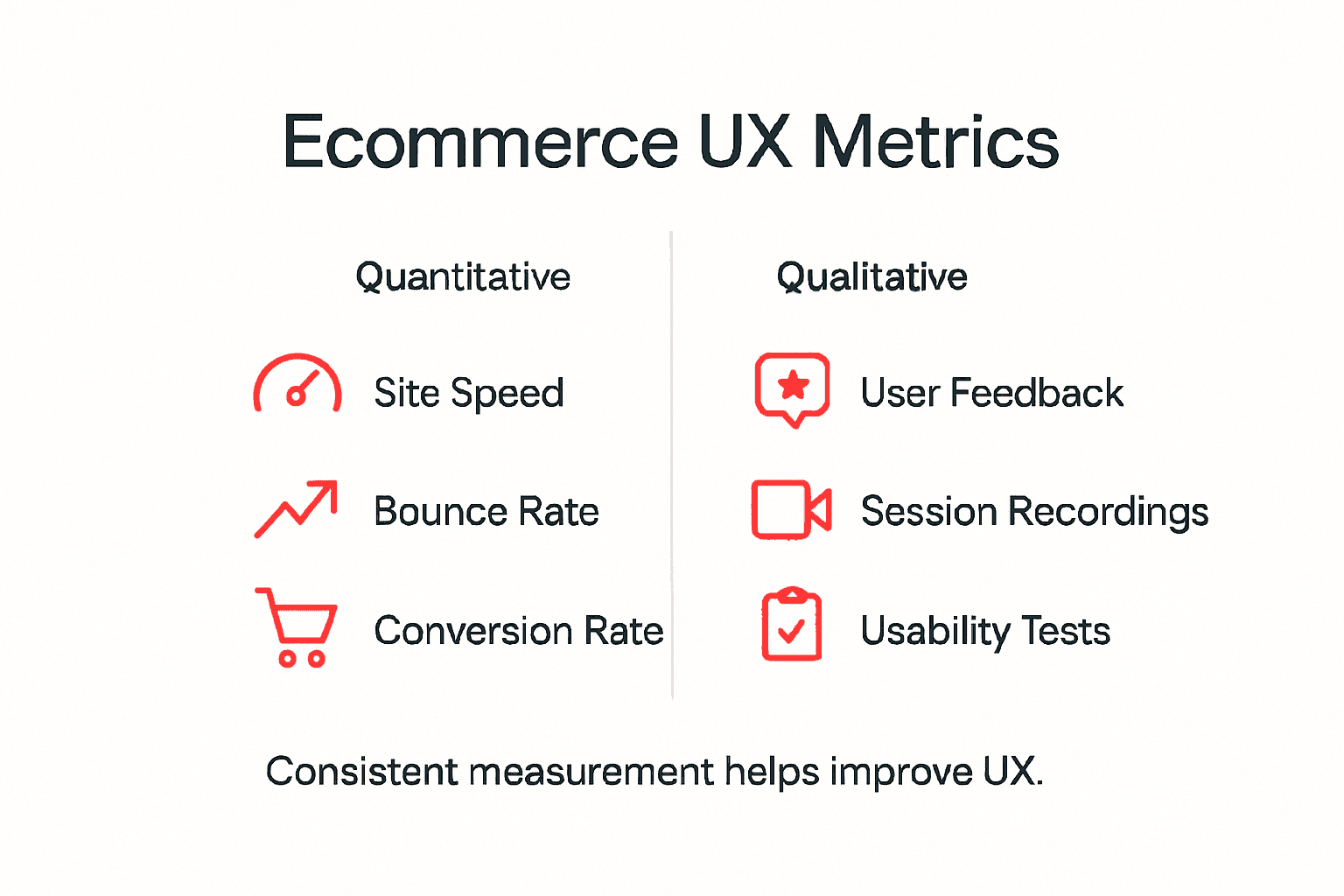
Key performance metrics serve as critical indicators of online store effectiveness. Ecommerce platforms must track comprehensive metrics that illuminate user behaviour, engagement patterns, and potential friction points. These metrics extend beyond traditional web analytics, requiring a holistic approach that captures both numerical data and user sentiment. Successful UX measurement involves triangulating multiple data sources to create a comprehensive understanding of user interactions.
Crucial UX measurement metrics include:
- Task success rate
- User error rates
- Time spent completing specific actions
- Conversion funnel performance
- Bounce rates across different pages
- Navigation path analysis
- Customer satisfaction scores
- Interaction depth and engagement levels
Implementing effective UX measurement requires sophisticated tools and strategic approaches. Advanced analytics platforms, heatmap technologies, and user behaviour tracking systems enable businesses to gain granular insights into digital interaction patterns. By systematically analysing these metrics, ecommerce brands can identify opportunities for interface refinement, streamline user journeys, and incrementally improve overall digital experience performance.
Pro tip: Implement a quarterly UX audit using both quantitative metrics and qualitative user feedback to continuously refine and optimise your online store’s digital experience.
Transform Your Ecommerce UX to Drive Sales and Loyalty
The challenge many UK retailers face today is creating an ecommerce experience that not only attracts visitors but also converts them into loyal customers. This article highlights crucial pain points including confusing navigation, poor SEO foundations, and lack of personalised user journeys that frustrate shoppers and stall growth. At Big Eye Deers, we understand that seamless UX design, fast performance, and clear product discovery are vital to overcoming these challenges. Our expertise with Magento and Shopify platforms allows us to deliver customised solutions such as advanced B2B ecommerce features, tailored frontend interfaces using Hyvä, and integrated search and merchandising systems that enhance product visibility and boost conversion.
We focus on the vital elements of ecommerce UX:
- Streamlined checkout processes
- Mobile responsive design
- Personalised user journeys
- Robust SEO and fast loading times
By partnering with us, retailers can benefit from over 17 years of experience in building secure, high-performing online stores that meet evolving customer expectations and regulatory demands.
Ready to elevate your ecommerce user experience and secure lasting customer loyalty?
Discover how Big Eye Deers can transform your online store’s UX and drive measurable business growth. Visit our Magento and Shopify ecommerce services page today and start your journey to a smarter, more profitable digital retail experience.
Frequently Asked Questions
How can ecommerce UX improve sales?
Ecommerce UX enhances sales by creating intuitive navigation, reducing friction in the checkout process, and providing clear product information, which all contribute to a smoother shopping experience and higher conversion rates.
What are the key components of effective ecommerce UX?
Key components include intuitive navigation, streamlined checkout processes, responsive design across devices, personalised user journeys, and fast page loading times, all of which create engaging and efficient shopping experiences.
Why is user testing important for improving ecommerce UX?
User testing provides valuable insights into customer behaviour and preferences, helping retailers identify friction points and areas for improvement, which can lead to increased customer satisfaction and loyalty.
How does UX impact customer loyalty?
A positive user experience fosters emotional connections with the brand, builds trust, and encourages repeat purchases. When customers find an online store easy to navigate and enjoyable to use, they are more likely to return.
Recommended



Adobe Commerce (Magento)
Formerly known as Magento, Adobe Commerce is built for complex catalogues, integrations, and long term growth. We design and develop stable, scalable stores that support demanding eCommerce requirements, including multi-store setups, complex pricing, and Hyva based performance improvements.

Bespoke Build
We design and build custom eCommerce platforms for businesses with complex workflows, integrations, or non standard requirements. Built from scratch around your business needs using Laravel and modern architectures.

Working with brands across the UK from our offices in Cardiff and Exeter, you deal directly with a senior team of designers and developers specialising in Shopify, Magento, WordPress and bespoke eCommerce platforms.
We focus on commercial outcomes. Better conversion rates, strong SEO foundations and eCommerce platforms that continue to improve long after launch.