What is digital consultancy? A guide for businesses
TL;DR:
- Digital consultancy helps businesses define strategic technology decisions aligned with their goals. It focuses on planning and organizational change rather than executing campaigns or building software. Small and mid-sized companies can benefit from targeted, short-term engagements that prevent costly mistakes.
Digital consultancy is the professional service that helps businesses design and execute digital strategies aligned with their commercial goals. It sits at the intersection of business strategy, technology, data, and organisational change. Unlike hiring a developer to build a website or an agency to run paid ads, digital consultancy focuses on the strategic layer: deciding what to build, why, and in what order. For businesses and entrepreneurs exploring how to grow their online presence or improve eCommerce performance, understanding this distinction is the first step to spending wisely.
What is digital consultancy and what does it actually cover?
Digital consultancy is defined as expert advisory work that helps organisations make better decisions about technology and digital channels. The term is sometimes used interchangeably with digital transformation consulting, though the latter tends to imply broader organisational change. Both describe the same core activity: an external expert analyses your current situation, identifies the gap between where you are and where you need to be, and produces a clear plan to close it.
Digital consultancy operates at the strategic layer, defining technology architecture, data strategy, and organisational changes, rather than executing campaigns or writing code. That distinction matters enormously. A business that hires a consultant expecting a finished product will be disappointed. A business that hires one to answer “which platform should we build on, and why?” will get genuine value.
The scope of digital consultancy services typically covers:
- Technology assessment: Reviewing your current tools, platforms, and integrations to identify what is working and what is creating drag.
- Digital roadmap development: Producing a prioritised plan of initiatives ranked by business impact and delivery risk.
- Operating model design: Defining how your internal teams, external partners, and technology systems should work together.
- Change planning: Mapping the people, process, and skills changes needed to make new technology stick.
Pro Tip: Ask any consultant to show you a sample deliverable before you engage them. A good digital consultancy produces concise, action-focused frameworks, not 80-page reports nobody reads.
What do digital consultants do day to day?
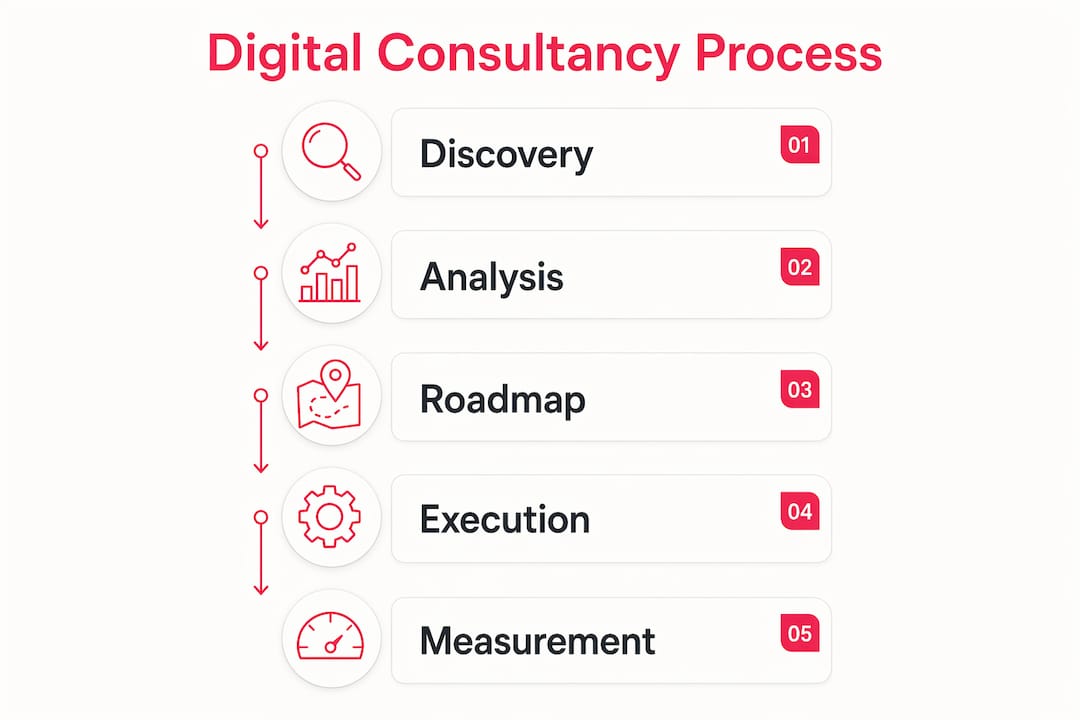
Digital consultants spend most of their time in diagnosis and planning, not execution. A typical engagement begins with a structured discovery phase. During this phase, consultants analyse your current technology stack, interview key stakeholders, and map actual workflows against documented processes.

Current state documentation is often inaccurate. What a business thinks it does and what it actually does frequently diverge. A good consultant treats client documentation as a starting point, not a source of truth. This diagnostic rigour is what separates a genuine consultancy engagement from a superficial audit.
From discovery, the consultant builds a prioritised roadmap. Prioritisation typically identifies 3–5 initiatives that deliver the most value for the least risk. This is where consultancy pays for itself. Businesses that skip this step often invest heavily in the wrong platform, the wrong channel, or the wrong sequence of changes.
The final deliverable is a clear framework showing which channels to invest in, at what level, and tied to measurable success metrics. Brief, action-focused strategy documents outperform lengthy reports every time. The goal is a plan your team can actually execute, not a document that sits in a shared drive.
How does digital consultancy differ from IT consulting and digital marketing?
This is one of the most common points of confusion, and it is worth being direct about it.
| Discipline | Primary focus | Typical output |
|---|---|---|
| Digital consultancy | Strategy and organisational change | Roadmaps, operating models, business cases |
| IT consulting | Infrastructure and software deployment | System architecture, technical specifications |
| Digital marketing agency | Channel execution and campaign management | Ad campaigns, content, SEO, paid media |
Digital consulting takes a broader view than traditional IT consulting, focusing on rethinking how value is created and delivered rather than deploying specific software. An IT consultant will tell you how to implement a new ERP system. A digital consultant will tell you whether you need one at all, and how it fits into your wider commercial model.
Digital marketing agencies execute within channels. A digital consultant decides which channels deserve investment in the first place. There is overlap, particularly with agencies that offer strategic planning alongside execution. But the core distinction holds: consultancy is about decisions, not delivery.
For eCommerce businesses specifically, this matters. A consultant might recommend a platform migration, a new checkout flow, or a B2B pricing model. Executing those recommendations is then handed to a specialist agency or internal team. Understanding how digital agencies drive eCommerce growth helps clarify where consultancy ends and delivery begins.
What are the key benefits of digital consultancy for businesses?
The most direct benefit is avoiding expensive mistakes. Technology investments fail most often not because of poor execution, but because of poor decisions made before a line of code is written. A consultant validates your objectives and technology choices before you commit budget.
Digital consulting services help businesses design digital roadmaps, value cases, target operating models, and change plans, supporting growth, cost, and risk objectives simultaneously. That breadth is the point. A single engagement can align your technology choices, your team structure, and your commercial targets in a way that internal teams rarely achieve alone.
The benefits of engaging digital consultancy services include:
- Objective external perspective: Internal teams are too close to existing systems and processes to see the full picture clearly.
- Expert prioritisation: A consultant with cross-sector experience knows which initiatives typically deliver and which ones drain resource without return.
- Faster decision-making: A structured engagement produces clear recommendations in weeks, not months of internal debate.
- Risk reduction: Validating technology choices before procurement avoids costly platform switches down the line.
Smaller and mid-sized businesses also leverage digital consulting with scoped efforts and clear budgets. This is not a service reserved for enterprise organisations. A focused engagement with a clear brief delivers real value for a growing eCommerce brand just as much as for a large retailer.
How does a typical digital consultancy engagement work?
Most engagements follow a structured sequence of phases, and the timeline is shorter than most businesses expect.
- Scoping call (week 1): The consultant and client agree on the problem to solve, the stakeholders to involve, and the deliverables expected. A clear brief at this stage prevents scope creep later.
- Discovery (weeks 1–3): Stakeholder interviews, technology audits, data reviews, and process mapping. This is the diagnostic phase. Typical engagements last between 4 and 10 weeks, with discovery consuming roughly the first third.
- Analysis and prioritisation (weeks 3–5): The consultant synthesises findings, identifies gaps, and ranks initiatives by impact and complexity.
- Roadmap presentation (weeks 5–8): A clear, prioritised plan is presented to stakeholders. Good consultants present options with trade-offs, not a single prescribed answer.
- Handover and support (weeks 8–10): The roadmap is handed to internal teams or delivery partners. Some consultants remain involved during early implementation to maintain strategic alignment.
Client involvement is active throughout. The quality of a consultancy engagement depends heavily on access to the right people. Blocking a consultant from speaking to your operations manager or finance lead produces a weaker output.
The ROI of digital consulting is measured in avoided mistakes and actionable guidance, not the volume of documentation produced. A ten-page roadmap that your team executes is worth more than a hundred-page report that gathers dust.
Pro Tip: Before signing an engagement, ask the consultant to define three specific success metrics for the project. If they cannot name them, the engagement lacks focus.
Key takeaways
Digital consultancy delivers the most value when it is treated as a decision-making tool, not a delivery service. Businesses that engage consultants with a clear brief, active stakeholder involvement, and a focus on prioritised action get the best return.
| Point | Details |
|---|---|
| Strategic, not executional | Digital consultancy defines what to build and why, not how to build it. |
| Discovery is non-negotiable | Accurate diagnosis requires on-the-ground investigation, not just reviewing documents. |
| Prioritisation is the core output | The best engagements identify 3–5 high-value initiatives ranked by impact and risk. |
| Short, focused deliverables win | Brief, action-focused roadmaps outperform lengthy reports that teams cannot execute. |
| Avoid pre-determined solutions | A consultant recommending a specific platform before diagnosis is a red flag. |
What businesses get wrong about digital consultancy
I have seen businesses approach consultancy with the wrong mental model, and it costs them. The most common mistake is treating a consultant like a senior employee who will manage delivery. They will not. A consultant’s job is to give you clarity, not to run your project.
The second mistake is undervaluing the discovery phase. Businesses often want to skip straight to recommendations. But a consultant pushing specific technology platforms before conducting an objective diagnostic is a warning sign, not a shortcut. Pre-determined solutions indicate vendor bias, not expertise. The diagnostic is where the real value is created.
The third thing I see consistently is businesses measuring consultancy by the weight of the output. A thick report feels like value. It rarely is. The best consultants I have encountered produce concise frameworks that connect every investment to a measurable business outcome. If you cannot review progress against the strategy in six months, the strategy was not written clearly enough.
My honest advice: treat consultancy as a capital decision, not a cost. The right engagement, with the right brief, pays back many times over in avoided waste and faster execution. For eCommerce businesses specifically, getting your web development consulting approach right before you build is the single biggest lever you have.
— Steve
How Bigeyedeers approaches eCommerce digital consultancy
Bigeyedeers is a UK-based eCommerce agency with over 17 years of experience building and supporting high-performing online stores on Magento and Shopify.
Before writing a line of code, we work through the strategic questions: which platform fits your trading model, how your catalogue and pricing logic should be structured, and which integrations will support growth rather than create technical debt. Whether you are a growing DTC brand or a wholesale operation needing complex B2B functionality, our Magento and Shopify services are built around your commercial goals, not a pre-packaged template. If you want a team that combines strategic thinking with hands-on delivery, we are worth a conversation.
FAQ
What is digital consultancy in simple terms?
Digital consultancy is expert advisory work that helps businesses make better decisions about technology and digital channels. It focuses on strategy and planning, not execution or campaign management.
How long does a digital consultancy engagement typically last?
Most engagements run between 4 and 10 weeks, covering discovery, analysis, and roadmap delivery. Scope and complexity determine where in that range a project falls.
What is the difference between digital consultancy and a digital marketing agency?
A digital marketing agency executes within channels such as SEO, paid media, and email. A digital consultant decides which channels deserve investment and how technology should support them.
What should I look for when choosing a digital consultant?
Look for consultants who conduct a thorough diagnostic before recommending any technology. A consultant who names a specific platform before understanding your business is likely biased toward that vendor.
Can small businesses benefit from digital consultancy services?
Smaller businesses engage digital consulting with scoped, time-bound briefs focused on specific growth challenges or legacy system problems. The engagement does not need to be large to deliver clear commercial value.
Recommended



Adobe Commerce (Magento)
Formerly known as Magento, Adobe Commerce is built for complex catalogues, integrations, and long term growth. We design and develop stable, scalable stores that support demanding eCommerce requirements, including multi-store setups, complex pricing, and Hyva based performance improvements.

Bespoke Build
We design and build custom eCommerce platforms for businesses with complex workflows, integrations, or non standard requirements. Built from scratch around your business needs using Laravel and modern architectures.
Working with brands across the UK from our offices in Cardiff and Exeter, you deal directly with a senior team of designers and developers specialising in Shopify, Magento, WordPress and bespoke eCommerce platforms.
We focus on commercial outcomes. Better conversion rates, strong SEO foundations and eCommerce platforms that continue to improve long after launch.