Why invest in headless storefronts for ecommerce growth
TL;DR:
- Headless storefronts separate the frontend from the backend, offering greater speed and customization opportunities. They are best suited for large, multi-channel brands with strong engineering resources and complex integrations. Smaller businesses are generally better served by traditional platforms due to high ongoing technical and operational costs.
Headless storefronts are ecommerce architectures that separate the frontend user interface from the backend commerce engine, giving businesses direct control over every customer touchpoint. This decoupled approach is why invest in headless storefronts has become a serious strategic question for brands outgrowing traditional monolithic platforms. Platforms like Shopify Plus, Commercetools, and BigCommerce Catalyst have made headless more accessible, but the investment still demands technical capacity, clear planning, and a realistic budget. This article breaks down the benefits, the risks, and the right conditions for making the move.
What are the primary benefits of headless storefronts?
Speed is the most immediate and measurable advantage. Shopify stores render 1.8x faster on average compared to other platforms when using a headless setup. Faster pages mean lower bounce rates and higher conversion potential, particularly on mobile where milliseconds matter.

Beyond speed, headless gives your frontend team complete creative freedom. You are no longer constrained by the template logic of a monolithic theme. Your developers can build in React, Vue, or Next.js and deliver interactions that a standard Shopify or Magento theme simply cannot replicate.
The unified customer experience across web, mobile, kiosks, voice interfaces, and in-store displays is the primary driver for most serious headless investments. A single API layer feeds consistent product data and pricing to every channel. That consistency is what monolithic themes structurally struggle to deliver at scale.
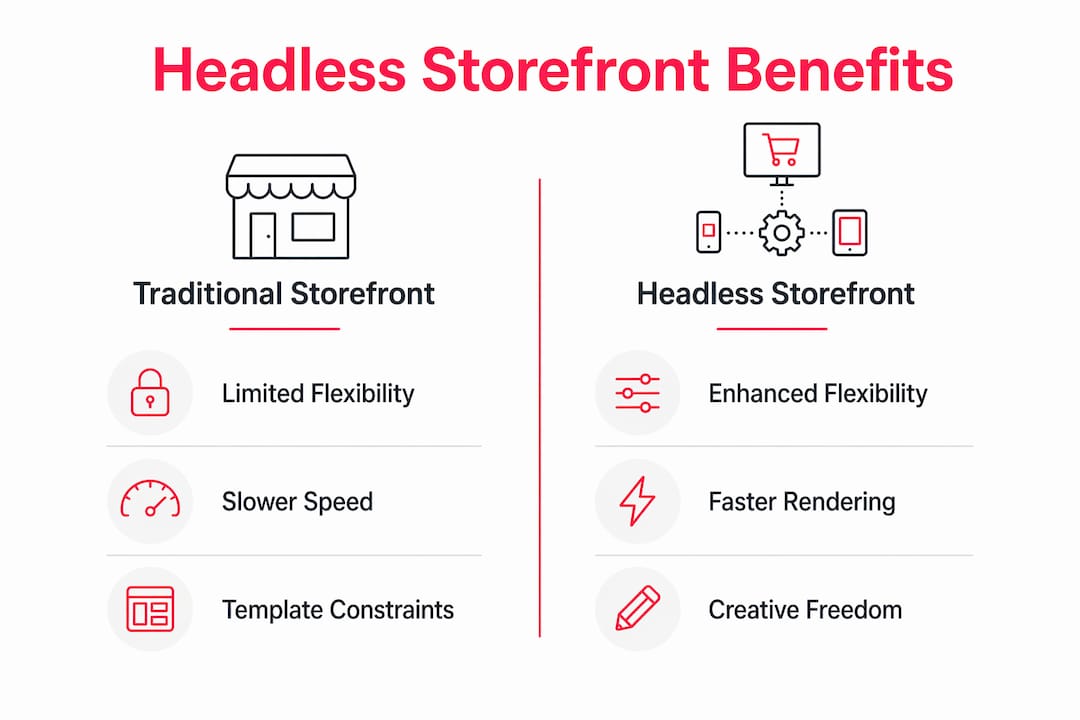
Here is how headless compares to traditional storefronts across the key dimensions:
| Dimension | Traditional storefront | Headless storefront |
|---|---|---|
| Frontend flexibility | Limited to platform themes | Full custom frontend in any framework |
| Site speed | Platform-dependent | Optimised independently |
| Omnichannel reach | Web-first, limited | Web, mobile, kiosk, voice, in-store |
| Integration capability | Plugin-based | API-first, best-of-breed |
| Engineering overhead | Low | High, ongoing |
| Time to launch | Weeks | Months |
Pro Tip: Before committing to headless, audit your current theme’s limitations. If your team is spending more time working around the theme than building features, that is a strong signal headless is worth the investment.
Who should consider investing in headless storefronts?
Headless is a strategic choice, not a default one. Merchants best positioned for headless have internal development teams, budgets above £1 million, and project timelines of six months or more. Smaller budgets and shorter timelines are better served by traditional architectures.
The clearest use cases for headless investment are:
- Multi-channel selling where you need a single commerce backend feeding web, app, and physical retail simultaneously
- Complex integrations with ERP systems, PIM platforms, or custom pricing engines that a standard plugin cannot handle
- Brand differentiation where the customer experience itself is a competitive advantage, not just the product catalogue
- Multiple storefronts or regions requiring unified backend management with distinct frontend experiences per market
Headless is a poor fit for businesses with a single web channel, no dedicated engineering resource, and revenue below £5 million. The complexity tax is marginal for smaller stores but genuinely transformative for organisations operating at £50 million or above. If you sit in the middle, a hybrid ecommerce model is often the smarter starting point. It lets you decouple selectively without rebuilding everything at once.
What operational challenges come with headless storefronts?
The engineering overhead is the most underestimated part of any headless project. Dedicated ongoing capacity of 2–4 engineers is required to manage frontend frameworks, APIs, deployment pipelines, and security. Treating headless as a one-time build project is one of the most expensive mistakes a business can make.
The hidden costs compound quickly:
- API management requires ongoing versioning, monitoring, and documentation as your commerce backend evolves
- Frontend framework updates in React or Next.js introduce breaking changes that need engineering time to resolve
- Security responsibilities shift partly to your team, since the frontend is no longer managed by the platform vendor
- Deployment and hosting for a decoupled frontend adds infrastructure costs and operational complexity
Failing to secure ongoing engineering capacity leads to costly agency retainers that quickly exceed what a traditional platform would have cost in the first place. That is not a hypothetical. We see it regularly with brands that launch headless on a project basis and then struggle to maintain it.
Poorly planned headless migrations can waste 18 months re-engineering features already available natively on monolithic platforms. Checkout customisation, promotional rules, and product filtering are common examples where teams rebuild what Shopify or Magento already provides out of the box.
Pro Tip: Map every feature your current platform provides before scoping a headless build. Anything on that list that you plan to rebuild needs a clear justification. If the answer is “we want more control,” make sure that control is commercially valuable enough to justify the cost.
How does headless investment impact business growth?
The growth case for headless is strongest when conversion rate improvement is measurable. A 1% conversion improvement on £10 million revenue equals £100,000 in annual gain. At that scale, the engineering investment pays back quickly if the performance gains are real and sustained.
Marketing agility is the second major growth lever. With a decoupled frontend, your marketing team can run A/B tests, launch campaign landing pages, and iterate on user journeys without waiting for backend deployments. That speed of experimentation compounds over time.
Brands like ALDI and Ulta Beauty have adopted Commercetools’ API-first architecture to manage multiple storefronts and geographies from a single commerce layer. The ability to localise the frontend experience per market while keeping pricing, inventory, and fulfilment centralised is a genuine operational advantage at enterprise scale.
Here is a summary of the growth and experience metrics headless can influence:
| Metric | Headless impact |
|---|---|
| Page load speed | Up to 1.8x faster rendering |
| Conversion rate | Measurable gains at £10M+ revenue scale |
| Marketing experiment velocity | Faster cycles, no backend dependency |
| Omnichannel consistency | Unified experience across all touchpoints |
| Regional scalability | Independent frontends, shared backend |
For businesses operating a single web channel with stable traffic, the growth case is harder to make. The benefits of headless commerce are most pronounced when you have multiple channels to serve or significant traffic volume to convert. You can explore how ecommerce trends in 2026 are shaping the case for headless investment across UK retail.
What technology options should you consider for headless?
Choosing the right platform is as important as deciding to go headless in the first place. The leading options each suit different operational profiles:
- Shopify Plus + Storefront API with Hydrogen is the default choice for many DTC brands going headless. It combines Shopify’s commerce reliability with a React-based frontend framework purpose-built for the task.
- Commercetools suits businesses running multiple storefronts, geographies, or business models with its API-first, cloud-native architecture. Annual costs run from £50,000 to £200,000 or more, plus developer resources.
- BigCommerce Catalyst offers a headless-ready framework with strong out-of-the-box commerce features, making it a practical option for teams that want headless flexibility without building everything from scratch.
- Magento Open Source or Adobe Commerce with a Hyvä frontend is a strong choice for complex B2B or multi-store setups where catalogue depth and pricing logic are central requirements.
Annual platform fees range from £50,000 to £200,000 before you factor in developer headcount or agency costs. That figure is the floor, not the ceiling. Match your platform choice to your team’s existing skills. A Shopify-native development team should not be forced onto Commercetools simply because it is the more powerful option.
Pro Tip: If your team has never managed a decoupled frontend before, start with Shopify Hydrogen or BigCommerce Catalyst. Both provide opinionated frameworks that reduce the number of architectural decisions your team needs to make from day one.
Key takeaways
Headless storefronts deliver their strongest returns for businesses with the revenue scale, engineering capacity, and multi-channel ambition to justify the investment.
| Point | Details |
|---|---|
| Speed and performance gains | Shopify headless stores render 1.8x faster, directly supporting conversion improvement. |
| Engineering capacity is non-negotiable | Plan for 2–4 dedicated engineers to manage APIs, frameworks, and deployment ongoing. |
| Right fit matters | Businesses with £1M+ budgets, 6-month timelines, and internal dev teams are best positioned. |
| Growth case is scale-dependent | A 1% conversion gain on £10M revenue equals £100,000 annually, making the ROI clear at scale. |
| Platform choice must match your team | Shopify Hydrogen suits DTC brands; Commercetools suits multi-market enterprise operations. |
My honest assessment of headless investment
I have worked with enough ecommerce businesses to say this plainly: headless is not the right answer for most brands, and the industry does not say that loudly enough.
The platforms and agencies selling headless projects have a commercial interest in making the architecture sound universally appealing. The reality is that headless is not a default for modern commerce. Many brands achieve genuinely differentiated experiences using native platform themes, and they do it without the engineering overhead.
Where I have seen headless deliver clear competitive advantage is in three specific scenarios. First, brands operating across five or more channels simultaneously where monolithic themes create real friction. Second, businesses with £50 million or more in revenue where a 1% conversion improvement has a six-figure commercial impact. Third, organisations with established internal engineering teams who treat the frontend as a product, not a project.
The warning I give every client considering headless is this: the first six months are exciting. The following 24 months are where the real cost shows up. Maintenance, framework updates, API versioning, and security responsibilities do not go away after launch. They grow. If you do not have the internal capacity to own that ongoing work, you will end up paying agency retainers that make the original investment look modest.
My advice is to approach headless incrementally. Start with a hybrid approach that decouples one channel or one experience before committing to a full composable stack. That staged adoption gives your team time to build the operational muscle headless actually requires.
— Steve
How Bigeyedeers can help you invest in headless the right way
If you are weighing up a headless investment and want a straight answer on whether it is right for your business, we are the people to talk to.
At Bigeyedeers, we have over 17 years of experience building and supporting high-performing ecommerce stores on Shopify and Magento. We work with brands across the UK to design, build, and maintain headless and hybrid architectures that are grounded in commercial reality, not architectural fashion. From Shopify Hydrogen builds to Hyvä frontends on Adobe Commerce, we match the technology to your team’s capacity and your growth ambitions. Visit our ecommerce agency to see how we work, or explore our dedicated Shopify development services to find out what a headless build looks like in practice.
FAQ
What is a headless storefront?
A headless storefront is an ecommerce architecture where the frontend user interface is decoupled from the backend commerce system, connected via APIs. This separation allows businesses to build custom frontends in any framework while keeping commerce logic centralised.
Is headless commerce worth the investment for smaller businesses?
Headless is generally not worth the investment for businesses with revenue below £5 million or budgets under £1 million. The complexity and ongoing engineering costs outweigh the benefits at smaller scale, where native platform themes deliver comparable results.
How much does a headless ecommerce build cost?
Platform fees alone range from £50,000 to £200,000 annually, before developer staffing or agency costs. Total investment depends on platform choice, team size, and the complexity of integrations required.
Which headless platform is best for DTC brands?
Shopify Plus with the Storefront API and Hydrogen framework is the most common choice for DTC brands going headless. It combines Shopify’s commerce reliability with a purpose-built React frontend framework.
How many engineers do you need to run a headless storefront?
A dedicated team of 2–4 engineers is required to manage a headless frontend on an ongoing basis, covering API management, framework updates, deployment, and security responsibilities.
Recommended



Adobe Commerce (Magento)
Formerly known as Magento, Adobe Commerce is built for complex catalogues, integrations, and long term growth. We design and develop stable, scalable stores that support demanding eCommerce requirements, including multi-store setups, complex pricing, and Hyva based performance improvements.

Bespoke Build
We design and build custom eCommerce platforms for businesses with complex workflows, integrations, or non standard requirements. Built from scratch around your business needs using Laravel and modern architectures.

Working with brands across the UK from our offices in Cardiff and Exeter, you deal directly with a senior team of designers and developers specialising in Shopify, Magento, WordPress and bespoke eCommerce platforms.
We focus on commercial outcomes. Better conversion rates, strong SEO foundations and eCommerce platforms that continue to improve long after launch.