Why invest in brand presence online: a 2026 guide
TL;DR:
- Investing in online brand presence builds lasting digital authority that enhances SEO, trust, and conversions.
- Consistency in messaging and branding across all touchpoints is essential for establishing recognition and customer confidence.
Online brand presence is defined as the sum of every digital touchpoint where a customer can find, evaluate, and form an opinion about your business. For business owners and marketing professionals, the question of why invest in brand presence online has a clear answer: 97% of consumers search for local businesses online, and 87% begin product searches on the internet. Those numbers mean your digital reputation is your first impression, your shop window, and your sales team rolled into one. Get it right and you build compounding authority. Ignore it and you hand customers to competitors who did the work.
What are the key benefits of investing in your brand presence online?
The benefits of online branding are direct and measurable. A recognised brand earns higher click-through rates from search results, converts more visitors into buyers, and generates referrals without paid spend. These are not soft marketing outcomes. They are commercial results tied to how familiar and trustworthy your business appears before a customer ever speaks to you.
Here is what a strong online brand presence delivers in practice:
- Higher organic traffic. Businesses recognised online receive better click-through rates because users choose familiar names over unknown ones in search results.
- Improved SEO rankings. Positive reviews act as ranking signals for Google, meaning your reputation directly influences your position in search results.
- Greater customer trust. Consistent branding across touchpoints increases recognisability and improves customer confidence, which drives repeat visits and stronger referrals.
- Lead generation at lower cost. A brand that ranks well organically and holds strong reviews attracts leads without constant paid advertising.
- Stronger conversion rates. Brand familiarity reduces hesitation at the point of purchase, which means more visitors complete a transaction.
“Rankings alone are insufficient. Familiarity and trust drive user engagement and conversions far more effectively than a top position held by an unknown name.” — Advisible, 2026
The importance of online presence compounds over time. Each piece of content, each review, and each consistent brand signal adds to an authority that becomes harder for competitors to displace.
How does online brand presence influence SEO and digital marketing effectiveness?

SEO and branding are not separate disciplines. When both strategies operate together, digital authority grows faster, backlinks accumulate more naturally, and conversion rates improve across every channel. Treating them as separate budgets is one of the most common and costly mistakes we see.
Here is how brand presence directly shapes SEO performance:
- Branded search volume signals authority. When users search your company name directly, Google interprets this as a trust signal. High branded search volume tells the algorithm your business is worth surfacing for competitive terms too.
- Familiarity drives organic backlinks. Publishers and bloggers link to brands they recognise. A business with a clear, consistent online identity earns links without outreach campaigns.
- Consistent content reduces bounce rates. When your website, social profiles, and review listings all carry the same message and visual identity, visitors stay longer. Lower bounce rates feed back into Google’s quality assessment.
- Positive mentions amplify domain authority. Search presence shapes perceptions before any direct sales pitch, and those perceptions generate the kind of organic mentions that build domain authority over months.
- Brand trust shortens the sales cycle. A prospect who already recognises your name from search results, social media, and industry content needs fewer touchpoints before converting.
The role of branding in ecommerce is particularly pronounced for retail businesses, where product pages compete on price and a recognisable brand is often the deciding factor.
Pro Tip: Run a branded search for your own business name every month. If the results show outdated information, a competitor ad, or a negative review on page one, that is your most urgent brand problem to fix.
What practical steps can you take to build your brand online?
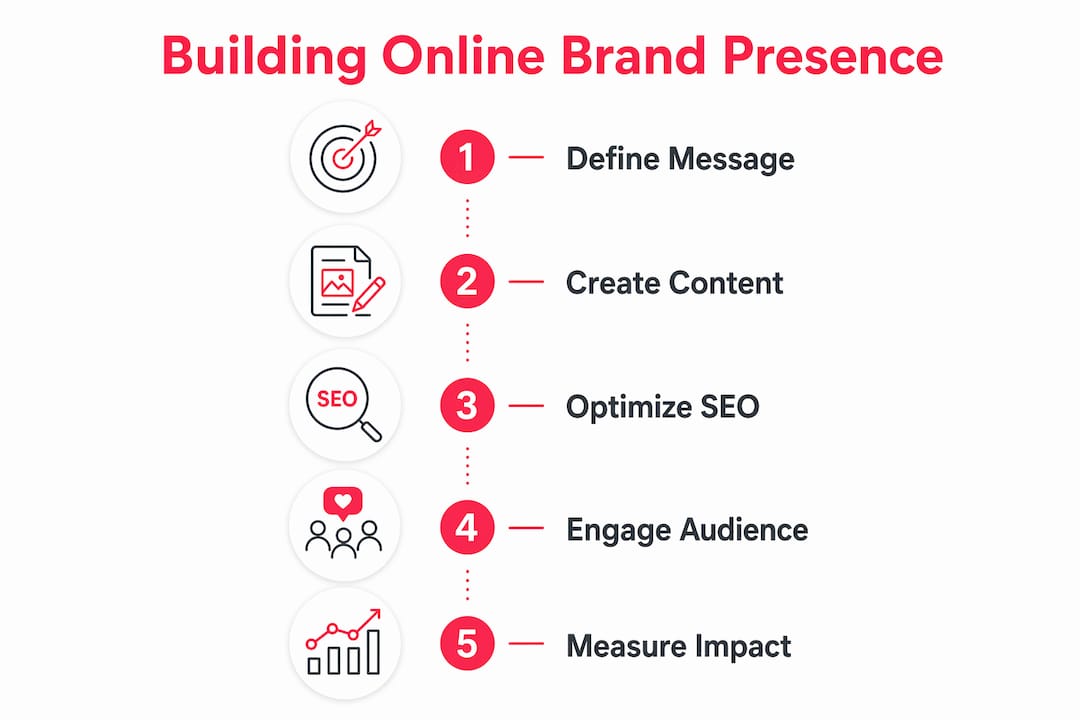
Building online brand visibility does not require a large budget. It requires clarity, consistency, and the discipline to maintain both over time. The businesses that build the strongest digital brands start with a tight value proposition and expand from there.
Start with messaging, not media
Before you post on LinkedIn or commission a new website, define what your brand actually stands for. Write one sentence that explains who you help, what you do, and why it matters. Every piece of content, every review response, and every social post should reflect that sentence. Starting with clear messaging and focused direct feedback is more effective for early brand building than mass marketing.
One practical method worth knowing is the “talk to seven” approach. Before investing in broad campaigns, speak directly with seven existing or potential customers. Ask them how they describe your business to others. Their language is almost always more compelling than anything a marketing team writes in isolation. Use their words in your headlines, your meta descriptions, and your social bios.
Manage your search footprint actively
Your search footprint includes your website, your Google Business Profile, your review listings on Trustpilot or Google, and your social media profiles. Outdated or inconsistent branding across these touchpoints harms customer confidence and costs you sales before a conversation even begins.
The key areas to audit and maintain:
- Website: Up-to-date product or service information, fast load times, and mobile-optimised design.
- Reviews: Actively request reviews from satisfied customers. Respond to every review, positive or negative, within 48 hours.
- Social profiles: Consistent profile images, bios, and contact details across every platform you use.
- Photography and visuals: Consistent imagery across your Google Business Profile, website, and social channels builds instant recognition.
Create content that demonstrates expertise
Content is the mechanism by which your brand earns authority. A blog post that answers a real customer question, a case study that shows your process, or a short video explaining a common problem in your industry all build credibility that a paid advert cannot replicate. For UK ecommerce retailers, understanding SEO strategies for retail brands is a practical starting point for aligning content with search demand.
| Brand-building activity | Primary benefit | Effort level |
|---|---|---|
| Google Business Profile optimisation | Local search visibility | Low |
| Review generation programme | Trust and SEO rankings | Low |
| Consistent social media presence | Brand recall and engagement | Medium |
| Blog and content marketing | Organic authority and backlinks | Medium |
| Guest contributions and PR | Domain authority and reach | High |
Pro Tip: Do not try to be active on every social platform at once. Pick one or two channels where your customers actually spend time, and do those well before expanding.
How do you measure and maintain your online brand presence?
Measuring online brand visibility requires tracking signals that most analytics dashboards do not surface by default. Vanity metrics like follower counts tell you very little. The metrics that matter are the ones tied to trust, engagement, and commercial outcomes.
Track these consistently:
- Branded search volume: Use Google Search Console to monitor how many people search your brand name each month. Growth here indicates your offline and online efforts are building recognition.
- Review volume and average rating: Set a target for monthly review acquisition and monitor your average rating across Google, Trustpilot, and any sector-specific platforms.
- Organic click-through rate: A rising CTR from search results, without a change in ranking position, often signals improved brand recognition among searchers.
- Direct traffic: Users who type your URL directly or find you via a bookmark are your most loyal audience. Growth in direct traffic is a reliable indicator of brand strength.
- Brand mentions: Use tools like Google Alerts or a social listening platform to track unlinked mentions of your brand name. These are opportunities to engage and, where appropriate, request a link.
Pro Tip: Set up a monthly brand audit. Spend 30 minutes reviewing your top search results, your most recent reviews, and your social profile accuracy. Small inconsistencies compound into significant trust problems if left unchecked.
Consistent branding across all touchpoints is not a one-time project. It is an ongoing commitment that pays dividends in customer retention and referral quality. Schedule a quarterly review of your brand messaging to check it still reflects your current offer and market position.
Key takeaways
Investing in your online brand presence is the single most effective way to build compounding digital authority that improves SEO, conversion rates, and customer loyalty simultaneously.
| Point | Details |
|---|---|
| Brand presence drives SEO | Recognised brands earn higher click-through rates and organic backlinks without additional paid spend. |
| Trust converts better than rankings | Familiarity reduces purchase hesitation, making brand investment more valuable than chasing top positions alone. |
| Consistency is non-negotiable | Outdated or mismatched branding across your website, reviews, and social profiles actively costs you sales. |
| Start with messaging clarity | Define your value proposition before investing in any channel; use real customer language to shape it. |
| Measure what matters | Track branded search volume, review ratings, and direct traffic rather than follower counts or impressions. |
Why I think most businesses invest in brand presence too late
From where I sit, having worked with ecommerce brands across the UK for well over a decade, the pattern is almost always the same. Businesses invest heavily in paid advertising, chase short-term ranking gains, and treat branding as something to sort out later when the budget allows. Then they wonder why their cost per acquisition keeps climbing and their organic traffic plateaus.
The uncomfortable truth is that brand investment pays back slowly at first and then very quickly. The businesses that started building consistent digital identities three or four years ago are now the ones with strong branded search volumes, natural backlink profiles, and review counts that a new competitor cannot replicate overnight. That compounding effect is the real argument for investing early.
I have also seen what happens when messaging is inconsistent. A business with a polished website, an outdated Google Business Profile, and a handful of unanswered reviews looks unreliable to a first-time visitor. That visitor does not call to ask for clarification. They click back and choose someone else. The web design and branding relationship matters enormously here. Your site is not just a catalogue. It is the clearest signal of whether your business can be trusted.
The other thing I would push back on is the idea that brand building is only for large businesses with large budgets. The “talk to seven” method costs nothing. A well-maintained Google Business Profile costs nothing. Responding to reviews costs nothing. The businesses that win online are not always the ones with the biggest spend. They are the ones with the clearest identity and the discipline to maintain it.
— Steve
How Bigeyedeers helps you build a stronger brand online
If you are ready to move from scattered digital activity to a coherent brand presence that drives real commercial results, Bigeyedeers is the team to call.
We are a UK-based ecommerce agency with offices in Cardiff and Exeter, and over 17 years of experience building high-performing online stores on Magento and Shopify. We do not just build websites. We design the full brand experience, from Figma wireframes and user journey planning through to Klaviyo lifecycle marketing and Klevu product discovery. Every decision we make is tied to visibility, trust, and growth. Visit our Shopify agency services or meet the Bigeyedeers team to find out how we can help your brand compete and convert online.
FAQ
Why does online brand presence matter for SEO?
Brand recognition increases branded search volume and organic click-through rates, both of which Google treats as trust signals. Positive reviews also act as direct ranking factors, making brand investment and SEO inseparable.
How long does it take to see results from brand investment?
Brand building compounds over time, with meaningful SEO and conversion improvements typically visible within six to twelve months of consistent effort. Early wins, such as improved review ratings and direct traffic, often appear within the first few weeks.
What is the most important first step to build a brand online?
Define a single clear value proposition before investing in any channel. Use real customer language gathered from direct conversations to shape your messaging, then apply it consistently across your website, social profiles, and review responses.
How do reviews affect online brand presence?
Positive reviews signal trust to both search engines and prospective customers. They improve local search rankings and reduce purchase hesitation, making review generation one of the highest-return brand activities available to small and mid-sized businesses.
Can small businesses compete on brand presence against larger competitors?
Yes. Trust is the key differentiator for small businesses competing digitally, and trust is built through consistency and authenticity rather than budget size. A well-maintained profile, clear messaging, and genuine customer reviews outperform a large but impersonal brand presence.
Recommended



Adobe Commerce (Magento)
Formerly known as Magento, Adobe Commerce is built for complex catalogues, integrations, and long term growth. We design and develop stable, scalable stores that support demanding eCommerce requirements, including multi-store setups, complex pricing, and Hyva based performance improvements.

Bespoke Build
We design and build custom eCommerce platforms for businesses with complex workflows, integrations, or non standard requirements. Built from scratch around your business needs using Laravel and modern architectures.
Working with brands across the UK from our offices in Cardiff and Exeter, you deal directly with a senior team of designers and developers specialising in Shopify, Magento, WordPress and bespoke eCommerce platforms.
We focus on commercial outcomes. Better conversion rates, strong SEO foundations and eCommerce platforms that continue to improve long after launch.