Role of content strategy online: 2026 business guide
TL;DR:
- A documented content strategy aligns content decisions with business goals, audience needs, and brand conviction. It drives higher ROI, generates more leads, and builds trust by focusing on pipeline-aligned outcomes and authoritative content. AI changing search priorities emphasizes the need for strategic governance, original insights, and measurable commercial impact.
A content strategy online is a documented governance plan that aligns every content decision with business objectives, audience needs, and brand conviction. The industry term for this discipline is content strategy, distinct from content marketing, which covers execution and distribution. The role of content strategy online goes far beyond maintaining an editorial calendar. According to Techradiant, documented strategies generate three times more leads per dollar and achieve 33% higher ROI than ad-hoc content production. For digital marketing professionals and business owners, understanding this distinction is the difference between content that compounds in value and content that simply fills a feed.
What measurable impact does a documented content strategy deliver?
The business case for formal digital content planning is built on hard numbers, not theory. Documented content strategies generate three times more leads per dollar compared to unplanned content production. That gap exists because documented strategies force alignment between content topics and buyer journey stages, eliminating wasted effort on content nobody needs.

Trust is the second major lever. Research from WordStream shows that 64% of buyers trust brands that provide consistent educational content. That figure rises to 73% after just one week of regular content consumption. Consistent educational content does not just build awareness. It shortens sales cycles by establishing credibility before a prospect ever speaks to your team.
The financial return is equally clear. Content marketing delivers approximately $3 for every £1 invested when the focus shifts from traffic metrics to pipeline-aligned outcomes. The critical word there is “pipeline-aligned.” Brands that measure content by page views alone consistently underestimate its commercial contribution.
| Metric | Finding | Source |
|---|---|---|
| Lead generation efficiency | 3x more leads per dollar vs. ad-hoc content | Techradiant 2026 |
| ROI uplift | 33% higher ROI with documented strategy | Techradiant 2026 |
| Buyer trust at week one | 64% trust brands with educational content | WordStream 2026 |
| Buyer trust after one week | Rises to 73% with consistent consumption | WordStream 2026 |
| Pipeline ROI | $3 return per $1 invested (pipeline focus) | Techradiant 2026 |
Pro Tip: Swap activity metrics like page views and social shares for impact metrics: pipeline contribution, revenue influenced, and customer lifetime value. These are the numbers your C-suite actually cares about.
How has AI changed the role of digital strategy for content?
The content strategy impact of AI is real, but it is frequently misunderstood. AI is a tool for reducing production costs, not a replacement for human insight and original brand frameworks. Brands that treat AI as a content factory produce more volume, but volume without authority is invisible in modern search environments.
The Content Marketing Institute describes a fundamental shift in how content earns visibility. Modern strategies prioritise authority, engagement, and citation in AI-driven search rather than pure keyword rankings. This is sometimes called the “Share of Model” concept: the goal is to earn citations inside AI overview engines like Google’s AI Overviews, ChatGPT, and Perplexity, not just to rank on page one.
What does this mean in practice? Content that gets cited by AI systems tends to share specific characteristics:
- Answer-first structure: The core claim appears in the first sentence, not buried in paragraph four.
- Named entities and proprietary frameworks: AI systems favour content that references specific tools, methodologies, and data points over generic advice.
- Structured data and clear headings: Schema markup and logical heading hierarchies help AI engines parse and attribute content correctly.
- Unique human insight: Original research, case studies, and brand-specific perspectives cannot be replicated by AI generation tools.
The practical implication for your content programme is a shift from producing fifty average posts per quarter to producing ten genuinely authoritative pieces. Brands winning in 2026 use AI to reduce production costs and then invest the savings into deeper research, better distribution, and more intensive promotion of fewer, higher-quality assets. The role of AI in content strategy is explored further in this analysis of AI and SEO success.
Pro Tip: Format key articles with a direct definition or claim in sentence one, use H2 question headings, and add FAQ schema markup. This combination significantly improves your chances of appearing in AI-generated answers.
Content strategy vs content marketing: why the difference matters
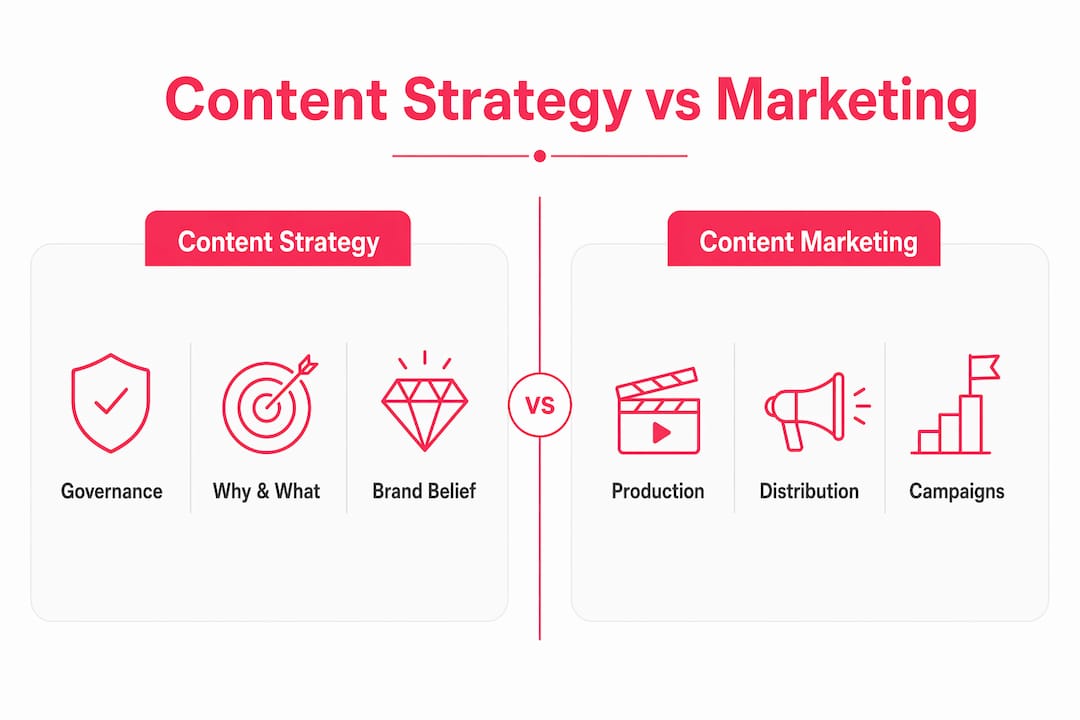
Content strategy is a governance function, not a publishing schedule. It answers the “why” and “what” questions: why does this content exist, what beliefs does it express, and how does it serve both the audience and the business? Content marketing, by contrast, answers the “how” and “where” questions: how do we produce and distribute content to reach our audience?
Conflating the two is one of the most common and costly mistakes in digital content planning. Conflating strategy with marketing causes inconsistent messaging, wasted resources, and content programmes that generate activity without commercial impact. A brand that publishes consistently without a governing strategy ends up with a catalogue of disconnected posts that reflect trends rather than brand conviction.
The Starfish framework for content strategy introduces the concept of brand conviction: the documented set of beliefs and positions that every piece of content must express. This is not a tone-of-voice guide. It is a strategic filter that determines which topics the brand should own and which it should ignore.
| Dimension | Content Strategy | Content Marketing |
|---|---|---|
| Primary question | Why does this content exist? | How do we produce and distribute it? |
| Focus | Governance, positioning, taxonomy | Publishing, promotion, channel management |
| Output | Strategic framework and decision rights | Blog posts, videos, social content, email |
| Time horizon | Long-term brand equity and compounding value | Campaign-level and quarterly performance |
| Risk of neglect | Inconsistent messaging, wasted investment | Missed distribution opportunities |
The compounding value point deserves emphasis. A well-governed content strategy builds topical authority over time. Each new piece reinforces the brand’s position on a set of owned topics, making the overall content programme worth more than the sum of its individual parts. Without that governance layer, each post starts from zero. For ecommerce brands in particular, the strategic role of content in driving long-term commercial performance is significant.
How to develop an effective online content strategy today
Building an effective content strategy for websites and digital channels requires more than picking topics and setting a publishing cadence. The governance elements come first. Here is a practical sequence we recommend:
- Define your brand conviction. Document the specific beliefs and positions your brand holds on the topics it covers. This is your strategic filter for every content decision.
- Map your audience with precision. Go beyond demographics. Identify the questions your audience asks at each stage of the buying journey, and the formats they prefer for each stage.
- Establish decision rights. Decide who approves content, who owns each content type, and what the escalation path looks like when content does not align with strategy.
- Build your content taxonomy. Create a structured classification system for your content: topics, subtopics, content types, and buyer journey stages. This prevents duplication and identifies gaps.
- Set pipeline-aligned measurement. Define success in terms of revenue influenced, pipeline contribution, and customer lifetime value. Vanity metrics mislead teams; real success requires measuring multi-touch pipeline contribution over a 36-month horizon.
- Integrate AI as a production tool. Use AI to draft, research, and repurpose content. Reserve human effort for original insights, proprietary data, and brand-specific frameworks that AI cannot replicate.
- Plan omni-channel distribution. A single piece of authoritative content should appear across email via Klaviyo, organic search, social channels, and sales enablement materials. Distribution intensity multiplies the return on each content investment.
- Review and optimise quarterly. Measure content performance against pipeline metrics, update high-performing pieces with new data, and retire content that no longer reflects your brand conviction.
C-suite leadership now expects content measurement linked to revenue impact, AI visibility, customer lifetime value, and operational efficiency. Building your measurement framework around these dimensions from the outset positions your content programme as a commercial asset, not a marketing cost centre.
Pro Tip: Involve sales, operations, and customer service teams in your content planning process. They know the questions prospects actually ask and the objections that stall deals. That intelligence is worth more than any keyword research tool.
For ecommerce brands, writing content for online stores requires this same governance thinking applied to product pages, category descriptions, and buying guides, not just blog content.
Key takeaways
A documented content strategy is the single most important factor separating content programmes that generate measurable commercial returns from those that simply produce output.
| Point | Details |
|---|---|
| Strategy is governance, not publishing | Define why content exists and what brand beliefs it expresses before producing anything. |
| Documented strategies outperform ad-hoc content | Formal plans generate 3x more leads per dollar and 33% higher ROI than unplanned production. |
| AI reduces costs, not strategic thinking | Use AI for production efficiency; invest the savings in original insights and deeper distribution. |
| Measure pipeline, not page views | Link content performance to revenue influenced, customer lifetime value, and AI citation visibility. |
| Strategy and marketing are distinct disciplines | Conflating governance with execution causes inconsistent messaging and wasted investment. |
Why most content programmes fail before they start
After working with ecommerce brands for over 17 years, I have seen the same pattern repeat itself. A business invests in content, produces a reasonable volume of posts, and then wonders why the commercial needle does not move. The answer is almost always the same: they started with a content calendar instead of a content strategy.
A calendar tells you what to publish and when. A strategy tells you why any of it should exist. Without that “why,” content teams end up chasing trends, reacting to competitors, and producing material that reflects what is easy to write rather than what the brand genuinely owns. The result is a catalogue of disconnected assets that builds no authority and converts nobody.
The AI era has made this problem more urgent, not less. When AI tools can produce a competent 1,000-word article in minutes, the only content worth producing is content that AI cannot replicate: original research, proprietary frameworks, and genuine brand perspective. Brands that have not documented their conviction and their owned topics will find their content indistinguishable from machine-generated noise.
The measurement conversation has also shifted. I have sat in enough board meetings to know that “we increased organic traffic by 40%” no longer satisfies a commercially minded leadership team. They want to know how content influenced pipeline, shortened sales cycles, and reduced customer acquisition costs. If your content programme cannot answer those questions, it is at risk regardless of how good the writing is.
The opportunity here is real. Most brands have not made this shift yet. A well-governed, pipeline-aligned content strategy built around genuine brand conviction is still a genuine competitive advantage in most sectors.
— Steve
How Bigeyedeers supports your content and commerce strategy
At Bigeyedeers, we understand that content strategy and ecommerce performance are not separate conversations. The brands that grow fastest are the ones that align their content governance with their store architecture, their customer data, and their commercial goals from day one.

Whether you are building on Magento or Shopify, our team at Bigeyedeers brings over 17 years of ecommerce experience to help you connect content planning with measurable store performance. From Klaviyo lifecycle marketing to Klevu-powered product discovery, we build the infrastructure that makes a content strategy work commercially. If you want to understand how strategic content planning fits into a high-performing online store, explore our Shopify services or get in touch to discuss your specific requirements.
FAQ
What is the role of content strategy online?
Content strategy online is a governance framework that aligns all content decisions with business objectives, audience needs, and brand conviction. It determines why content exists, what it should express, and how it connects to commercial outcomes.
How does content strategy differ from content marketing?
Content strategy governs positioning, taxonomy, and brand belief. Content marketing handles production, distribution, and promotion. Conflating the two leads to inconsistent messaging and wasted resources.
What ROI can a documented content strategy deliver?
Documented strategies generate three times more leads per dollar and achieve 33% higher ROI than ad-hoc content production, according to Techradiant. Pipeline-focused content delivers approximately $3 for every $1 invested.
How should content strategy adapt to ai-driven search?
Modern content strategies should prioritise earning citations in AI overview engines rather than chasing keyword rankings alone. Answer-first formatting, structured data, and proprietary insights are the key signals AI systems reward.
What metrics should i use to measure content strategy success?
Measure revenue influenced, pipeline contribution, customer lifetime value, and AI citation visibility. C-suite leadership now expects these impact metrics rather than activity metrics like page views or social shares.
Recommended



Adobe Commerce (Magento)
Formerly known as Magento, Adobe Commerce is built for complex catalogues, integrations, and long term growth. We design and develop stable, scalable stores that support demanding eCommerce requirements, including multi-store setups, complex pricing, and Hyva based performance improvements.

Bespoke Build
We design and build custom eCommerce platforms for businesses with complex workflows, integrations, or non standard requirements. Built from scratch around your business needs using Laravel and modern architectures.

Working with brands across the UK from our offices in Cardiff and Exeter, you deal directly with a senior team of designers and developers specialising in Shopify, Magento, WordPress and bespoke eCommerce platforms.
We focus on commercial outcomes. Better conversion rates, strong SEO foundations and eCommerce platforms that continue to improve long after launch.