Hyvä frontend benefits for Magento ecommerce
TL;DR:
- Hyvä is a modern Magento frontend theme built on Tailwind CSS and Alpine.js, offering significant performance and developer experience improvements by reducing JavaScript payload by up to 90%. This results in faster page loads, better Core Web Vitals, higher search rankings, and increased conversion rates, often between 8 and 25%. It maintains full backend compatibility while simplifying extension integration, enabling faster development cycles and more maintainable stores.
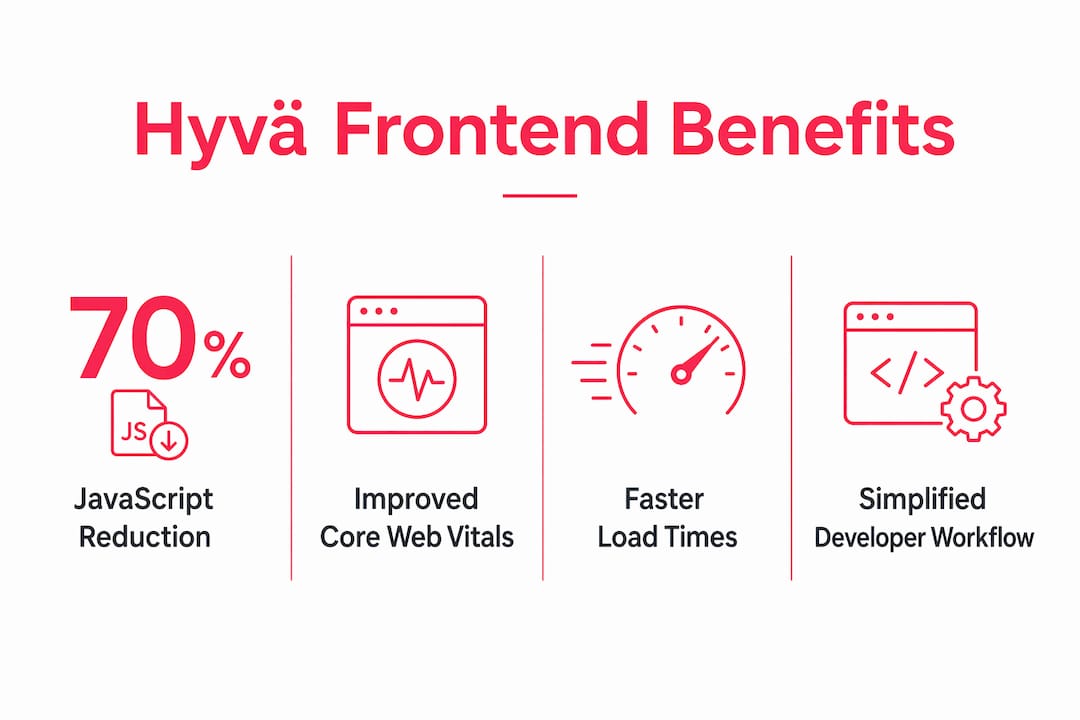
Hyvä is a modern Magento frontend theme that replaces the legacy Luma architecture with a lightweight stack built on Tailwind CSS and Alpine.js, delivering measurable improvements in performance, developer experience, and user experience. For web developers and ecommerce professionals running Adobe Commerce or Magento Open Source stores, the Hyvä frontend benefits are direct and quantifiable: faster page loads, cleaner code, and better conversion rates. Where Luma ships 2 to 8 MB of JavaScript, Hyvä ships under 300 KB, a reduction of 70 to 90% that changes what is possible for store performance and SEO. This guide covers what that means in practice, from Core Web Vitals to developer onboarding and real-world revenue outcomes.
How does Hyvä frontend improve ecommerce site performance?
Hyvä’s performance advantage over Luma is not marginal. The JavaScript payload reduction of 70 to 90% is the single biggest driver of improved Core Web Vitals scores, including Largest Contentful Paint (LCP), Cumulative Layout Shift (CLS), and First Input Delay (FID). These three metrics directly influence Google’s search rankings, which means a Hyvä migration is simultaneously a performance upgrade and an SEO investment.
The practical impact on Lighthouse scores is consistent. Hyvä’s minimal tech stack enables consistently high Lighthouse scores and superior Core Web Vitals performance, translating into faster loading times and enhanced customer experience. For merchants competing in crowded categories, a faster storefront is a genuine commercial differentiator, not just a technical nicety.
The conversion rate data backs this up. Stores migrating to Hyvä have recorded conversion rate increases of 8 to 25%, with revenue growth of 15% reported in 2026 case studies. That is not a coincidence. Faster pages reduce bounce rates, improve product discovery, and lower the friction between intent and purchase.
Here is what the performance picture looks like in concrete terms:
- JavaScript payload: Under 300 KB on Hyvä versus 2 to 8 MB on Luma
- Core Web Vitals: LCP, CLS, and FID all improve significantly with reduced JS blocking
- Lighthouse scores: Consistently high across mobile and desktop
- Conversion uplift: 8 to 25% increases documented across multiple store migrations
- SEO impact: Improved page speed signals feed directly into Google’s ranking algorithm
The SEO angle is worth dwelling on. Google’s Core Web Vitals are a confirmed ranking factor, and Luma stores routinely fail mobile performance thresholds. Switching to Hyvä does not just make your store faster for users. It makes it more visible in organic search, which compounds the revenue benefit over time.
Pro Tip: Before migrating, run a Lighthouse audit on your current Luma store and record your baseline LCP and CLS scores. This gives you concrete before-and-after data to demonstrate ROI to stakeholders after the Hyvä migration.
What are the developer experience advantages of Hyvä?
Hyvä’s developer experience improvements are as significant as its performance gains, and they are often underestimated by merchants evaluating the switch. The core of the advantage is the technology stack. Tailwind CSS and Alpine.js replace Knockout.js and RequireJS, two frameworks that most modern frontend developers find unfamiliar and difficult to debug. This is not just a preference issue. It has a direct impact on how quickly developers can build, test, and ship frontend changes.

Magento’s legacy frontend is notoriously complex. Layout XML files, UI Components, and RequireJS module definitions create layers of abstraction that slow down even experienced Magento developers. Hyvä drastically reduces XML configuration and complexity, with templates focused on minimal PHP and direct HTML attributes. The result is code that is easier to read, easier to debug, and easier to hand over to another developer.
Onboarding is faster too. Hyvä’s simplified frontend stack shortens onboarding for developers new to a project, reducing time spent navigating complex Magento UI Components and layout XML. A developer who knows Tailwind CSS and basic Alpine.js can be productive on a Hyvä project within days. The same developer on a Luma project might spend weeks just understanding the existing architecture before writing a single line of meaningful code.
Frontend developers describe this as a cultural shift. The move to standard HTML, Tailwind CSS, and Alpine.js brings Magento frontend development back in line with how modern web development works everywhere else. That matters for hiring, for agency partnerships, and for the long-term maintainability of your store.
How does Hyvä handle backend compatibility and extensions?
One of the most common misconceptions about Hyvä is that it requires significant backend changes. It does not. Hyvä is server-side rendered within Magento’s existing backend, requiring no changes to admin panels or the database. It is not a PWA or a headless solution. The Magento backend, including all catalogue management, order processing, and admin functionality, remains completely unchanged.
This is an important distinction for merchants who are nervous about the scope of a frontend migration. You are replacing the theme layer, not the platform. Your ERP integrations, payment gateways, and admin workflows all continue to function exactly as before.
The area that does require attention is third-party extensions. Many Magento extensions require Hyvä-compatible templates or overrides due to frontend architecture differences versus the Luma theme. This is because extensions that render frontend output were built against Luma’s template structure, and Hyvä’s templates are fundamentally different.
Here is how to approach extension compatibility practically:
- Audit your extension list before migration and identify which ones render frontend output (product pages, checkout, search, reviews)
- Check the Hyvä compatibility repository, which tracks known-compatible extensions and available modules
- Prioritise checkout and search extensions, as these are the highest-risk areas for compatibility gaps
- Budget for template overrides where no compatible module exists, as custom work is sometimes required
- Test in a staging environment thoroughly before going live, particularly for checkout flows
Licensing is also worth noting. Hyvä is a commercial product requiring a per-project licence. The investment is offset by savings in development time and improved store performance, but it is a cost to factor into your project budget from the outset.
What practical ecommerce benefits does Hyvä frontend deliver?
The business case for Hyvä is clearest when you look at real store outcomes. Gaudì Fashion is one of the most cited examples. After adopting Hyvä on Adobe Commerce, the brand saw page speed improve by 30%, conversion rate climb 10%, and revenue grow 15%. Frontend development time was cut by 50%, which meant campaign features and seasonal updates could be shipped significantly faster.
That last point matters more than it might seem. In ecommerce, the ability to iterate quickly on frontend features is a genuine competitive advantage. If your development team can ship a new promotional banner, a revised product page layout, or a checkout optimisation in hours rather than days, you can test more, learn faster, and respond to trading conditions in real time.
Here is how the practical benefits stack up across the business:
- Faster page loads reduce bounce rates and improve the shopping experience, particularly on mobile where Luma performance is weakest
- Better Core Web Vitals improve organic search rankings, reducing reliance on paid acquisition
- Shorter development cycles mean frontend changes reach customers faster, supporting agile trading and campaign execution
- Improved product discovery is supported by integrations with tools like Klevu, which work well within Hyvä’s clean template structure
- Stronger brand perception comes from a store that feels fast and responsive, which builds trust with first-time visitors
“The shift to Hyvä is not just a technical upgrade. It is a commercial decision that pays back through faster delivery, better SEO, and a store that converts at a higher rate.” — Bigeyedeers
For merchants using Klevu for search and merchandising, Hyvä’s lean template structure makes integration cleaner and more maintainable than on Luma. The same applies to Klaviyo-driven personalisation on product and category pages. A faster, simpler frontend makes every layer of your ecommerce stack easier to work with.
You can read more about how Hyvä impacts store speed and sales outcomes in our dedicated breakdown, or explore the Luma versus Hyvä comparison if you are still weighing up the architectural decision.
Key takeaways
Hyvä frontend delivers its most significant benefits through JavaScript payload reduction, which directly improves Core Web Vitals, developer productivity, and ecommerce conversion rates.
| Point | Details |
|---|---|
| Performance gains are substantial | Hyvä reduces JavaScript payload by 70 to 90%, improving Core Web Vitals and Lighthouse scores significantly. |
| Conversion rates increase measurably | Stores migrating to Hyvä have recorded conversion rate increases of 8 to 25% and revenue growth of 15%. |
| Developer onboarding is faster | Tailwind CSS and Alpine.js replace Knockout.js, reducing complexity and shortening time to productivity. |
| Backend remains unchanged | Hyvä is server-side rendered within Magento’s existing backend, requiring no admin or database changes. |
| Extension compatibility needs planning | Third-party extensions often require Hyvä-compatible templates, so an audit before migration is necessary. |
Why Hyvä changed how we think about Magento frontend work
I have been working with Magento stores for a long time, and the honest truth is that Luma frontend development was never enjoyable. Knockout.js is a framework that most modern developers have never encountered outside of Magento, and the XML layout system creates a level of indirection that makes even simple changes feel disproportionately complicated. Every new developer we brought onto a Magento project faced the same steep learning curve, and that cost time and money on every engagement.
Hyvä changed that dynamic. The first time I worked on a Hyvä project, the thing that struck me most was not the performance numbers. It was how quickly the team could move. Tailwind CSS and Alpine.js are tools that developers already know. The templates are readable. The debugging is straightforward. That simplicity compounds over the life of a project in ways that are hard to quantify but very easy to feel.
The extension compatibility issue is real, and I would not minimise it. On complex stores with many third-party modules, the pre-migration audit and compatibility work can add meaningful time to a project. But in every case we have handled, that upfront investment has been recovered within the first few months of improved development velocity.
My honest view is that for any Magento merchant investing in their store for the long term, Hyvä is the right frontend choice. The performance benefits are proven, the developer experience is genuinely better, and the commercial outcomes speak for themselves. The question is not really whether to adopt Hyvä. It is when, and how to plan the migration properly.
— Steve
How Bigeyedeers can help with your Hyvä migration
Bigeyedeers is a UK-based ecommerce agency with over 17 years of experience building and supporting Magento stores, including Magento Open Source and Adobe Commerce. We specialise in Hyvä frontend implementations for growing and enterprise retail brands, handling everything from pre-migration extension audits to full theme builds and ongoing support. Our team uses Figma for UX planning before development begins, so every Hyvä project is grounded in clear user journeys and interface decisions before a line of code is written. If you are ready to move beyond Luma and build a faster, more maintainable storefront, we would be glad to talk through what that looks like for your store.
FAQ
What is Hyvä frontend for Magento?
Hyvä is a commercial Magento frontend theme built on Tailwind CSS and Alpine.js, replacing the legacy Luma theme to deliver significantly faster page loads and a simpler developer experience.
How much faster is Hyvä compared to Luma?
Hyvä ships under 300 KB of JavaScript compared to 2 to 8 MB on Luma, a reduction of 70 to 90%, which directly improves Core Web Vitals scores and page load times.
Does Hyvä work with existing Magento extensions?
Many extensions require Hyvä-compatible templates or overrides because they were built against Luma’s frontend architecture. An extension audit before migration is strongly recommended.
Is Hyvä suitable for Adobe Commerce stores?
Yes. Hyvä is server-side rendered within Magento’s existing backend and works with both Magento Open Source and Adobe Commerce without requiring changes to the admin panel or database.
What conversion rate improvements can Hyvä deliver?
Stores migrating to Hyvä have recorded conversion rate increases of 8 to 25%, with Gaudì Fashion reporting a 10% conversion uplift and 15% revenue growth after adoption.
Recommended



Adobe Commerce (Magento)
Formerly known as Magento, Adobe Commerce is built for complex catalogues, integrations, and long term growth. We design and develop stable, scalable stores that support demanding eCommerce requirements, including multi-store setups, complex pricing, and Hyva based performance improvements.

Bespoke Build
We design and build custom eCommerce platforms for businesses with complex workflows, integrations, or non standard requirements. Built from scratch around your business needs using Laravel and modern architectures.
Working with brands across the UK from our offices in Cardiff and Exeter, you deal directly with a senior team of designers and developers specialising in Shopify, Magento, WordPress and bespoke eCommerce platforms.
We focus on commercial outcomes. Better conversion rates, strong SEO foundations and eCommerce platforms that continue to improve long after launch.