Why unified commerce matters for retail growth in 2026
TL;DR:
- Unified commerce unifies customer data, inventory, and orders on a single, real-time platform for all channels. It enables consistent customer experiences, reduces fulfillment errors, and drives faster growth compared to less integrated approaches. Successful adoption depends on high data quality, organizational alignment, and prioritizing shared data layers over mere API integrations.
Unified commerce is defined as a single, connected platform that synchronises customer data, inventory, orders, and fulfilment in real time across every channel a business operates. Where fragmented systems create blind spots and broken promises, unified commerce creates clarity. According to Manhattan Associates, the platform exposes real-time views to every team, enabling faster decisions and fewer surprises. The stakes are real: only 7% of retailers have achieved true unified commerce leadership as of 2026, while 33% remain in the basic category. For business leaders and eCommerce professionals, that gap represents both a warning and an opportunity.
Why unified commerce matters more than ever in 2026
The retail environment has shifted decisively. Customers now expect to browse online, collect in store, return via post, and receive consistent pricing and stock information at every step. Delivering that experience requires more than good intentions. It requires every system in your business to share the same data, at the same time, without reconciliation delays. That is precisely what unified commerce provides.

Salesforce defines unified commerce as a business strategy and technology stack built around a single source of truth, unifying pricing, inventory availability, promotions, and messaging across all channels in real time. The practical effect is that a customer service agent, a warehouse picker, and a store associate all see identical information simultaneously. No more “the website said it was in stock” complaints. No more split orders caused by inventory blind spots.
The importance of unified commerce becomes clearest when you look at growth outcomes. Retailers classified as unified commerce leaders enjoy nearly double the growth rate of their basic-tier peers. That benchmark, drawn from over 400 speciality retailers and 330 assessed capabilities, is not a theoretical projection. It is a measured commercial result from businesses that made the investment in data unification.
How does unified commerce differ from omnichannel and integrated commerce?
This is the question we hear most often from eCommerce directors and operations leads, and the confusion is understandable. The three terms are frequently used interchangeably, but they describe meaningfully different approaches.
Integrated commerce connects separate systems through APIs and middleware. Your OMS talks to your ERP, your ecommerce platform syncs with your POS, and data moves between them on a schedule or via triggers. The systems remain distinct. Deposco clarifies that integrated commerce still involves data reconciliation delays and the risk of inconsistencies building up between syncs. It is better than nothing, but it is not unified.
Omnichannel commerce focuses on the customer experience layer. It is about designing consistent journeys across touchpoints: click and collect, cross-channel returns, unified loyalty programmes. The problem is that omnichannel can be built on top of disconnected back-end systems. You can have a polished front-end experience while your inventory data is still siloed. For a deeper look at how omnichannel ecommerce differs from true unification, it is worth understanding the architectural distinction.
Unified commerce goes further than both. It replaces the patchwork of integrations with a shared data layer that all channels draw from simultaneously. There is no sync. There is no reconciliation. Every system reads from and writes to the same record.
| Approach | Data model | Real-time accuracy | Customer experience |
|---|---|---|---|
| Integrated commerce | Separate systems, synced periodically | Moderate, sync-dependent | Inconsistencies possible |
| Omnichannel commerce | Separate back ends, unified front end | Variable | Consistent surface, fragile underneath |
| Unified commerce | Single shared data layer | High, always current | Consistent at every layer |
Pro Tip: When evaluating a vendor’s “unified commerce” claim, ask specifically whether their platform uses a single shared data model or whether channels are connected via APIs and middleware. The answer tells you immediately whether you are looking at true unification or sophisticated integration.
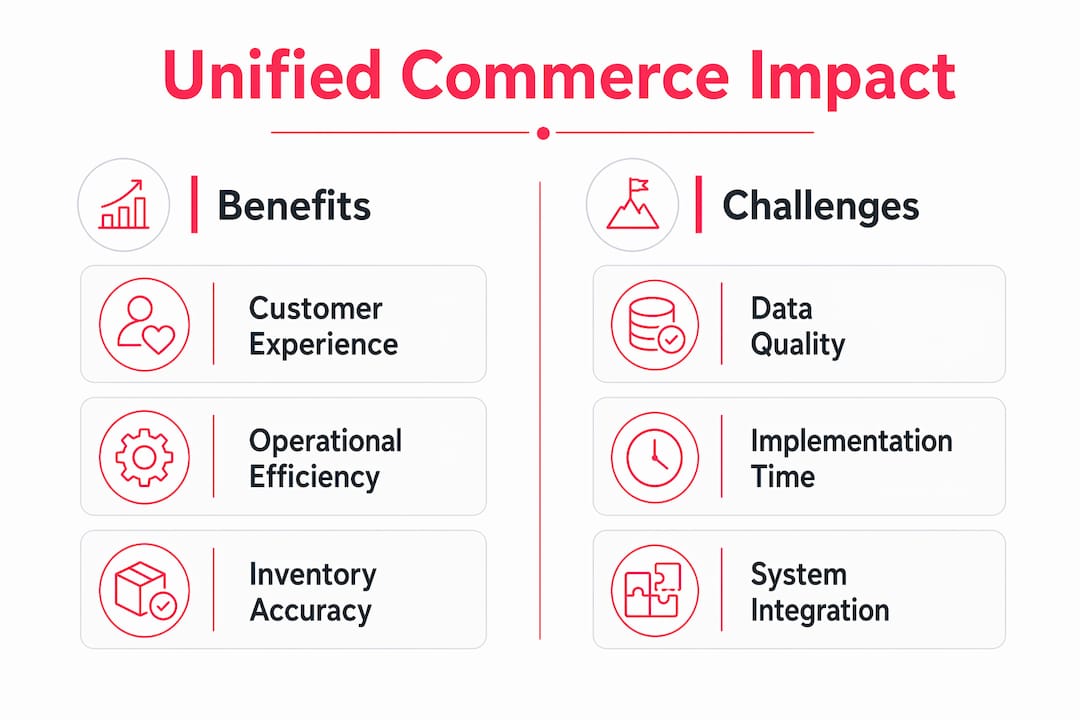
What are the core benefits of unified commerce for customer experience and operations?
The benefits of unified commerce fall into two categories: what customers feel and what your operations team gains. Both matter, and they are directly connected.
From a customer perspective, unified commerce delivers consistent buying experiences by unifying pricing, inventory availability, promotions, and messaging across all channels simultaneously. A customer who adds an item to their basket on mobile and completes the purchase in store encounters no friction, no price discrepancy, and no stock surprise. That consistency builds trust, and trust drives repeat purchase.
From an operational perspective, the gains are equally significant:
- Fewer fulfilment exceptions. When every channel draws from the same inventory record, overselling becomes structurally impossible rather than just unlikely.
- Faster case resolution. Customer service teams with full order visibility resolve queries in minutes rather than hours, because they are not chasing data across systems.
- Reduced operational costs. Eliminating duplicate data entry, manual reconciliation, and error correction frees resource for higher-value work.
- Higher conversion rates. Accurate stock availability displayed at the point of purchase removes a primary reason for basket abandonment.
- Stronger customer loyalty. Consistent, personalised experiences across channels increase retention. Unified data enables personalisation at scale, not just on one channel.
AI integration amplifies all of these gains. The 2026 benchmark identifies AI as a transformative element within unified commerce maturity, enabling dynamic pricing, predictive inventory management, and personalised customer experiences. AI requires clean, unified data to function accurately. Without a shared data foundation, AI tools produce unreliable outputs. With it, they become a genuine commercial advantage.
Why is inventory unification pivotal to a successful unified commerce strategy?
Inventory is where unified commerce either proves itself or falls apart. Shopify highlights that inventory unification is the highest-leverage component of a unified commerce system, underpinning order routing, allocation, and fulfilment promises. Get it right and every downstream process benefits. Get it wrong and the entire customer promise collapses.
Disconnected systems cause duplicated inventory records, split orders, and blind spots that produce stockouts, late deliveries, and higher operational costs. A retailer running separate inventory pools for their website, store network, and wholesale channel will routinely oversell, under-fulfil, and disappoint customers. Unified inventory eliminates those failure modes by making a single, accurate record the only record.
The technical requirements for inventory unification are worth understanding clearly. SKU standardisation across all channels is non-negotiable. If your ecommerce platform uses different product identifiers than your ERP or your POS, the shared data layer cannot function. Master data management, the discipline of maintaining clean, consistent product and inventory records, becomes a foundational capability rather than a back-office concern.
| KPI | Typical improvement with unified inventory |
|---|---|
| Stockout rate | Reduced through real-time visibility across all locations |
| Order split rate | Reduced by accurate, channel-agnostic allocation |
| Fulfilment promise accuracy | Improved by routing based on live stock positions |
| Inventory carrying cost | Reduced by eliminating duplicate safety stock across channels |
For retailers operating multi-store ecommerce environments, inventory unification is the technical prerequisite that makes everything else possible.
What challenges do businesses face when adopting unified commerce?
Adoption is not straightforward, and we would rather be honest about that than oversimplify. The most common barriers we see are not technological in isolation. They are a combination of legacy system complexity, data quality problems, and organisational misalignment.
The specific challenges worth preparing for include:
- Legacy system lock-in. Many retailers have invested heavily in ERP, POS, and OMS platforms that were not designed to share a data layer. Replacing or re-architecting these systems takes time and budget.
- Data quality deficits. Inventory accuracy and data cleanliness are crucial for running an effective unified commerce system. Poor data quality handicaps orchestration before it starts. SKU mismatches, duplicate records, and inconsistent product attributes are common and must be resolved before unification delivers value.
- Integration-first thinking. Many businesses attempt to achieve unified commerce by adding more integrations between existing systems. Deposco is clear that this approach misses the point. More integrations create more reconciliation complexity, not less.
- Cross-team alignment. Unified commerce affects every department: merchandising, logistics, customer service, IT, and finance. Without executive sponsorship and shared ownership of the data layer, projects stall at the organisational boundary.
Pro Tip: Measure your unified commerce programme by business outcomes, not by the number of systems connected. Conversion rate, fulfilment accuracy, and customer satisfaction scores tell you whether unification is working. API connection counts do not.
The gap between leaders and basic players continues to widen, which means the cost of delayed adoption compounds year on year. Businesses that treat unified commerce as a future project rather than a current priority are conceding ground to competitors who have already made the move.
Key takeaways
Unified commerce matters because it replaces fragmented, sync-dependent systems with a single shared data layer that drives consistent customer experiences, accurate fulfilment, and measurable commercial growth.
| Point | Details |
|---|---|
| Single data layer is the differentiator | True unified commerce shares one real-time record across all channels, not synced copies. |
| Leaders grow nearly twice as fast | The 2026 benchmark shows unified commerce leaders achieve close to double the growth of basic-tier retailers. |
| Inventory unification is foundational | Clean SKU data and a unified inventory record underpin every downstream fulfilment promise. |
| Integration alone is insufficient | Adding more APIs between separate systems increases reconciliation complexity rather than resolving it. |
| Measure outcomes, not connectivity | Conversion rate, fulfilment accuracy, and customer satisfaction are the right success metrics. |
Why unified commerce should be at the top of your 2026 agenda
I have spent years working with retailers who are genuinely good at ecommerce but are held back by the architecture underneath their operations. The pattern is consistent. A business invests in a polished front end, strong marketing, and solid logistics, and then discovers that the data layer connecting those elements is a patchwork of scheduled syncs and manual workarounds. The customer experience suffers in ways that are hard to diagnose because the failure is structural, not surface-level.
What the 2026 benchmark data confirms is something we have observed directly: the retailers pulling ahead are not necessarily the ones with the biggest budgets. They are the ones who made a deliberate decision to treat data unification as a strategic priority rather than an IT project. That distinction matters enormously. When data quality and shared visibility are owned at the leadership level, the downstream benefits, faster fulfilment, better personalisation, fewer errors, follow naturally.
The uncomfortable truth is that most businesses are further from true unified commerce than they think. Connecting systems via APIs feels like progress, and it is, but it is not the same as sharing a data layer. If your inventory figures differ between your website and your warehouse management system at any point in the day, you are not unified. That gap has a cost, and it shows up in stockouts, split orders, and customer service queues.
My advice is to start with data quality before you start with platform selection. Audit your SKU data, your inventory records, and your customer data for consistency and accuracy. The best unified commerce platform in the world cannot compensate for dirty data underneath it. Fix the foundation, then build on it.
— Steve
How Bigeyedeers helps businesses build for unified commerce
At Bigeyedeers, we work with growing and enterprise retail brands to design, build, and support ecommerce platforms on Magento and Shopify, two of the most capable foundations for unified commerce implementation in the UK market.

Whether you are migrating from a legacy platform, integrating an ERP, or building out a multi-store architecture, our team brings 17 years of experience to the technical and strategic decisions that unified commerce demands. We handle everything from Figma-based UX planning and Hyvä frontend builds to Klaviyo lifecycle marketing and Klevu product discovery, so your platform performs at every layer. If you are ready to move beyond integration and build something genuinely unified, explore our Shopify development services or our Magento build expertise to see how we approach it.
FAQ
What is unified commerce in simple terms?
Unified commerce is a single platform that connects all your sales channels, inventory, orders, and customer data in real time. Unlike integrated systems that sync periodically, unified commerce shares one live data record across every touchpoint.
How does unified commerce improve sales?
Unified commerce improves sales by eliminating stock inaccuracies, reducing basket abandonment caused by incorrect availability information, and enabling personalised experiences across channels. The 2026 Manhattan Associates benchmark shows unified commerce leaders grow at nearly twice the rate of basic-tier retailers.
What is the difference between omnichannel and unified commerce?
Omnichannel focuses on designing consistent customer journeys across channels but can run on disconnected back-end systems. Unified commerce goes further by replacing those separate systems with a single shared data layer, making consistency structural rather than cosmetic.
Why is data quality so important for unified commerce?
Poor data quality, including inconsistent SKUs, duplicate inventory records, and mismatched product attributes, prevents the shared data layer from functioning accurately. Shopify identifies clean master data as a prerequisite for effective inventory orchestration and fulfilment promise accuracy.
How long does unified commerce implementation take?
Implementation timelines vary based on existing system complexity and data quality, but most mid-market retailers should plan for six to eighteen months for a full transition. Starting with a data quality audit and a clear platform strategy significantly reduces risk and accelerates time to value.
Recommended



Adobe Commerce (Magento)
Formerly known as Magento, Adobe Commerce is built for complex catalogues, integrations, and long term growth. We design and develop stable, scalable stores that support demanding eCommerce requirements, including multi-store setups, complex pricing, and Hyva based performance improvements.

Bespoke Build
We design and build custom eCommerce platforms for businesses with complex workflows, integrations, or non standard requirements. Built from scratch around your business needs using Laravel and modern architectures.

Working with brands across the UK from our offices in Cardiff and Exeter, you deal directly with a senior team of designers and developers specialising in Shopify, Magento, WordPress and bespoke eCommerce platforms.
We focus on commercial outcomes. Better conversion rates, strong SEO foundations and eCommerce platforms that continue to improve long after launch.