The role of site search intelligence in e-commerce
TL;DR:
- Site search intelligence transforms on-site search data into actionable insights that increase e-commerce revenue by addressing demand gaps and user intent.
- Reducing zero-result rates and deploying semantic AI significantly improve customer experience, boosting conversion and lifetime value.
- Effective ownership, continuous measurement, and treating search as a product enable businesses to maximize their search strategy’s commercial impact.
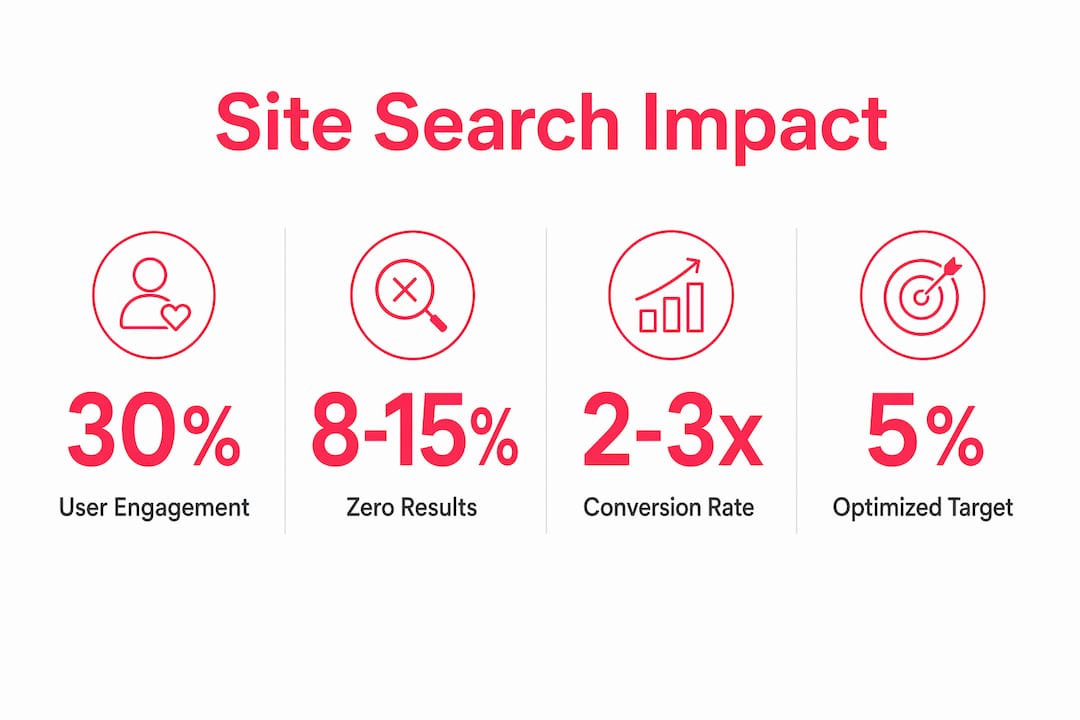
Site search intelligence is defined as the ability to interpret and act on the intent behind users’ on-site search queries, transforming raw keyword data into a revenue-driving signal for e-commerce businesses. It goes well beyond a simple text-matching box. 82% of respondents consider site search queries very or critically important for understanding visitor intent, and search users convert at two to three times the rate of non-searchers. That gap is not a coincidence. It reflects the fundamental role of site search intelligence as the clearest window into what your customers actually want, right now, on your site.
What is the role of site search intelligence in e-commerce?
Site search intelligence, often called enterprise search analytics or search experience optimisation in industry circles, is the practice of collecting, interpreting, and acting on the data generated by your on-site search bar. Every query a visitor types is a direct statement of intent. Aggregated across thousands of sessions, those queries reveal demand gaps, catalogue weaknesses, and merchandising opportunities that no other data source can match.

The importance of site search becomes clear when you look at who is actually using it. Around 30% of visitors use site search, yet this group consistently drives a disproportionate share of revenue. These are high-intent shoppers who have already decided they want something. Your job is to get out of their way and deliver it. When search fails them, they leave. When it works, they buy.
Tools like Klevu, Searchspring, and Algolia have moved the conversation from “does our search box work?” to “what is our search data telling us, and how fast can we act on it?” That shift in framing is what separates e-commerce leaders from the rest.
How does site search enhance user experience?
Traditional site search is built on exact-match logic. A shopper types “grey trainers” and the engine looks for those precise characters. Type “gray trainers” or “running shoes grey” and many native search implementations return nothing. This is what Baymard Institute researchers describe as the Syntax Tax, the invisible penalty shoppers pay for not knowing your catalogue’s exact terminology.
The practical consequences are significant. 41% of e-commerce sites fail to support basic symbols and abbreviations, contributing directly to single-session abandonment. A shopper who searches once, finds nothing, and leaves is not coming back. That is a permanent loss, not a bounce you can recover with a retargeting ad.
Intelligent search addresses this through several mechanisms:
- Semantic understanding: Techniques like stemming, lemmatisation, and vector embeddings allow the engine to recognise that “running shoes,” “trainers,” and “athletic footwear” all point to the same product category.
- Typo tolerance and synonym mapping: Queries like “adiddas” or “hoody” resolve correctly rather than returning zero results.
- Autocomplete and contextual suggestions: Predictive suggestions guide shoppers toward in-stock, high-margin products before they finish typing.
- Smart no-results handling: Rather than a dead-end page, intelligent search surfaces related categories, bestsellers, or a guided navigation prompt.
The cumulative effect on user experience in e-commerce is measurable. Shoppers who find what they are looking for quickly report higher satisfaction, return more often, and spend more per session.
Pro Tip: Audit your search logs for the top 20 zero-result queries this month. Map each one to an existing product or category and add synonym rules immediately. This single action typically produces a visible conversion uplift within two to four weeks.
What is the measurable business impact on conversion and revenue?
The benefits of search intelligence are not theoretical. The numbers are concrete and the calculation is straightforward.
Between 8% and 15% of site searches return zero results on a typical e-commerce site. Rescuing those zero-result events can yield a 3% to 7% conversion uplift on total search revenue. That is not a marginal gain. For a mid-sized retailer generating £500,000 per year from search-driven sessions, a 5% uplift is £25,000 in recovered revenue from a single improvement.
The maths becomes even more compelling when you model it directly. Reducing a zero-result rate from 20% to 7% on 5,000 monthly searches averaging £40 revenue per session recovers approximately £26,000 per month. That is a figure most e-commerce managers can take straight to a board meeting.
| Metric | Benchmark | Optimised target |
|---|---|---|
| Zero-result rate | 12–24% of searches | Below 5% |
| Search-to-conversion rate | 2–3x non-search visitors | Maintained or improved |
| Average order value lift | Baseline | 10–20% uplift via recommendations |
| Monthly search sessions | Varies by traffic | 30–40% of total visitors |
Beyond conversion rate, tracking search ROI on conversion rate alone undercounts the true impact by 30% to 50%. Average order value lift, repeat purchase frequency, and loyalty metrics all move when search experience improves. A shopper who finds exactly what they want, quickly, is far more likely to return. That compounding effect on lifetime value is where the real commercial case for search intelligence lives.
Forrester research also shows that during Black Friday, shoppers arriving via answer engines were 38% more likely to purchase. This confirms that intent-driven search, whether on-site or via external AI tools, is the most reliable predictor of purchase behaviour available to e-commerce teams.
What are the common pitfalls in leveraging site search data?
Knowing the importance of site search is one thing. Realising its potential is another. Most e-commerce businesses fall short not because of bad technology, but because of structural and operational failures that prevent them from acting on what their search data is telling them.
The most common pitfalls, in order of frequency, are:
- Fragmented ownership. Search sits between marketing and IT, and neither team owns it fully. Marketing wants to update synonyms and boost products. IT controls the platform. The result is a slow, ticket-driven process that means fixes take weeks instead of hours.
- Poor analytics instrumentation. Many teams track overall conversion rate but never isolate search sessions as a separate cohort. Without dedicated site search analytics, zero-result events are invisible, and funnel softness gets misattributed to traffic quality or product pricing.
- Native CMS search limitations. Out-of-the-box search in platforms like Magento Open Source or basic Shopify themes is built for functionality, not intelligence. It lacks semantic understanding, personalisation, and the analytics layer needed to act on data.
- Surrendering UX control to third-party engines. Some retailers route queries through Google Custom Search or similar tools. This solves the relevance problem but removes your ability to merchandise, boost, or bury products based on business rules.
- No governance for brand voice and compliance. Particularly relevant for B2B and regulated categories, search results must reflect approved terminology, restricted products, and account-level pricing. Without governance, AI-driven search can surface the wrong products to the wrong customers.
“Site search intelligence should be treated as a revenue intelligence tool, not a feature request queue for IT teams.” — CMSWire, 2026
Tracking zero-results searches as a distinct failure mode, separate from general bounce or exit data, is the single most underused diagnostic in e-commerce. Teams that instrument this metric correctly find they can pinpoint and fix revenue leaks that were previously invisible.
Best practices for implementing site search intelligence
Getting this right requires a combination of the right technology, clear ownership, and a commitment to continuous measurement. Here is how we recommend approaching it.
Define ownership and deployment speed
Assign a named owner for search performance, ideally within the digital or trading team rather than IT. This person needs the ability to update synonyms, adjust boosts, and modify facets without raising a development ticket. Tools like Klevu and Searchspring are built with this in mind, offering merchandising interfaces that non-technical users can operate confidently.
Instrument your zero-results metrics
Typical e-commerce benchmarks show 12% to 24% of searches return zero results. If you are not measuring this separately, you are flying blind. Set up a dedicated zero-results dashboard in Google Analytics 4 or your analytics platform of choice, segmented by query, device, and traffic source. Review it weekly, not monthly.
Deploy semantic search with AI capabilities
Move away from keyword matching toward vector-based semantic search. Neural intent matching, as used by Klevu and Algolia, understands that “waterproof jacket for hiking” and “outdoor rain coat” are the same intent. This is the core technical upgrade that separates intelligent search from legacy implementations.
- Prioritise fixing the top-volume zero-results queries first by mapping them to your product taxonomy.
- Build a synonym library covering brand abbreviations, common misspellings, and category synonyms.
- Use dynamic facets that adapt to the query context rather than showing the same filters for every search.
- Deploy personalised recommendations on search results pages to lift average order value.
Measure the full picture
Conversion rate is a starting point, not the finish line. Track AOV lift for search sessions versus browse sessions, repeat purchase rate for search-converted customers, and the success rate of conversational or long-tail queries. These metrics together give you a complete view of search and conversion rates and the true ROI of your investment.
Pro Tip: Run a monthly “query-to-commerce” audit. Export your top 50 search queries, check the results page for each one, and score relevance on a simple 1 to 5 scale. Any query scoring below 3 is a revenue leak. Fix it before the next audit cycle.
Key takeaways
Site search intelligence is a direct revenue driver: fixing zero-result rates, deploying semantic AI, and assigning clear ownership are the three actions that produce the fastest measurable return for e-commerce businesses.
| Point | Details |
|---|---|
| Search users are your best customers | Search visitors convert at 2 to 3 times the rate of non-searchers, making search experience a top commercial priority. |
| Zero-result rate is a critical KPI | Between 8% and 15% of searches return nothing; reducing this to below 5% can recover tens of thousands in monthly revenue. |
| Conversion rate alone understates ROI | Tracking AOV lift and repeat purchase rate alongside conversion gives a 30% to 50% more accurate picture of search value. |
| Ownership and speed matter as much as technology | Marketing teams need direct control over synonyms and boosts to act on search data without IT delays. |
| Semantic AI is the technical baseline | Vector embeddings and neural intent matching are now standard requirements, not premium add-ons, for competitive search performance. |
Steve’s take: search is a product, not a feature
After working with e-commerce businesses across Magento and Shopify for years, the pattern I see most often is this: teams invest heavily in traffic acquisition and almost nothing in what happens when a visitor arrives and types something into the search bar. That is a backwards allocation of resource.
The shift I am watching accelerate in 2026 is the move toward conversational and AI-mediated shopping. Shoppers are increasingly comfortable typing full sentences, asking questions, and expecting the search bar to behave like a knowledgeable shop assistant. The retailers who treat search as a living product, with a dedicated owner, a weekly review cadence, and a clear improvement roadmap, are the ones pulling ahead. The ones who set it up once and forget it are quietly haemorrhaging revenue to competitors who have not.
The uncomfortable truth is that most zero-result failures are not technology problems. They are data hygiene and governance problems. Your search engine is only as good as the synonym rules, product data, and merchandising logic you feed it. Neglect that layer and even the best AI-powered engine will let you down. Treat it as a living system and it compounds in value every month.
— Steve
How Bigeyedeers can help you unlock search intelligence
At Bigeyedeers, we have spent over 17 years building and optimising high-performing e-commerce stores on Magento and Shopify. Search experience is central to that work. We implement and configure Klevu search and merchandising for our clients, giving trading teams the control they need to act on search data without waiting for development cycles.

Whether you are running an Adobe Commerce build with complex B2B catalogue rules or a Shopify store looking to reduce zero-result rates and lift conversion, we can help you build a search experience that works as hard as the rest of your site. Visit Bigeyedeers to speak with our team about what intelligent search could mean for your revenue.
FAQ
What is site search intelligence?
Site search intelligence is the practice of interpreting and acting on the intent behind on-site search queries to improve product discovery, reduce zero-result failures, and increase conversion rates. It combines AI-driven relevance with analytics to turn search data into commercial decisions.
How does site search affect conversion rates?
Search users convert at two to three times the rate of non-search visitors, according to Forrester data. Improving search relevance and reducing zero-result events directly increases the proportion of those high-intent visitors who complete a purchase.
What is a good zero-result rate for e-commerce?
The typical e-commerce benchmark sits between 12% and 24% of searches returning zero results. A well-optimised site should target below 5%, as reducing this rate can yield a 3% to 7% conversion uplift on total search revenue.
Which tools are best for e-commerce site search?
Klevu, Algolia, and Searchspring are the leading platforms for intelligent e-commerce search. Each offers semantic understanding, merchandising controls, and analytics dashboards that go well beyond the native search functionality in Magento or Shopify.
How do I measure the ROI of site search improvements?
Track zero-result rate, search-to-conversion rate, average order value for search sessions, and repeat purchase frequency. Conversion rate alone undercounts search ROI by 30% to 50%, so a multi-metric approach gives you the full commercial picture.
Recommended



Adobe Commerce (Magento)
Formerly known as Magento, Adobe Commerce is built for complex catalogues, integrations, and long term growth. We design and develop stable, scalable stores that support demanding eCommerce requirements, including multi-store setups, complex pricing, and Hyva based performance improvements.

Bespoke Build
We design and build custom eCommerce platforms for businesses with complex workflows, integrations, or non standard requirements. Built from scratch around your business needs using Laravel and modern architectures.

Working with brands across the UK from our offices in Cardiff and Exeter, you deal directly with a senior team of designers and developers specialising in Shopify, Magento, WordPress and bespoke eCommerce platforms.
We focus on commercial outcomes. Better conversion rates, strong SEO foundations and eCommerce platforms that continue to improve long after launch.