Ecommerce automation in 2026: what leaders need to know
TL;DR:
- Ecommerce automation in 2026 is driven by autonomous AI agents that independently manage transactions across platforms, requiring high-quality, structured data. Success depends on platform readiness, real-time data integration, and cross-team governance to avoid errors and disintermediation. Businesses must prioritize data infrastructure and operational discipline before adopting agentic AI tools to achieve meaningful results.
Ecommerce automation in 2026 is defined by agentic AI systems that independently initiate, evaluate, and complete transactions across multiple platforms without human input at each step. This is a material shift from the rule-based automations and chatbots that dominated the previous decade. Approximately 34% of US online purchases in Q1 2026 involved AI shopping agents initiating or completing transactions, up from 9% a year earlier, with projections reaching 40 to 45% by late 2026. That pace of adoption means the future of ecommerce automation 2026 is not a planning horizon. It is happening now, and the businesses best positioned are those already investing in the infrastructure to support it.
What is agentic AI and how is it redefining ecommerce automation?
Agentic AI is defined as software that autonomously plans and executes multi-step tasks by calling APIs, interpreting outputs, and making decisions without requiring a human to approve each action. This is categorically different from assistive or conversational AI, which responds to prompts but does not act independently. Forrester’s 2026 analysis notes that most current agentic experiences are still assistive rather than fully autonomous, which is an important calibration for leaders setting strategy.

The practical difference matters enormously for operations. An assistive AI might recommend a reorder quantity. An agentic AI places the order, updates the warehouse management system, adjusts the product listing, and triggers a supplier notification, all within a single workflow. Shopify stores using agentic AI recorded a 14% improvement in inventory sell-through and a 9% reduction in customer acquisition costs in a Triple Whale study. Those are not marginal gains.
The operational scope of agentic AI in ecommerce currently covers:
- Inventory replenishment triggered by real-time stock thresholds and demand signals
- Ad spend optimisation across Google Ads and Meta, adjusted autonomously based on margin and conversion data
- Order management and routing, including split fulfilment decisions across warehouse locations
- Customer service triage, escalating only the cases that require human judgement
- Pricing adjustments responding to competitor data and margin rules without manual intervention
Pro Tip: Do not deploy agentic AI against live trading data until your product catalogue, inventory feeds, and pricing APIs are clean and consistent. Agents amplify whatever data quality exists. Bad inputs produce bad autonomous decisions at scale.
How are Google Universal Cart and Shopify Sidekick shaping 2026 automation?
The most significant platform-level development in 2026 ecommerce technology is Google’s Universal Cart, which operates across Search, Gemini, YouTube, and Gmail. It maintains a persistent, decision-making shopping state rather than simply surfacing product recommendations. Universal Cart uses Gemini AI and Google Wallet context to discover deals proactively, run compatibility checks across multi-retailer builds, and smooth checkout across surfaces. This marks a shift from Google as a discovery engine to Google as an active purchasing agent on behalf of the shopper.
Shopify’s Sidekick operates on the merchant side, functioning as an AI co-pilot that can autonomously execute campaigns, manage inventory thresholds, and generate performance reports. The distinction between Sidekick and a standard dashboard assistant is that Sidekick can act, not just advise. For merchants on Shopify, this means routine operational tasks are increasingly delegated rather than performed.
The table below compares the current agentic capabilities across the four major platforms relevant to UK ecommerce leaders:
| Platform | Agentic capability | Merchant action required |
|---|---|---|
| Google (Universal Cart) | Cross-surface cart management, deal discovery, compatibility checks via Gemini AI | Catalogue compliance with Google Merchant Centre schema |
| Shopify (Sidekick) | Campaign execution, inventory management, performance reporting | API access and clean product data feeds |
| BigCommerce | Automated pricing rules, catalogue sync, third-party agent integrations | ERP and PIM integration setup |
| WooCommerce | Plugin-based automation via WooCommerce Automations and third-party agents | Developer configuration and data hygiene |
Platform infrastructure readiness is the limiting factor in every case. Universal Cart, for example, requires catalogue compatibility reasoning to avoid surfacing invalid product combinations or missed deal notifications. If your product data does not meet schema requirements, the agent either skips your products or presents them incorrectly. Neither outcome is acceptable.
Pro Tip: Run your product feed through Google Rich Results Test and Google Merchant Centre diagnostics before assuming Universal Cart compatibility. Schema errors that were previously cosmetic are now conversion-critical.
What data and infrastructure challenges must ecommerce leaders address?
The successful deployment of agentic AI depends less on the AI itself and more on the quality of the data it operates against. AI-referred traffic converted 42% better than non-AI traffic in March 2026, according to Adobe data cited by Digital Applied. That uplift is only realisable if your product data is structured, accurate, and machine-readable. Businesses with fragmented catalogues, inconsistent GTINs, or stale inventory feeds will not see that conversion benefit. They will see the opposite.
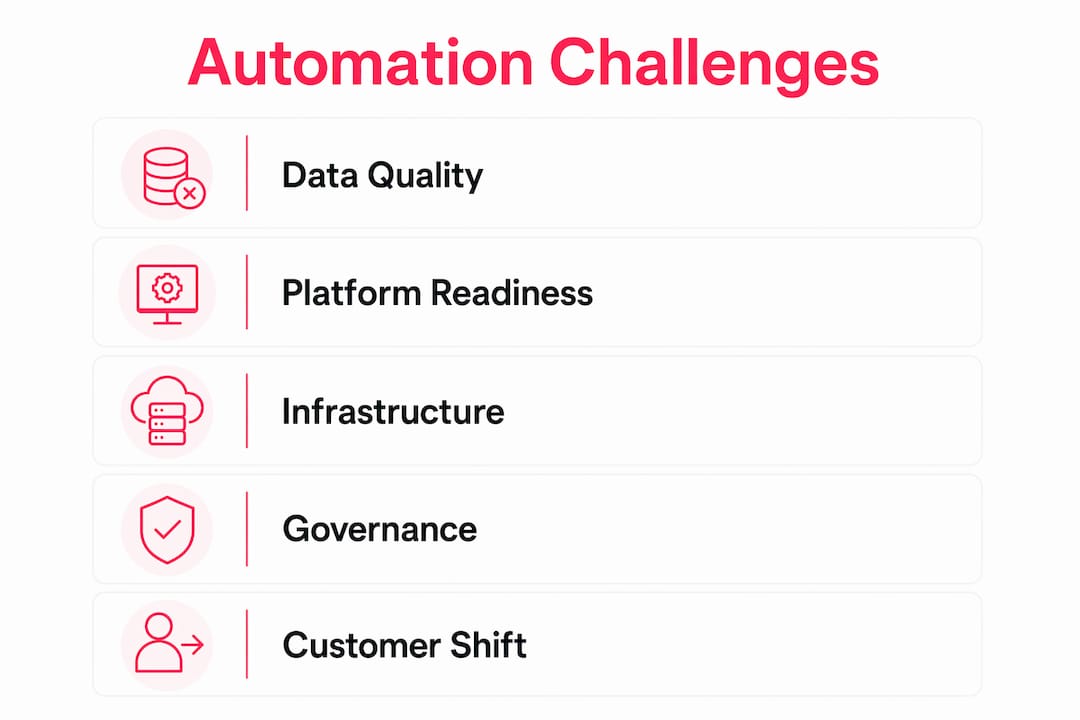
Platforms embedding agentic AI have grown their transaction market share from 11% in early 2025 to a projected 34% by Q4 2026, with the addressable market rising to $6.8 trillion. That consolidation is accelerating, and it is happening around businesses with clean, integrated data infrastructure. The gap between prepared and unprepared merchants is widening quickly.
Here is a practical sequence for auditing and improving your automation readiness:
- Audit your product catalogue for GTIN completeness, schema.org compliance, and attribute consistency across all sales channels and platforms.
- Establish real-time inventory feeds connected to your ecommerce platform, ERP, and any third-party agent surfaces. Stale stock data causes agent errors and customer frustration.
- Review your API integrations between your platform (Magento, Shopify, BigCommerce), your PIM or ERP, and any external agent environments. Document where data is transformed or delayed.
- Identify ownership gaps across your teams. Fragmented organisational ownership of product data is one of the most common internal failure modes Forrester identifies. Someone must own data quality end to end.
- Run a unified readiness assessment that covers both your owned commerce environment and the non-owned surfaces where agents may represent your products.
Pro Tip: Treat your product data infrastructure as a commercial asset, not a technical maintenance task. The businesses winning in agent-mediated commerce are those where the merchandising, tech, and marketing teams share a single source of truth.
How is agent-mediated commerce changing customer behaviour?
AI agents do not browse. They evaluate. This is the single most disruptive behavioural shift for ecommerce merchandising in 2026. A human shopper might respond to a hero image, a lifestyle photograph, or a compelling brand story on a product page. An AI agent reads structured attributes, pricing signals, availability data, and review scores. Traditional on-site merchandising tactics have limited influence over agent decisions.
This changes the conversion funnel in ways that require a strategic response:
- Product metadata becomes the primary sales asset. Accurate, complete, and schema-compliant product attributes are what agents use to match products to shopper intent.
- Brand differentiation must be encoded in data. Sustainability credentials, certifications, and unique product specifications need to be machine-readable, not just visible on a page.
- Cart abandonment patterns shift. Agent-mediated sessions show lower abandonment rates because agents complete transactions more efficiently than human shoppers navigating checkout friction.
- Channel disintermediation is a real risk. Forrester stresses that as agents operate on non-owned surfaces, brands lose direct control over the purchase experience. Your product page may never be seen.
The implication for UK retailers is that investment in product information management and structured data now delivers returns through agent-mediated channels, not just organic search. These are no longer separate workstreams.
What practical steps should ecommerce professionals take now?
Preparation for 2026 automation trends is not a single project. It is an ongoing operational discipline. The following steps reflect what ecommerce leaders with mature automation programmes are doing right now:
- Validate schema compliance using Google Rich Results Test and Google Merchant Centre diagnostics. Fix errors before connecting to agent surfaces.
- Integrate real-time inventory and pricing across your platform, third-party marketplaces, and any agent APIs. Delayed data creates agent errors that damage customer trust.
- Build audit logs and human review checkpoints into every automated workflow. Ecommerce teams must establish comprehensive audit logs and cross-functional coordination to safely govern autonomous agent actions.
- Select platforms and app stacks that support agent APIs natively. Magento with custom API layers, Shopify with Sidekick integrations, and BigCommerce with its open API architecture are all viable. WooCommerce requires more developer configuration to reach the same level.
- Avoid isolated AI implementation. Agents deployed by one team without visibility across the business create conflicts. A pricing agent and a promotions agent operating independently can produce margin-destroying combinations.
The advancements in ecommerce automation reshaping UK retail in 2026 reward businesses that treat AI governance as a commercial priority, not an IT afterthought.
Key takeaways
Ecommerce automation in 2026 is won or lost on data infrastructure quality, platform readiness, and cross-team governance, not on which AI tool you select.
| Point | Details |
|---|---|
| Agentic AI acts, not just advises | Agents autonomously execute inventory, pricing, and order tasks without per-step human approval. |
| Data quality is the primary constraint | AI-referred traffic converts 42% better, but only when product data is clean and schema-compliant. |
| Platform choice shapes automation ceiling | Google Universal Cart, Shopify Sidekick, and BigCommerce each require specific catalogue and API readiness. |
| Channel disintermediation is a strategic risk | Agents operating on non-owned surfaces mean your product page may never be seen by the buyer. |
| Governance prevents costly agent conflicts | Audit logs, human checkpoints, and cross-team ownership are non-negotiable for safe autonomous operations. |
Why I think most businesses are solving the wrong problem
The conversation around the future of digital retail in 2026 is dominated by tool selection. Which AI platform? Which agent framework? Which automation vendor? In my experience, that is the wrong starting point by a considerable margin.
The businesses we see struggling with automation are not struggling because they chose the wrong tool. They are struggling because their product catalogue has 40% GTIN coverage, their inventory feed updates every four hours, and three different teams own different parts of the product data with no shared standard. You can deploy the most capable agentic AI available and it will fail against that foundation.
The businesses getting real results have done something less glamorous. They have invested in data infrastructure, API reliability, and cross-team alignment before touching agent configuration. The 14% inventory sell-through improvement and 9% customer acquisition cost reduction we referenced earlier did not come from clever AI. They came from clean data that the AI could act on reliably.
My honest advice: run your readiness assessment first. Audit your ecommerce analytics and product data quality before committing budget to agent platforms. The quick wins are real, but they require a foundation that most teams underestimate. Staged, well-governed adoption with clear ownership is not the cautious option. It is the commercially sound one.
— Steve
How Bigeyedeers can help you prepare for ecommerce automation
If your platform is not ready for agent-mediated commerce, the automation opportunity passes you by entirely. At Bigeyedeers, we build and support Magento and Shopify stores specifically designed for the operational demands of 2026 ecommerce technology, including ERP integrations, real-time inventory feeds, and API architectures that support third-party agent connections.

Our Magento development services cover the full stack: custom catalogues, tiered pricing, account hierarchies, and multi-store setups that give your data the structure agentic AI requires to perform. We also support Magento web design built around performance and schema compliance, so your products are visible and actionable across agent surfaces. If you want a practical conversation about where your platform stands and what needs to change, get in touch with the team.
FAQ
What is agentic AI in ecommerce?
Agentic AI in ecommerce refers to software systems that autonomously plan and execute multi-step commercial tasks, such as placing orders, adjusting pricing, or managing inventory, without requiring human approval at each step. This differs from conversational AI, which responds to prompts but does not act independently.
How does Google Universal Cart work for retailers?
Google Universal Cart maintains a persistent shopping state across Search, Gemini, YouTube, and Gmail, using Gemini AI and Google Wallet context to discover deals and complete purchases. Retailers must have schema-compliant product catalogues in Google Merchant Centre for their products to be included in agent-mediated sessions.
Why does product data quality matter for automation?
AI agents evaluate structured product attributes rather than browsing pages, meaning incomplete or non-compliant data causes agents to skip or misrepresent your products. Adobe data shows AI-referred traffic converted 42% better than non-AI traffic in March 2026, but only where product data met machine-readable standards.
What platforms support ecommerce automation in 2026?
Magento, Shopify, BigCommerce, and WooCommerce all support varying degrees of automation, with Shopify’s Sidekick and Google’s Universal Cart representing the most advanced agentic integrations currently available. Platform choice determines your automation ceiling, and API readiness is the critical differentiator.
How do I start preparing for agentic commerce?
Begin with a data audit covering GTIN completeness, schema.org compliance, and real-time inventory feed accuracy across all your sales channels. Then map your API integrations and identify which teams own which parts of your product data, since fragmented ownership is the most common cause of automation failure according to Forrester.
Recommended



Adobe Commerce (Magento)
Formerly known as Magento, Adobe Commerce is built for complex catalogues, integrations, and long term growth. We design and develop stable, scalable stores that support demanding eCommerce requirements, including multi-store setups, complex pricing, and Hyva based performance improvements.

Bespoke Build
We design and build custom eCommerce platforms for businesses with complex workflows, integrations, or non standard requirements. Built from scratch around your business needs using Laravel and modern architectures.

Working with brands across the UK from our offices in Cardiff and Exeter, you deal directly with a senior team of designers and developers specialising in Shopify, Magento, WordPress and bespoke eCommerce platforms.
We focus on commercial outcomes. Better conversion rates, strong SEO foundations and eCommerce platforms that continue to improve long after launch.