The role of front-end frameworks in modern web development
TL;DR:
- Front-end frameworks unify UI components, data flow, and tooling to simplify complex, interactive web applications.
- Long-term success relies on strategic architecture, internal UI layers, and choosing frameworks based on project complexity and maintainability.
Front-end frameworks are structured JavaScript systems that provide reusable components, standardised data flow, and tooling support for building scalable, interactive web applications. React, Angular, Vue, and Svelte each address the same core problem: writing maintainable UI code at scale without descending into a tangle of ad hoc DOM manipulation and scattered event handlers. JavaScript frameworks serve as reliable engineering footholds, abstracting complex web platform features so developers can focus on product logic rather than browser inconsistencies. Understanding the role of front-end frameworks, and when to apply them, is one of the most consequential architectural decisions a development team will make.
How front-end frameworks reduce complexity and improve maintainability
A well-designed JavaScript UI framework replaces scattered custom code with a structured, reusable system that standardises components, data handling, and development patterns. That shift from ad hoc DOM manipulation to a framework-managed component tree is not just a stylistic preference. It changes how predictably your application behaves under pressure, and how quickly a new team member can reason about the codebase.
The structural benefits are concrete:
- Reusable components cut duplicated effort across a project. A button, modal, or data table built once in React or Vue can be used consistently across every view without copy-pasting styles and behaviour.
- Standardised data flow removes ambiguity. React’s unidirectional data flow, Angular’s dependency injection, and Vue’s reactivity system each enforce a clear contract between state and UI, which makes debugging far more predictable.
- Shared conventions allow large teams to collaborate without constant coordination overhead. When everyone writes components the same way, code reviews focus on logic rather than style disputes.
- Modularity means you can update or replace individual components without triggering cascading failures across the application.
For enterprise applications, these benefits compound. A team of ten developers working on a Magento or Shopify storefront with complex product catalogues, account hierarchies, and dynamic pricing cannot afford inconsistency in the UI layer. Frameworks provide the scaffolding that keeps that complexity manageable.
Pro Tip: When onboarding a new developer to a framework-based project, point them to the component library first, not the routing or state management. Understanding what already exists prevents duplication and sets the right mental model from day one.

The maintainability argument is strongest over time. Centralising DOM and event handling to framework-standardised patterns produces more predictable debugging and development processes, which matters enormously when you are maintaining a codebase two or three years after the initial build.
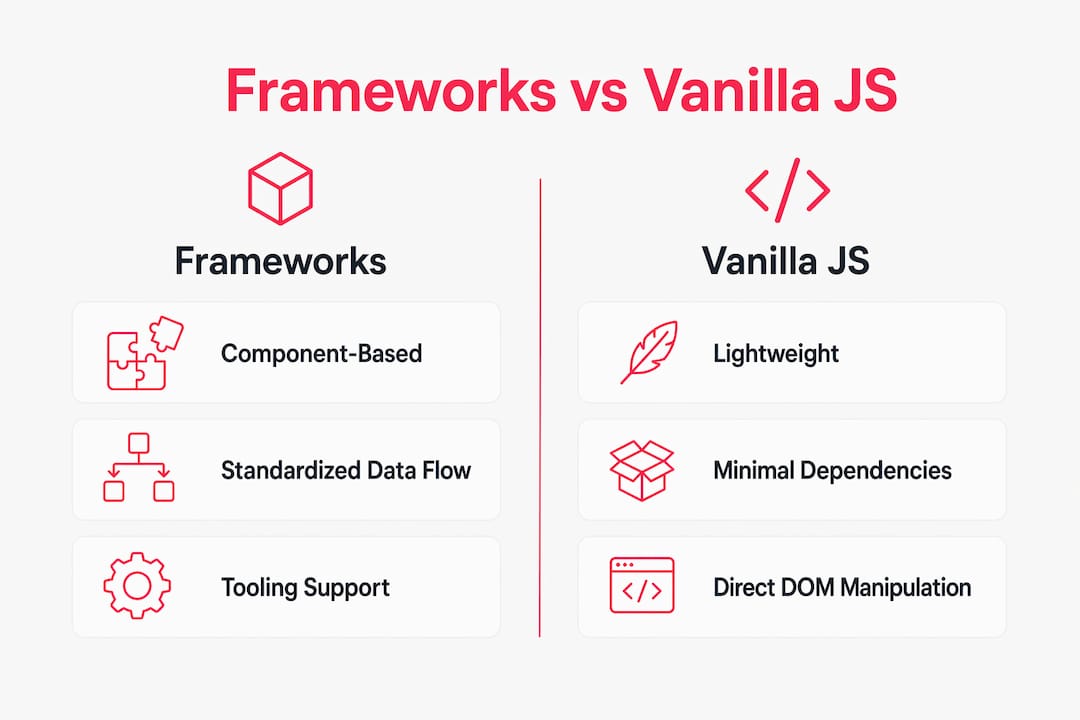
Frameworks vs vanilla JavaScript: what should drive the choice?
Frameworks are not inherently superior to vanilla JavaScript. Best practice is progressive enhancement: start with vanilla JS and introduce a framework only where the complexity of interactivity genuinely demands it. That distinction matters more than most teams acknowledge.
Every framework carries a complexity tax. Build tooling, dependency management, upgrade cycles, and abstraction layers all add overhead that a simple content site or lightly interactive page does not need. Vanilla JavaScript, by contrast, remains stable across browsers for years without intervention.
The average front-end developer uses only 2.6 different frameworks across their entire career. That figure tells you something important: framework choice is a long-term architecture decision, not a monthly experiment. Switching frameworks mid-project is expensive, and switching them mid-product lifecycle is painful.
| Factor | Framework | Vanilla JavaScript |
|---|---|---|
| Complex stateful UI | Strong fit | Difficult to maintain at scale |
| Simple content pages | Overkill | Ideal |
| Team size | Scales well with shared conventions | Harder to coordinate at scale |
| Long-term upgrade cost | Moderate to high | Low |
| Ecosystem and tooling | Rich | Minimal |
| Performance baseline | Depends on implementation | Lean by default |
The right question is not “which framework is best?” but “does this project’s UI complexity justify the overhead of a framework at all?” A marketing landing page with one interactive form does not. A B2B ecommerce platform with real-time pricing, account-level catalogues, and multi-step checkout absolutely does.
Pro Tip: Map your UI state requirements before choosing a framework. If you can list every interactive element on a single page and none of them share state, vanilla JS with a few targeted enhancements will serve you better and cost less to maintain.
Enterprise teams in 2026 evaluate frameworks on time to market, component completeness, accessibility, performance at scale, and vendor support. Stability and backward compatibility now outrank novelty as selection criteria, which is a healthy correction after years of framework churn.
How do front-end frameworks support performance and accessibility?
Performance and accessibility are no longer optional concerns. They are measurable, legally mandated, and directly tied to commercial outcomes.
Core Web Vitals require Largest Contentful Paint under 2.5 seconds, Interaction to Next Paint under 200 milliseconds, and Cumulative Layout Shift below 0.1, measured at the 75th percentile of real users. LCP is the hardest metric to pass and the one most directly tied to user perception of speed. Missing it costs you both rankings and conversions.
Frameworks influence all three metrics, but not always in the ways developers assume:
- LCP is primarily a server and critical rendering path problem. React Server Components, Next.js streaming, and Nuxt’s server-side rendering can help, but performance improvements must start with server response times (TTFB) before JavaScript tuning has meaningful impact.
- INP is directly affected by JavaScript execution cost. Frameworks that batch DOM updates efficiently, such as Vue 3’s reactivity system or React’s concurrent rendering, reduce interaction latency.
- CLS is often caused by images and embeds without explicit dimensions, which is a component authoring discipline issue that frameworks can enforce through component contracts.
On accessibility, WCAG 2.2 compliance is now a legal requirement in many jurisdictions, including the UK under the Equality Act 2010. Frameworks with comprehensive component libraries reduce compliance costs by providing accessible UI elements out of the box. Angular Material, Radix UI for React, and Vuetify each ship with ARIA attributes, keyboard navigation, and focus management built in.
“In 2026, enterprise teams prioritise framework stability, performance, legal accessibility compliance, and total cost of ownership over bleeding-edge innovation.” — Sencha
Piecemeal component library combinations introduce API mismatches, inconsistent theming, and divergent release cadences that multiply maintenance overhead. For ecommerce teams building accessible retail experiences, choosing a framework with a complete, integrated component set is a practical risk reduction strategy, not just a convenience.
What architectural patterns maximise long-term framework benefits?
The biggest source of technical debt in framework-based projects is tight coupling between product logic and the framework’s API surface. When your components directly consume a third-party UI library’s props and events without any abstraction, a major version upgrade or library replacement becomes a full rewrite.
The solution is an internal UI layer. Building an internal wrapper that sits between your product code and the underlying framework or component library creates a stable abstraction boundary. That wrapper handles theming, SSR compatibility, browser quirks, and migration adapters. Your product code calls "rather than`, which means swapping the underlying library requires changes in one place, not hundreds.
Practical architectural disciplines that extend framework lifespan:
- Isolate framework-specific code behind internal component wrappers so product logic remains portable.
- Adopt progressive enhancement by introducing framework components only where interactivity demands it, keeping static sections lean.
- Plan upgrade windows into your roadmap. React, Angular, and Vue all publish migration guides, but upgrades left to accumulate become expensive.
- Prefer comprehensive component sets over piecemeal integrations in enterprise contexts. A single library with consistent APIs, accessibility, and theming reduces the surface area for breakage.
- Document component contracts explicitly. When a component’s expected props, events, and accessibility behaviour are written down, replacements are scoped and predictable.
Frameworks with strong backward compatibility reduce the blast radius of breaking changes. Angular provides structured upgrade tooling. React offers clearer migration paths but more frequent ecosystem updates. Choosing a framework with a mature, predictable release cadence is as important as choosing one with the right feature set.
For progressive web app implementations in retail, these architectural disciplines translate directly into faster delivery cycles and lower maintenance costs over a three to five year product horizon.
Key takeaways
Front-end frameworks deliver their greatest value when matched to project complexity, applied with architectural discipline, and evaluated on long-term cost rather than short-term capability.
| Point | Details |
|---|---|
| Frameworks reduce complexity | Standardised components and data flow replace ad hoc code, improving consistency and debugging. |
| Framework choice is long-term | The average developer uses 2.6 frameworks in their career; treat selection as an architecture decision. |
| Performance starts server-side | Fix TTFB and critical rendering path before tuning JavaScript for Core Web Vitals. |
| Accessibility is a legal requirement | WCAG 2.2 compliance under UK law makes frameworks with built-in accessible components a practical necessity. |
| Internal UI layers protect longevity | Wrapping third-party components behind internal abstractions reduces upgrade cost and migration scope. |
Why I think most teams get framework adoption backwards
Most teams I speak with choose a framework first and then figure out the architecture. That order is backwards, and it causes most of the pain I see in long-running projects.
The honest reality is that React, Vue, and Angular are all capable of producing excellent or terrible codebases depending on the discipline applied around them. A poorly structured React project with no component abstraction layer is harder to maintain than a well-structured vanilla JS application. The framework does not save you from yourself.
What I have found consistently is that teams who treat framework selection as a one-time infrastructure decision, rather than a recurring debate, ship faster and accumulate less debt. They pick a framework that matches their team’s existing knowledge, their project’s UI complexity, and their organisation’s appetite for upgrade cycles. Then they invest in the internal architecture that protects them from ecosystem volatility.
The other thing worth saying plainly: performance problems blamed on frameworks are almost always structural problems in disguise. I have seen teams spend weeks micro-optimising React render cycles when the real issue was a 1.2-second server response time. Sort the foundations first.
The role of JavaScript frameworks in 2026 is not to make development magical. It is to provide a shared language for your team and a stable system for your users. That is worth a great deal, but only if you use it deliberately.
— Steve
How Bigeyedeers can help with your front-end build
At Bigeyedeers, we have spent over 17 years building and supporting high-performance ecommerce platforms across Magento and Shopify. Front-end architecture is central to everything we deliver, from Hyvä-powered Magento storefronts to custom component systems designed for long-term maintainability.

Whether you are evaluating frameworks for a new build, dealing with performance issues on an existing platform, or planning a migration, our team brings the technical depth and commercial understanding to make the right call. We design in Figma, build with performance and accessibility in mind, and support what we deliver. If you want a development partner who treats architecture as seriously as delivery, talk to our team about what you are building.
FAQ
What is the role of front-end frameworks?
Front-end frameworks provide reusable component systems, standardised data flow, and tooling support that reduce UI complexity and improve maintainability in web applications. They are most valuable in projects with complex, stateful interfaces where consistency and team collaboration are critical.
How do front-end frameworks differ from libraries?
A framework provides a complete structure for your application, including conventions for routing, state management, and component architecture. A library, such as jQuery or Lodash, provides specific utilities you call on demand without dictating overall application structure.
When should you use vanilla JavaScript instead of a framework?
Vanilla JavaScript is preferable for simple content pages, lightly interactive sites, or performance-critical contexts where framework overhead is not justified. Apply a framework only where UI complexity and state management genuinely require it.
Which front-end frameworks are most widely used in 2026?
React remains the dominant choice by usage, with Vue and Angular maintaining strong adoption in enterprise contexts. Framework selection in 2026 increasingly prioritises stability, backward compatibility, and total cost of ownership over feature novelty.
How do frameworks affect Core Web Vitals performance?
Frameworks influence LCP, INP, and CLS, but most performance issues are structural rather than framework-specific. Start with server response times and critical rendering path optimisation before addressing JavaScript execution costs.
Recommended



Adobe Commerce (Magento)
Formerly known as Magento, Adobe Commerce is built for complex catalogues, integrations, and long term growth. We design and develop stable, scalable stores that support demanding eCommerce requirements, including multi-store setups, complex pricing, and Hyva based performance improvements.

Bespoke Build
We design and build custom eCommerce platforms for businesses with complex workflows, integrations, or non standard requirements. Built from scratch around your business needs using Laravel and modern architectures.

Working with brands across the UK from our offices in Cardiff and Exeter, you deal directly with a senior team of designers and developers specialising in Shopify, Magento, WordPress and bespoke eCommerce platforms.
We focus on commercial outcomes. Better conversion rates, strong SEO foundations and eCommerce platforms that continue to improve long after launch.