Why choose open source ecommerce for your business
TL;DR:
- Open source ecommerce provides full control over code, data, and deployment, enabling tailored platforms that meet specific business needs. While license costs are minimal, significant expenses are involved in hosting, maintenance, and security, especially for complex setups. Choosing open source offers scalability, data sovereignty, and flexibility, particularly for businesses with demanding customization requirements.
Open source ecommerce gets talked about in two ways: as the free alternative to expensive SaaS platforms, or as the technically intimidating option only large enterprises can manage. Both framings miss the point entirely. The real question of why choose open source ecommerce is not about licence fees or technical complexity in isolation. It is about control, data sovereignty, and the ability to build a platform that fits your business rather than one you fit your business around. This article cuts through the noise and gives you the honest picture.
Table of Contents
- Key takeaways
- Why choose open source ecommerce: the real picture
- The real benefits of open source ecommerce
- The real costs you must plan for
- Flexibility and future-proofing
- Evaluating open source solutions: where to start
- My honest take on open source ecommerce adoption
- How Bigeyedeers can help you build on open source
- FAQ
Key takeaways
| Point | Details |
|---|---|
| No licence fee is not zero cost | Budget for hosting, developer time, security patching, and compliance alongside any platform choice. |
| Control is the core advantage | Open source gives you full ownership of code, data, and deployment decisions that SaaS platforms cannot match. |
| Vendor lock-in is a real risk | Depending on proprietary modules before migrating can mean expensive rebuilds that erode your cost savings. |
| Maintenance protects revenue | Regular patching and updates are not optional overheads. They directly reduce financial and reputational risk. |
| Match the platform to your model | Open source is particularly well suited to B2B, multi-store, and cross-border setups that require deep customisation. |
Why choose open source ecommerce: the real picture
Open source ecommerce refers to platforms where the underlying source code is publicly available, free to inspect, modify, and deploy. This is the standard industry term: open source ecommerce platform. The contrast with proprietary or SaaS platforms is significant. With a SaaS solution, you rent access to software that lives on someone else’s infrastructure, updated on someone else’s schedule, subject to someone else’s pricing decisions. With an open source platform, the code is yours to work with.
The key differentiators come down to three things:
- Code access. You can read, modify, and extend every part of the platform. No black-box features you cannot audit or adjust.
- Deployment flexibility. Self-hosting means choosing your own infrastructure provider, your own server location, and your own scaling strategy.
- Headless and modular architecture. Modern open source platforms support decoupled frontends, meaning your presentation layer and commerce logic can evolve independently.
Well-known open source ecommerce platforms include Magento Open Source, WooCommerce, and PrestaShop. Each has its own ecosystem of extensions, community support, and commercial add-ons. The licence type also matters practically. Permissive licences such as BSD and MIT allow you to build proprietary features on top without any obligation to open-source your own modifications, which matters a great deal for commercial deployments.
The real benefits of open source ecommerce
The benefits of open source ecommerce are often reduced to “you save money on licences.” That is true, but only the start of it. The deeper advantages are structural.
- No recurring licence fees. A mid-market merchant reported paying $30k per year for Adobe Commerce Cloud licensing, versus zero for Magento Open Source. That gap compounds over time.
- Data sovereignty. You decide where your customer data lives. For businesses trading in regulated environments, this is not a nice-to-have. Self-hosted platforms enable deployment on infrastructure under your direct control, supporting GDPR and NIS2 compliance.
- No vendor lock-in. SaaS platforms control their own roadmap. If they deprecate a feature, raise prices, or sunset a product tier, your business is exposed. Open source removes that dependency entirely.
- Scalability without ceiling. You are not constrained by pricing tiers or usage limits imposed by a platform vendor.
- Native support for complex models. Open source platforms can handle B2B account hierarchies, tiered pricing, multi-vendor marketplaces, and cross-border commerce in ways that SaaS platforms often require expensive workarounds to support. Some platforms ship B2B and marketplace functionality as core features rather than paid add-ons.
Pro Tip: If your business needs custom catalogue structures, ERP integrations, or multi-store setups, evaluate open source platforms first. These requirements often push SaaS total costs far beyond their headline pricing.
The open source ecommerce advantages become most visible at the point where your requirements diverge from what a platform was designed for out of the box. SaaS platforms optimise for the common case. Open source lets you build for your specific case.

The real costs you must plan for
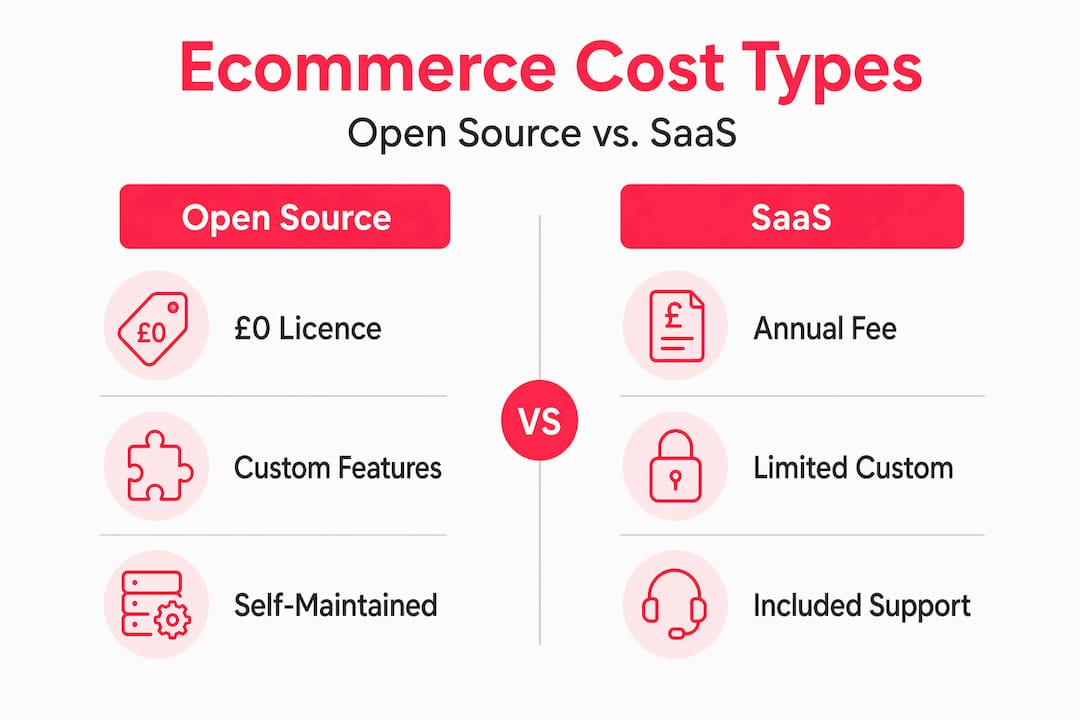
Here is where honest conversations get uncomfortable. Open source ecommerce solutions carry no licence fee, but they are absolutely not free to run. Hosting costs typically run between £250 and £800 per month depending on traffic and infrastructure complexity. Developer costs for B2B setups can reach £80,000 to £160,000 per year. Add compliance, security auditing, and incremental feature work on top of that.
The table below gives a clearer comparison of total cost of ownership between open source and SaaS:
| Cost category | Open source | SaaS |
|---|---|---|
| Licence fee | £0 | £10,000 to £40,000+ per year |
| Hosting and infrastructure | £3,000 to £10,000+ per year | Included or add-on |
| Developer and maintenance | £30,000 to £160,000+ per year | Reduced but not zero |
| Security patching | Your responsibility | Vendor-managed |
| Customisation ceiling | Unlimited | Platform-limited |
The total cost of ownership for B2B ecommerce sometimes favours SaaS precisely because of the predictability and reduced operational burden. That is not a reason to rule out open source. It is a reason to go into the decision with accurate numbers.
Security patching deserves particular attention. Regular maintenance directly protects revenue by reducing exposure to vulnerabilities, performance regressions, and compliance failures. This is not an optional overhead. Unpatched vulnerabilities on open source platforms are actively exploited, and the financial and reputational cost of an incident dwarfs the cost of proper maintenance. We see this regularly in our Magento work at Bigeyedeers, and it is why proactive security monitoring using tools like Sansec is built into everything we do.
Pro Tip: When calculating budget for an open source platform, add at least 20% on top of your initial development estimate to cover the first year of security patching, extension compatibility work, and performance improvements.
Flexibility and future-proofing
One of the strongest open source ecommerce advantages is something that rarely appears in feature comparison tables: control over your own release cycle. SaaS platforms push updates on their own schedule. Sometimes those updates break integrations, change behaviour, or remove features. With open source, your engineering team or agency decides when to apply updates and how to test them before they reach production.
This matters in several practical ways:
- Infrastructure choice. You can deploy on AWS, Azure, Google Cloud, or a dedicated European provider. For businesses with strict data residency requirements, this is the deciding factor.
- Regulatory adaptability. When GDPR requirements shift or new EU digital commerce regulations arrive, you can implement changes directly in your codebase rather than waiting for a vendor to release a patch.
- No forced migrations. SaaS platforms retire product tiers and force upgrades. With open source, you control the timing and scope of any platform evolution.
- Custom feature development. Need a product configuration tool, a complex B2B approval workflow, or a custom pricing engine? Open source lets you build it. SaaS platforms let you request it and hope it appears on the roadmap.
The European digital sovereignty argument is a good example of this in practice. Businesses selling across multiple EU markets can deploy on infrastructure based in their chosen jurisdiction, implement localised tax rules, support multiple currencies natively, and maintain audit trails that satisfy local regulatory requirements. None of this requires waiting for a third-party vendor to prioritise your market.
Evaluating open source solutions: where to start
Asking whether open source ecommerce is worth it is the right question, but it needs to be grounded in your specific situation. Here is a practical evaluation process:
- Map your current and future feature requirements. List every feature you rely on. Identify which ones would require custom development on an open source platform versus those available out of the box or via established extensions.
- Assess your developer capacity. Do you have in-house engineers capable of ongoing platform maintenance? If not, identify a specialist agency before you commit. Running open source without technical support is a significant risk.
- Build a realistic budget. Include hosting, security monitoring, annual maintenance, and planned feature development. Compare this honestly against SaaS total costs including any per-transaction fees and customisation limitations.
- Understand migration complexity. If you are moving from a platform that relies heavily on proprietary modules, assess the rebuild cost carefully. Rebuilding B2B functionality after a migration away from Adobe Commerce Cloud can run to around £95,000 alone.
- Check the licence terms. Permissive licences such as MIT give you more commercial freedom than copyleft licences. This affects your ability to build and protect proprietary features.
- Choose the right platform for your model. Magento Open Source suits complex catalogues, B2B, and multi-store configurations. Other platforms suit simpler DTC setups. Match the platform to your actual requirements, not to marketing claims.
For open source ecommerce for small businesses, the calculus is different. A lean DTC retailer with straightforward requirements may find SaaS more cost-effective at lower volumes. The economics shift as complexity grows.
My honest take on open source ecommerce adoption
I have spent years working with businesses migrating to and building on open source platforms, and the pattern I see most often is this: companies underestimate the operational side and overestimate the licence savings.
The licence saving is real. But when a business treats that saving as the primary justification, they tend to underfund the maintenance and development work that makes the platform actually perform. Maintenance reframed as revenue protection rather than a cost centre is the mindset shift that separates successful open source deployments from the ones that quietly cause commercial damage.
The other pitfall I see regularly is migration complexity that was never properly scoped. If you have spent years building functionality on top of proprietary modules, those dependencies do not disappear when you switch platform. I have seen businesses absorb significant rebuild costs that wiped out years of projected licence savings, precisely because proprietary module dependencies were not identified early enough.
What I genuinely believe is this: owning your commerce stack is a competitive advantage when the business is ready for it. You get negotiating leverage with infrastructure providers, faster incident response, and the ability to move quickly on product decisions. But that advantage only materialises when the operational discipline is in place to support it. Evaluate your requirements honestly, budget accurately, and get the right technical partner involved before you commit.
— Steve
How Bigeyedeers can help you build on open source
If you are seriously evaluating open source platforms, you need more than a technology choice. You need a partner who understands the operational realities from day one.

At Bigeyedeers, we have over 17 years of experience designing, building, and supporting Magento Open Source and Adobe Commerce stores for growing and enterprise retail brands across the UK. Our work covers everything from initial UX and Figma-led design through to ERP integrations, Hyvä frontend builds, and Magento web design for complex B2B and DTC requirements. We also handle proactive security monitoring, PCI compliance, and ongoing platform maintenance so your team can focus on trading, not patching. Visit our homepage to explore our services or meet the team to discuss your project.
FAQ
What is open source ecommerce?
Open source ecommerce refers to platforms where the source code is publicly available for businesses to inspect, modify, and deploy. Popular examples include Magento Open Source and WooCommerce.
Is open source ecommerce really free?
There is no licence fee, but you will still need to budget for hosting, developer time, security patching, and compliance. Annual costs can range from tens of thousands to over £150,000 per year depending on complexity.
Who benefits most from open source ecommerce?
Businesses with complex requirements such as B2B, multi-store, or multi-currency setups typically see the strongest benefits. Open source ecommerce for small businesses with simple catalogues may not offer the same return compared to a SaaS platform.
What are the main risks of open source ecommerce?
The primary risks are underestimating maintenance costs, relying on proprietary modules before migrating, and running without adequate security patching. Each of these can offset the cost advantages if not managed proactively.
How does open source ecommerce support GDPR compliance?
Self-hosted open source platforms allow you to choose your own infrastructure and data location, making it easier to meet GDPR and NIS2 data residency requirements without depending on a vendor’s compliance posture.
Recommended



Adobe Commerce (Magento)
Formerly known as Magento, Adobe Commerce is built for complex catalogues, integrations, and long term growth. We design and develop stable, scalable stores that support demanding eCommerce requirements, including multi-store setups, complex pricing, and Hyva based performance improvements.

Bespoke Build
We design and build custom eCommerce platforms for businesses with complex workflows, integrations, or non standard requirements. Built from scratch around your business needs using Laravel and modern architectures.
Working with brands across the UK from our offices in Cardiff and Exeter, you deal directly with a senior team of designers and developers specialising in Shopify, Magento, WordPress and bespoke eCommerce platforms.
We focus on commercial outcomes. Better conversion rates, strong SEO foundations and eCommerce platforms that continue to improve long after launch.