Proactive ecommerce security for UK store owners
TL;DR:
- Account takeover attacks against ecommerce retailers increased by 148%, costing over $1.1 billion worldwide. Implementing layered, proactive security measures such as two-factor authentication, timely patching, and advanced defenses significantly reduces the risk of breaches and fraud. Working with experts like Big Eye Deers ensures ongoing risk management, compliance, and comprehensive protection for UK Magento and Shopify stores.
Account takeover attacks against ecommerce retailers rose 148% year-over-year, with losses exceeding $1.1 billion globally. If you’re running a Magento or Shopify store in the UK, that figure should sharpen your focus immediately. The role of proactive ecommerce security has never been more critical. Reactive responses, patching after a breach or scrambling once customer data is stolen, cost far more in fines, lost revenue, and reputational damage than prevention ever would. This guide explains the key measures that actually make a difference.
Table of Contents
- Ecommerce security risks retail owners face today
- Core elements of proactive ecommerce security
- Advanced layered security for account takeover protection
- Practical security measures for Magento and Shopify stores
- Continuous risk reviews and network segmentation
- What most UK ecommerce owners overlook about proactive security
- Secure your Magento and Shopify store with Big Eye Deers
- Frequently asked questions
Key Takeaways
| Point | Details |
|---|---|
| Rising threats | Account takeover attacks and cyber incidents against UK ecommerce are increasing sharply, posing major risks. |
| Layered defences | Combining passkeys, adaptive MFA, device intelligence, and behavioural biometrics significantly reduces fraud. |
| Platform hardening | Regular patching, 2FA enforcement, and admin audits on Magento and Shopify prevent most automated attacks. |
| Network isolation | Separating payment environments from general networks limits attacker movement and malware spread. |
| Ongoing process | Proactive ecommerce security requires continuous reviews, monitoring, and incident response rehearsals. |
Ecommerce security risks retail owners face today
The threats targeting UK online stores are not theoretical. They are active, automated, and increasingly well-organised. Attackers do not need to pick your store specifically; they run scripts across thousands of sites simultaneously, probing for weak credentials, unpatched plugins, and exposed admin panels. If your store has a gap, it will be found.
The highest-impact incidents for retailers include card data theft, ransomware targeting ecommerce and EPoS systems, and customer database breaches. Each carries a distinct sting:
- Card data theft triggers PCI DSS (Payment Card Industry Data Security Standard) non-compliance penalties alongside GDPR (General Data Protection Regulation) obligations, which can run into hundreds of thousands of pounds for UK businesses.
- Ransomware can shut your trading down entirely, often timed for peak periods like Black Friday or January sales to maximise pressure on you to pay.
- Customer database breaches hand attackers everything they need for targeted phishing campaigns against your own shoppers, damaging trust that took years to build.
- Account takeover (ATO) gives fraudsters access to stored payment methods, loyalty points, and order histories. ATO attack rates rose 148% year-over-year, making it one of the fastest-growing threats facing ecommerce right now.
Attackers deliberately time campaigns around high-traffic trading periods. More orders mean more noise, making fraudulent activity harder to spot in real time. Understanding ecommerce security risks for UK retailers is the essential first step before applying the right controls.
With this threat landscape clear, the next section explores core proactive security strategies to defend your store.
Core elements of proactive ecommerce security
Proactive security is not a product you buy once. It is a set of ongoing practices, layered together, that make your store a much harder target. The importance of ecommerce security becomes obvious when you consider that most successful attacks exploit controls that were missing or neglected, not unknown vulnerabilities.
The fundamentals matter enormously. Enforcing two-factor authentication (2FA) on all admin accounts and applying patches promptly prevents 99% of automated attacks on Magento and Shopify platforms. That is not a minor statistic. It means the vast majority of breaches are avoidable with disciplined basics.
Here is what the core of a proactive security programme looks like in practice:
- Two-factor authentication on every admin login, without exception. Shared passwords and single-factor access are an open door.
- Patch management with urgency. When Magento or Shopify release a security update, apply it within days, not weeks. Attackers begin scanning for unpatched versions almost immediately after a vulnerability is disclosed.
- Network isolation. Keep payment processing systems on a separate network segment from general staff browsing. One employee clicking a phishing link should not be able to compromise your payment infrastructure.
- Continuous monitoring for suspicious activity, including unusual login times, unexpected admin account creation, and anomalous order patterns.
- Quarterly internal audits of payment systems, a requirement under PCI DSS 4.0.1 that also gives you regular visibility into your own attack surface.
Following a solid security checklist for ecommerce sites is a practical way to ensure nothing slips through. Pair that with ongoing ecommerce monitoring and you shift from hoping nothing goes wrong to knowing quickly when something does.
Pro Tip: Set calendar reminders for patch releases from Magento and Shopify. Both platforms publish security bulletins on predictable schedules. Making patch application a routine task removes the “we’ll get to it” delay that attackers rely on.
Having outlined the core security controls, now we analyse advanced layered defence techniques for ecommerce.
Advanced layered security for account takeover protection
Single controls fail. If your entire ATO (account takeover) defence rests on a password policy, a credential-stuffing attack that uses already-leaked username and password combinations will walk straight through it. The benefits of proactive security come from stacking multiple independent layers so attackers must defeat each one in sequence.
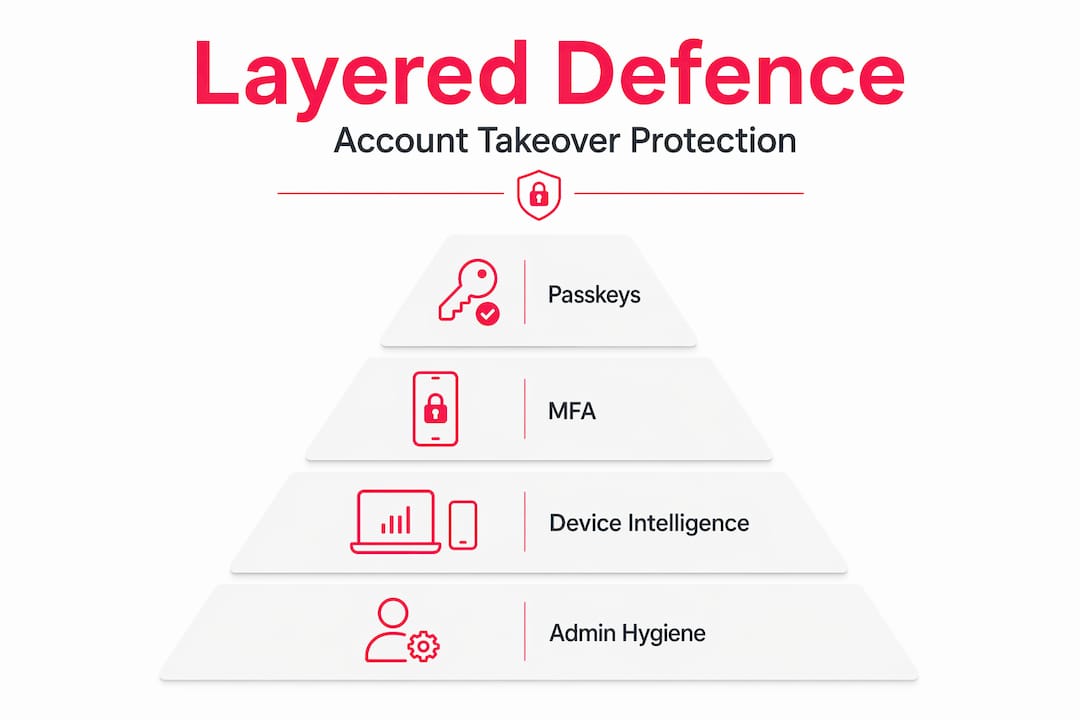
Retailers that stacked phishing-resistant passkeys, adaptive MFA, device intelligence, and behavioural biometrics alongside a tested incident response plan reduced ATO incidents by 71% within six months. Here is what each layer adds:
- Passkeys replace passwords entirely, eliminating credential theft as an attack vector. There are no passwords to steal, phish, or brute-force.
- Adaptive MFA analyses each login attempt in real time, triggering a second verification step only when risk signals are present, such as a new device, unusual location, or velocity anomaly.
- Device intelligence fingerprints the devices used by attackers, allowing you to block or flag access attempts from known bad devices even when credentials are correct.
- Behavioural biometrics detects unusual patterns in how a user interacts with your site, typing rhythm, mouse movement, navigation sequence, and flags sessions that do not match the account holder’s normal behaviour.
- A tested incident response plan means that when something does slip through, your team knows exactly what to do in the first 60 minutes. Containment speed is everything.
| Layer | What it blocks | Complexity to implement |
|---|---|---|
| Passkeys | Credential theft, phishing | Medium |
| Adaptive MFA | Unauthorised logins | Low to medium |
| Device intelligence | Known attacker devices | Medium |
| Behavioural biometrics | Session hijacking | High |
| Incident response plan | Breach escalation | Low (planning only) |
Understanding the role of security in ecommerce means accepting that no single control is enough. Each layer forces attackers to clear another hurdle, and most will move on to an easier target before they clear all five.
Pro Tip: Adaptive MFA is not just a security win, it is a user experience win. It keeps friction off 95 to 98% of legitimate sign-ins, only stepping up when genuine risk signals appear. You protect customers without irritating them.
Beyond advanced authentication, secure platform management is key. The next section covers practical steps for Magento and Shopify stores.
Practical security measures for Magento and Shopify stores
Good intentions without specific actions leave your store exposed. The following measures are directly applicable to both Magento (including Adobe Commerce and Magento Open Source) and Shopify, and together they close the most commonly exploited gaps.
Changing the default admin URL, enforcing 2FA, applying patches within days, and running monthly malware scans prevent the majority of automated attacks against Magento and Shopify stores. These are not aspirational goals. They are achievable this week.
- Change your admin URL. The default Magento admin path is publicly known. Changing it immediately removes your admin login from automated scanners.
- Enforce 2FA on every admin account. Not just the super-admin. Every account with access to your admin panel is a potential entry point.
- Apply security patches within days. Prioritise any patch marked as critical or addressing remote code execution vulnerabilities.
- Run monthly malware scans. Skimmers (malicious code injected into checkout pages to steal card details) are often invisible to the naked eye. Automated scanning tools detect them reliably.
- Audit admin accounts quarterly. Remove former employees, agencies, and freelancers who no longer need access. Restrict admin login to specific, known IP addresses where possible.
- Implement file-integrity monitoring. This compares your site’s files against a known-good baseline and alerts you when anything changes unexpectedly, an early warning for skimmer injection.
Reviewing website security tips for ecommerce alongside a structured ecommerce security audit process gives you a repeatable framework rather than ad hoc fixes.
Pro Tip: At Big Eye Deers, we use Sansec as part of our ongoing Magento support to detect malware and prevent supply chain attacks, where malicious code is injected through a compromised third-party extension rather than your own code. It is one of the most underappreciated attack vectors in Magento security right now.
With these practical steps clear, we now explore the vital role of ongoing risk reviews and network segmentation.
Continuous risk reviews and network segmentation
Security is not a project with an end date. The threat landscape shifts constantly, and your store changes too: new extensions, new team members, new integrations. Regular risk reviews keep your defences aligned with your current reality.

Risk reviews convert reactive data into a proactive posture by prioritising assets and vulnerabilities to reduce exposure. For ecommerce, this means identifying which systems are most critical, your payment gateway integration, your customer database, your admin access points, and ensuring they receive the highest level of protection.
Effective risk reviews and network controls include:
- Structured reviews on a regular schedule, at minimum quarterly, aligned with your PCI DSS audit cycle.
- Asset prioritisation. Not every system carries equal risk. Your checkout flow and payment data warrant far more attention than your blog.
- VLAN (Virtual Local Area Network) separation. VLAN isolation between cardholder data and general networks is a PCI DSS requirement. It prevents malware on a staff member’s machine from reaching your payment systems.
- Limiting lateral movement. If an attacker gains a foothold in one part of your network, segmentation stops them from moving freely to higher-value targets.
- Continuous network traffic monitoring to spot anomalies: unexpected outbound connections, unusual data volumes, or communication with known malicious IP addresses.
Your UK ecommerce security checklist should include scheduled risk reviews as a standing item, not something triggered only by a scare.
Understanding network and risk controls completes the defence framework. Now for a perspective on what UK ecommerce owners often miss entirely.
What most UK ecommerce owners overlook about proactive security
Here is something we see regularly, and it is worth saying plainly. Most store owners who take security seriously focus on one or two controls, set them up once, and consider the job done. Not good. Proactive security is an ongoing effort, not a one-time project, and the gaps between your controls are exactly where sophisticated attackers operate.
The biggest oversight? Most retailers over-invest in MFA but skip other layers, leaving them exposed to SIM-swap attacks (where an attacker hijacks your phone number to intercept SMS verification codes) and session hijacking (where a valid login session is stolen and replicated). MFA alone does not stop either of those.
Behavioural biometrics and device intelligence are routinely ignored because they feel complex or expensive. In reality, several platform-level tools now surface these signals without requiring custom development. The barrier is lower than most owners assume.
Incident response plans are another common casualty of “we’ll get to it.” An untested incident response plan is nearly as dangerous as having none. If your team has never actually practised the first 60 minutes of a breach response, the plan will fall apart under real pressure. Tabletop exercises, where you walk through a simulated breach scenario with the people involved, take a few hours and can make an enormous difference.
Admin hygiene is underestimated across the board. Old accounts, shared credentials, and passwords that have not changed since the store launched are shockingly common. A quarterly admin account audit, as we outlined in reviewing common ecommerce security oversights, is one of the highest-return activities you can do in a single afternoon.
Why proactive security matters comes down to this: the cost of prevention is predictable and manageable. The cost of a breach is neither.
Secure your Magento and Shopify store with Big Eye Deers
Applying the layered security strategies we have covered here requires both technical expertise and consistent follow-through. That is exactly where working with a specialist agency makes a tangible difference to your risk exposure.

At Big Eye Deers, we work with UK ecommerce businesses to secure their Magento and Shopify platforms with hands-on security audits, patch management, 2FA enforcement, and continuous monitoring using Sansec to detect malware and prevent supply chain attacks. We understand UK compliance requirements including PCI DSS and GDPR, and we build security into ongoing support rather than treating it as an afterthought. If you want to start with a clear picture of where your store currently stands, our ecommerce security checklist is a practical first step. Get in touch and we can take it from there.
Frequently asked questions
What is proactive ecommerce security and why is it important?
Proactive ecommerce security means continuously implementing and updating measures to prevent attacks before they succeed, rather than responding after damage is done. Stacking multiple controls significantly reduces both the likelihood and impact of breaches, protecting your revenue and customer trust.
How often should I audit my Magento or Shopify store’s security?
Quarterly audits covering admin accounts, patch status, and malware scans are the minimum recommended cadence. PCI DSS 4.0.1 requires quarterly internal audits and continuous monitoring, so aligning your audit schedule with compliance obligations makes both more manageable.
What is adaptive MFA and how does it reduce friction for users?
Adaptive MFA (multi-factor authentication) analyses risk signals at the point of login and only triggers a second verification step when something looks suspicious. It keeps friction off 95 to 98% of sign-ins, meaning your genuine customers are rarely inconvenienced whilst fraudulent access attempts are blocked.
Why is network segmentation critical in ecommerce security?
Network segmentation isolates your payment and sensitive data systems so that a compromised staff device cannot become a route into your checkout infrastructure. VLAN separation is a PCI DSS requirement specifically designed to stop malware from spreading between general office networks and cardholder data environments.
Can Big Eye Deers help improve my ecommerce security?
Yes. We offer specialised Magento and Shopify security services including audits, patch management, malware monitoring via Sansec, and incident response planning, all tailored for UK ecommerce businesses operating under PCI DSS and GDPR requirements.
Recommended



Adobe Commerce (Magento)
Formerly known as Magento, Adobe Commerce is built for complex catalogues, integrations, and long term growth. We design and develop stable, scalable stores that support demanding eCommerce requirements, including multi-store setups, complex pricing, and Hyva based performance improvements.

Bespoke Build
We design and build custom eCommerce platforms for businesses with complex workflows, integrations, or non standard requirements. Built from scratch around your business needs using Laravel and modern architectures.
Working with brands across the UK from our offices in Cardiff and Exeter, you deal directly with a senior team of designers and developers specialising in Shopify, Magento, WordPress and bespoke eCommerce platforms.
We focus on commercial outcomes. Better conversion rates, strong SEO foundations and eCommerce platforms that continue to improve long after launch.