Ecommerce monitoring explained: Protect revenue and boost uptime
TL;DR:
- UK retailers lose significant revenue from store outages and silent failures without proper monitoring.
- Effective ecommerce monitoring covers availability, security, revenue flows, integrations, and background operations.
- Implementing comprehensive, real-time monitoring tools provides strong ROI by preventing costly outages and compliance issues.
UK retailers lose staggering sums every hour their stores are unavailable or behaving badly — large retailers lose £4,400+ per minute of downtime, and mid-market stores can lose 20 to 35% of a full day’s revenue from a two-hour outage. Yet most e-commerce owners are still watching a single green uptime light and assuming everything is fine. It isn’t. This guide cuts through the confusion around ecommerce monitoring, explains what it genuinely covers beyond uptime, and gives you a clear framework to protect the revenue your store works so hard to generate.
Table of Contents
- What ecommerce monitoring means for UK online stores
- Core monitoring areas: More than just uptime
- How ecommerce monitoring works: Methods and tools explained
- Securing your platform: Monitoring and UK e-commerce compliance
- The business case: Returns on ecommerce monitoring investment
- Why most ecommerce monitoring advice falls short
- Take your store monitoring to the next level
- Frequently asked questions
Key Takeaways
| Point | Details |
|---|---|
| Monitor more than uptime | Track checkout, payments, integrations, and background jobs to catch hidden errors. |
| Prioritise revenue flows | Checking checkout and payment processes prevents the most damaging silent failures. |
| Link monitoring with security | Align monitoring with PCI DSS and Cyber Essentials to meet UK compliance and cybercrime threats. |
| Invest for real ROI | Even modest monitoring spend stops losses that far exceed costs for UK e-commerce stores. |
| Use real-time alerts | Fast alerts enable preventive action, protecting both revenue and reputation. |
What ecommerce monitoring means for UK online stores
Let’s get the definition right, because this is where most retailers go wrong immediately.
“Ecommerce monitoring is the continuous tracking and analysis of an online store’s performance, availability, security, and revenue-critical processes to detect issues early and prevent revenue loss.”
That is a meaningfully different thing from standard web analytics. Google Analytics tells you what happened to your traffic. Monitoring tells you why your revenue dropped before you even notice the drop. It is the difference between a post-mortem and a prevention.
Many people conflate monitoring with analytics, KPI dashboards, or e-commerce product monitoring which focuses on conversion rates, average order value, and product shelf visibility. Those are important, but they are descriptive. Technical ecommerce monitoring is preventive — it watches the machinery that keeps your store functional, not just the outputs that tell you how it performed.
For UK retailers specifically, the stakes are climbing. Cyber incidents cost UK retailers between £270 million and £440 million in 2025 alone. And the nature of those attacks is shifting, making surface-level monitoring dangerously insufficient. If you are serious about auditing ecommerce performance, you need to understand what monitoring actually covers first.
Here is what ecommerce monitoring genuinely tracks across a well-run UK store:
- Availability: Is your store accessible to real users right now, from UK-based locations?
- Security: Are there active threats, injected scripts, or compromised integrations affecting your store?
- Revenue-critical flows: Is checkout actually completing? Are payment confirmations being sent?
- Infrastructure and integrations: Are your APIs, ERP connections, and third-party services responding correctly?
- Background operations: Are inventory levels syncing? Are order confirmation emails dispatching? Are cron jobs running on schedule?
Simple analytics captures none of this. A green dashboard in Google Analytics means nothing if your checkout is silently failing for users on a specific payment method.
Core monitoring areas: More than just uptime
Now you understand the why, let’s look at what you actually need to monitor beyond the basics. Most store owners stop at uptime. That’s a belt-and-braces approach to only one trouser leg.
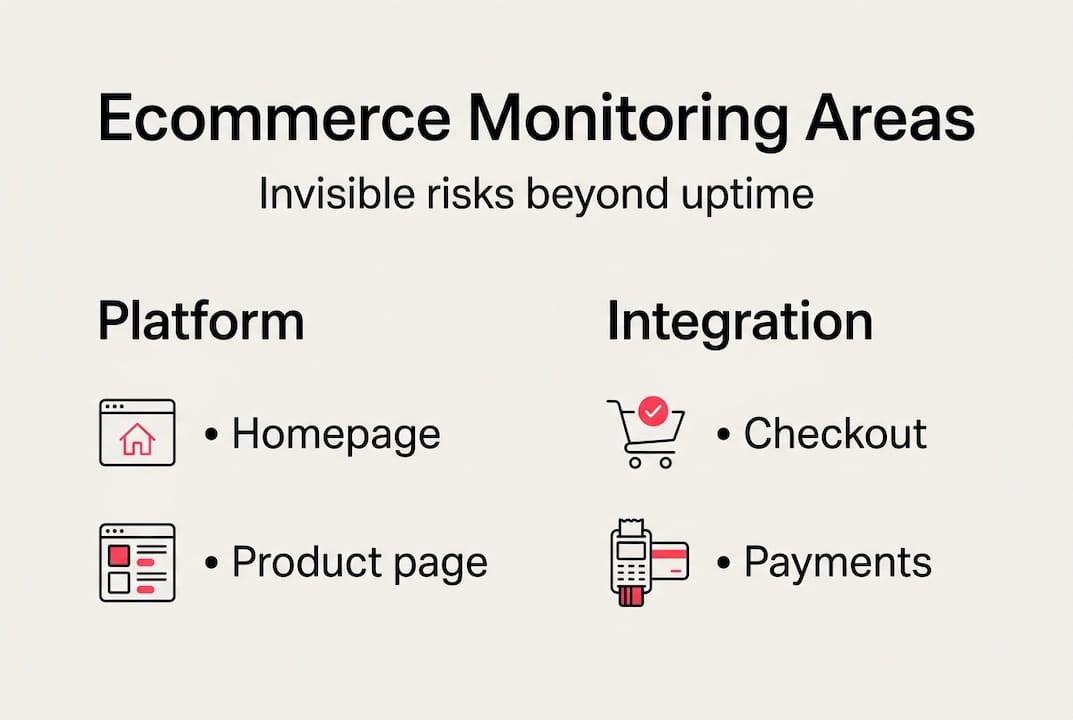
The four core categories of ecommerce monitoring are:
| Category | What it covers | Example failure |
|---|---|---|
| Core availability | Homepage, category, product pages | Server down, DNS failure, CDN outage |
| Revenue-critical flows | Checkout, basket, payment processing | SSL expiry, payment gateway timeout |
| Infrastructure and integrations | APIs, ERP, third-party services | Webhook failure, ERP sync drop |
| Background operations | Inventory sync, email dispatch, cron jobs | Overselling, missing order confirmations |
Notice how three of those four categories are completely invisible to uptime monitoring. Your homepage can be green while checkout silently fails, an SSL certificate quietly expires blocking all purchases, or a payment integration breaks without producing a single HTTP error code. Customers simply abandon. You see a conversion rate dip and assume it’s a marketing problem.

This is genuinely dangerous. And it happens more often than anyone in this industry likes to admit.
Here is a practical checklist of what you should be monitoring across those four categories:
- Homepage and key landing pages from UK-based monitoring nodes
- Category and product page load times and response codes
- Add-to-basket functionality via synthetic transaction monitoring
- The complete checkout journey from basket to order confirmation
- Payment gateway endpoint availability and response times
- SSL certificate validity and expiry alerts (set for 30 and 14 days ahead)
- API endpoints connecting to your ERP, WMS, or stock management system
- Inventory sync job completion and timestamps
- Order confirmation email dispatch success rates
- Cron job heartbeat monitoring for scheduled tasks
That’s a thorough list. But working through our launch checklist for secure stores can help you confirm these are all properly configured from day one.
Pro Tip: Do not weight every check equally. Set your payment integration and checkout monitoring to alert within 60 seconds. Product page checks can wait 5 minutes. Revenue impact should drive your alert priority, not technical convenience.
How ecommerce monitoring works: Methods and tools explained
With the categories mapped out, next is how you actually monitor each area, and what most store owners get wrong when they set it up.
The methods involved are more varied than people realise. Key methodologies include HTTP checks, synthetic user journey monitoring, payment gateway endpoint validation, SSL certificate expiry alerting, job heartbeat monitoring, and real-time log analysis. Each does a different job.
| Monitoring method | What it detects | Recommended interval |
|---|---|---|
| HTTP/HTTPS checks | Page availability, response codes | Every 1 minute (critical pages) |
| Synthetic transaction monitoring | Checkout flow failures, JS errors | Every 5 minutes |
| Payment gateway validation | API timeouts, endpoint failures | Every 1 minute |
| SSL certificate monitoring | Expiry, misconfiguration | Daily check, 30-day alert |
| Job heartbeat monitoring | Failed cron jobs, missed syncs | Per job schedule |
| Real-time log analysis | Error spikes, attack patterns | Continuous |
| Real User Monitoring (RUM) | Actual user experience, Core Web Vitals | Continuous |
Here is a sensible order for setting these up as a UK retailer:
- Start with HTTP checks on your homepage, checkout, and key category pages. This is your baseline and takes minutes to configure in tools like UptimeRobot or Pingdom.
- Add SSL certificate monitoring immediately. An expired certificate kills your entire store without warning. Set two alerts: 30 days out and 14 days out.
- Configure synthetic transaction monitoring to walk through your full purchase journey. This is where the real value lives. Tools like Checkly or Datadog Synthetics can simulate a real purchase every few minutes.
- Validate your payment gateway endpoints directly. Do not rely on your payment provider’s own status page — monitor their API response from your environment.
- Set up heartbeat monitoring for inventory sync jobs and any scheduled tasks that power your operations.
- Implement log analysis for real-time error detection and security pattern recognition.
A critical point worth emphasising: basic uptime monitoring misses over 80% of failure modes. Most failures do not take your homepage down. They attack the specific flows that turn browsers into buyers. That is where your monitoring effort should be focused, and that means going well beyond a simple ping check.
For a deeper look at configuring these tools correctly, our guide on monitoring website performance covers the practical implementation in detail.
Securing your platform: Monitoring and UK e-commerce compliance
Performance monitoring naturally leads into compliance, and for UK stores in 2026, this has fast-evolving requirements that cannot be ignored.
“Post-2025 ransomware trends mean UK retailers must focus on EPoS separation, CSP headers to counter skimming attacks, and continuous scans per PCI DSS 4.0, moving away from periodic assessments to always-on detection.”
This is a significant shift. PCI DSS 4.0 specifically requires continuous monitoring rather than point-in-time scans. That brings monitoring from a nice-to-have into a compliance obligation for any store handling card data. For UK businesses, Cyber Essentials certification also requires demonsturable controls around access management, malware protection, and network boundary security — all of which monitoring directly supports.
For UK owners, the right approach is to integrate Cyber Essentials and PCI DSS requirements directly into your monitoring setup, rather than treating compliance as a separate annual exercise.
Here is what this means in practice. Your monitoring stack should cover:
- Content Security Policy (CSP) header monitoring to detect unauthorised script injections (a primary Magecart attack vector)
- Third-party script change detection to identify supply chain compromises in external JavaScript
- File integrity monitoring to flag unexpected changes to core platform files
- Failed login attempt alerting to catch brute force attacks on admin panels early
- API authentication monitoring to detect unusual access patterns or credential stuffing
- Malware scanning using tools like Sansec, which we use specifically for our Magento clients to detect skimming scripts and malicious code before it affects customers
Our roundup of security tips for UK retailers covers these controls in practical detail, and the website security checklist gives you a structured way to audit your current posture.
Pro Tip: The failures that cost you the most are not dramatic crashes. A payment confirmation email that silently stops sending, or an inventory sync that quietly falls 4 hours behind, will cause real financial damage and customer service chaos long before anyone notices. Monitor the quiet processes, not just the loud ones. If you want to understand why this matters commercially, secure ecommerce for growth makes the business case clearly.
The business case: Returns on ecommerce monitoring investment
With security and compliance covered, let’s look at the real returns: how monitoring directly impacts your bottom line and peace of mind.
The numbers here are compelling. A monitoring stack costing £20 to £60 per month can pay for its entire annual cost by preventing a single significant outage for any store generating £400,000 or more in annual revenue. Real-time alerts fundamentally shift your operation from reactive to preventive — you fix the problem before customers encounter it, rather than responding to a flood of support tickets after the fact.
Consider what a two-hour checkout failure costs a mid-market UK store doing £1.5 million annually. At an average conversion rate of 2.5%, that store processes roughly £3,000 to £4,000 per hour during peak trading. A two-hour silent checkout failure costs £6,000 to £8,000 in lost sales, plus the customer experience damage and the inevitable social media complaints. A £40 monthly monitoring tool that catches it in 60 seconds? That is an extraordinary return.
Signs that you need stronger monitoring right now:
- You have discovered issues from customer complaints rather than your own systems
- Your developers investigate performance problems reactively rather than preventing them
- You have no visibility into whether your ERP or stock system is syncing correctly
- Your SSL certificate has ever expired unexpectedly
- You are unsure whether order confirmation emails are actually reaching customers
- You have had an unexplained conversion rate drop that lasted more than an hour
- You process card payments but have not reviewed your PCI DSS compliance monitoring recently
If three or more of those apply to your store, your monitoring is materially insufficient for the revenue at risk. The good news is that this is fixable, and the tooling available in 2026 makes it more accessible than ever for UK retailers at any scale.
Why most ecommerce monitoring advice falls short
Here is something we have seen consistently across 17 years of building and supporting ecommerce platforms: most monitoring advice is written for people who want to feel secure, not for people who actually want to be secure. There is a difference, and it costs money.
Most guides will tell you to set up uptime monitoring and check your Core Web Vitals. Both are sensible. Neither will catch the integration failures that quietly kill your revenue. We have seen stores with perfect uptime scores losing thousands per week because an ERP webhook was silently failing and no one had configured an alert for it. The homepage was green. The business was bleeding.
The truth is that your greatest monitoring risk is not your platform going down. It is your integrations behaving unpredictably. A payment provider silently rate-limiting your API calls. A third-party script injected via a compromised marketing tag. An inventory feed that drifts out of sync during a sale event and causes mass overselling. These are not exotic edge cases — we encounter them regularly.
What UK leaders do differently is monitor at the integration layer, not just the platform layer. They treat every third-party connection as a potential point of failure and validate it continuously. They use tools like Sansec to watch for script injection at the front end, and they set heartbeat monitors on every background job. They review their advanced audit strategies on a schedule, not just after something breaks.
The uncomfortable truth is that quiet errors are more dangerous than visible outages. An outage generates immediate alarm. A silent failure generates gradual, confusing revenue erosion that takes days to diagnose. Build your monitoring to catch the whispers, not just the shouts.
Take your store monitoring to the next level
Getting monitoring right is not a one-afternoon job, and the configuration decisions you make at the start will shape your security and revenue protection for years. If you are running a serious UK e-commerce operation and you are not fully confident in what your current monitoring covers, this is your heads-up to take action.

We work with UK retailers on Shopify monitoring and Magento platform builds, embedding robust monitoring and security into every store we support. From Sansec malware detection to synthetic transaction monitoring and PCI DSS compliance, we set these up as standard, not as afterthoughts. If you want a frank conversation about where your store’s monitoring currently stands and what needs to improve, speak to our ecommerce experts today. We are based in Cardiff and Exeter and we know exactly what UK retailers face.
Frequently asked questions
What does ecommerce monitoring track beyond uptime?
Ecommerce monitoring also tracks checkout flows and payment integrations, security events, and inventory synchronisations to prevent hidden revenue-killing failures that uptime checks alone will never catch.
How quickly can ecommerce monitoring detect issues?
Cutting-edge platforms can detect critical failures in under two minutes, with one-minute monitoring intervals recommended for key revenue flows such as checkout and payment processing endpoints.
Why is checkout monitoring more important than homepage checks?
Checkout and payment failures can silently cause revenue losses far greater than homepage outages because they disrupt orders without producing obvious error messages that trigger standard alerts.
How does ecommerce monitoring support UK security compliance?
Continuous monitoring helps meet PCI DSS 4.0 and Cyber Essentials requirements by detecting threats, failed scans, and malicious script injections in real time rather than through periodic assessments.
What is the business ROI of implementing ecommerce monitoring?
For stores with £400k or more in annual sales, monitoring stacks costing £20 to £60 per month can pay for their entire annual cost by preventing just one significant outage or silent checkout failure per year.
Recommended



Adobe Commerce (Magento)
Formerly known as Magento, Adobe Commerce is built for complex catalogues, integrations, and long term growth. We design and develop stable, scalable stores that support demanding eCommerce requirements, including multi-store setups, complex pricing, and Hyva based performance improvements.

Bespoke Build
We design and build custom eCommerce platforms for businesses with complex workflows, integrations, or non standard requirements. Built from scratch around your business needs using Laravel and modern architectures.

Working with brands across the UK from our offices in Cardiff and Exeter, you deal directly with a senior team of designers and developers specialising in Shopify, Magento, WordPress and bespoke eCommerce platforms.
We focus on commercial outcomes. Better conversion rates, strong SEO foundations and eCommerce platforms that continue to improve long after launch.