Enterprise ecommerce explained: A guide for UK retail brands
TL;DR:
- Enterprise ecommerce platforms offer scalability, customization, and deep integration for growing brands.
- UK retailers adopt enterprise solutions to meet rising customer expectations and expand internationally.
- Success depends on aligning platform choice with business goals, processes, and ongoing improvement efforts.
Enterprise ecommerce carries a reputation for being the preserve of global giants with bottomless budgets. That assumption is costing mid-sized UK retail brands dearly. With the UK ecommerce market worth £353.5bn in 2026, the competitive pressure to operate at scale is real, regardless of your current size. This guide breaks down what enterprise ecommerce actually means, which features matter most, and how to choose a platform that fits your ambitions rather than just your current turnover. Whether you are running a growing DTC brand or managing a complex wholesale operation, the principles here apply directly to you.
Table of Contents
- What is enterprise ecommerce?
- Why UK retail brands are shifting to enterprise ecommerce
- Key features of enterprise ecommerce platforms
- How to choose the right enterprise ecommerce solution
- The reality of scaling with enterprise ecommerce: Lessons from the field
- Taking your next steps with enterprise ecommerce
- Frequently asked questions
Key Takeaways
| Point | Details |
|---|---|
| Enterprise ecommerce defined | Enterprise ecommerce means scalable, robust platforms designed for growing brands and complex business needs. |
| UK brands benefit now | With fierce competition and a £353.5bn market, UK retailers need enterprise solutions to stay ahead. |
| Key features matter | Security, scalability, and integration capabilities are non-negotiable for effective enterprise ecommerce. |
| Smart evaluation is vital | Choosing the right platform requires a structured process focused on long-term fit for business goals. |
What is enterprise ecommerce?
The term gets thrown around loosely, so let us be precise. Enterprise ecommerce refers to high-capacity, scalable online trading platforms built to handle complex business requirements. We are talking about multi-store management, advanced catalogue structures, sophisticated pricing rules, ERP integrations, and the ability to serve thousands of concurrent customers without breaking a sweat.
Critically, this is not a category reserved for multibillion-pound corporations. Any brand with genuine growth ambitions, operational complexity, or plans to expand into new markets or channels should be thinking about enterprise ecommerce solutions now, not after the pain of outgrowing a basic platform.
The core characteristics that define enterprise-grade platforms include:
- Scalability: The ability to handle traffic spikes, catalogue growth, and geographic expansion without performance degradation
- Customisability: Flexible architecture that bends to your business model rather than forcing you to adapt your processes to the platform
- Integration capability: Native or robust API-based connections to ERP, CRM, PIM, and third-party logistics systems
- Security: Advanced compliance frameworks, proactive monitoring, and regular patching to protect high-value transactions
- Multi-store and multi-channel management: A single back-end to manage multiple storefronts, locales, and trading models
“Enterprise ecommerce is not about complexity for its own sake. It is about having the infrastructure to grow without friction.”
Understanding the definition of ecommerce platforms at this level matters because the wrong choice early on creates technical debt that is expensive and disruptive to resolve. With UK ecommerce projected at £353.5bn, the stakes for getting this right are higher than ever.
Why UK retail brands are shifting to enterprise ecommerce
Understanding what enterprise ecommerce is leads naturally to asking why so many UK retailers are making the leap. The short answer is competitive necessity.
UK ecommerce businesses exceed 508,000, which means the market is crowded and unforgiving. Brands that cannot deliver fast, personalised, and seamless experiences across every channel are losing ground to those that can. That reality is pushing retailers to invest in platforms that can genuinely support them at scale.
The key drivers we see consistently across our client base include:
- Rising customer expectations: Shoppers now expect one-click checkout, real-time stock visibility, and personalised product recommendations as standard
- Data-driven marketing: Lifecycle tools like Klaviyo require clean, structured data pipelines that basic platforms simply cannot provide reliably
- B2B and B2C convergence: Many brands now trade across both models, requiring tiered pricing, account hierarchies, and trade-specific catalogues alongside their consumer-facing store
- Performance at scale: High-traffic events like Black Friday or product launches expose the weaknesses of under-powered platforms quickly
- Global expansion: Moving into new territories requires multi-currency, multi-locale, and multi-tax capabilities that are built into enterprise platforms from the ground up
Consider a realistic scenario: a mid-tier UK homewares brand generating £8m annually wants to expand into Germany and Australia while launching a trade portal for interior designers. A standard Shopify plan or WooCommerce setup will not manage that gracefully. Staying across UK ecommerce trends in 2026 makes it clear that the brands investing in custom ecommerce for UK brands now are the ones building sustainable competitive advantage.

Pro Tip: Invest early in platforms that scale with your ambitions. Migrating from a basic platform to an enterprise solution mid-growth is significantly more costly, disruptive, and time-consuming than building on the right foundations from the start.
Key features of enterprise ecommerce platforms
Knowing the drivers, it is time to evaluate what actually separates enterprise-grade platforms from everything else. Feature lists can be overwhelming, so here is how to think about it practically.
The non-negotiable capabilities for any serious enterprise platform are:
- Scalable infrastructure: Cloud hosting, CDN support, and architecture that handles traffic surges without downtime
- Advanced security: PCI DSS compliance, malware monitoring, and robust access controls for high-value transactions
- Multi-channel capability: Unified management of web, mobile, marketplace, and in-store channels from a single system
- Deep integration support: Pre-built connectors and open APIs for ERP, CRM, PIM, and fulfilment systems
- Advanced analytics: Real-time reporting, customer segmentation, and revenue attribution built into the platform
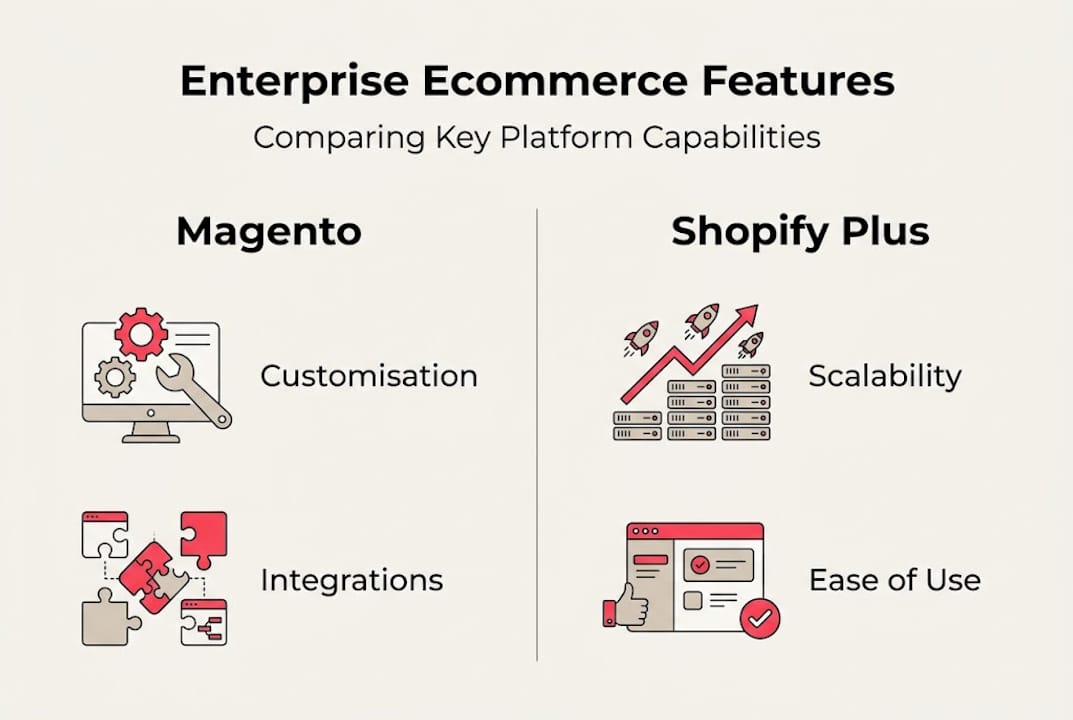
When enterprise solutions are chosen for scalability, the comparison between Magento and Shopify is usually where the decision gets difficult. Here is a straightforward breakdown:
| Feature | Magento (Adobe Commerce) | Shopify Plus |
|---|---|---|
| Customisation depth | Very high | Moderate to high |
| B2B capability | Native, advanced | Growing, via apps |
| Multi-store management | Excellent | Good |
| ERP integration | Robust, complex | Simpler, app-based |
| Total cost of ownership | Higher | More predictable |
| Developer ecosystem | Large, specialist | Very large, accessible |
| UK compliance support | Strong | Strong |
The common mistake we see is brands fixating on feature lists without asking how those features map to their actual business processes. A platform with every capability imaginable is worthless if your team cannot use it effectively or if it requires six months of custom development to match your catalogue structure.
Good ecommerce design for retail success is inseparable from platform choice. The front-end experience your customers see is only as good as the infrastructure beneath it. Platforms that support scalable online growth give your design and merchandising teams the tools to act on data quickly, without waiting for developer intervention every time.
Pro Tip: Prioritise platforms with proven multi-currency and multi-locale capabilities if international expansion is on your roadmap. Retrofitting these features later is painful and expensive. Getting ecommerce right from the outset saves considerable time and budget.
How to choose the right enterprise ecommerce solution
Armed with a clearer picture of features, the logical next step is choosing wisely. This is where many brands stumble, not from lack of information but from lack of a structured decision process.
Start by defining your business goals with precision. Are you prioritising international expansion, omnichannel unification, B2B trade portal functionality, or rapid DTC growth? Your answer shapes everything that follows. UK ecommerce growth and complexity demand that you approach this with a robust framework rather than going on gut instinct or a vendor’s sales pitch.
Here is a practical step-by-step evaluation process:
- Audit your current pain points: Document where your existing platform is failing you, whether that is slow page speeds, integration failures, or inability to manage complex pricing
- Define your non-negotiables: List the capabilities you cannot operate without, separate from nice-to-haves
- Set a realistic total cost of ownership budget: Include licensing, development, integrations, ongoing support, and training
- Shortlist two or three platforms: Run proof-of-concept tests or request detailed demos focused on your specific use cases
- Evaluate vendor and agency support: The platform is only part of the equation; the expertise behind it matters equally
To help frame the decision, here is a simplified scenario matrix:
| Scenario | Recommended platform |
|---|---|
| Complex B2B with tiered pricing and account hierarchies | Magento (Adobe Commerce) |
| Fast-growing DTC brand needing speed to market | Shopify Plus |
| Multi-store, multi-locale international retail | Magento or Adobe Commerce |
| Brand needing lower TCO with strong app ecosystem | Shopify Plus |
| Enterprise with existing ERP requiring deep integration | Magento |
The pitfalls to avoid are consistent across projects we have worked on:
- Underestimating integration complexity, particularly with legacy ERP systems
- Ignoring change management and internal team training
- Choosing a platform based on peer recommendation rather than your own operational requirements
- Failing to account for ecommerce development trends when locking into long-term contracts
The reality of scaling with enterprise ecommerce: Lessons from the field
After 17 years working with UK retail brands across Magento and Shopify, we have seen a consistent pattern. The brands that struggle most with enterprise ecommerce are not the ones that chose the wrong platform. They are the ones that treated the platform launch as the finish line rather than the starting gun.
Enterprise ecommerce promises scale, but it can expose process bottlenecks and internal buy-in gaps that were invisible when the business was smaller. A new platform will not fix a broken fulfilment workflow or a merchandising team that lacks the data literacy to act on analytics. The technology surfaces problems; it does not automatically solve them.
The most successful outcomes we have seen marry platform capability with a genuine commitment to continuous improvement. Teams that treat their scalable online growth programme as an ongoing operational discipline, rather than a one-off IT project, consistently outperform those that do not. Our honest advice to any leader considering this investment: budget for the cultural shift as seriously as you budget for the technology.
Taking your next steps with enterprise ecommerce
If this guide has clarified what enterprise ecommerce involves and where your brand sits on that journey, the next step is getting the right expertise behind you. Understanding the landscape is valuable; applying it correctly to your specific business is where the real work begins.
At Big Eye Deers, we specialise in designing, building, and supporting high-performing Shopify for UK brands and complex Magento web design services for retail brands across the UK. Whether you are evaluating platforms for the first time or planning a migration, we bring 17 years of hands-on experience to every project. Talk to us about your requirements and we will help you make a confident, well-informed decision. Visit Big Eye Deers to start the conversation.
Frequently asked questions
How do I know if my retail brand needs an enterprise ecommerce solution?
If you regularly face growth bottlenecks, need advanced integrations, or plan multi-territory expansion, enterprise ecommerce is likely essential. Enterprise platforms support scaling and the operational complexity that comes with serious commercial ambition.
What is the average cost difference between Magento and Shopify enterprise solutions?
Shopify Plus offers more predictable monthly costs with lower up-front development investment, while Magento typically requires greater spend on customisation and specialist development but delivers deeper flexibility for complex requirements.
Can existing systems like ERP and CRM be integrated with enterprise ecommerce platforms?
Yes. Leading solutions like Magento and Shopify Plus are built for this, with robust integration capabilities via open APIs and pre-built connectors for most major ERP and CRM systems.
Is enterprise ecommerce secure enough for high-value transactions?
Absolutely. Security is a core reason brands shift to enterprise platforms, which include PCI DSS compliance, advanced access controls, and proactive monitoring as standard features rather than optional add-ons.
Recommended



Adobe Commerce (Magento)
Formerly known as Magento, Adobe Commerce is built for complex catalogues, integrations, and long term growth. We design and develop stable, scalable stores that support demanding eCommerce requirements, including multi-store setups, complex pricing, and Hyva based performance improvements.

Bespoke Build
We design and build custom eCommerce platforms for businesses with complex workflows, integrations, or non standard requirements. Built from scratch around your business needs using Laravel and modern architectures.
Working with brands across the UK from our offices in Cardiff and Exeter, you deal directly with a senior team of designers and developers specialising in Shopify, Magento, WordPress and bespoke eCommerce platforms.
We focus on commercial outcomes. Better conversion rates, strong SEO foundations and eCommerce platforms that continue to improve long after launch.