Secure payment gateways: strengthen your UK store
TL;DR:
- A secure payment gateway encrypts data, tokenizes information, and includes fraud prevention tools.
- Ongoing management, updates, and monitoring are essential to maintain payment security.
- Many breaches result from neglecting security practices despite having the right gateway.
Most UK e-commerce owners assume their checkout is secure the moment they bolt on a payment button. That assumption is costly. A single gap in your payment security can expose customer card data, trigger chargebacks, and shatter the trust you have spent years building. This guide cuts through the confusion around secure payment gateways: what they actually are, why they matter far more than most people realise, and how to choose and implement the right one for your UK online store. Whether you are running a Shopify shop or a complex Magento build, the principles here apply directly to you.
Table of Contents
- What is a secure payment gateway?
- How secure payment gateways protect your business
- Key features to look for in a secure payment gateway
- Choosing and implementing the right gateway for your UK store
- Common mistakes and how to avoid them
- Our perspective: security theatre is the real threat
- Ready to build a more secure store?
- Frequently asked questions
Key Takeaways
| Point | Details |
|---|---|
| Gateway security is crucial | A secure payment gateway protects your business, reputation and customers from fraud. |
| Look for key features | Prioritise PCI DSS compliance, encryption, and robust support when comparing gateway providers. |
| Set up and monitor regularly | Careful implementation and ongoing checks keep your payment systems secure long-term. |
| Avoid common pitfalls | Regularly update settings and stay compliant to prevent costly mistakes. |
What is a secure payment gateway?
A payment gateway is the technology that sits between your customer, your online store, and the bank. When a shopper enters their card details at checkout, the gateway captures that data, encrypts it, and forwards it to the payment processor for authorisation. Think of it as the digital equivalent of a card machine in a physical shop, except the risks of interception are far greater online.
Having a checkout on your website is not the same as having a secure checkout. A basic gateway might process payments, but without robust security layers it leaves sensitive data exposed at multiple points in the transaction chain. Payment gateways are vital for encrypting sensitive cardholder information, and that encryption is what separates a trustworthy store from a liability.
A genuinely secure payment gateway includes several non-negotiable features:
- End-to-end encryption: Card data is scrambled from the moment the customer types it in.
- Tokenisation: Real card numbers are replaced with unique tokens, so even if data is intercepted, it is useless.
- Fraud prevention tools: Real-time checks flag suspicious behaviour before transactions complete.
- PCI DSS compliance: The Payment Card Industry Data Security Standard sets the baseline rules all legitimate gateways must follow.
“A payment gateway that ticks every feature box but lacks PCI DSS certification is not a secure gateway. It is a risk dressed up as a solution.”
For a broader view of security tips for UK e-commerce, it is worth understanding how gateway security fits into your wider store protection strategy.
How secure payment gateways protect your business
Understanding what a secure gateway is leads directly to why it is so critical for your online store. The protection works on several levels simultaneously.
Here is how a secure gateway handles a typical transaction:
- Capture: The customer submits card details via an encrypted form.
- Encrypt: Data is immediately encrypted using TLS (Transport Layer Security) before transmission.
- Authorise: The gateway sends a tokenised request to the card network for approval.
- Fraud check: Automated rules and machine learning scan for anomalies in real time.
- Respond: An approval or decline is returned to your store, usually within seconds.
Without this chain, you are exposed. Chargebacks alone can cost UK merchants between £20 and £100 per disputed transaction once fees and administrative time are factored in. Repeat chargebacks can result in your merchant account being terminated entirely. Not good.
UK payment fraud trends show that online fraud continues to rise year on year, making robust gateway security less of a luxury and more of a baseline requirement. Secure gateways encrypt card data, reducing exposure to cyber attacks at every stage of the transaction.

For more on protecting against e-commerce fraud, the same principles of layered defence apply across your entire store.
Pro Tip: When evaluating providers, look specifically for 3D Secure 2.0 (3DS2) support. This adds an extra authentication layer for high-risk transactions while keeping low-risk purchases frictionless, which protects you without annoying your customers.
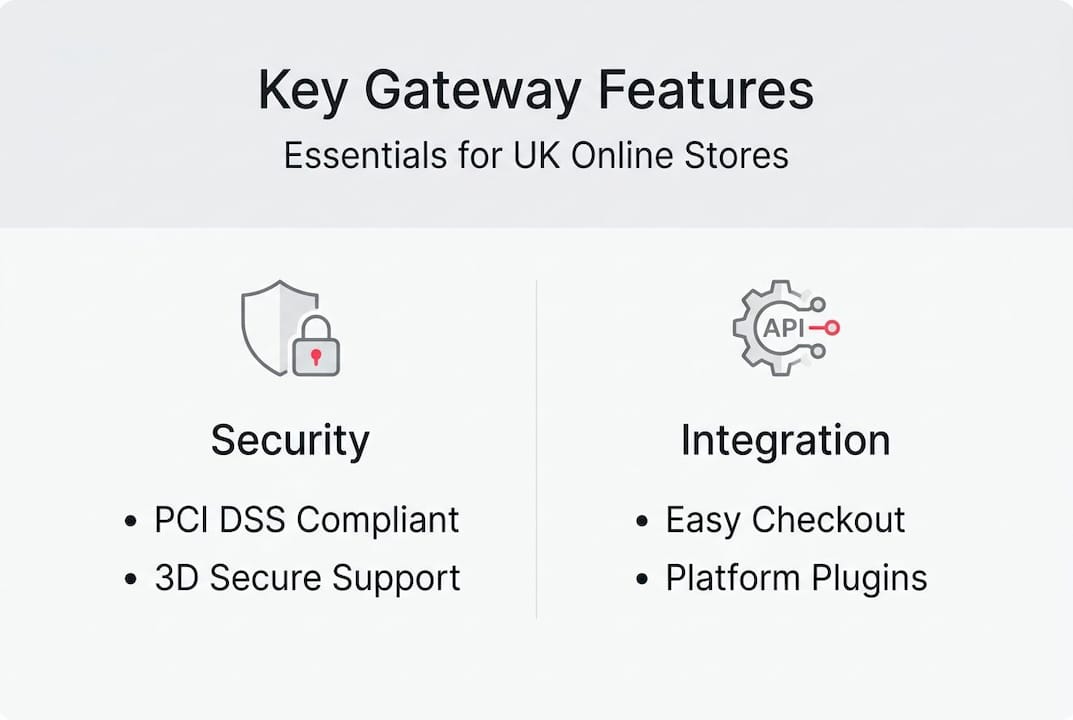
Key features to look for in a secure payment gateway
With risks and benefits clear, next we will compare what to look for when choosing your gateway. Not all payment gateways offer the same level of security or integration options, and that gap matters enormously once you are processing real customer transactions.
Here is a comparison of the features that separate good gateways from great ones:
| Feature | Basic gateway | Secure gateway |
|---|---|---|
| PCI DSS compliance | Sometimes | Always |
| End-to-end encryption | Partial | Full |
| Tokenisation | Rarely | Standard |
| 3DS2 support | No | Yes |
| Fraud detection tools | Basic | Advanced (ML-driven) |
| Integration flexibility | Limited | Broad (API, plugin) |
| 24/7 support | No | Yes |
Beyond the feature list, ask vendors these questions before committing:
- What PCI DSS level are you certified to, and can you provide documentation?
- How do you handle data breaches, and what is your incident response time?
- What fraud detection rules can we customise for our product catalogue?
- Does your gateway support recurring billing if we plan to offer subscriptions?
- What are your uptime guarantees and how do you handle outages?
Integration quality matters too. A gateway that works beautifully in isolation but causes friction at checkout will cost you conversions. Pairing your gateway with secure UK cloud hosting ensures the entire payment environment is hardened, not just the gateway itself. Understanding the business impacts of secure e-commerce makes it clear that these decisions compound over time.
Choosing and implementing the right gateway for your UK store
Once you know what to look for, it is time to put it into practice and ensure top-notch integration. Smooth integration enhances checkout experience and keeps customers safe, so the implementation phase deserves as much attention as the selection phase.
Follow this process:
- Shortlist: Identify three to five gateways that meet your PCI DSS, encryption, and integration requirements.
- Evaluate: Test each against your platform (Magento, Shopify, or otherwise) in a staging environment.
- Compliance check: Verify certifications directly with the provider and cross-reference with UK payment regulations.
- Integrate: Use the provider’s official plugin or API, never a third-party workaround.
- Monitor: Set up transaction monitoring alerts and review logs weekly.
Here are the minimum security standards every UK store should meet post-integration:
| Standard | Requirement | Review frequency |
|---|---|---|
| PCI DSS | Level 1 or SAQ-A compliant | Annual |
| SSL/TLS certificate | TLS 1.2 or higher | Quarterly |
| Fraud rules | Active and customised | Monthly |
| Plugin/extension updates | Latest stable version | Monthly |
| Access controls | Role-based, MFA enabled | Quarterly |
Use our secure e-commerce site launch checklist to make sure nothing is missed before you go live. Regularly auditing your website security after launch is equally important.
Pro Tip: Schedule a formal security review every quarter, not just when something breaks. Threat landscapes shift fast, and a gateway configuration that was solid six months ago may have gaps today.
Common mistakes and how to avoid them
Finally, let us make sure you are not making errors that compromise all your hard work. Missing security updates and misconfiguring settings leave UK stores vulnerable, and these are almost always avoidable mistakes.
The most common errors we see:
- Ignoring PCI DSS scope: Merchants assume their gateway handles all compliance. It does not. If your store touches card data at any point, you share responsibility.
- Weak admin credentials: Using default or simple passwords for your payment dashboard is an open invitation. Use long, unique passwords and enable multi-factor authentication.
- No transaction monitoring: Fraud often starts small. Without alerts on unusual transaction patterns, you will not notice until the chargebacks arrive.
- Outdated plugins: A gateway plugin that has not been updated in six months is a known attack vector. Attackers actively scan for unpatched versions.
- Skipping staging tests: Pushing gateway changes straight to production without testing is how misconfigurations happen.
“The NCSC guidance on e-commerce security is explicit: unpatched software and weak access controls are among the leading causes of UK online store compromises.”
For each mistake, the fix is straightforward: assign ownership, set a schedule, and stick to it. Use our guide to keep your e-commerce site secure as a practical reference for ongoing maintenance. Treat security as a process, not a one-time setup.
Our perspective: security theatre is the real threat
After 17 years of building and supporting e-commerce stores, we have noticed a pattern. Most merchants who suffer payment security incidents did not lack the right gateway. They had one. What they lacked was ongoing attention.
There is a dangerous comfort that comes from ticking the compliance box at launch and then moving on. PCI DSS certification gets filed away, the gateway plugin sits unupdated, and the fraud rules never get revisited. The gateway becomes security theatre: it looks secure, it passes a surface-level audit, but the operational discipline behind it has quietly eroded.
The stores we see handling payment security well treat it the same way they treat stock management or customer service. It has an owner, a schedule, and accountability. They review fraud rules monthly. They test gateway updates in staging before pushing live. They know exactly which team member has admin access and why.
The uncomfortable truth is that choosing the right gateway is the easy part. The hard part is the unglamorous, ongoing work of keeping it configured correctly, updated, and monitored. That is where most breaches actually originate, not from exotic attacks, but from neglected basics.
If you are serious about protecting your customers and your revenue, build the operational habits around your gateway, not just the gateway itself.
Ready to build a more secure store?
Payment security is not a feature you add at the end of a project. It is woven into every layer of how your store is built, hosted, and maintained.

At Big Eye Deers, we design and build Magento and Shopify stores with security as a foundation, not an afterthought. From PCI-compliant gateway integrations to proactive monitoring with Sansec, we handle the technical complexity so you can focus on growing your business. We work with UK retailers across Cardiff, Exeter, and beyond, and we know what secure, high-performing e-commerce looks like in practice. If you want a payment setup that genuinely protects your customers and your reputation, get in touch with our team and let us talk through your options.
Frequently asked questions
What is a secure payment gateway in simple terms?
A secure payment gateway encrypts and transmits card details safely between your customer, your online store, and the bank. Payment gateways are vital for encrypting sensitive cardholder information at every step of the transaction.
How do payment gateways prevent fraud?
They use real-time encryption, automated fraud checks, and regulatory compliance tools to block unauthorised transactions before they complete. Secure gateways encrypt card data, which significantly reduces exposure to cyber attacks.
Is PCI DSS compliance mandatory for UK e-commerce payment gateways?
Yes, any gateway processing card data in the UK must meet PCI DSS standards, and merchants share compliance responsibility even when using a third-party provider.
How often should I review my payment gateway’s security?
At minimum, carry out a formal review every quarter. Missing security updates and misconfigured settings are among the most common causes of UK store vulnerabilities, and quarterly checks catch these before they become incidents.
Recommended



Adobe Commerce (Magento)
Formerly known as Magento, Adobe Commerce is built for complex catalogues, integrations, and long term growth. We design and develop stable, scalable stores that support demanding eCommerce requirements, including multi-store setups, complex pricing, and Hyva based performance improvements.

Bespoke Build
We design and build custom eCommerce platforms for businesses with complex workflows, integrations, or non standard requirements. Built from scratch around your business needs using Laravel and modern architectures.

Working with brands across the UK from our offices in Cardiff and Exeter, you deal directly with a senior team of designers and developers specialising in Shopify, Magento, WordPress and bespoke eCommerce platforms.
We focus on commercial outcomes. Better conversion rates, strong SEO foundations and eCommerce platforms that continue to improve long after launch.