Why invest in mobile commerce: unlock UK retail growth
TL;DR:
- Mobile commerce accounts for over 58% of UK online sales in 2026, making it the primary sales channel. Investing in mobile strategies enhances customer engagement, personalization, and competitive differentiation. Retailers should focus on strategic leadership, seamless omnichannel integration, and innovative technologies like AI and AR to drive growth.
Mobile commerce now accounts for over 58% of UK online sales in 2026, yet a surprising number of retail businesses still treat it as a secondary priority behind desktop. That disconnect is costing real revenue. The shift is not gradual or theoretical; it is happening at scale, right now, across every retail category. This guide is for UK retail owners who want to understand what mobile commerce investment actually means, why the numbers demand attention, and what practical steps separate retailers who are growing from those quietly falling behind. We cover the data, the business case, the innovations, and the honest challenges.
Table of Contents
- The reality: Mobile commerce drives UK retail sales
- The business case: Key benefits of mobile commerce investment
- Going beyond the basics: Innovations and best practices
- Overcoming challenges and building for growth
- Our perspective: The uncomfortable truth about mobile commerce investment
- Ready to future-proof your retail business?
- Frequently asked questions
Key Takeaways
| Point | Details |
|---|---|
| Mobile is now the majority | Most UK online retail sales now occur on mobile devices, not desktops or tablets. |
| Drives deep engagement | Investing in mobile commerce boosts customer engagement and loyalty through personalisation and features. |
| Adoption fuels sales growth | UK retailers that prioritise mobile see higher conversions and stronger sales even in competitive markets. |
| Innovation is essential | Future gains depend on AI-driven features, loyalty integration, and seamless omnichannel strategy. |
| Avoid common pitfalls | Complacency and piecemeal tech adoption limit mobile commerce ROI—success requires strategic alignment. |
The reality: Mobile commerce drives UK retail sales
Let’s start with the numbers, because they are genuinely striking. 61.5% of Christmas 2025 UK spend was made via mobile devices, totalling £16.5bn and representing a 14.1% year-on-year increase. That is not a seasonal blip. It confirms a structural shift in how British consumers shop. Peak trading periods are now mobile-first by a clear majority, and that pattern is repeating across Black Friday, back-to-school, and everyday browsing-to-buy journeys.
Zoom out further and the picture becomes even more compelling. 49% of all UK retail purchases and 66% of online purchases are completed on mobile. Think about what that means for your store. Even customers standing in a physical shop are reaching for their phones to compare prices, read reviews, or scan QR codes before committing to a purchase.
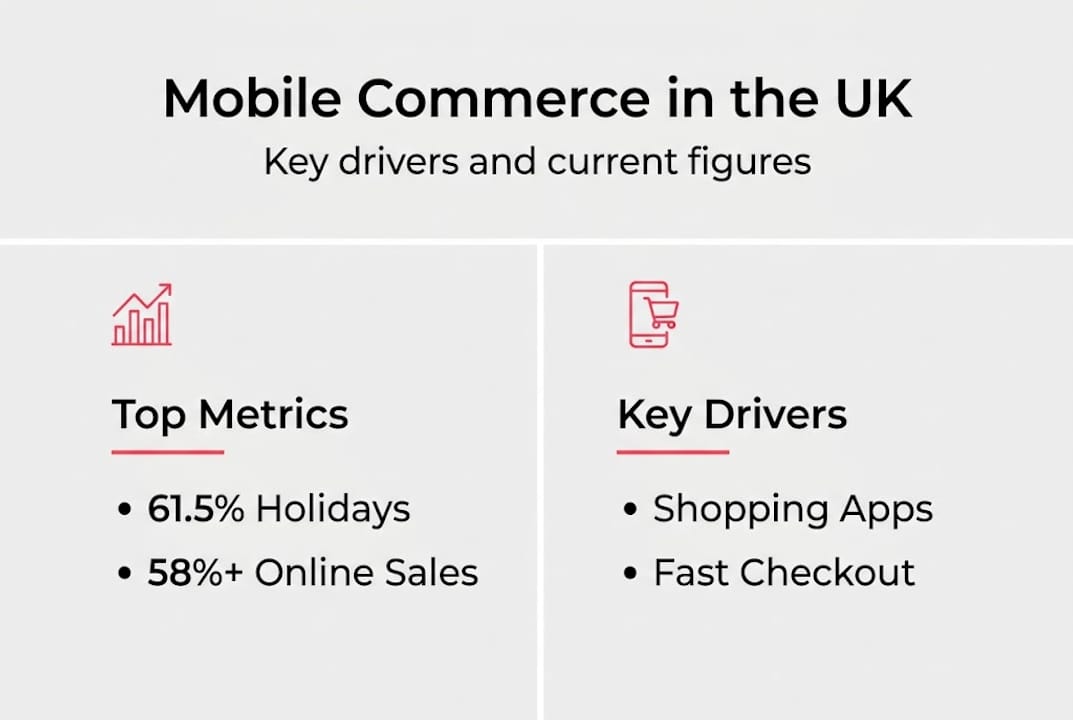
Here is a snapshot of where UK mobile commerce stands right now:
| Metric | Figure |
|---|---|
| Share of UK online sales via mobile | 58%+ |
| Christmas 2025 mobile spend | £16.5bn (61.5% of total) |
| YoY growth in mobile Christmas spend | +14.1% |
| Share of all UK retail on mobile | 49% |
| Share of UK online purchases on mobile | 66% |
Despite these figures, UK retail still trails global leaders in mobile-first engagement. Markets such as China and South Korea have built entire commerce ecosystems around mobile, with deeply integrated social commerce, one-tap payments, and live-stream shopping. The UK has significant room to close that gap, and the retailers who move now will capture that upside. Staying focused on UK ecommerce trends in 2026 and the web development trends shaping ecommerce will help you understand where the market is heading and position your business accordingly.
The core message here is simple: mobile is not a channel you can afford to treat as an afterthought. It is the primary channel.
The business case: Key benefits of mobile commerce investment
With the statistics clear, what do retailers actually gain by investing in mobile commerce solutions? The benefits go well beyond simply having a site that loads on a phone. Done properly, mobile commerce investment creates compounding commercial advantages.
Investing in mobile commerce enhances customer engagement and drives measurable sales growth. Here is how that plays out in practice:
-
Personalisation at scale. Mobile apps and progressive web apps (PWAs) allow you to serve personalised product recommendations, tailored promotions, and dynamic content based on browsing history, location, and purchase behaviour. Customers respond to relevance. Generic experiences get ignored.
-
Push notifications that convert. Unlike email, push notifications reach customers instantly on their lock screen. Used well, they drive urgency around flash sales, back-in-stock alerts, and abandoned basket reminders. The key word is used well: frequency and relevance matter enormously.
-
Loyalty programme integration. Mobile is the natural home for loyalty schemes. Customers can check points, redeem rewards, and receive exclusive offers without friction. This increases repeat purchase rates and strengthens brand attachment over time.
-
Richer data for smarter decisions. Mobile interactions generate granular behavioural data. Which products do customers browse most on mobile? Where do they drop off? That intelligence feeds better merchandising, stock management, and marketing decisions.
-
Competitive differentiation. Your competitors are investing in mobile. Retailers who delay are not standing still; they are falling behind relative to the market.
Pro Tip: Before investing in a native app, assess whether a well-built PWA could deliver 80% of the benefit at a fraction of the cost. PWAs are installable, fast, and work offline, making them an excellent starting point for many retail businesses. Explore mobile commerce setup and optimisation to understand which approach fits your current stage.
The comparison below shows how mobile commerce investment stacks up against a desktop-only focus:
| Factor | Desktop-only focus | Mobile-first investment |
|---|---|---|
| Customer reach | Shrinking share | Majority channel |
| Engagement tools | Limited | Push, loyalty, personalisation |
| Data richness | Moderate | High (behavioural + location) |
| Conversion potential | Declining | Growing |
| Competitive position | Reactive | Proactive |
Going beyond the basics: Innovations and best practices
Beyond the obvious benefits, what separates the most successful mobile commerce strategies from those that just tick the box? The answer is usually a combination of smart technology choices and genuine customer focus.
AI-driven recommendation engines are now table stakes for serious retailers. When a customer opens your app or mobile site, the products they see should reflect their individual preferences, not just a generic bestseller list. Retailers using AI-powered discovery tools report meaningful lifts in average order value and session depth. The technology is accessible; the barrier is usually organisational will rather than budget.
Mobile wallets are another area where UK retailers can close the gap quickly. Apple Pay, Google Pay, and PayPal One Touch remove the friction of typing card details on a small screen. That friction is a genuine conversion killer. Integrating mobile wallet support is one of the fastest wins available to any retail business.
“UK retailers must evolve to AI-driven discovery, personalisation, loyalty, and omnichannel integration to remain competitive in mobile commerce.” UK Mobile Commerce Opportunity 2026
Omnichannel is where the real complexity lives, and also where the biggest rewards are. Customers do not think in channels. They browse on mobile, visit the store, and complete the purchase on a tablet. Your systems need to reflect that reality. Inventory, loyalty points, purchase history, and promotions should be consistent and visible across every touchpoint.
Here are the innovations worth prioritising right now:
- AI-powered search and merchandising to surface the right products at the right moment
- Social commerce integration to capture purchase intent directly from platforms like Instagram and TikTok
- Live shopping features that combine entertainment with instant purchase capability
- Augmented reality (AR) try-on for fashion, beauty, and home furnishing retailers
- Seamless ecommerce design that prioritises thumb-friendly navigation and fast load times
Pro Tip: Work with a social media specialist to align your mobile commerce promotions with your social content calendar. The best-performing campaigns treat social and mobile as a single, joined-up experience rather than separate efforts.
Retailers who treat mobile as a standalone project, disconnected from their broader strategy, consistently underperform those who integrate it into every commercial decision.

Overcoming challenges and building for growth
While the potential is huge, many retailers struggle to realise the full value of mobile commerce. Here is how to overcome those hurdles.
The most common barriers we see are:
- Complacency. Many UK merchants remain complacent on cross-channel strategy despite adoption rising to 61%. The assumption that “our customers are different” rarely holds up to scrutiny.
- Legacy technology. Older platforms were not built with mobile-first in mind. They can be slow, inflexible, and difficult to integrate with modern tools. This is a genuine constraint, but it is solvable.
- Poor integration between systems. Stock management, CRM, loyalty, and payment systems that do not talk to each other create a fragmented customer experience. Fixing this requires investment but pays back quickly.
- Underestimating UX. A mobile site that technically works is not the same as one that converts. Speed, layout, and checkout flow all matter enormously on small screens.
So how do you move forward without overwhelming your team or budget?
- Audit your current mobile experience honestly. Use real devices, not just browser emulators. Where does the journey break down?
- Prioritise phased investment. You do not need to rebuild everything at once. Start with checkout optimisation and page speed, then layer in personalisation and loyalty features.
- Choose the right platform. Mobile responsive design best practices differ depending on whether you are on Shopify, Magento, or a custom build. Platform choice shapes your options.
- Partner with specialists. Internal teams rarely have all the expertise needed. Enterprise ecommerce strategies often involve a mix of platform expertise, UX design, and performance engineering that benefits from external support.
- Review continuously. Mobile commerce technology evolves fast. What works today may need updating in 12 months. Build a review cadence into your roadmap.
Pro Tip: Set a quarterly mobile performance review. Track load speed, mobile conversion rate, and basket abandonment separately from desktop metrics. Treating them as one blended figure hides the real picture.
Our perspective: The uncomfortable truth about mobile commerce investment
We have worked with UK retailers across a wide range of sizes and sectors, and we keep seeing the same pattern. Businesses invest in the technology, launch an app or a new mobile site, and then wait for results that do not arrive at the expected scale. The technology was fine. The strategy was missing.
The uncomfortable truth is that mobile commerce success is not primarily a technology problem. It is a leadership and customer focus problem. The retailers who make transformative gains are those whose leadership teams genuinely understand their customers’ mobile journeys and make decisions accordingly. They treat mobile not as a project to complete but as a lens through which every commercial decision is evaluated.
Many UK retailers invest in apps but neglect the strategic experience sitting underneath. They chase features rather than fixing friction. They measure app downloads rather than repeat purchase rates.
Our view, informed by over 17 years of building ecommerce platforms, is that real growth comes from aligning every technology decision with a clear understanding of what your customers actually need at each stage of their journey. Staying sharp on key digital trends matters, but only when those trends are filtered through genuine customer insight rather than followed for their own sake.
Ready to future-proof your retail business?
If this guide has clarified the scale of the mobile commerce opportunity, the next step is working out where your business sits on the journey and what to prioritise.
At Big Eye Deers, we help UK retail businesses design, build, and optimise mobile-first ecommerce experiences that drive real commercial results. Whether you need Shopify solutions built for retail growth, a progressive web application that delivers app-like performance without the app store overhead, or a full Magento web design and build for a more complex retail operation, we have the expertise to help. Mobile commerce is your competitive advantage. Let us help you use it.
Frequently asked questions
What is mobile commerce, and how is it different from ecommerce?
Mobile commerce means buying and selling via smartphones or tablets, usually through apps or mobile-optimised sites, while ecommerce covers all online sales across every type of device.
Is mobile commerce really that important in the UK for 2026?
Absolutely. Over 58% of UK online sales now happen on mobile, and 61.5% of Christmas 2025 spend was via mobile devices, confirming that mobile is firmly the majority channel.
How does investing in mobile commerce improve customer engagement?
Investing in mobile commerce allows retailers to personalise experiences, send targeted push notifications, and integrate loyalty programmes, all of which increase engagement and drive repeat purchases.
What is the biggest mistake UK retailers make with mobile commerce?
Many UK merchants remain complacent on cross-channel strategy, launching apps or mobile sites without unifying them with in-store and web experiences, which limits the growth they can actually achieve.
Recommended



Adobe Commerce (Magento)
Formerly known as Magento, Adobe Commerce is built for complex catalogues, integrations, and long term growth. We design and develop stable, scalable stores that support demanding eCommerce requirements, including multi-store setups, complex pricing, and Hyva based performance improvements.

Bespoke Build
We design and build custom eCommerce platforms for businesses with complex workflows, integrations, or non standard requirements. Built from scratch around your business needs using Laravel and modern architectures.

Working with brands across the UK from our offices in Cardiff and Exeter, you deal directly with a senior team of designers and developers specialising in Shopify, Magento, WordPress and bespoke eCommerce platforms.
We focus on commercial outcomes. Better conversion rates, strong SEO foundations and eCommerce platforms that continue to improve long after launch.