Why Update Your Website? 30% More Ecommerce Conversions

Your ecommerce site could be bleeding sales right now without you realising it. Research shows that even a one second delay in page load speed cuts conversion rates by 7%. For many UK retail brands, website updates sit at the bottom of the priority list until performance problems become impossible to ignore. This article explains why strategic website updates are essential for ecommerce growth, how they directly impact your bottom line, and which update approaches deliver the best return for your business.
Table of Contents
- Why Updating Your Website Matters: A Market Overview
- Performance and User Experience Improvements from Updates
- Security and Compliance Advantages of Website Updates
- Common Misconceptions and Realities about Website Updates
- Comparing Update Approaches: Incremental vs. Full Redesign
- Business Growth Benefits of Strategic Website Updates
- Partner with Experts for Your Ecommerce Website Updates
Key Takeaways
| Point | Details |
|---|---|
| Performance Impact | Site updates improve speed and mobile experience, directly boosting conversion rates by up to 30%. |
| Security Necessity | Regular updates maintain PCI compliance and protect against supply chain attacks threatening customer data. |
| Strategic Choice | Incremental updates deliver faster ROI while full redesigns support complex long term business transformation. |
| Growth Enabler | Backend updates enable advanced features like ERP integration and tiered pricing, reducing operational costs by 10 to 15%. |
Why Updating Your Website Matters: A Market Overview
The UK ecommerce landscape is both massive and intensely competitive. Nearly 59 million users shop online regularly, accounting for over 28% of total retail sales. Yet ecommerce growth has slowed to just 2.8% in 2024 as cautious consumers tighten spending. When market expansion stalls, the brands that win are those converting more visitors from existing traffic.
This environment makes continuous website optimisation non negotiable. You cannot rely on rising tide economics to lift sales. Instead, you need sharper ecommerce website essentials that capture attention, build trust quickly, and remove friction from checkout.
Consider these market realities:
- Over half of UK consumers browse and buy on mobile devices, demanding flawless mobile experiences.
- Economic uncertainty pushes shoppers to compare more carefully before purchasing.
- Competition from marketplaces and direct to consumer brands raises user expectations for site quality.
- Brands failing to meet modern standards lose sales to competitors with faster, more intuitive platforms.
For detailed UK ecommerce statistics, the data confirms that standing still means falling behind. Updates keep your site aligned with shifting user behaviour and technology standards.
Performance and User Experience Improvements from Updates
Website updates directly improve the performance metrics that control your conversion rate. Mobile optimisation sits at the top of this list. Mobile ecommerce accounted for 73% of online sales in 2022, and that percentage climbs each year. If your site delivers a poor mobile experience, you are turning away the majority of potential customers.

Speed matters just as much. Site speed research consistently shows that every second of delay costs you 7% in conversions. A site taking four seconds to load instead of one loses over 20% of sales before visitors even see your products. Updates targeting frontend performance, image optimisation, and code efficiency remove these roadblocks.
Beyond speed, updates enhance navigation and user flow. Modern ecommerce platforms integrate omnichannel features, allowing customers to move seamlessly between mobile apps, web browsers, and physical stores. These integrations boost repeat purchase rates because shoppers enjoy consistent experiences wherever they engage with your brand.
Key performance improvements from updates include:
- Faster page load times through optimised code and image compression.
- Mobile responsive design adapting perfectly to all screen sizes.
- Streamlined checkout reducing cart abandonment.
- Enhanced search and filtering helping customers find products quickly.
Lifecycle marketing tools enabled by platform updates also support retention. Integrating solutions like Klaviyo allows you to automate personalised emails based on browsing and purchase history, pulling customers back for repeat orders. For brands exploring Magento ecommerce benefits, the platform’s flexibility makes these integrations straightforward.
Pro tip: Prioritise mobile speed first. Run Google PageSpeed Insights on your mobile site and tackle the highest impact fixes. Compressing images and enabling lazy loading often deliver quick wins that measurably lift conversions.
If you want to increase conversion urgency tactics, performance updates create the foundation. A fast, smooth site builds trust, and trust converts browsers into buyers. Strategic ecommerce consulting can identify which performance improvements deliver the greatest return for your specific customer base. For more on mobile ecommerce statistics, the trend is undeniable and growing.
Security and Compliance Advantages of Website Updates
Ecommerce sites are prime targets for cyberattacks, and security threats grow more sophisticated each year. Regular updates patch vulnerabilities that hackers exploit to steal customer data, inject malware, or disrupt operations. Ecommerce security is not optional. It protects your revenue, your reputation, and your legal standing.
PCI compliance requires continuous monitoring and updates. Payment card industry standards mandate that you secure customer payment data and regularly patch known security flaws. Failing compliance audits can result in fines, losing the ability to process card payments, and destroying customer trust. Updates ensure your platform meets these evolving requirements without manual intervention.
Supply chain attacks represent a growing risk for retail ecommerce. Attackers compromise third party scripts, plugins, or integrations to inject malicious code into your site. Tools like Sansec detect and prevent these attacks by monitoring for unauthorised changes. Regular updates to your core platform, themes, and extensions close the doors that attackers try to exploit.
Key security benefits from updates include:
- Patching known vulnerabilities before they are exploited.
- Maintaining PCI compliance to avoid fines and service disruptions.
- Protecting customer data and preserving brand reputation.
- Preventing supply chain attacks through proactive monitoring.
Ignoring security updates exposes your business to breaches that can cost tens of thousands in remediation, legal fees, and lost sales. Customers who experience a data breach on your site rarely return. For comprehensive guidance, explore our resource on ecommerce security essentials.
Pro tip: Schedule security updates during low traffic periods and always test on a staging environment first. Automated monitoring tools alert you to threats in real time, allowing you to respond before damage occurs.
Common Misconceptions and Realities about Website Updates
Many ecommerce managers hold outdated beliefs about website updates that prevent them from capturing available gains. Let us debunk the most common myths with data.
Myth: Website updates rarely affect sales directly.
Reality: Studies show continuous updates can raise conversion rates by up to 30%. Performance improvements, better mobile experiences, and streamlined checkouts all translate directly into more completed purchases. Updates are not cosmetic. They are revenue drivers.
Myth: Security updates are optional for small stores.
Reality: Small ecommerce sites face the same cyber threats as large retailers. Attackers often target smaller brands precisely because they assume security is weaker. PCI compliance applies regardless of size. Skipping security updates invites breaches that can destroy a small business.
Myth: A full redesign is always better than incremental updates.
Reality: Full redesigns cost more, take longer, and introduce greater risk. Incremental updates targeting specific issues like page speed or mobile navigation often deliver faster ROI with less disruption. Redesigns make sense when you need fundamental changes to site architecture, but most brands benefit more from ongoing optimisation.
Key realities about updates include:
- Updates drive measurable conversion and revenue gains.
- Security patches are mandatory, not optional.
- Incremental updates often outperform full redesigns for ROI.
- Continuous improvement beats sporadic overhauls.
“Brands that adopt continuous update strategies outperform competitors who wait for major redesigns. Small, data driven changes compound into significant performance gains over time.”
For strategies to boost site conversion rate, the evidence strongly favours regular updates. Understanding ecommerce website must haves helps you prioritise which updates deliver the most value. For context on ecommerce update misconceptions, industry research consistently contradicts the myths holding many brands back.
Comparing Update Approaches: Incremental vs. Full Redesign
Choosing between incremental updates and a full redesign depends on your business goals, budget, and timeline. Both approaches have clear advantages and trade offs.
| Approach | Pros | Cons | Best For |
|---|---|---|---|
| Incremental Updates | Faster ROI, lower cost, less risk, continuous improvement | Limited architectural changes, may not solve deep structural issues | Brands needing performance gains, UX tweaks, or feature additions without disrupting operations |
| Full Redesign | Complete overhaul, supports complex business model changes, modern tech stack | Higher cost, longer timeline, greater disruption risk | Enterprise brands, platform migrations, or businesses requiring fundamental architecture changes |
Incremental updates focus on targeted improvements. You might optimise page load speed, refine checkout flow, or integrate new payment methods. These changes deliver measurable results quickly, often within weeks. They suit brands that need steady performance gains without the expense or risk of a total rebuild.
Full redesigns enable long term scalability. If your current platform cannot support multi store setups, complex B2B pricing, or ERP integrations, a redesign may be necessary. Redesigns also make sense when your site’s design and user experience lag so far behind competitors that incremental fixes cannot close the gap.
How to choose the right update strategy:
- Assess urgency: If conversion rates are dropping now, incremental updates deliver faster relief than a six month redesign project.
- Evaluate technical debt: Sites with outdated codebases or unsupported platforms may require a redesign to remain viable.
- Consider budget: Incremental updates cost less upfront and spread investment over time, while redesigns demand significant capital.
- Align with business goals: Growing brands needing advanced features like tiered pricing or account hierarchies often benefit from redesigns enabling those capabilities.
- Test first: Run small updates to measure impact before committing to a full redesign. Data should drive your decision.
For brands exploring custom ecommerce solutions, a strategic approach combines both methods. Incremental updates maintain momentum while planning a phased redesign that minimises disruption. Expert ecommerce website design services help you map the most cost effective path based on your specific situation.
Business Growth Benefits of Strategic Website Updates
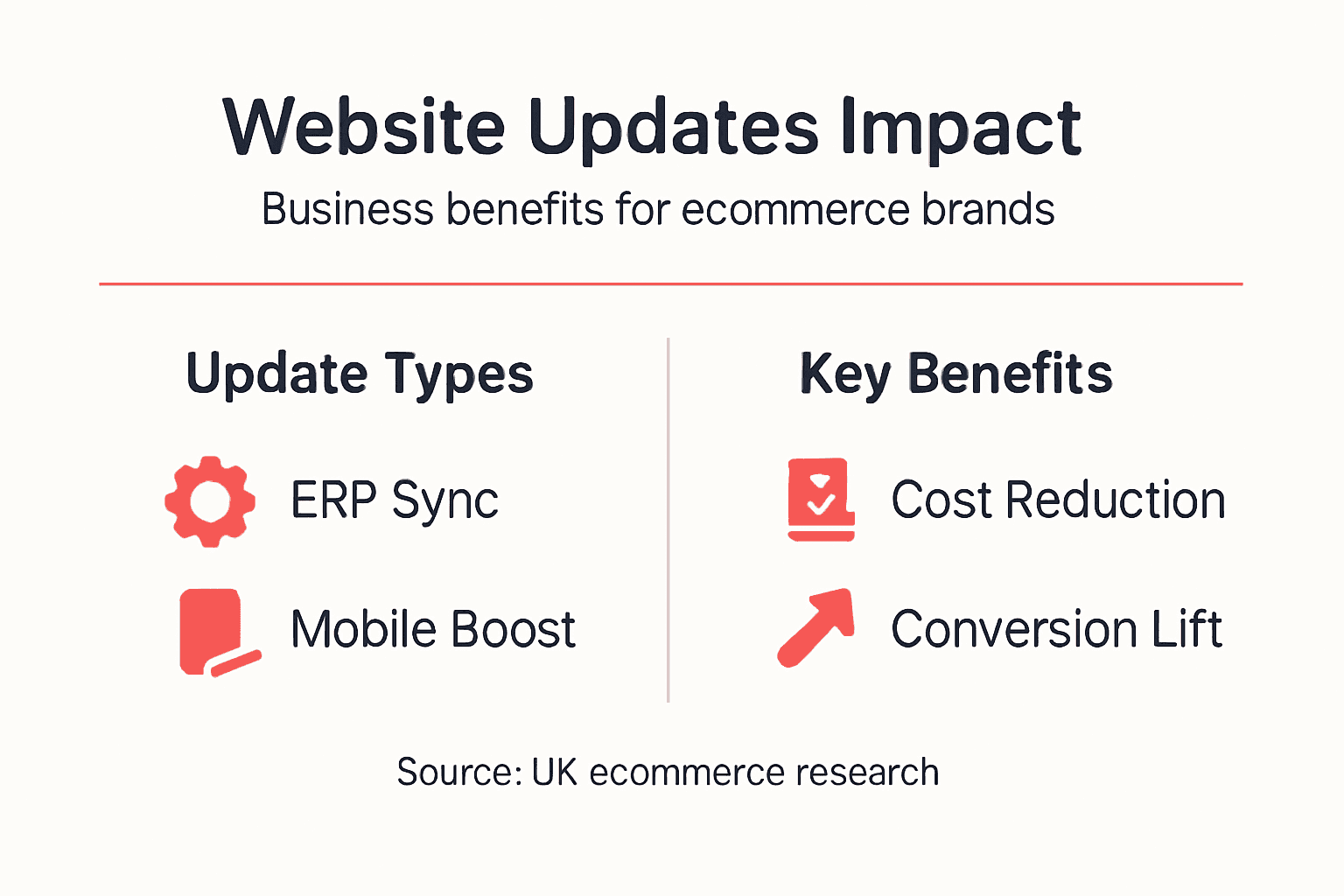
Website updates are not just about fixing problems. They unlock advanced ecommerce features that drive commercial growth and operational efficiency. Backend updates enabling ERP integrations, tiered pricing, and account hierarchies reduce manual workload and support complex business models.
ERP integrations synchronise inventory, orders, and customer data across systems, cutting operational costs by 10 to 15%. Automated data flows eliminate manual entry errors and free your team to focus on strategy rather than administration. For B2B ecommerce, these efficiencies become even more critical as order volumes and customer account complexity increase.
Tiered pricing and account hierarchies support wholesale and B2B models where different customer segments receive different pricing. Updates enable you to configure these structures within your ecommerce platform, allowing sales teams to manage pricing rules without developer involvement. This flexibility accelerates your ability to test pricing strategies and respond to market conditions.
| Update Type | Business Benefit | Estimated Impact |
|---|---|---|
| ERP Integration | Reduced manual data entry, inventory sync | 10 to 15% cost savings |
| Tiered Pricing | Support for B2B and wholesale models | Enables new revenue streams |
| Mobile Optimisation | Higher mobile conversion rates | Up to 30% conversion gain |
| Lifecycle Marketing | Improved customer retention | 20 to 25% increase in repeat purchases |
Strategic updates also enhance customer lifetime value. Integrating lifecycle marketing tools like Klaviyo automates personalised communication based on purchase history and browsing behaviour. Customers receive timely reminders, product recommendations, and exclusive offers that encourage repeat purchases. Brands using these tools report 20 to 25% increases in repeat purchase rates.
Key growth benefits from updates include:
- Operational cost reductions through automation and integration.
- Support for advanced pricing and customer segmentation.
- Improved customer retention via personalised marketing.
- Scalability to handle growing product catalogues and order volumes.
For brands pursuing complex B2B ecommerce success, updates transform your platform from a basic storefront into a comprehensive commercial engine. Accessing expert ecommerce guidance ensures your update strategy aligns with long term business objectives, maximising return on technology investment.
Partner with Experts for Your Ecommerce Website Updates
Navigating website updates requires technical expertise and strategic planning. Partnering with an experienced ecommerce agency ensures your updates align with business goals, deliver measurable results, and avoid costly missteps. Whether you need incremental performance improvements or a full platform migration, expert support accelerates success.
Specialist teams bring deep knowledge of Shopify and Magento platforms, understanding how to configure advanced features, optimise performance, and maintain security. Professional audits identify high impact opportunities you might overlook, prioritising updates that deliver the greatest return.
For UK retail brands ready to enhance their ecommerce performance, getting ecommerce updates right means working with professionals who understand your market and technical requirements. Explore our Shopify design and development services or discover how our Magento web design services deliver high performing online stores built for growth.
Frequently Asked Questions
How often should ecommerce websites be updated?
You should review and update your ecommerce site quarterly at minimum, with security patches applied as soon as they are released. High performing brands update continuously, testing and deploying small improvements weekly to maintain competitive advantage.
What is the quickest way to improve site speed?
Compress images, enable lazy loading, and minify CSS and JavaScript files. These changes often reduce page load time by 30 to 50% within days. Use tools like Google PageSpeed Insights to identify the highest impact fixes for your specific site.
Are security updates mandatory for small online stores?
Yes. PCI compliance requirements apply to all ecommerce sites processing card payments, regardless of size. Security updates protect customer data, prevent breaches, and maintain your legal right to accept payments.
Which update approach suits a growing UK retail brand?
Growing brands typically benefit most from incremental updates targeting performance, mobile experience, and conversion rate. This approach delivers quick wins while you assess whether a full redesign is needed to support long term scalability.
How can updates improve customer retention?
Updates enabling lifecycle marketing integrations, personalised recommendations, and loyalty programmes keep customers engaged after their first purchase. Automated email flows based on browsing and purchase history increase repeat purchase rates by 20 to 25%.
Do website updates disrupt ongoing sales?
Properly planned updates cause minimal disruption. Agencies deploy updates during low traffic periods and use staging environments to test changes before going live. Most updates happen without customers noticing any downtime.
Recommended



Adobe Commerce (Magento)
Formerly known as Magento, Adobe Commerce is built for complex catalogues, integrations, and long term growth. We design and develop stable, scalable stores that support demanding eCommerce requirements, including multi-store setups, complex pricing, and Hyva based performance improvements.

Bespoke Build
We design and build custom eCommerce platforms for businesses with complex workflows, integrations, or non standard requirements. Built from scratch around your business needs using Laravel and modern architectures.
Working with brands across the UK from our offices in Cardiff and Exeter, you deal directly with a senior team of designers and developers specialising in Shopify, Magento, WordPress and bespoke eCommerce platforms.
We focus on commercial outcomes. Better conversion rates, strong SEO foundations and eCommerce platforms that continue to improve long after launch.