What Is SEO in Ecommerce? Strategies for UK Retailers

Finding reliable ways to attract new shoppers on Magento can feel like a constant challenge for British retailers. For managers aiming to boost online sales, effective Search Engine Optimisation is more than just adding extra keywords. SEO for ecommerce is a strategic, ongoing process that balances site speed, keyword research, and technical health to improve visibility across British search markets. This guide breaks down common misconceptions, key optimisation methods, and practical tips to help your online store stand out and connect with local customers.
Table of Contents
- Defining SEO in Ecommerce and Common Misconceptions
- Types of Ecommerce SEO: On-Page, Technical, Off-Page
- How Ecommerce SEO Works for Online Stores
- Key Optimisation Strategies for UK Retailers
- Risks, Pitfalls, and What to Avoid in SEO
Key Takeaways
| Point | Details |
|---|---|
| SEO is a Continuous Process | Retailers must regularly refine their SEO strategies to adapt to search engine changes and maintain visibility. |
| Holistic SEO Approach | Successful e-commerce SEO requires integrating on-page, technical, and off-page strategies for optimal results. |
| Performance Metrics are Crucial | Tracking key metrics like organic traffic and conversion rates helps in crafting targeted strategies. |
| Avoid Common Pitfalls | Retailers should remain vigilant against duplicate content and poor site performance to enhance user experience. |
Defining SEO in Ecommerce and Common Misconceptions
Search Engine Optimisation (SEO) in e-commerce is a strategic approach to improving an online store’s visibility and organic search performance. Understanding core SEO principles helps retailers drive targeted traffic without relying solely on paid advertising.
Contrary to popular belief, SEO is not just about cramming keywords into product descriptions. It’s a comprehensive strategy involving multiple elements:
- Technical optimisation of website infrastructure
- Content development aligned with user search intent
- Keyword research targeting customer queries
- User experience improvements
- Link building from reputable sources
Many retailers mistakenly believe SEO is a one-time task. In reality, it’s an ongoing process requiring continuous refinement and adaptation to search engine algorithm changes. Successful e-commerce SEO demands a holistic approach that balances technical performance with engaging, relevant content.
Performance metrics like organic traffic, conversion rates, and search rankings provide critical insights into SEO effectiveness. By understanding these indicators, UK retailers can develop more targeted strategies that connect directly with potential customers.
Pro tip: Conduct a comprehensive SEO audit quarterly to identify and address potential optimisation opportunities in your online store.
Types of Ecommerce SEO: On-Page, Technical, Off-Page
E-commerce Search Engine Optimisation (SEO) encompasses three critical strategic approaches: on-page, technical, and off-page optimisation. Understanding these SEO categories helps retailers develop comprehensive strategies for improving online visibility.
On-Page SEO focuses directly on webpage content and structure, involving key elements such as:
- Optimising product descriptions with relevant keywords
- Creating compelling, informative meta titles and descriptions
- Developing clear, descriptive URLs
- Implementing internal linking strategies
- Ensuring high-quality, unique content for each product page
Technical SEO addresses the backend infrastructure that enables search engines to effectively crawl and index an online store. This involves critical components like:
- Improving website loading speed
- Ensuring mobile responsiveness
- Creating XML sitemaps
- Implementing schema markup
- Fixing broken links and redirects
- Securing website with HTTPS protocol
Off-Page SEO centres on building the website’s external reputation and authority through activities outside the direct website control:
- Generating high-quality backlinks from reputable websites
- Developing brand mentions across digital platforms
- Engaging in social media marketing
- Creating shareable, link-worthy content
- Participating in industry forums and discussions
Successful e-commerce SEO requires a balanced approach that integrates these three categories, creating a holistic strategy that improves search rankings and drives organic traffic.
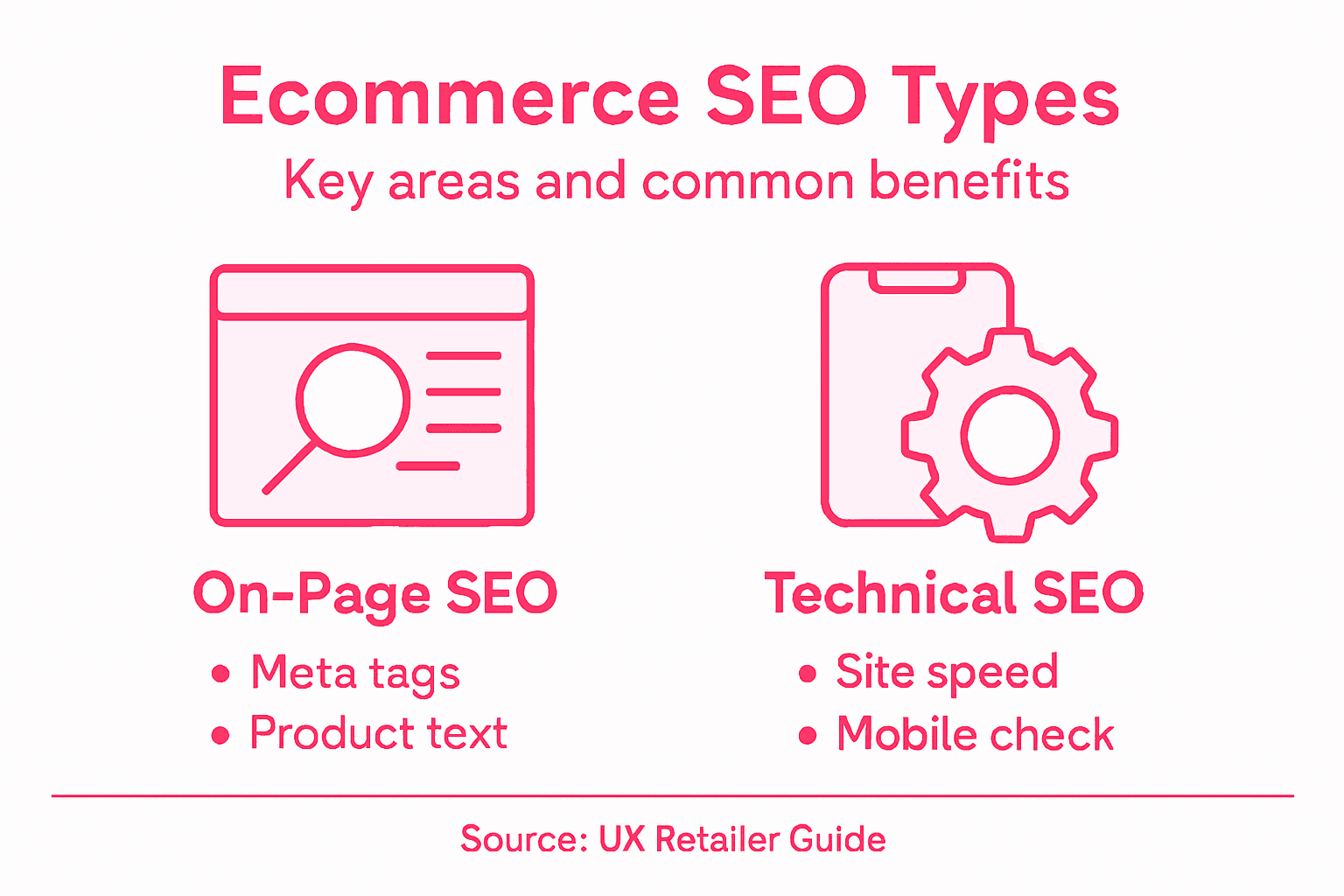
Here’s a concise overview of the three core e-commerce SEO types and their impact on online retail success:
| SEO Category | Focus Area | Example Benefit | Typical Challenge |
|---|---|---|---|
| On-Page SEO | Website content & structure | Higher keyword relevancy | Duplicate product content |
| Technical SEO | Backend infrastructure | Improved search engine indexing | Slow site speed |
| Off-Page SEO | External reputation | Enhanced domain authority | Unreliable backlinks |
Pro tip: Regularly audit your e-commerce website across all three SEO dimensions to identify and address potential optimisation opportunities.
How Ecommerce SEO Works for Online Stores
E-commerce SEO operates as a sophisticated mechanism designed to enhance online store visibility and attract targeted organic traffic. Comprehensive SEO strategies transform websites into search engine-friendly platforms that connect potential customers with relevant products.
The core functionality of e-commerce SEO involves several interconnected processes:
- Keyword Research: Identifying precise search terms customers use
- Content Optimisation: Developing relevant, informative product descriptions
- Site Architecture: Creating logical, easily navigable website structures
- Performance Tracking: Monitoring search rankings and user engagement
- Continuous Improvement: Adapting strategies based on analytical insights
Search Engine Algorithms evaluate multiple factors when ranking online stores. These include:
- Page loading speed
- Mobile responsiveness
- Quality and relevance of content
- Internal linking structure
- User engagement metrics
- External backlink profiles
Successful e-commerce SEO transforms technical optimisation into a strategic approach that balances technical performance with user experience. By understanding and implementing these sophisticated techniques, UK retailers can significantly improve their online visibility and attract more qualified traffic.

The ultimate goal is creating a seamless digital experience that simultaneously satisfies both search engine requirements and customer expectations. This means developing websites that are not just technically sound, but genuinely helpful and user-friendly.
Pro tip: Invest in regular technical audits to ensure your e-commerce platform remains fully optimised and aligned with current search engine best practices.
Key Optimisation Strategies for UK Retailers
E-commerce SEO for UK retailers demands a nuanced, locally-focused approach that goes beyond generic digital marketing tactics. Targeted SEO strategies must account for specific British consumer behaviours and search patterns.
Successful optimisation involves several strategic components:
- Keyword Research: Focusing on commercial and local search intents
- Content Localisation: Developing regionally relevant product descriptions
- Technical Performance: Ensuring fast, mobile-responsive websites
- Local Link Building: Generating backlinks from reputable British sources
- User Experience: Creating intuitive navigation and seamless purchasing journeys
Commercial Keyword Targeting requires deep understanding of UK-specific search behaviours. This involves:
- Identifying region-specific purchasing terminology
- Understanding local market nuances
- Incorporating regional dialect and language variations
- Targeting geographically-specific long-tail keywords
- Analysing seasonal search trends unique to British markets
Technical optimisation remains crucial for UK e-commerce success. Retailers must prioritise website speed, mobile responsiveness, and structured data implementation to meet increasingly sophisticated search engine algorithms.
Regional search performance depends on a holistic approach that combines technical excellence with genuinely useful, locally-relevant content. By understanding and implementing these sophisticated strategies, UK retailers can significantly enhance their online visibility and attract more qualified traffic.
Pro tip: Conduct quarterly localised SEO audits to ensure your online store remains perfectly aligned with evolving British digital consumer expectations.
Risks, Pitfalls, and What to Avoid in SEO
E-commerce SEO strategies can quickly unravel when retailers overlook critical optimization elements. Common SEO mistakes can dramatically undermine search performance and user engagement.
Key pitfalls that UK retailers must vigilantly avoid include:
- Duplicate Content: Using identical product descriptions across multiple pages
- Keyword Stuffing: Overloading content with unnaturally placed search terms
- Neglecting Mobile Optimization: Ignoring responsive design principles
- Poor Site Speed: Allowing slow page loading times
- Inadequate URL Structures: Creating complex, non-descriptive webpage addresses
Technical SEO Risks pose significant challenges for online stores:
- Inefficient website crawlability
- Broken internal linking structures
- Missing or incorrect schema markup
- Insufficient metadata optimization
- Lack of canonical tag implementation
Search engines penalise websites that compromise user experience. This means retailers must balance technical optimization with genuine content value, ensuring that every optimization strategy serves both algorithmic requirements and user needs.
Successful e-commerce SEO demands continuous monitoring and proactive management. Retailers must remain adaptable, regularly auditing their digital infrastructure to identify and rectify potential performance barriers.
Pro tip: Implement monthly technical SEO audits to quickly identify and resolve potential optimization issues before they impact search rankings.
Unlock the Full Potential of Your Ecommerce SEO with Expert Support
The article highlights the complex challenges UK retailers face with ecommerce SEO from technical optimisation to content localisation and continuous site performance management. If you find yourself overwhelmed by issues like slow site speed, duplicate content or ineffective keyword targeting, you are not alone. Achieving seamless integration of on-page, technical, and off-page SEO takes expertise, precision and ongoing effort to deliver measurable growth in search rankings and organic traffic.
At Big Eye Deers, we specialise in building high-performing online stores on platforms like Magento and Shopify tailored specifically for UK retailers. Our comprehensive approach covers everything from UX-focused design using Figma and optimisation of site speed and mobile responsiveness, to advanced B2B ecommerce solutions and localised content strategies that align perfectly with British consumer behaviour. We also provide continuous support including lifecycle marketing and security monitoring to keep your ecommerce store secure, compliant and performing at its best.
Discover how our specialised ecommerce agency can help you overcome common SEO pitfalls and implement cutting-edge strategies designed for long-term UK market success.
Explore our expert solutions and take your SEO to the next level with a partner who understands both the technical and commercial nuances of ecommerce growth. Take action now to secure your store’s competitive advantage and unlock the full power of ecommerce SEO tailored for UK retailers.
Learn more about elevating your ecommerce presence today.
Frequently Asked Questions
What is the role of keyword research in e-commerce SEO?
Keyword research identifies the precise search terms customers use when looking for products. This understanding helps retailers optimise their product descriptions and improve search rankings effectively.
How can on-page SEO improve my e-commerce site?
On-page SEO enhances your website’s content and structure by optimising product descriptions, creating informative meta titles, and developing engaging URLs. This leads to higher keyword relevancy and potentially increased organic traffic.
What are the key elements of technical SEO for online stores?
Technical SEO involves optimising the backend of your website for effective crawling and indexing by search engines. Key elements include improving site speed, ensuring mobile responsiveness, and implementing structured data.
Why is off-page SEO important for e-commerce retailers?
Off-page SEO builds your website’s external reputation and authority through activities like generating high-quality backlinks, engaging in social media marketing, and creating shareable content. This helps enhance your site’s visibility and boosts search rankings.
Recommended



Adobe Commerce (Magento)
Formerly known as Magento, Adobe Commerce is built for complex catalogues, integrations, and long term growth. We design and develop stable, scalable stores that support demanding eCommerce requirements, including multi-store setups, complex pricing, and Hyva based performance improvements.

Bespoke Build
We design and build custom eCommerce platforms for businesses with complex workflows, integrations, or non standard requirements. Built from scratch around your business needs using Laravel and modern architectures.

Working with brands across the UK from our offices in Cardiff and Exeter, you deal directly with a senior team of designers and developers specialising in Shopify, Magento, WordPress and bespoke eCommerce platforms.
We focus on commercial outcomes. Better conversion rates, strong SEO foundations and eCommerce platforms that continue to improve long after launch.