Custom Web Application Development for Ecommerce Success

Over 60 percent of British retail brands now turn to custom web applications for greater control over Magento and Shopify stores. In an environment where off-the-shelf features no longer meet the growing demands of British consumers, ecommerce managers need solutions built around their unique workflows. Here, discover how tailored web application development delivers stronger user experiences, refined operational efficiency, and a distinct competitive edge for modern British retail.
Table of Contents
- Defining Custom Web Application Development
- Types of Ecommerce Web Applications
- Key Features For Magento And Shopify
- Strategic Benefits For Retail Brands
- Risks, Costs, And Common Pitfalls
Key Takeaways
| Point | Details |
|---|---|
| Custom Web Applications Provide Strategic Advantages | Tailored solutions enhance operational control, align with business strategies, and improve efficiency through specific functionalities. |
| Ecommerce Models Vary Significantly | Understanding the unique characteristics of B2C, B2B, C2C, and C2B models is essential for selecting the right platform for your business needs. |
| Platform Choice Affects Scalability | Choose between Magento for complex enterprises and Shopify for ease of use, ensuring the platform aligns with business scale and capabilities. |
| Mitigating Risks is Crucial | Conduct thorough planning and vendor assessments to avoid hidden costs, technical debt, and security vulnerabilities in custom development projects. |
Defining Custom Web Application Development
Custom web application development represents a strategic approach to creating software solutions precisely tailored to an organisation’s unique business requirements. Unlike generic off-the-shelf platforms, these applications offer comprehensive flexibility and precise functionality alignment with specific operational needs.
At its core, custom web application development involves designing interactive software platforms that solve distinct business challenges through bespoke technological solutions. These applications are meticulously crafted to integrate seamlessly with existing systems, providing scalable and adaptable tools that evolve alongside organisational objectives. The development process encompasses a comprehensive strategy including detailed requirement analysis, strategic technology selection, user experience design, agile implementation, rigorous testing, and ongoing maintenance.
The key distinguishing factors of custom web applications include their ability to provide unparalleled operational control, enhanced user experiences, and direct alignment with business strategy. By prioritising unique functionality over generic features, businesses can create digital solutions that dramatically improve efficiency, streamline complex processes, and deliver competitive advantages. These applications are not merely software products but strategic assets that can transform how organisations interact with technology and manage their digital ecosystems.
Pro tip: When planning a custom web application, invest significant time in thoroughly documenting your specific business requirements to ensure the development process remains focused and aligned with your strategic objectives.
Types of Ecommerce Web Applications
Ecommerce web applications are diverse platforms designed to support various transactional models that cater to different business needs and customer interactions. These digital commerce platforms fundamentally transform how businesses engage with customers across multiple market segments, providing tailored technological solutions for specific commercial requirements.
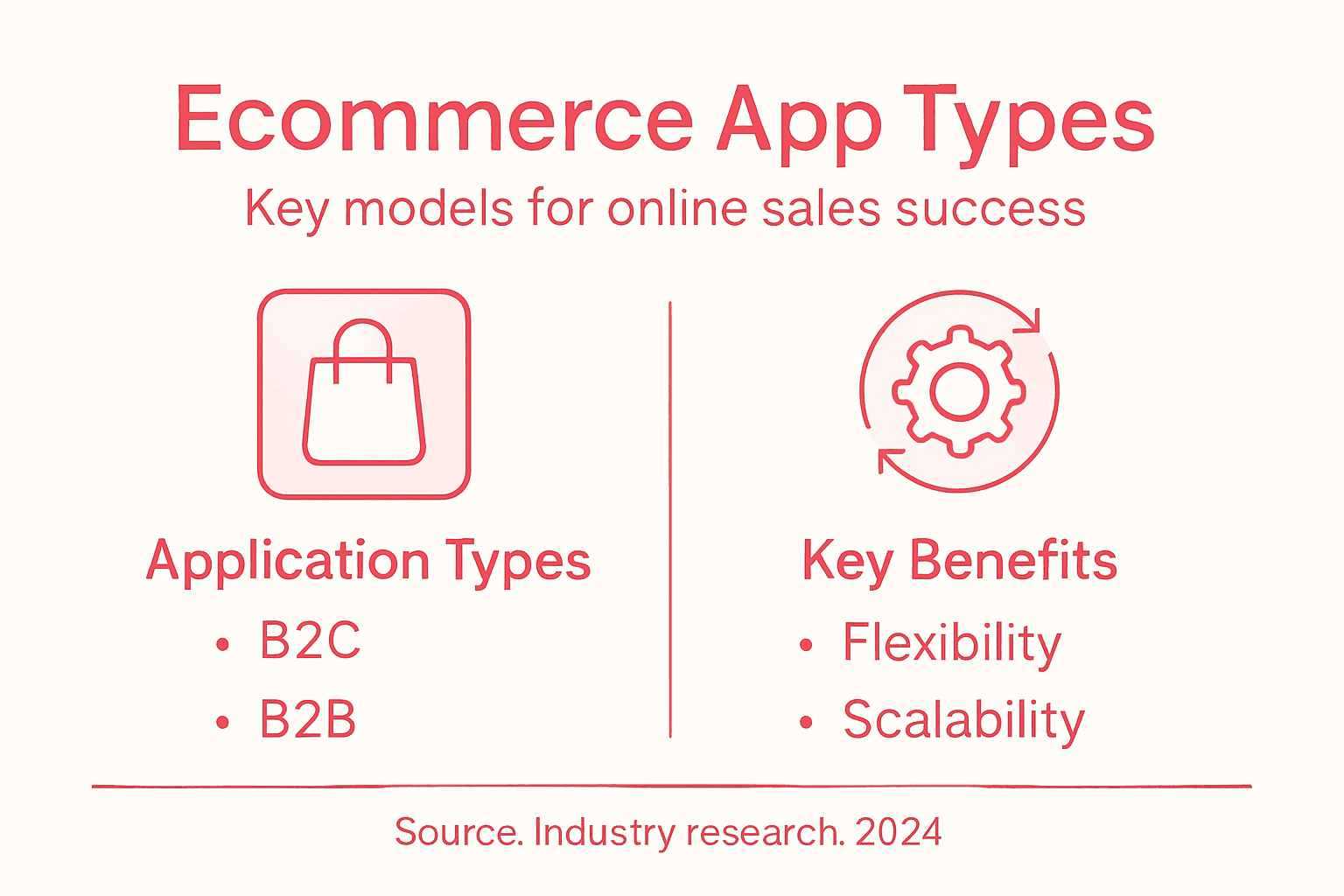
The primary ecommerce web application types include Business-to-Consumer (B2C), Business-to-Business (B2B), Consumer-to-Consumer (C2C), and Consumer-to-Business (C2B) models. Each model presents unique characteristics and demands specialised features:
Here is a high-level comparison of the main ecommerce web application models and their typical use cases:
| Model Type | Typical Users | Main Transaction Flow |
|---|---|---|
| B2C | Retailers and individual buyers | Businesses sell directly to consumers |
| B2B | Wholesalers and enterprises | Companies sell products or services to other businesses |
| C2C | Individual consumers | Consumers trade goods and services with each other |
| C2B | Freelancers and companies | Consumers offer goods or expertise to businesses |
- B2C Applications: Retail-focused platforms enabling direct sales from businesses to individual consumers
- B2B Applications: Complex systems supporting wholesale transactions and enterprise-level procurement
- C2C Applications: Peer-to-peer marketplaces facilitating transactions between individual consumers
- C2B Applications: Platforms allowing consumers to offer services or products to businesses
Successful ecommerce web applications require robust infrastructure supporting secure payment gateways, comprehensive inventory management, sophisticated user engagement tools, and seamless integration capabilities. The selection of an appropriate application type depends critically on understanding the specific market dynamics, target customer base, and desired transactional complexity.

Pro tip: Conduct thorough market research to identify the most suitable ecommerce web application model that aligns precisely with your business objectives and target audience characteristics.
Key Features for Magento and Shopify
Choosing the right ecommerce platform is critical for online retail success, and both Magento and Shopify offer unique advantages for businesses seeking robust digital commerce solutions. Each platform provides distinctive features that cater to different business scales, technical capabilities, and operational requirements.
Magento stands out with its exceptional customisation capabilities, making it ideal for complex, large-scale enterprises. Key features include:
- Advanced product management with complex configuration options
- Extensive customisation through modular architecture
- Powerful inventory management systems
- Multi-store and multi-language support
- Sophisticated SEO and marketing tools
Shopify, conversely, excels in user-friendliness and rapid deployment, offering strengths such as:
- Intuitive drag-and-drop website builders
- Streamlined payment processing
- Comprehensive app marketplace
- Built-in mobile responsiveness
- Simplified inventory and shipping management
The selection between Magento and Shopify ultimately depends on specific business requirements, technical expertise, scalability needs, and budget constraints. Larger organisations with complex requirements typically favour Magento’s flexibility, while smaller businesses often appreciate Shopify’s ease of use and quick setup.
Pro tip: Conduct a thorough audit of your specific business needs, technical capabilities, and growth projections before selecting an ecommerce platform to ensure long-term compatibility and scalability.
Strategic Benefits for Retail Brands
Retail brands increasingly recognise the transformative potential of custom web applications in driving competitive advantage and meeting evolving consumer expectations. Digital transformation strategies have become critical for businesses seeking to enhance customer engagement, operational efficiency, and market responsiveness.
The strategic benefits for retail brands encompass several key dimensions:
- Customer Personalisation: Advanced data analytics and machine learning enable hyper-targeted experiences
- Omnichannel Integration: Seamless interactions across digital and physical touchpoints
- Operational Efficiency: Streamlined inventory management, automated processes, and reduced manual interventions
- Enhanced Customer Insights: Real-time data collection and advanced reporting capabilities
- Scalable Infrastructure: Flexible technological solutions that grow with business requirements
Moreover, custom web applications provide retail brands with unprecedented flexibility in adapting to market changes. They allow businesses to quickly implement new features, integrate emerging technologies, and create unique customer experiences that differentiate them from competitors. By investing in bespoke digital solutions, retailers can develop more agile, responsive, and customer-centric business models that drive long-term growth and customer loyalty.
This table outlines the strategic impact of custom web applications on retail brands:
| Benefit Dimension | Example Application | Business Impact |
|---|---|---|
| Personalisation | Data-driven content recommendations | Increases conversion rates |
| Omnichannel Integration | Unified customer profiles | Enables seamless experiences |
| Operational Efficiency | Automated stock updates | Reduces staffing costs |
| Customer Insights | Advanced analytics dashboards | Improves marketing targeting |
| Scalability | Cloud-based infrastructure | Supports business growth |
Pro tip: Prioritise user experience and data-driven insights when developing custom web applications, ensuring that technological investments directly translate into tangible business value and customer satisfaction.
Risks, Costs, and Common Pitfalls
Custom web application development presents numerous potential challenges that businesses must carefully navigate to ensure successful implementation. Hidden development costs can significantly impact project outcomes, making strategic planning and vendor selection critical for long-term success.
Key risks and potential pitfalls in custom web application development include:
- Budget Overruns: Unexpected complexity leading to extended development timelines
- Technical Debt: Poorly architected solutions requiring extensive future refactoring
- Security Vulnerabilities: Inadequate protection against potential cyber threats
- Performance Issues: Inefficient code resulting in slow application responsiveness
- Scalability Limitations: Rigid architectural choices restricting future growth
The most significant risks emerge from selecting inexperienced development partners or prioritising cost-cutting over quality. Organisations frequently underestimate the long-term implications of initial development decisions, overlooking critical factors such as maintainability, security, and potential future integrations. Comprehensive due diligence, rigorous vendor assessment, and a holistic approach to project planning are essential to mitigate these potential challenges.
Pro tip: Invest in a thorough discovery phase and request detailed technical documentation, architectural diagrams, and comprehensive security assessments before committing to any custom web application development project.
Empower Your Ecommerce Growth with Custom Web Applications
Custom web application development is essential for ecommerce success because it solves unique business challenges like complex product catalogues, tiered pricing, and seamless ERP integrations. If you want to avoid common pitfalls such as scalability limitations and performance issues mentioned in the article, trust a partner who understands these specific ecommerce demands. At Big Eye Deers, we specialise in building tailored Magento and Shopify solutions that deliver robust functionality precisely aligned with your retail strategy.
Experience the difference of working with experts who prioritise UX, security, and long-term growth. Whether you need a bespoke Magento Open Source or Adobe Commerce build or powerful B2B capabilities, we combine design, development, and ongoing support to transform your online store. Explore our range of ecommerce services today at Big Eye Deers and take the first step towards a custom solution that drives conversions and enhances customer loyalty.
Frequently Asked Questions
What is custom web application development?
Custom web application development is a strategic process of creating software solutions bespoke to an organisation’s specific business needs, enabling greater flexibility and precise functionality compared to off-the-shelf platforms.
What are the different types of ecommerce web applications?
Ecommerce web applications can be categorised into four main types: Business-to-Consumer (B2C), Business-to-Business (B2B), Consumer-to-Consumer (C2C), and Consumer-to-Business (C2B). Each type serves different user interactions and transactional models.
What key features should I consider for ecommerce platforms like Magento and Shopify?
When choosing between platforms like Magento and Shopify, consider key features such as customisation capabilities, inventory management, user-friendliness, and SEO tools. Magento is ideal for large-scale enterprises needing complex customised solutions, while Shopify caters to smaller businesses with easier setups.
What are the potential risks involved in custom web application development?
Potential risks include budget overruns, technical debt, security vulnerabilities, performance issues, and scalability limitations. It’s crucial to plan comprehensively and work with experienced developers to mitigate these risks.
Recommended



Adobe Commerce (Magento)
Formerly known as Magento, Adobe Commerce is built for complex catalogues, integrations, and long term growth. We design and develop stable, scalable stores that support demanding eCommerce requirements, including multi-store setups, complex pricing, and Hyva based performance improvements.

Bespoke Build
We design and build custom eCommerce platforms for businesses with complex workflows, integrations, or non standard requirements. Built from scratch around your business needs using Laravel and modern architectures.
Working with brands across the UK from our offices in Cardiff and Exeter, you deal directly with a senior team of designers and developers specialising in Shopify, Magento, WordPress and bespoke eCommerce platforms.
We focus on commercial outcomes. Better conversion rates, strong SEO foundations and eCommerce platforms that continue to improve long after launch.