What is composable commerce? A guide for eCommerce pros
TL;DR:
- Composable commerce is an architectural approach that assembles best-of-breed tools via APIs instead of relying on a single platform. It is built on MACH principles—Microservices, API-first, Cloud-native, and Headless—enabling faster feature deployment, greater flexibility, and customisation. However, successful implementation requires careful governance, clear ownership of integrations, and an organised operating model to manage complexity and mitigate costs.
Composable commerce is one of those terms that gets thrown around at every eCommerce conference, yet most explanations either drown you in acronyms or stay so abstract you leave none the wiser. At its core, what is composable commerce? It is an architectural approach to building online stores by assembling best-of-breed, specialised components via APIs rather than relying on a single, all-in-one platform. If your current eCommerce setup feels like you are constantly fighting the software to get what your business actually needs, this guide is for you.
Table of Contents
- Key takeaways
- The composable commerce definition, explained properly
- The real business advantages and honest trade-offs
- Personalisation, AI, and the future of composable commerce
- How to implement composable commerce: hybrid vs full transition
- Pulling it together: what to do next
- My honest take on composable commerce
- Ready to explore composable commerce with us?
- FAQ
Key takeaways
| Point | Details |
|---|---|
| MACH architecture is the foundation | Composable commerce is built on Microservices, API-first, Cloud-native, and Headless principles. |
| Speed to market improves significantly | Organisations adopting composable commerce can implement new features 80% faster than competitors. |
| It is an operating model shift | Composable commerce changes platform ownership, governance, and team accountability, not just the technology stack. |
| Hybrid adoption reduces risk | Combining modular capabilities at the edges of existing platforms balances stability with agility during transition. |
| Integration complexity is real | Underestimating orchestration and observability investment leads to higher total cost of ownership than expected. |
The composable commerce definition, explained properly
The composable commerce definition describes an architectural approach that assembles best-of-breed components through APIs to create a flexible, scalable storefront. Rather than buying a single platform that handles everything from product catalogue to checkout to marketing, you choose the best tool for each job and connect them together.
The underpinning framework is MACH architecture, which stands for:
- Microservices: Individual business functions, such as search, checkout, or promotions, are built and deployed independently.
- API-first: Every component communicates through well-defined APIs, making integration predictable and interchangeable.
- Cloud-native: Services live in the cloud, scaling on demand without manual infrastructure work.
- Headless: The customer-facing front end is decoupled from the back-end commerce engine, giving you full creative control over the experience.
Within this framework, you work with Packaged Business Capabilities (PBCs). Think of a PBC as a self-contained module covering one business function, such as loyalty, search, or identity management. You pick the PBCs you need, connect them via APIs, and build your store from those components.
Composable vs traditional platforms
| Dimension | Traditional (monolithic) | Composable |
|---|---|---|
| Flexibility | Limited to platform features | Choose best tool for each capability |
| Deployment | Whole platform updates together | Individual components deploy independently |
| Vendor dependency | High (single vendor controls everything) | Low (swap components without full rebuilds) |
| Team ownership | Managed by one vendor’s roadmap | Internal teams own specific components |
| Time to adopt new features | Weeks to months | Days in many cases |
Pro Tip: If you are on a platform where adding a new checkout feature requires waiting for the next major release, that is a classic sign you are hitting the limits of a monolithic architecture.
The appeal is clear. You are no longer held hostage to one vendor’s roadmap or one platform’s interpretation of what your store should do.

The real business advantages and honest trade-offs
The business case for composable commerce is compelling, particularly for brands that have outgrown their current platform or are constantly workarounding its limitations.
On the benefits side, the numbers speak clearly. Organisations that adopt composable commerce can implement features 80% faster than competitors due to independent development and deployment capabilities. The composable commerce market is seeing leaders report 30% revenue growth in 2025, driven by enterprise need to modernise without locking into a single vendor. The reasons this matters to your business include:
- Vendor lock-in reduction: You can swap out an underperforming search tool or payment provider without rebuilding your entire store.
- Genuine customisation: You build exactly what your customers need, not what a platform’s feature set allows.
- Scalability on your terms: Cloud-native microservices scale independently, so your checkout does not slow down because your product catalogue is under load.
- Faster experimentation: Teams can test and deploy new capabilities without touching unrelated parts of the system.
That said, the trade-offs are real and worth confronting honestly. Integration overhead is frequently underestimated, requiring dedicated investment in orchestration, automation, and observability. Governance and API schema maintenance are ongoing commitments, not one-off setup tasks. The total cost of ownership can exceed that of a monolith if you do not invest properly in cross-component coordination.
Pro Tip: Before signing off on a composable architecture, map out every integration point between your planned components and assign clear ownership. Gaps in this map become expensive surprises six months into the build.
Composable commerce is more an operating model change than a technology swap. It requires your organisation to have the governance structures, team capabilities, and accountability frameworks to manage multiple vendors and services simultaneously. That is not a reason to avoid it. It is a reason to go in prepared.
Personalisation, AI, and the future of composable commerce
This is where composable commerce stops being a technical architecture story and becomes a genuine competitive differentiator. 71% of shoppers expect personalised interactions, and legacy monolithic platforms simply cannot integrate the specialised AI personalisation and identity tools needed to deliver those experiences at scale.
Composable commerce changes that. Here is how the capability builds progressively:
- AI-driven product recommendations: Because your catalogue, search, and personalisation layers are decoupled, you can plug in a specialist AI recommendation engine without overhauling your entire platform.
- Identity and access management integration: Composable architectures allow you to connect dedicated identity platforms that manage customer recognition, consent, and data in real time across every touchpoint.
- Dynamic content and pricing: Headless frontends can serve different content, offers, and pricing to different customer segments simultaneously, driven by data from your connected AI layer.
- Agentic commerce readiness: This is the next frontier. Agentic commerce involves autonomous AI agents making purchases on behalf of consumers, requiring composable, API-driven infrastructure to handle agent-to-merchant payments and agent-to-agent transactions.
That last point deserves attention. Agentic commerce will redefine how buyers interact with stores. An AI agent shopping for a customer will not browse a product page. It will query your APIs directly, assess product data, check availability, and transact. If your store is not built on a composable, API-first foundation, you will not be able to participate in that model. You can read more about AI in Magento and Shopify workflows to see how this is already taking shape.
How to implement composable commerce: hybrid vs full transition
Not every business should attempt a full composable migration in one go. In fact, for most mature enterprises, a clean break from an existing platform is more risk than it is worth.
The recommended path for most businesses is a hybrid composable approach, which involves adding modular capabilities at the edges of your existing platform while maintaining core stability. This is sometimes called the “strangler” pattern: you gradually replace functions with composable microservices until the legacy core is either decommissioned or significantly reduced. Hybrid composable strategies are explicitly recommended for mature enterprises to minimise disruption while gaining flexibility.
| Approach | Best suited for | Key consideration |
|---|---|---|
| Full composable migration | Greenfield builds or heavily custom requirements | High upfront investment, maximum long-term flexibility |
| Hybrid composable | Established stores with working core platforms | Lower risk, incremental gains, easier team adoption |
| Modular add-ons only | Businesses testing composable principles | Limited transformation, proof-of-concept value |
Pro Tip: Start with a single high-impact PBC, such as site search or loyalty, and replace it with a best-of-breed composable service. Measure the delivery improvement before committing to a wider transformation.
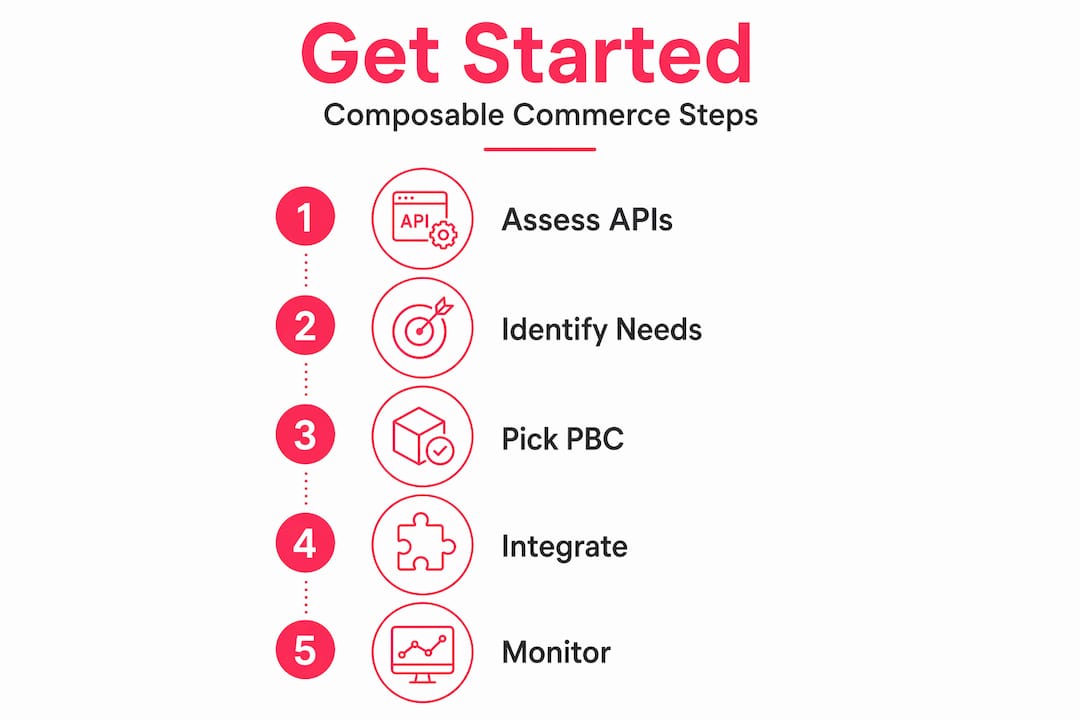
Practical steps for getting started include assessing your current platform’s API capabilities, identifying the one or two business functions where your existing solution is holding you back, defining integration ownership before you write a single line of code, and investing in observability tooling from day one. Vendor demos frequently misrepresent reality, particularly around legacy ERP integration complexity, so build your business case on your own requirements rather than a polished presentation.
The latest eCommerce trends for 2026 show that UK retailers are increasingly adopting modular approaches to stay competitive, making now a sensible time to assess your own readiness.
Pulling it together: what to do next
If there is one thing to take from this guide, it is that composable commerce is not a technology you buy. It is a strategy you adopt. The core principles to carry forward are:
- Align business goals first: Technology choices should follow business needs, not the other way around.
- Understand your total cost: Factor in integration overhead, observability tooling, governance time, and skills alongside licence fees.
- Assign integration ownership: Know who owns each API connection and what the escalation path is when something breaks.
- Start incrementally: A hybrid approach lowers risk and builds internal capability before a full transition.
- Plan for the AI future: Composable, API-first architecture is the prerequisite for agentic commerce and AI-driven personalisation at scale.
The businesses that will struggle are those that adopt composable commerce as a vanity exercise because it sounds modern. The ones that win will be those who treat it as a deliberate operating model decision, backed by clear governance and honest cost accounting.
My honest take on composable commerce
I have worked with enough eCommerce platforms and enough merchants to say this plainly: composable commerce is genuinely exciting, and it is also genuinely hard. What I see most often is businesses that get sold on the headline benefits, speed, flexibility, no vendor lock-in, and then hit the reality wall about eight months in when integration debt starts accumulating and no one can agree on who owns the API layer.
The architecture is not the hard part. The governance is. Who owns the search integration when it fails at 11pm on Black Friday? Who manages the API schema when your ERP vendor pushes an update that breaks three downstream services? These are not technical questions. They are organisational ones, and most businesses underestimate how much work it takes to answer them well.
My advice: before you discuss MACH with any vendor, write down exactly which business problem you are trying to solve and who in your organisation will own the solution ongoing. If you cannot answer both questions clearly, you are not ready for a full composable transition yet. That is fine. Start with one modular service, learn the operational model, and build from there. Composable commerce rewards those who are deliberate about it.
— Steve
Ready to explore composable commerce with us?
If this article has you thinking seriously about where your current eCommerce setup is holding you back, we would be glad to help you assess your options.

At Bigeyedeers, we have spent over 17 years building high-performing online stores on Magento and Shopify for UK retailers, and we understand exactly how composable and hybrid architectures translate from theory into working stores. Whether you are considering a Magento platform build with a modular front end, exploring Shopify’s composable capabilities, or simply want an honest assessment of your current setup, our team in Cardiff and Exeter is well-placed to guide you. Get in touch with the team to start the conversation.
FAQ
What is composable commerce in simple terms?
Composable commerce is an approach to building eCommerce platforms by connecting best-of-breed, specialised tools via APIs rather than using a single all-in-one platform. It gives businesses the flexibility to choose and swap individual components such as search, checkout, and personalisation independently.
How does composable commerce differ from a monolithic platform?
A monolithic platform bundles all eCommerce functions into a single system controlled by one vendor, while composable commerce assembles independent services that can be deployed and updated separately. This means you are no longer tied to one vendor’s roadmap or feature schedule.
Is composable commerce only suitable for large enterprises?
Not exclusively, though larger enterprises with complex requirements and internal technical teams benefit most immediately. Smaller businesses can adopt composable principles incrementally by replacing one component at a time, using a hybrid approach to manage cost and complexity.
What is MACH architecture and why does it matter?
MACH stands for Microservices, API-first, Cloud-native, and Headless, and it is the foundational framework underpinning composable commerce. It matters because it defines the technical standards that make components interoperable, independently deployable, and scalable on demand.
What are the biggest risks when adopting composable commerce?
The most significant risks are underestimating integration complexity, failing to assign clear ownership of individual API connections, and neglecting ongoing governance. Integration overhead can drive total cost of ownership higher than a monolithic alternative if not properly planned for from the outset.
Recommended



Adobe Commerce (Magento)
Formerly known as Magento, Adobe Commerce is built for complex catalogues, integrations, and long term growth. We design and develop stable, scalable stores that support demanding eCommerce requirements, including multi-store setups, complex pricing, and Hyva based performance improvements.

Bespoke Build
We design and build custom eCommerce platforms for businesses with complex workflows, integrations, or non standard requirements. Built from scratch around your business needs using Laravel and modern architectures.

Working with brands across the UK from our offices in Cardiff and Exeter, you deal directly with a senior team of designers and developers specialising in Shopify, Magento, WordPress and bespoke eCommerce platforms.
We focus on commercial outcomes. Better conversion rates, strong SEO foundations and eCommerce platforms that continue to improve long after launch.