Why Invest in Custom Websites for Ecommerce Growth

Choosing between a template and a custom ecommerce website is not just about cost or speed. For British retail brands managing intricate product lines and serving both DTC and B2B markets, that decision shapes your entire digital strategy. A custom website gives you control over design, features, and integrations, allowing your platform to evolve as your business grows. This overview unpacks the real difference between generic templates and builds crafted around your brand, operations, and customers.
Table of Contents
- Defining Custom Websites For Ecommerce Success
- Template Sites Vs Custom Solutions Compared
- Essential Features For Complex Retail Needs
- Enhancing User Experience And Conversion Rates
- Security, Compliance, And Future-Proof Performance
Key Takeaways
| Point | Details |
|---|---|
| Custom Websites Enhance Flexibility | Custom ecommerce websites provide tailored solutions, allowing for unique functionalities that templates cannot offer. This supports distinct business models and customer experiences. |
| Investing in Scalability | Custom platforms are built to grow with your business, accommodating increased product lines and varying customer needs without requiring extensive rebuilds. |
| Improved User Experience and Conversion Rates | A custom-designed site enhances user experience through personalised features, which directly contributes to increased conversion rates. |
| Security and Compliance as Core Features | Custom sites ensure that security and compliance are integrated from the outset, reducing risks of breaches and maintaining customer trust effectively. |
Defining Custom Websites for Ecommerce Success
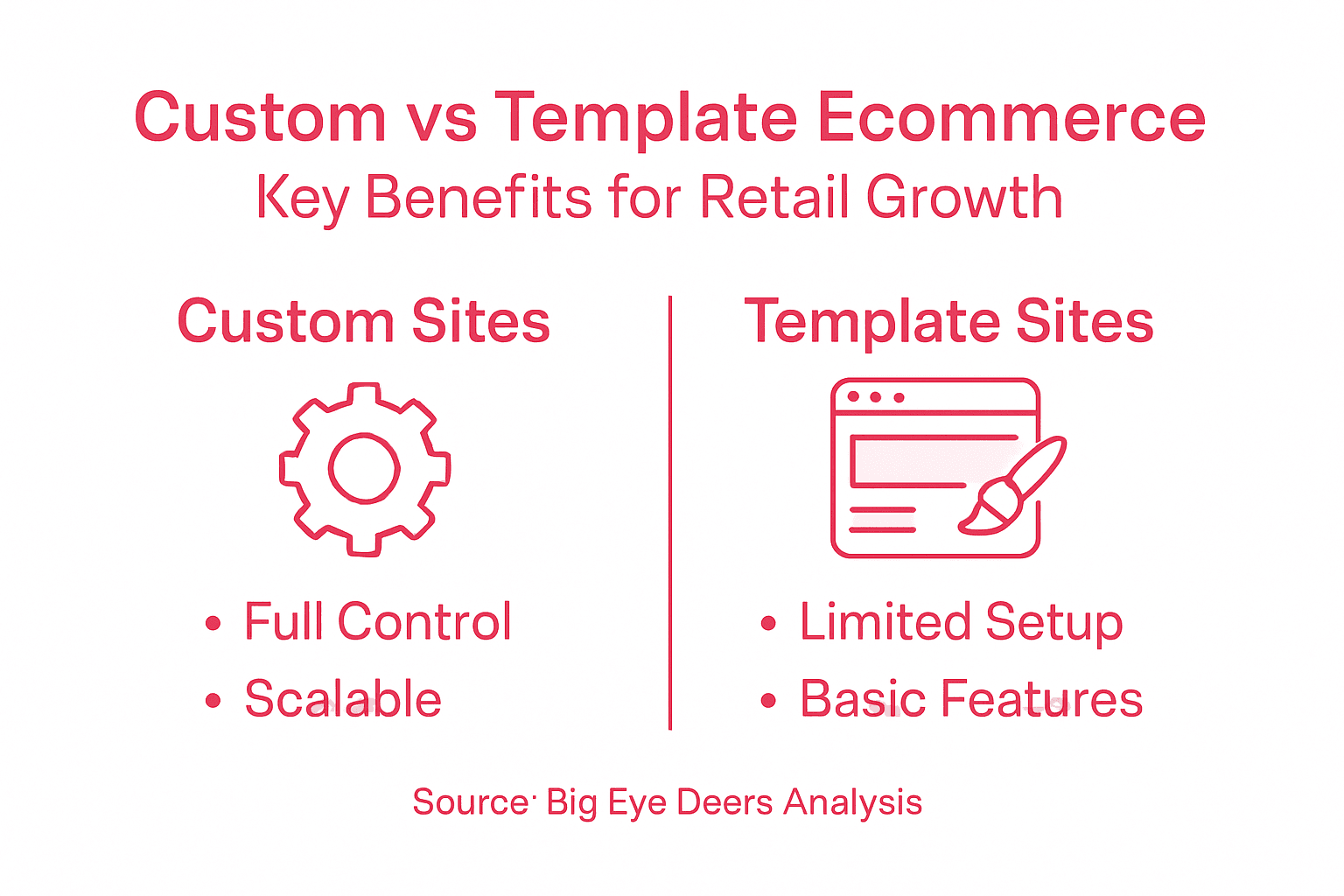
A custom ecommerce website is fundamentally different from what you get when you pluck a template off the shelf and adjust the colours. Rather than starting with constraints, custom websites are built specifically around your business model, product complexity, and customer behaviour. For retailers with intricate product catalogues, multiple pricing tiers, or both DTC and B2B channels, this distinction matters enormously. Your site becomes a tool designed for your exact objectives, not a compromise between what a template offers and what your brand actually needs.
When you invest in a custom website, you gain control over every element that touches customer experience. Custom website design provides infinite flexibility in how you structure navigation, present product information, handle inventory across channels, and manage customer journeys. A template might force you to display products in a grid, limit filter options, or struggle when you add a tenth product attribute. A custom build adapts to your requirements. You can integrate ERP systems directly, implement tiered pricing that reflects your wholesale arrangements, and structure account hierarchies that mirror how B2B customers actually operate. Performance improves because the code isn’t bloated with features you’ll never use. SEO control becomes genuinely yours instead of fighting against template limitations. Customers see a site that reflects your brand authenticity, not a generic storefront they’ve encountered a hundred times before.

The relationship between functionality and brand differentiation is where custom really proves its worth. UK retail brands competing in crowded markets often find that the fastest path to growth isn’t more marketing spend on an average platform. It’s building something that works so much better for your customers that they choose you. Consider a fashion wholesaler managing stock across multiple warehouses and customer accounts with different credit terms. Or a beauty brand selling direct to consumers whilst maintaining margins on distribution through retailers. Or a complex B2B operation where customers need custom quotes based on volume and account history. These aren’t edge cases anymore. These are exactly the operations that need websites engineered around their reality, not squeezed into predetermined boxes.
Custom websites also solve the scalability problem that template users face repeatedly. You grow into new markets, add product lines, or shift your business model. The template that worked fine with 500 SKUs becomes sluggish at 5000. New requirements that didn’t exist at launch now feel urgent. Building custom from the start means your architecture accommodates growth without requiring a complete rebuild. You’re not constantly fighting against the platform’s assumptions about what retail should look like.
Here’s an at-a-glance summary of how custom ecommerce websites drive business impact compared to templates:
| Area of Benefit | Custom Website Impact | Template Website Outcome |
|---|---|---|
| Business Adaptability | Supports unique processes | Restricts to standard workflows |
| Growth Potential | Scales with expansion easily | Requires frequent workarounds |
| Customer Experience | Enables deep personalisation | Offers generic interactions |
| Operational Efficiency | Integrates with core systems | Limited system connectivity |
| Long-Term Value | Reduces future rebuild costs | Accumulates hidden maintenance costs |
Pro tip: Before committing to custom development, map your actual customer journeys and technical requirements (product attributes, pricing rules, integrations needed). This clarity prevents gold-plating features you won’t use whilst ensuring the builder understands what truly matters for your growth.
Template Sites vs Custom Solutions Compared
The choice between template and custom solutions comes down to what you’re trying to achieve and how fast you need to achieve it. Template websites use pre-designed themes that let you launch quickly and cheaply. You pick a layout, adjust some colours, add your products, and you’re live within days. This approach works if you’re selling a straightforward product range with standard customer journeys. But the moment your business has specific requirements, template limitations become frustratingly obvious. Template ecommerce websites force you into generic user experiences because customisation is restricted to superficial changes. You can’t easily modify how products are displayed, you can’t build complex filtering systems, and you definitely can’t integrate bespoke business logic that your operations depend on. For UK retail brands with intricate product catalogues, tiered pricing, or complex B2B requirements, templates feel like wearing someone else’s shoes.
Custom solutions, by contrast, are built from the ground up specifically for your business. The development team starts by understanding how your customers behave, what your operational needs are, and where you want to compete. They then architect a platform tailored to those requirements. Yes, this costs more upfront. But the long-term economics tell a different story. Custom sites tend to deliver better ROI because they solve your actual problems instead of making you adapt to software constraints. You get genuine control over performance, SEO, and brand expression. You can integrate directly with your ERP system, implement the exact pricing logic your business needs, and scale without rebuilding. The code isn’t bloated with features you’ll never use, so page speed stays competitive. Most importantly, your customers experience something genuinely tailored to how they want to shop with you, not a generic storefront they’ve seen elsewhere.
Let’s compare them directly across what actually matters to growing retailers:
- Speed to market: Templates win here by weeks or months. Custom builds take longer because they’re engineered for your specific needs.
- Upfront cost: Templates are cheaper to launch, sometimes by thousands of pounds. Custom requires higher initial investment.
- Flexibility: Templates offer cosmetic changes only. Custom lets you modify anything.
- Scalability: Templates struggle when you grow product ranges or add new sales channels. Custom architecture accommodates growth naturally.
- Brand differentiation: Templates guarantee you look similar to competitors using the same template. Custom makes your brand distinctly yours.
- Integration capability: Templates often force you into expensive middleware to connect with other systems. Custom integrations are built in from the start.
- Performance and SEO: Templates carry unnecessary code. Custom platforms are optimised specifically for your requirements.
- Long-term cost: Template licensing and limitations often push businesses toward custom solutions eventually anyway, meaning you end up spending more overall.
The real question isn’t whether custom is “better” universally. It’s whether you need a platform built for generic retail or one engineered for how your business actually operates. If you’re competing primarily on price, a template might suffice. If you’re trying to build genuine competitive advantage through superior customer experience, better inventory management, or operational efficiency, custom is where the growth happens.
Pro tip: Calculate your total cost of ownership over five years, including template licensing, developer costs for workarounds, and lost revenue from platform limitations, before deciding custom is too expensive.
Essential Features for Complex Retail Needs
Complex retail operations require far more than a basic product catalogue and shopping cart. When you’re managing multiple product lines with varying attributes, handling both B2B and DTC channels simultaneously, or operating across different pricing structures and customer account hierarchies, your ecommerce platform needs to be engineered for that reality. Key ecommerce website features like user-friendly navigation, mobile optimisation, and secure checkout processes form the foundation, but for retailers with sophisticated business models, the real requirements go much deeper. You need systems that handle inventory complexity, accommodate tiered pricing across customer segments, integrate seamlessly with ERP platforms, and provide the operational flexibility that your teams depend on daily.
Think about what genuinely drives your growth. If you’re a fashion wholesaler, you need account hierarchies that reflect how your customers are structured. Different buyers within the same company might have different credit limits, pricing tiers, and product access levels. Your platform must enforce those rules automatically, not rely on manual intervention. If you’re a beauty brand selling direct to consumers while maintaining wholesale distribution, you need inventory that doesn’t oversell when the same stock is available across channels. If you’re managing complex product attributes like size, colour, fabric weight, and customisation options, your system needs to handle those combinations intelligently, not force customers through painful workarounds. These aren’t nice-to-have features. They’re operational necessities that directly affect whether your business runs smoothly or creates friction at every point.
Custom platforms built for complex retail typically include these essential capabilities:
- Advanced inventory management across multiple locations and sales channels, preventing overselling and providing real-time stock visibility
- Flexible pricing models supporting tiered pricing by customer segment, volume-based discounts, wholesale rates, and dynamic pricing rules
- Account hierarchies and permissions enabling B2B customers to structure their buying teams with different approval levels and product access
- ERP integration connecting your ecommerce platform directly with your financial and operational systems, eliminating manual data entry
- Robust product information management handling complex attributes, variants, bundled products, and customisation options
- Multi-store and multi-channel capability allowing you to operate separate storefronts, wholesale channels, or market-specific versions from a single platform
- Advanced search and merchandising helping customers navigate large catalogues through smart filtering, recommendations, and intelligent sorting
- Comprehensive analytics and reporting providing visibility into customer behaviour, sales patterns, and operational metrics that inform business decisions
- Payment flexibility supporting multiple payment methods, including invoice-based purchasing for B2B customers
- Performance optimisation ensuring the platform remains fast and responsive regardless of product catalogue size or transaction volume
Why do these features matter so much? Because they solve real problems that directly affect your bottom line. A customer who can’t find what they want abandons the cart. A wholesaler frustrated by outdated pricing tiers takes their business elsewhere. An inventory mistake costs you money and damages customer trust. Disconnected systems create administrative overhead that slows down your team. Each of these scenarios is avoidable when your platform is designed specifically around how you operate.
Below are essential advanced features and their impact for complex UK retail sites:
| Advanced Feature | What It Enables | Business Impact |
|---|---|---|
| ERP Integration | Seamless data synchronisation | Fewer manual errors and delays |
| Tiered Pricing | Customised customer rates | Greater B2B loyalty |
| Account Hierarchies | Multiple buyer permissions | Streamlined purchasing process |
| Real-Time Inventory | Live stock across channels | Minimised overselling risk |
The key is matching your platform capabilities to your actual business complexity, not settling for a solution that forces compromises. Generic templates can’t do this. They’re built for companies with straightforward operations and standard customer journeys. The moment your requirements become sophisticated, you need a platform engineered for your reality.
Pro tip: Before selecting a platform or building custom, document your top ten operational pain points and required features, then evaluate every option against that list rather than being influenced by marketing claims or what competitors use.
Enhancing User Experience and Conversion Rates
User experience and conversion rates are inextricably linked. A beautifully designed website that frustrates customers at the checkout won’t drive growth. Conversely, a technically sound platform with confusing navigation will leak revenue at every stage of the customer journey. Custom websites allow you to optimise both dimensions simultaneously because every element is designed with conversion in mind, not forced into templates that compromise on either front. When you build for your specific audience and business model, you eliminate the friction that templates create between what customers want and what your platform allows.
Personalisation is one of the most powerful conversion levers available, and it’s where custom platforms genuinely outperform generic solutions. Personalised advertising content tailored to individual user preferences significantly increases engagement and purchase likelihood within UK ecommerce markets. This isn’t about intrusive tracking or spammy recommendations. It’s about understanding your customers’ behaviour and presenting relevant products, offers, and experiences that match what they’re actually looking for. A fashion retailer can show size recommendations based on previous purchases. A B2B supplier can display pricing and inventory specific to each customer’s account tier. A beauty brand can surface products complementary to what customers have bought before. These personalisations aren’t afterthoughts in custom builds. They’re baked into the platform architecture from the start because they’re central to how you convert.
Conversion optimisation in custom platforms extends across the entire customer journey. Consider what happens at each critical touchpoint:
Product discovery: Instead of forcing customers through generic search, you can implement smart filtering that understands your catalogue complexity. A fashion retailer shows size ranges that actually exist in stock. A B2B platform displays only products the customer is authorised to purchase. Recommendation engines surface related items, bundles, or alternatives intelligently rather than randomly.
Product information: Your pages are structured around what your customers need to decide. For complex products, this means detailed specifications, comparison tools, and confidence-building information. For wholesale customers, it includes pricing for their segment, volume discounts, and availability across locations.
Checkout experience: This is where templates genuinely hurt conversion. A custom checkout removes friction by offering the payment methods your customers prefer. B2B customers can place orders on account rather than paying immediately. International customers see currencies and shipping options relevant to them. Progress indicators reduce anxiety. Form fields only ask for information that’s actually necessary.
Post-purchase: Custom platforms enable lifecycle marketing that templates can’t. You can send targeted follow-ups based on purchase history, offer relevant upsells, and build loyalty through personalised communication. This is where one-time transactions become repeat customers.
The relationship between user experience and conversion feels obvious in theory but requires deliberate engineering in practice. Every decision about navigation structure, form design, loading speed, mobile responsiveness, and visual hierarchy affects whether customers move forward or abandon. Templates make these decisions once for everyone. Custom platforms make them specifically for your customers and business model. That focus on your specific context compounds across the journey, turning modest improvements at each stage into significant conversion gains overall.
Why does this matter financially? Because the difference between a 2 percent conversion rate and a 3 percent conversion rate on significant traffic volume is the difference between profitable growth and struggling margins. Custom UX optimisation targets exactly those improvements through understanding your actual customer behaviour rather than guessing based on generic best practices.
Pro tip: Before building, conduct user testing with real customers on competitor sites and existing solutions to identify exactly where they get stuck, then design your custom platform to eliminate those specific friction points.
Security, Compliance, and Future-Proof Performance
Security and compliance aren’t optional extras you bolt on after launch. They’re fundamental to how your ecommerce platform operates, and they directly affect your ability to trade legally and maintain customer trust. UK retail brands face an increasingly complex regulatory environment where mistakes are expensive, not just in fines but in reputational damage and lost business. Custom websites allow you to build compliance into the architecture from day one, rather than retrofitting it onto a platform designed without your specific requirements in mind.
UK GDPR compliance is non-negotiable for any ecommerce business handling UK customer data. This means transparent data handling, secure payment processing, and proper cookie consent management. But compliance goes beyond ticking boxes. Recent high-profile breaches in UK retail have made consumers acutely aware of security issues. When customers see that your platform takes their data seriously, it becomes a competitive differentiator. They’re more likely to trust you, more willing to share information that helps personalisation, and more inclined to become loyal customers. Conversely, a single security incident can destroy years of brand building. Custom platforms built with security as a core principle rather than an afterthought provide this confidence at scale.
The regulatory landscape continues evolving. EU and UK ecommerce compliance frameworks now extend beyond data protection to include product safety standards, digital service rules, and consumer protection regulations. The Digital Services Act imposes new obligations on how platforms operate and how they handle disputes. These regulations are becoming more stringent, not less. A custom platform engineered for your business can adapt to regulatory changes because the architecture isn’t locked into predetermined limitations. You can implement new security protocols, update data handling processes, and ensure transparency in consumer communications without fighting against template constraints. This future-proofing is invaluable as regulations continue to evolve.
Performance is another dimension where security and compliance intertwine. Slow websites leak customers, but they also create security risks. Poorly optimised platforms become targets for attack because they’re easier to compromise. Custom builds allow you to optimise for both speed and security simultaneously. Your infrastructure can be hardened against common vulnerabilities. Payment data stays secure through PCI compliance standards. Sensitive customer information is encrypted and handled properly throughout the system. Regular security monitoring and updates happen proactively rather than reactively after incidents occur.
Consider what happens when compliance matters operationally. A wholesaler with international customers needs to handle data residency requirements for European buyers. A retailer operating across multiple markets needs to comply with different tax and privacy regulations per jurisdiction. A brand handling customer financial information needs to maintain PCI compliance rigorously. These aren’t edge cases. These are normal operations for growing UK retailers. Templates force you to either accept their standard approach (which might not meet your requirements) or spend enormous effort and cost working around limitations. Custom platforms build your exact compliance requirements into how the system functions.
The financial case is straightforward. GDPR fines can reach 20 million pounds or 4 percent of global turnover, whichever is higher. A security breach costs far more than the fine itself. Lost customers, damaged reputation, operational disruption, and recovery costs mount quickly. Investing in a secure, compliant custom platform prevents these catastrophic scenarios. You also gain competitive advantage because customers increasingly expect strong security and transparency as standard. Your platform becomes a point of differentiation rather than a compliance checkbox.
Pro tip: Engage a security audit and compliance assessment before building, not after, so your custom development incorporates these requirements from the architecture stage rather than adding them later when changes become expensive.
Unlock Your Ecommerce Growth Potential with Custom Solutions
If your ecommerce business demands advanced features like tiered pricing, ERP integration, and a tailored customer experience that off-the-shelf templates simply cannot deliver, it is time to consider a platform built around your unique operational needs. The challenges of managing complex product catalogues, B2B account hierarchies, and scalable architectures require expertise in custom ecommerce development to transform your store into a powerful growth engine.
At Big Eye Deers, we specialise in designing and building high-performing online stores using Magento and Shopify tailored specifically to UK retail brands like yours. Combining strategic UX planning with advanced technologies ensures your customers enjoy personalised journeys that convert while your business benefits from seamless system integrations and robust security. Our focus on performance, compliance, and long-term value means your ecommerce platform will scale confidently as your business evolves.
Ready to turn your unique ecommerce challenges into competitive advantage today Explore how custom ecommerce development with Big Eye Deers can deliver a secure, scalable, and conversion-optimised online store designed for your growth. Visit our site now to start your journey towards a truly bespoke digital experience.
Frequently Asked Questions
What are the key benefits of investing in a custom ecommerce website?
Investing in a custom ecommerce website provides benefits such as tailored functionality, improved scalability, enhanced user experience, and better SEO capabilities, allowing businesses to meet their specific operational needs and drive growth.
How does a custom website improve customer experiences compared to template solutions?
A custom website allows for deep personalisation and intuitive navigation tailored to user behaviour, which enhances the shopping experience and increases conversion rates, while template solutions offer limited customisation and may result in a generic customer experience.
Can a custom ecommerce website scale as my business grows?
Yes, custom ecommerce websites are designed with scalability in mind, allowing businesses to expand their product catalogue, add new sales channels, and adapt their architecture without needing a complete rebuild, unlike template solutions that often struggle under increased load.
What features should I consider essential when developing a custom ecommerce platform?
Essential features for a custom ecommerce platform include advanced inventory management, flexible pricing models, ERP integration, detailed product information management, and comprehensive analytics capabilities, all aimed at addressing the complexities of your retail operation.
Recommended



Adobe Commerce (Magento)
Formerly known as Magento, Adobe Commerce is built for complex catalogues, integrations, and long term growth. We design and develop stable, scalable stores that support demanding eCommerce requirements, including multi-store setups, complex pricing, and Hyva based performance improvements.

Bespoke Build
We design and build custom eCommerce platforms for businesses with complex workflows, integrations, or non standard requirements. Built from scratch around your business needs using Laravel and modern architectures.
Working with brands across the UK from our offices in Cardiff and Exeter, you deal directly with a senior team of designers and developers specialising in Shopify, Magento, WordPress and bespoke eCommerce platforms.
We focus on commercial outcomes. Better conversion rates, strong SEO foundations and eCommerce platforms that continue to improve long after launch.