International ecommerce: A practical guide for UK entrepreneurs
TL;DR:
- Successful international ecommerce requires adaptation to local regulations, payment methods, and customer expectations.
- Operational complexity, such as compliance and logistics, is a competitive advantage when managed properly.
- Focus on deep market entry and building scalable, localised systems to sustain long-term cross-border growth.
Selling online feels global by default. Your store is live, your product is ready, and technically anyone with an internet connection can find you. But the reality of international ecommerce is far more demanding than simply switching on international shipping. Hidden barriers, from local tax obligations and customs documentation to payment preferences and cultural expectations, can quietly drain revenue before you even realise what is happening. This guide cuts through the complexity and gives you a clear, honest picture of what it actually takes to sell successfully across borders in 2026.
Table of Contents
- Understanding international ecommerce: The essentials
- Key mechanics: How international ecommerce really works
- Shipping, customs, and returns: The cross-border challenge
- Choosing your route: DDP vs DDU and marketplaces
- 2026 trends: Scaling your international ecommerce efficiently
- Expert perspective: Why operational complexity is your greatest opportunity
- Partner with experts for global ecommerce success
- Frequently asked questions
Key Takeaways
| Point | Details |
|---|---|
| Localisation is vital | Success in international ecommerce comes from adapting your offering to every market, not just shipping overseas. |
| DDP builds trust | Including duties and taxes at checkout (DDP) increases trust and reduces customer drop-offs, despite being more complex for sellers. |
| Regulations matter | Regulatory, tax, and compliance issues are often underestimated—detailed advance planning is critical. |
| Focus over breadth | Depth in a few target markets delivers better results than shallow, broad international expansion. |
| 2026 strategy shift | AI, automation, and local optimisation provide an edge as cross-border ecommerce gets more regulated and competitive. |
Understanding international ecommerce: The essentials
International ecommerce is the sale of products or services across national borders through online platforms. But that definition barely scratches the surface. The real work lies in adapting to local expectations, regulations, payment norms, tax obligations, and logistics realities in each market you enter. That is a very different challenge from simply listing your products on a website.
Think about it this way. A UK brand launching into Germany needs to contend with German consumer protection law, local payment preferences (Germans love direct debit and invoice-based payments), VAT registration requirements, and the expectation of free returns. None of that is solved by plugging in a currency converter.
What makes international ecommerce distinct comes down to several core pillars:
- Localisation: Adapting language, currency, units of measurement, imagery, and tone to match local expectations
- Regulatory compliance: Understanding import rules, product standards, and consumer rights laws in each target market
- Payment and currency: Offering locally trusted payment methods, not just card payments
- Tax obligations: Registering for VAT or GST where required and collecting it correctly
- Logistics planning: Choosing the right carriers, managing customs documentation, and setting realistic delivery expectations
“International ecommerce demands adaptation across every layer of the customer experience, not just the front end of your store.”
The brands that get this right treat localisation as a competitive advantage, not a box-ticking exercise. Our ecommerce selling tips go deeper on conversion-focused tactics, but the foundation is always the same: make international customers feel like the store was built for them.
Market selection matters enormously here. Chasing every market at once is a fast route to operational chaos. Instead, use demand signals such as organic search traffic from specific countries, inbound enquiries, and competitor analysis to identify where genuine appetite exists. Then assess regulatory burden and logistics feasibility before committing resources. Watching emerging ecommerce trends by region also helps you prioritise markets with growing digital buying habits.
Pro Tip: Before investing in full localisation, test demand with a lightweight landing page in the target language and run small paid campaigns. Real conversion data is worth more than any market research report.
Key mechanics: How international ecommerce really works
Understanding the principles is one thing. Knowing the practical steps is where most businesses struggle. The key mechanics of cross-border selling cover market selection, localisation, tax compliance, payment setup, and logistics documentation. Each layer builds on the last.
Here is a comparison of the primary factors to evaluate when assessing a new international market:
| Factor | What to assess | Why it matters |
|---|---|---|
| Demand signals | Search volume, inbound traffic, competitor presence | Validates commercial opportunity |
| Regulatory burden | Import rules, product certifications, consumer law | Determines compliance cost and risk |
| Logistics feasibility | Carrier availability, transit times, customs complexity | Affects customer experience and margin |
| Payment landscape | Preferred local methods, fraud rates | Impacts conversion and trust |
| Tax obligations | VAT/GST thresholds, registration requirements | Affects pricing and legal exposure |
Once you have selected a market, the operational steps follow a logical sequence:
- Market selection: Use the framework above to shortlist two or three viable markets rather than spreading thin across ten
- Localisation: Translate and culturally adapt your store, including product descriptions, size guides, imagery, and checkout flow. Add hreflang tags for local SEO so search engines serve the right version of your site to the right audience
- Tax compliance: Determine whether you need to register for VAT or GST in the target market. Thresholds vary widely. The EU’s OSS (One Stop Shop) scheme simplifies VAT across member states, but you still need to register
- Payment and currency setup: Integrate locally trusted payment methods. In the Netherlands, that means iDEAL. In Brazil, Boleto. In Germany, SEPA direct debit. Multi-currency pricing is essential too, not just display conversion
- Logistics and documentation: Assign correct HS (Harmonised System) codes to your products, prepare commercial invoices, and include origin declarations where required. Errors here cause customs delays and unhappy customers
For brands managing multiple regional stores, a multi-store ecommerce setup on Magento or Shopify gives you the control to manage localised catalogues, pricing, and content from a single backend. This is far more scalable than maintaining separate standalone stores.
Pro Tip: Localisation is not just translation. A direct word-for-word translation of your product copy into French or German often reads awkwardly and can actually reduce trust. Invest in native copywriters who understand the tone and buying culture of the market. Your localised ecommerce content strategy should treat each market as its own brand voice. For complex builds requiring deep customisation across markets, custom ecommerce for UK brands is often the most efficient long-term investment.
Shipping, customs, and returns: The cross-border challenge
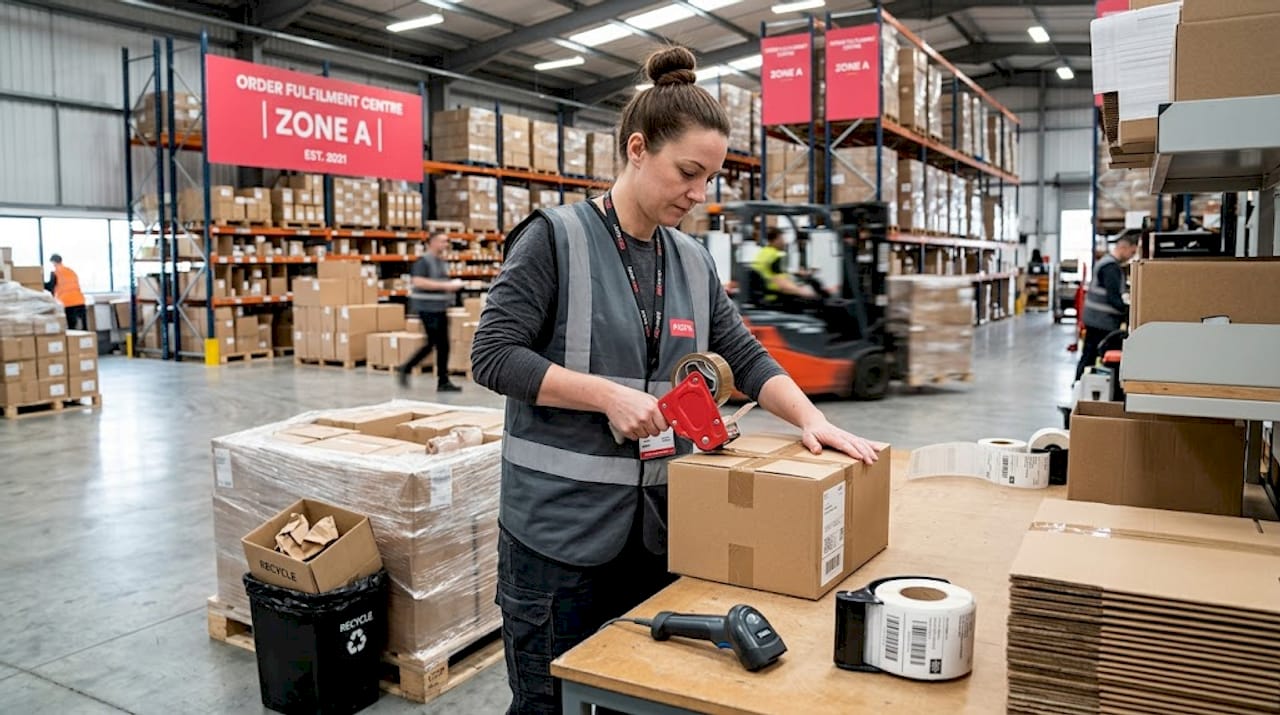
Logistics is where international ambitions often collide with hard commercial reality. Getting products across borders involves far more than booking a courier. Customs documentation, duty calculations, and returns policies all directly affect whether customers come back or file chargebacks.
Here is a straightforward comparison of the two dominant shipping approaches:
| Shipping method | Who pays duties | Customer experience | Seller risk |
|---|---|---|---|
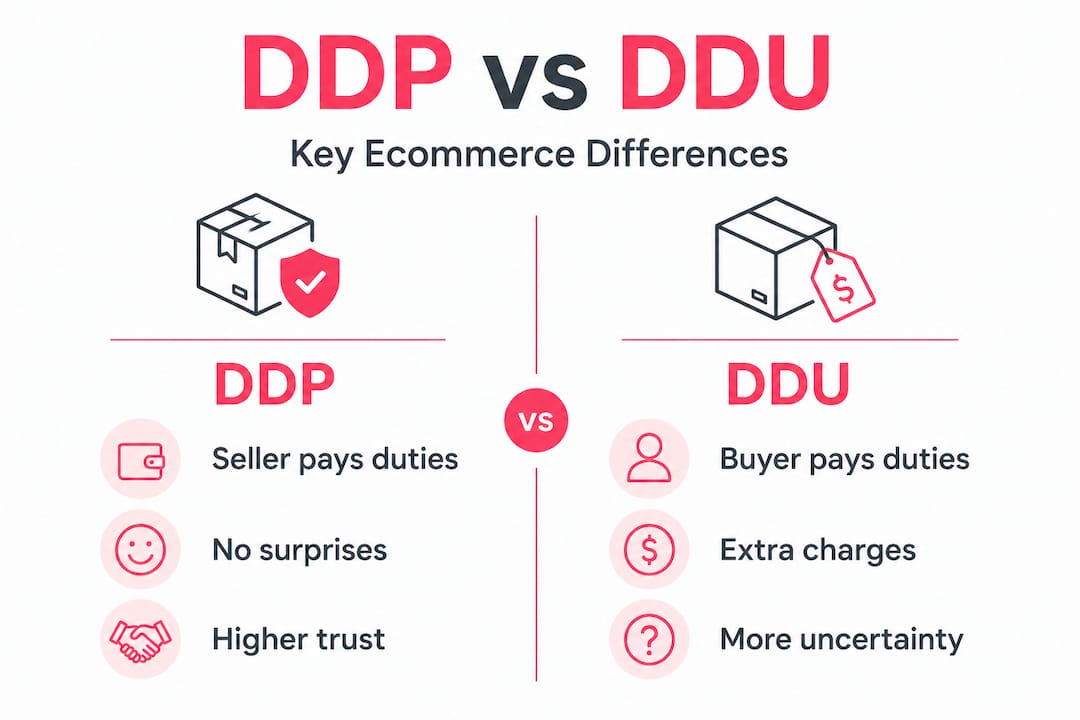
| DDP (Delivered Duty Paid) | Seller pays at checkout | Smooth, no surprises | Higher cost, VAT registration often required |
| DDU/DAP (Delivered Duty Unpaid) | Buyer pays on arrival | Friction, potential refusals | Simpler to operate, but higher abandonment |
DDP is generally preferred for B2C because customers hate surprise charges. Receiving a parcel and being told you owe £40 in import duties before it is released from the depot is a trust-destroying experience. Around 69% of shipments currently fall under de minimis thresholds and arrive duty-free, but those thresholds are tightening globally. The US made significant changes in 2025, and other markets are following.
The essential customs documentation checklist every cross-border seller needs:
- HS codes: The correct Harmonised System code for each product determines duty rates. Getting this wrong leads to delays or reclassification penalties
- Commercial invoice: Must include seller and buyer details, product descriptions, quantities, values, and country of origin
- Origin declarations: Required for preferential duty rates under trade agreements
- EORI number: UK businesses need an EORI (Economic Operators Registration and Identification) number to move goods in and out of the UK
“EU ICS2 data rules will reject imperfect DDU parcels outright, and US de minimis changes in 2025 have increased duty exposure for low-value shipments significantly.”
Returns deserve special attention. In German fashion retail, return rates exceed 50%. That is not a rounding error. It is a fundamental commercial reality that must be priced into your margins and logistics planning before you enter that market. A clear, localised returns policy, ideally with a local returns address, dramatically reduces refusals and improves repeat purchase rates.
There are also market-specific restrictions to be aware of. Mexico and Brazil, for example, require a local legal entity to act as the Importer of Record for DDP shipments. You cannot simply ship DDP into those markets as a foreign seller. For practical guidance on shipping electronics internationally, the regulatory requirements are even more specific, covering battery regulations, CE marking equivalents, and carrier restrictions. And for UK brands building out their custom ecommerce for UK operations, integrating automated HS code assignment and duty calculation tools at checkout is a worthwhile investment.
Choosing your route: DDP vs DDU and marketplaces
Once you understand the logistics landscape, the next decision is your commercial model. Do you go direct with DDP, accept the friction of DDU, or use marketplaces to reduce operational overhead?
| Approach | Control | Customer trust | Cost | Margin |
|---|---|---|---|---|
| DDP (direct) | High | High | High | Moderate |
| DDU/DAP (direct) | Moderate | Lower | Lower | Higher per unit |
| Marketplace | Low | High (platform trust) | Variable | Compressed |
Here is how to decide which model fits your business:
- Assess your average order value: DDP makes more sense when margins can absorb duty and VAT costs. Low-margin, low-AOV products often cannot sustain DDP economics
- Consider your brand stage: New entrants benefit from marketplace visibility. Established brands with loyal audiences can afford to go direct and capture more margin
- Evaluate your operational capacity: DDP requires VAT registration, local compliance, and often a logistics partner in the target market. Be honest about whether your team can manage that
- Look at your sector’s return norms: High-return categories like fashion need a returns strategy baked into the model from day one
- Test before you commit: Run a marketplace pilot to validate demand before investing in a localised direct store
DDP is preferred for B2C because it removes uncertainty from the customer journey. No surprise charges, no customs delays, no confused customers. But it is genuinely complex and costly to operate correctly. DDU is simpler for the seller but creates friction that directly increases basket abandonment and parcel refusals. Marketplaces compress your margin but reduce operational risk significantly, which makes them a sensible starting point.
Our thinking on local vs global strategy explores this trade-off in more detail. The short version is: depth beats breadth, especially early on. Owning one international market properly is worth far more than half-heartedly operating in five. And getting ecommerce right from the start saves you from expensive rebuilds later.
Pro Tip: B2C trust leans heavily towards DDP. If your sector has high basket abandonment at the customs-charge stage, switching to DDP, even at lower margins, often recovers more revenue than it costs. Run the numbers properly before dismissing it.
2026 trends: Scaling your international ecommerce efficiently
The international ecommerce landscape is shifting fast. The 2026 trends point clearly towards tighter regulation, reduced duty-free allowances, and a maturing market that rewards depth over breadth. Brands that built their cross-border model on low-value, duty-free shipping are now having to rethink their economics.
Here are the practical strategies that are working for scaling brands in 2026:
- Deep market research before entry: The days of testing ten markets simultaneously are over. Regulatory complexity and rising compliance costs mean you need conviction before you invest
- Local payment optimisation: Integrating market-specific payment methods at checkout can lift conversion by 20 to 30% in some markets. This is not optional for serious cross-border sellers
- Regional logistics partnerships: Working with local fulfilment partners reduces transit times, simplifies returns, and often lowers per-unit shipping costs significantly
- Scalable tech stacks: Platforms like Magento and Shopify support multi-currency, multi-language, and multi-store configurations natively. Build on a foundation that scales without requiring a full rebuild every time you enter a new market
- AI-assisted operations: Automated HS code classification, AI-powered customer service in local languages, and demand forecasting tools are reducing the manual overhead of cross-border operations considerably
Statistical callout: Around 69% of cross-border shipments currently qualify as duty-free under de minimis thresholds, but that figure is falling as governments tighten rules. Build your pricing model assuming duties will apply, not hoping they will not.
The brands winning in 2026 are not the ones entering the most markets. They are the ones with the strongest operational infrastructure in the markets they have chosen. Watching emerging retail trends by region helps you stay ahead of where consumer behaviour is shifting, so you can position before the crowd arrives.
Expert perspective: Why operational complexity is your greatest opportunity
Here is the uncomfortable truth most international ecommerce guides will not tell you. The complexity is the point. Most UK founders we speak to want to skip the boring bits: the VAT registrations, the HS code assignments, the localised returns policies. They want to get to the revenue. We understand the instinct, but it is exactly backwards.
The brands that have built durable international businesses did so by treating operational complexity as a moat. When you have correctly registered for VAT in Germany, built a local returns flow, integrated iDEAL at checkout, and localised your product copy with a native copywriter, you have done something your competitors have not bothered to do. That is a genuine competitive advantage, not just compliance hygiene.
We have seen UK brands lose tens of thousands of pounds to avoidable customs errors, non-recoverable VAT on DDP shipments, and return rates they never modelled. These are not edge cases. They are predictable consequences of underestimating the operational layer.
Our honest advice is to go deep before you go wide. Pick one international market, do it properly, and use what you learn to build a repeatable playbook. The temptation to launch in five markets simultaneously is strong, especially when the addressable market looks enormous. Resist it. Depth wins. And learning from mature local competitors in your target market, studying their pricing, returns policies, and checkout flows, will teach you more than any market entry report.
The balancing of local and global strategy is not a one-time decision. It evolves as your operational capability grows. Start narrow, build confidence, then expand from a position of genuine strength.
Partner with experts for global ecommerce success
Expanding internationally is one of the most rewarding moves a UK ecommerce brand can make, but only when the foundations are right. The complexity of localisation, compliance, payments, and logistics is real, and getting it wrong is expensive.
At Big Eye Deers, we have spent over 17 years helping UK brands build ecommerce platforms that are genuinely ready for cross-border growth. Whether you are building on Shopify or need the deeper customisation that Magento provides for multi-store, multi-currency, and B2B configurations, we bring the technical depth and commercial understanding to get it right. If you are serious about international growth, meet our team and let us talk through your specific market ambitions. We would rather help you avoid the costly mistakes upfront than fix them after launch.
Frequently asked questions
What are the legal requirements for UK businesses selling internationally?
UK businesses must comply with local laws, VAT/GST registration thresholds, and customs documentation requirements in every market they serve, including correct HS codes and commercial invoices.
What is the main difference between DDP and DDU shipping?
DDP means the seller handles all duties and taxes before delivery, while DDU leaves those costs for the buyer to pay on arrival, which frequently leads to parcel refusals and abandoned orders.
How can UK SMEs reduce abandoned baskets in international sales?
Displaying total landed costs including duties at checkout, offering local currency pricing, and integrating locally trusted payment methods all reduce friction. DDP is preferred for B2C trust because it removes the surprise charges that kill conversion.
Are there countries UK e-commerce sellers should avoid?
Markets like Mexico and Brazil require a local legal entity to act as Importer of Record for DDP shipments, making compliant entry significantly more complex and costly for foreign sellers.
What trends are shaping international ecommerce in 2026?
Declining de minimis thresholds, stricter customs data requirements, and the growing use of AI for operational automation are the defining forces shaping cross-border ecommerce strategy for UK brands in 2026.
Recommended



Adobe Commerce (Magento)
Formerly known as Magento, Adobe Commerce is built for complex catalogues, integrations, and long term growth. We design and develop stable, scalable stores that support demanding eCommerce requirements, including multi-store setups, complex pricing, and Hyva based performance improvements.

Bespoke Build
We design and build custom eCommerce platforms for businesses with complex workflows, integrations, or non standard requirements. Built from scratch around your business needs using Laravel and modern architectures.
Working with brands across the UK from our offices in Cardiff and Exeter, you deal directly with a senior team of designers and developers specialising in Shopify, Magento, WordPress and bespoke eCommerce platforms.
We focus on commercial outcomes. Better conversion rates, strong SEO foundations and eCommerce platforms that continue to improve long after launch.