Why Choose Custom Ecommerce for UK Retail Brands

Finding the right custom Magento solution is a challenge many British retail brands face as they push for stronger performance and a better user experience. With over 75 percent of UK ecommerce managers reporting that standard platforms fail to handle complex B2B and DTC needs, it is clear that off-the-shelf options often fall short. Discover how tailoring your ecommerce platform can address operational hurdles, elevate customer journeys, and keep your brand ahead in a fast-changing digital marketplace.
Table of Contents
- Custom Ecommerce Defined For Retail Brands
- Magento And Shopify Customisation Options
- Key Features For B2B And DTC Success
- Performance, UX, And Lifecycle Marketing
- Costs, Risks, And Security Considerations
- Comparing Custom And Off-The-Shelf Solutions
Key Takeaways
| Point | Details |
|---|---|
| Custom Ecommerce Benefits | Custom ecommerce platforms offer tailored user experiences, integrating advanced technologies to enhance consumer engagement for UK retail brands. |
| Platform Comparison | Magento provides extensive customisation flexibility, while Shopify focuses on quick deployment and ease of use, making the choice dependent on brand requirements. |
| B2B and DTC Features | Successful ecommerce platforms for B2B and DTC require sophisticated functionalities that prioritise personalised shopping experiences and advanced account management. |
| Financial and Security Considerations | Investing in ongoing security, compliance, and risk management is essential to maintain the viability of ecommerce platforms in a changing regulatory landscape. |
Custom ecommerce defined for retail brands
Custom ecommerce represents a strategic digital approach where online retail platforms are meticulously designed to address the unique operational requirements and consumer expectations of specific brands. Unlike standardised solutions, custom ecommerce platforms enable precise digital experiences that align closely with a brand’s distinctive market positioning and customer engagement strategies.
For United Kingdom retail brands, custom ecommerce means developing sophisticated online environments that transcend basic transactional interfaces. These platforms integrate advanced functionalities such as personalised product recommendations, seamless multichannel experiences, and intelligent user journeys tailored to specific consumer segments. By leveraging technologies like artificial intelligence and machine learning, brands can create dynamic digital ecosystems that adapt in real-time to customer behaviour and preferences.
The core benefits of custom ecommerce for UK retail brands include:
Below is a comparison of how custom ecommerce benefits different business models in UK retail:
| Benefit Area | B2B Retail Impact | DTC Retail Impact | Multi-Channel Brands |
|---|---|---|---|
| User Experience Control | Supports complex workflows | Enables tailored journeys | Harmonises brand touchpoints |
| Data Insight Depth | Detailed procurement analysis | Real-time consumer behaviour | Aggregate insights |
| System Integration | Connects ERP and CRM systems | Syncs marketing platforms | Unifies sales channels |
| Scalability | Adapts to enterprise growth | Handles traffic spikes | Expands to new markets |
| Direct Engagement | Enhances account management | Fosters brand loyalty | Drives omnichannel strategy |
- Granular control over user experience design
- Enhanced data capture and customer insights
- Flexible integration with existing business systems
- Scalable architecture supporting future growth
- Direct-to-consumer engagement capabilities
Pro tip: When planning a custom ecommerce solution, prioritise platforms that offer modular architecture and robust API connectivity to ensure long-term adaptability and seamless third-party integrations.
Magento and Shopify customisation options
Magento and Shopify represent two powerful yet distinctly different platforms for retail brands seeking customised ecommerce solutions. Magento offers extensive customization capabilities through its modular architecture, providing retail brands with granular control over every aspect of their digital storefront, from complex product configurations to bespoke checkout experiences.
Shopify, by contrast, provides a more streamlined approach to customisation, focusing on user-friendly theme editing and app integrations. While less structurally flexible than Magento, Shopify enables brands to rapidly deploy online stores with aesthetic and functional modifications. The platform excels at offering quick-to-implement solutions for smaller to medium-sized UK retail businesses seeking efficient digital storefronts without extensive technical development.
Key customisation options for each platform include:
Magento Customisation Features:
- Advanced XML configuration capabilities
- Comprehensive API integrations
- Complex product catalog management
- Multilingual and multi-currency support
- Highly scalable architecture
Shopify Customisation Features:
- Drag-and-drop theme editor
- Extensive app marketplace
- Pre-built design templates
- Simplified payment gateway integrations
- Quick deployment options
Pro tip: When selecting between Magento and Shopify, carefully assess your brand’s technical capabilities, scalability requirements, and long-term digital commerce strategy to choose the most appropriate platform.
Key features for B2B and DTC success
Successful B2B and direct-to-consumer (DTC) ecommerce platforms require sophisticated features that go beyond traditional transactional interfaces. UK retail brands must prioritise advanced technologies that enable personalised shopping experiences, integrating intelligent systems that adapt to evolving consumer expectations and business requirements.
For B2B platforms, critical features include robust buyer portals with granular access controls, allowing organisations to manage complex purchasing hierarchies and implement nuanced pricing strategies. These systems must support intricate account structures, enabling large enterprises to establish custom procurement workflows, delegate purchasing permissions, and maintain comprehensive transaction histories.
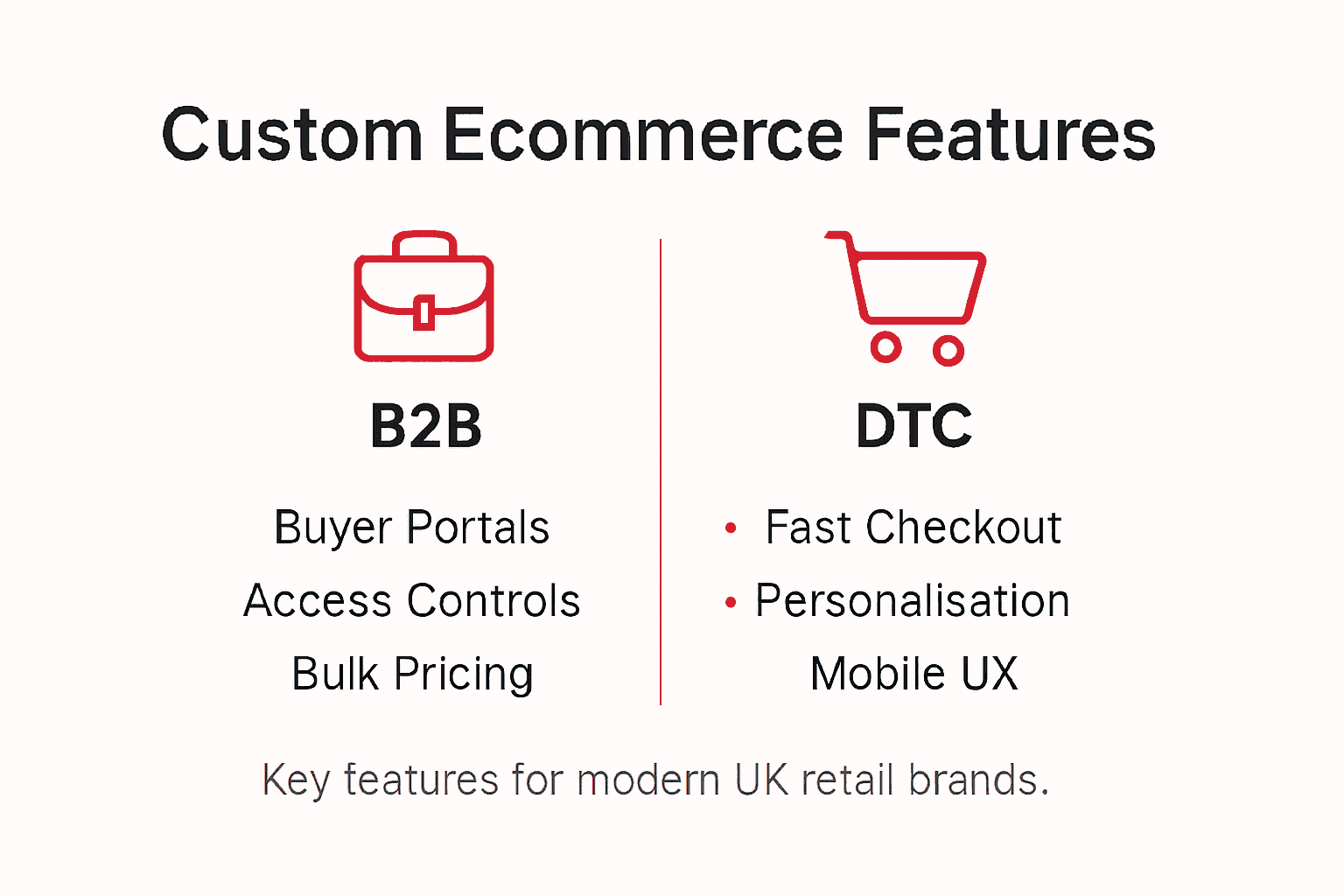
Key Success Features for B2B and DTC Platforms:
B2B Specific Features:
- Custom pricing and contract management
- Multi-level account hierarchies
- Advanced order approval workflows
- Integrated customer-specific catalogues
- Detailed transaction reporting
DTC Specific Features:
- Personalised product recommendations
- Seamless mobile shopping experiences
- Social commerce integrations
- Transparent shipping and returns processes
- Direct customer engagement tools
Pro tip: Invest in platforms that offer robust API integrations and modular architectures, enabling future scalability and quick adaptation to emerging market technologies.
Performance, UX, and lifecycle marketing
User Experience represents the core foundation of successful digital retail strategies, where sophisticated design directly impacts customer satisfaction and engagement. Modern UK retail brands must approach ecommerce platforms as comprehensive ecosystems that seamlessly blend technical performance, intuitive navigation, and strategic customer communication.

Performance metrics extend beyond traditional website speed measurements, encompassing mobile responsiveness, intuitive interface design, and smooth transactional experiences. Advanced platforms leverage sophisticated analytics to understand user behaviour, creating personalised journeys that adapt in real-time to individual customer preferences. By implementing intelligent tracking and segmentation, retailers can transform standard ecommerce interactions into dynamic, responsive experiences that anticipate and fulfil customer needs.
Key Performance and UX Considerations:
Technical Performance Elements:
- Millisecond page load times
- Seamless mobile responsiveness
- Adaptive interface design
- Robust security protocols
- Minimal transaction friction
User Experience Components:
- Intuitive navigation structures
- Personalised product recommendations
- Streamlined checkout processes
- Interactive product visualisations
- Transparent customer support channels
Pro tip: Implement continuous user testing and A/B experimentation to systematically refine your platform’s performance and user engagement strategies.
Costs, risks, and security considerations
Custom ecommerce platforms represent significant strategic investments for UK retail brands, requiring comprehensive financial and security planning. UK businesses must navigate complex risk landscapes involving regulatory compliance, cyber threats, and supply chain vulnerabilities, necessitating robust risk management frameworks and proactive security strategies.
Financial considerations extend beyond initial development costs, encompassing ongoing maintenance, infrastructure scaling, and potential regulatory adaptations. Retail brands must budget for continuous platform evolution, cybersecurity enhancements, and potential technical integrations. The post-Brexit commercial environment demands additional financial flexibility to address potential regulatory shifts and international trading complexities.
Key Risk and Cost Considerations:
Financial Investment Factors:
- Initial platform development expenses
- Ongoing maintenance and upgrade costs
- Technical infrastructure scaling
- Compliance and regulatory adaptation budgets
- Cybersecurity investment requirements
Security Risk Management Elements:
- Comprehensive cyber threat monitoring
- Regular security protocol updates
- Staff cybersecurity training programmes
- Data protection compliance mechanisms
- Supply chain security assessments
Pro tip: Allocate at least 15-20% of your digital transformation budget specifically for ongoing security enhancements and risk mitigation strategies.
The table below summarises how ongoing investment and risk management can influence ecommerce platform viability:
| Consideration | Impact on Longevity | Typical Approach | Potential Pitfall |
|---|---|---|---|
| Maintenance Funding | Ensures platform growth | Quarterly budget reviews | Underestimating upgrade needs |
| Security Enhancements | Protects user trust | Regular audits | Falling behind on threats |
| Regulatory Compliance | Avoids legal issues | Annual policy updates | Ignoring new regulations |
| Scalability Planning | Enables business expansion | Modular infrastructure | Overloading legacy systems |
Comparing custom and off-the-shelf solutions
Retail brands face critical strategic decisions when selecting ecommerce platforms, with commercial off-the-shelf solutions presenting distinct advantages and limitations for different business scales. Off-the-shelf platforms offer standardised functionalities that can rapidly deploy basic online retail capabilities, while custom solutions provide intricate, brand-specific digital experiences tailored to complex operational requirements.
The fundamental difference lies in architectural flexibility and strategic alignment. Off-the-shelf solutions provide immediate, cost-effective digital storefronts with pre-configured features, ideal for smaller retailers or businesses with straightforward transactional needs. Custom platforms, conversely, enable granular control over user journeys, backend integrations, and unique brand experiences that transcend template-based constraints.
Comparison of Key Characteristics:
Off-the-Shelf Solution Features:
- Lower initial development costs
- Rapid deployment timelines
- Standard feature sets
- Minimal technical complexity
- Quicker time-to-market
Custom Solution Advantages:
- Bespoke user experience design
- Advanced integration capabilities
- Scalable architectural frameworks
- Precise brand alignment
- Long-term adaptability
Pro tip: Conduct a comprehensive capability assessment of your specific business requirements before selecting between off-the-shelf and custom ecommerce solutions to ensure optimal strategic alignment.
Unlock the Full Potential of Custom Ecommerce for Your UK Retail Brand
Custom ecommerce platforms offer UK retailers the ability to deliver truly bespoke user experiences while integrating critical systems like ERP and CRM for both B2B and DTC models. If you are seeking granular control over product catalogues, tiered pricing, account hierarchies or scalable architecture that supports long-term growth, tackling these challenges requires a proven partner with deep technical expertise.
Big Eye Deers specialises in designing and building high-performing ecommerce solutions on Magento and Shopify, focusing on UX, performance, and security. With over 17 years of experience, we create platforms that not only meet your unique business needs but also enhance conversion and retention through tools like Klaviyo lifecycle marketing and Klevu product discovery. Our proactive support includes advanced security measures such as Sansec malware detection to protect your investment and customer trust.
Discover how our tailored ecommerce services can transform your retail operations and prepare your brand for scalable success. Visit Big Eye Deers to explore our Magento customisation and Shopify expertise. Contact us today to start your journey toward a secure, performant, and future-proof ecommerce platform.
Frequently Asked Questions
What are the benefits of choosing a custom ecommerce platform for retail brands?
Custom ecommerce platforms offer several benefits, including enhanced user experience control, deeper data insights, better system integration, scalability for future growth, and improved direct engagement with customers.
How does a custom ecommerce solution differ from off-the-shelf options?
Custom ecommerce solutions provide tailored user experiences and advanced integration capabilities, while off-the-shelf solutions offer standardised, pre-configured functionalities, suitable for businesses with simpler requirements.
What key features should B2B and DTC ecommerce platforms include?
B2B platforms should feature robust buyer portals, custom pricing, and advanced approval workflows. DTC platforms should focus on personalised product recommendations, mobile shopping experiences, and social commerce integrations.
Why is user experience crucial for ecommerce success?
User experience is vital as it affects customer satisfaction and engagement. A well-designed ecommerce platform can lead to improved navigation, faster transactions, and ultimately, higher conversion rates.
Recommended



Adobe Commerce (Magento)
Formerly known as Magento, Adobe Commerce is built for complex catalogues, integrations, and long term growth. We design and develop stable, scalable stores that support demanding eCommerce requirements, including multi-store setups, complex pricing, and Hyva based performance improvements.

Bespoke Build
We design and build custom eCommerce platforms for businesses with complex workflows, integrations, or non standard requirements. Built from scratch around your business needs using Laravel and modern architectures.
Working with brands across the UK from our offices in Cardiff and Exeter, you deal directly with a senior team of designers and developers specialising in Shopify, Magento, WordPress and bespoke eCommerce platforms.
We focus on commercial outcomes. Better conversion rates, strong SEO foundations and eCommerce platforms that continue to improve long after launch.