Why choose modular architecture for UK retail and B2B
TL;DR:
- Modular ecommerce architecture offers UK brands faster delivery, flexibility, and lower long-term costs. It enables independent component swapping and scalable growth, reducing vendor lock-in and operational risks. This approach is ideal for businesses with frequent change needs, complex workflows, or a focus on differentiated customer experiences.
For most UK retail and B2B brands, modular (composable, API-first) ecommerce architecture is the right call — particularly where business requirements shift frequently, custom B2B workflows exist, or a differentiated customer experience is a commercial priority.
Three things make the case quickly:
- Faster delivery: brands migrating to Shopify composable platforms reported implementing on average 20% faster than competitors and reported approximately 15% incremental revenue attributable to replatforming.
- Lower lock-in: API-first components let you swap search, payments, or PIM without rebuilding the entire store.
- Controlled flexibility: if you need to replace one service without a full replatform, modular is your answer.
Table of Contents
- What modular ecommerce architecture actually means
- Business and commercial benefits for UK retail and B2B brands
- Typical modular stack for UK brands — and where technologies fit
- What the evidence shows on speed, revenue, and TCO
- Trade-offs, risks, and when modular is not the right choice
- Migration checklist and realistic timelines for UK brands
- How to choose an agency for a modular ecommerce project
- How Bigeyedeers implements modular ecommerce for UK brands
- Is modular architecture the right move for your brand?
- Key takeaways
- A perspective on delivering modular projects
- Bigeyedeers can help you build and migrate with confidence
- Useful sources and further reading
What modular ecommerce architecture actually means
Modular (or composable) commerce is a development approach where your ecommerce platform is assembled from independent, interchangeable components, each connected via APIs. Rather than one monolithic codebase handling everything, you pick best-of-breed tools for each function: storefront, checkout, search, email, PIM, and so on.
A few terms your project team should share:
- Headless: the front end is decoupled from the back end; they communicate via API. Composable goes further, making every individual capability (checkout, search, payments) independently swappable.
- API-first: every service exposes a documented API, making integration with ERP, CRM, and PIM systems more predictable.
- Composable / MACH: Microservices, APIs, Cloud-native, Headless. The MACH stack is the architectural philosophy; composable commerce is the practical implementation.
- PBC (Packaged Business Capability): a self-contained software component representing one business function. A composable platform is a collection of PBCs stitched together via a unifying API.
- Orchestration layer / event bus: the integration layer that coordinates data flow between services, syncs master data, and handles event-driven communication.
The contrast with a monolith is stark. A monolithic platform couples all functions into one codebase; a change to the checkout can require retesting the entire system. Pure microservices go the other way, breaking everything into dozens of independently deployed services — but the coordination overhead often outweighs the gains for typical retail needs. Modular commerce sits in the middle: meaningful component flexibility without the operational cost of managing hundreds of microservices.
Business and commercial benefits for UK retail and B2B brands
The commercial case for modular architecture comes down to speed, flexibility, and long-term cost.
- Faster feature launches: because components are loosely coupled, developers can work in parallel. A new search experience or promotional module can go live without touching the checkout or order management system.
- Controlled experimentation: you can launch new features as separate modules, test them with a subset of customers, and measure performance before full rollout — a meaningful advantage for conversion rate work.
- Reduced vendor lock-in: API-first components mean an underperforming search tool or payment gateway can be swapped without rebuilding the store. For B2B brands managing complex contracts and multi-region deployments, this is particularly valuable.
- Scalability: individual components scale independently. During peak trading, only high-load services like checkout need additional resource — you are not scaling the entire platform unnecessarily.
- Long-term TCO: ungoverned microservices drive up total cost of ownership through cloud costs, engineering overhead, and integration work. A governed modular approach, with a managed commerce core and swappable peripherals, keeps TCO in check.
Statistic: IDC research surveying enterprise leaders found that a low total cost of ownership is important when changing to headless, hybrid, or full-stack architecture — and many have adopted a composable front end with a full-stack back end to balance optionality and cost.
For UK retailers, the benefits of custom ecommerce development are amplified when the underlying architecture allows components to be updated without platform-wide risk.
Typical modular stack for UK brands — and where technologies fit
| Component | Role | Best for | Vendor lock-in / TCO |
|---|---|---|---|
| Commerce core (Magento / Adobe Commerce, Shopify) | Cart, checkout, order management, catalogue | B2B complexity (Magento); DTC speed (Shopify) | Low with API-first config |
| Storefront (Hyvä, custom React/Vue) | Front-end presentation layer | High-performance, brand-led UX | Swappable independently |
| Search & merchandising (Klevu) | On-site search, personalised results | Large catalogues, B2B product discovery | API-connected; replaceable |
| Lifecycle marketing (Klaviyo) | Email, SMS, segmentation, automation | DTC retention; B2B re-engagement | API-connected |
| Security / PCI monitoring (Sansec) | Malware detection, supply chain attack prevention, PCI compliance | All Magento stores | Monitoring layer; non-intrusive |
| Design / UX (Figma) | User journeys, wireframes, interface systems | Pre-development planning | Internal tooling |
| PIM / ERP / WMS integrations | Master data sync, inventory, pricing | B2B multi-store, tiered pricing | Integration layer dependency |

The orchestration layer sits between these components: an API gateway routes requests, an event bus handles asynchronous data sync, and a master data strategy keeps product, pricing, and customer records consistent across services.
Bigeyedeers implements and supports all of the above. Security monitoring with Sansec is part of the ongoing Magento support service, covering PCI responsibilities and supply chain risk. Klevu and Klaviyo integrations are configured as part of the build, not bolted on afterwards.
What the evidence shows on speed, revenue, and TCO
Headline metric: brands migrating to composable platforms report implementing faster than competitors, with some incremental revenue attributable to replatforming — from vendor analysis of composable migrations.
A few important caveats:
- These figures come from vendor-commissioned or vendor-cited studies. Independent surveys are harder to find, but the directional evidence is consistent across multiple sources.
- The IDC survey of 1,000 enterprise leaders found the blended model (composable front end, full-stack back end) delivers faster time-to-market, better customer experience, and cost-effectiveness — without requiring full in-house engineering capability.
- Pure microservices consistently show higher TCO than governed composable approaches, due to cloud costs, integration overhead, and the engineering resource needed to maintain dozens of independently deployed services.
Ask for the underlying reports during a discovery conversation — any credible agency should be able to walk you through the methodology.
Trade-offs, risks, and when modular is not the right choice
Modular architecture is not universally the right answer. Here is where it can go wrong:
- Integration overhead: each additional PBC adds an API contract, a data dependency, and a potential failure point. Without a clear integration strategy, complexity compounds quickly.
- Skills gap: composable builds require integration engineers, DevOps capability, and governance discipline. If your internal team lacks this, the cost of maintaining a distributed stack rises sharply.
- Vendor sprawl: adding best-of-breed tools without a governance framework leads to uncontrolled sprawl — multiple vendors, multiple contracts, and no single owner of the integration layer.
- Higher short-term delivery cost: a phased composable build costs more upfront than a standard platform deployment. The payback comes over 18–36 months through faster iteration and avoided replatforming costs.
When to stay monolithic or go hybrid: if your catalogue is small, your workflows are standard, and your development resource is limited, a managed full-stack platform is often the better choice. IDC data shows 29% of enterprise leaders still run a full-stack platform — and for many, that is the right call.
Pro Tip: Treat composability as a capability programme, not a shopping list. The question is not “which tools can we add?” but “which capabilities do we need to own independently, and what governance keeps them coherent?” Start with one PBC, prove the value, then expand.
Migration checklist and realistic timelines for UK brands
Ordered checklist
- Discovery and business goals — define which capabilities need independence and why.
- Current system audit — map integrations, data flows, and technical debt.
- Data mapping — identify master data sources for product, pricing, customer, and inventory.
- Choose integration pattern — API gateway, event bus, or hybrid sync strategy.
- Pilot the first PBC — start with the highest-pain module (search, checkout, or PIM).
- Progressively migrate — expand capability by capability, validating each before moving on.
- Validation and load testing — test under realistic peak traffic before go-live.
- Rollback plan — document and test the rollback procedure for each phase.
- Post-launch optimisation — monitor, iterate, and govern ongoing component additions.
Typical timeline
| Phase | Duration | Key resources |
|---|---|---|
| Discovery and audit | 3–6 weeks | PM, solutions architect |
| Data mapping and integration design | 4–6 weeks | Integration engineer, DevOps |
| Pilot PBC (e.g. search or checkout) | 6 weeks | Developer, QA, PM |
| Full migration (remaining capabilities) | 12 weeks | Full team |
| Post-launch optimisation | Ongoing | Support engineer, PM |
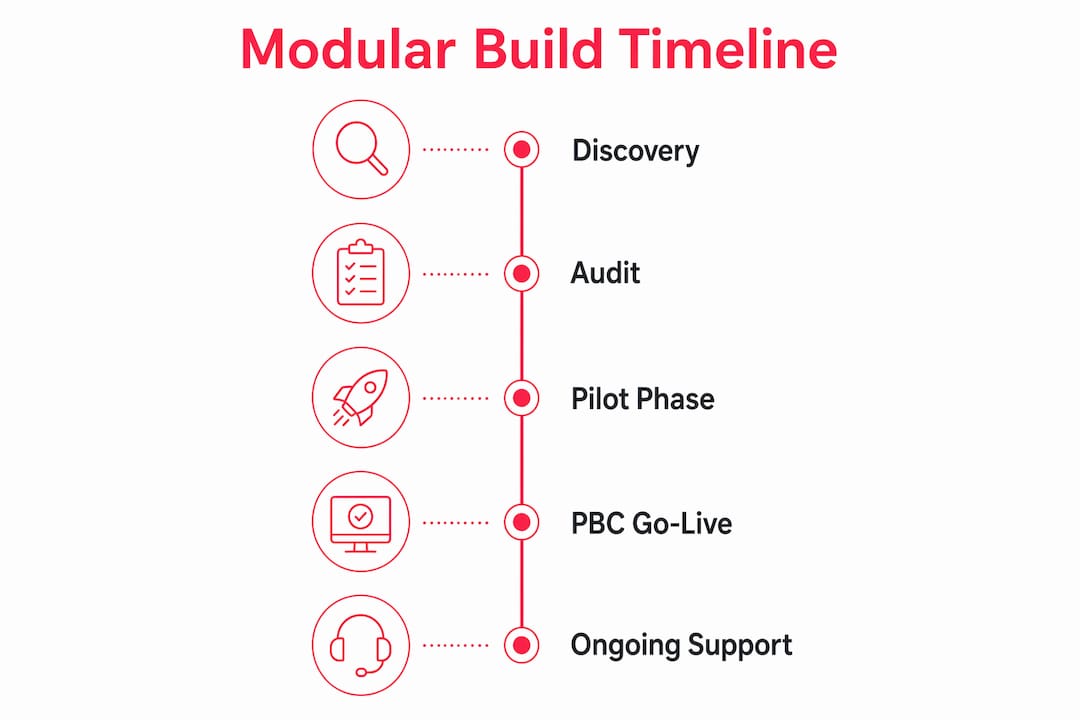
Governance checkpoints at the end of discovery, after the pilot, and before each new PBC go-live are non-negotiable. They are where scope creep and integration debt get caught early. For a deeper look at ecommerce replatforming timelines, the phased approach consistently outperforms big-bang migrations on both cost and risk.
How to choose an agency for a modular ecommerce project
Ask these questions before signing anything:
- Platform depth: can they show live Magento / Adobe Commerce and Shopify builds, including Hyvä frontends? How many years of active delivery?
- Integration experience: have they integrated Klevu, Klaviyo, and Sansec in production? Can they show the configuration approach?
- Phased migration examples: what is their process for piloting a single PBC before expanding? What does time-to-value look like at each phase?
- Test and rollback: how do they handle load testing, and what is the documented rollback procedure?
- Post-launch support: is ongoing support a structured retainer with defined SLAs, or ad hoc?
Red flags to watch for:
- No reference sites with measurable outcomes (conversion uplift, load time improvement, revenue change).
- No documented governance model for managing multiple vendors and integration dependencies.
- Vague staffing plans — “a team will be assigned” is not an answer.
- Blank dependency management: if they cannot explain how they handle API versioning and breaking changes, walk away.
Validate claims by asking for a migration timeline with milestones and named outcomes. Any agency worth working with can produce one.
How Bigeyedeers implements modular ecommerce for UK brands
What Bigeyedeers owns in a modular project:
- UX design and Figma-led planning (user journeys, wireframes, interface systems)
- Magento / Adobe Commerce and Shopify development, including Hyvä frontends
- Klevu search and merchandising configuration
- Klaviyo lifecycle marketing integration and segmentation setup
- Sansec monitoring, PCI compliance, and ongoing security management
- ERP, PIM, and WMS integration design and delivery
- Post-launch support retainer with defined SLAs
What the client retains:
- Content management and merchandising decisions
- Commercial strategy and promotional planning
- Internal stakeholder sign-off at governance checkpoints
Is modular architecture the right move for your brand?
Use these checks to make the call:
- High change frequency (new markets, channels, or B2B workflows every 6–12 months) → go modular.
- Custom B2B requirements (tiered pricing, account hierarchies, quote workflows) → go modular; Magento handles this well in a composable setup.
- Limited internal engineering and a standard catalogue → consider a managed full-stack platform first.
- Budget for governance (integration engineer, defined checkpoints, vendor management) → modular is viable.
- Need to go live in under 12 weeks with no custom workflows → a full-stack platform is faster.
One-sentence recommendations:
- Go modular if you need independent control over two or more major capabilities within 18 months.
- Consider hybrid (composable front end, full-stack back end) if you want optionality without full orchestration overhead.
- Stay monolith if your workflows are standard, your catalogue is stable, and speed-to-market is the overriding priority.
Key takeaways
Modular (composable, API-first) architecture is the right choice for UK retail and B2B brands that need controlled flexibility, faster feature delivery, and lower long-term risk than rigid monoliths or ungoverned microservices.
| Point | Details |
|---|---|
| Modular beats monolith for change-heavy brands | If you swap services or launch new capabilities regularly, composable architecture reduces replatforming risk. |
| Evidence supports faster delivery | Brands migrating to Shopify composable platforms implement on average 20% faster than competitors and report approximately 15% incremental revenue attributable to replatforming. |
| Hybrid is the most common enterprise choice | IDC found many enterprise leaders run a composable front end with a full-stack back end to balance cost and optionality. |
| Governance determines long-term success | Integration discipline, defined checkpoints, and a clear ownership model prevent vendor sprawl and rising TCO. |
| Bigeyedeers delivers the full stack | Bigeyedeers covers Magento, Shopify, Hyvä, Klevu, Klaviyo, Sansec, and Figma-led design in phased modular builds for UK brands. |
A perspective on delivering modular projects
The conversation around modular architecture has a tendency to get abstract fast. Vendors talk about MACH and PBCs; procurement teams hear “complexity and cost.” What gets lost is the practical question: where does the pain actually sit in your current platform, and what is the minimum viable change that fixes it?
The brands that get the most from a composable approach are not the ones who rebuilt everything at once. They started with one module — usually search or checkout — proved the value in a controlled pilot, and then expanded. That sequencing matters because it keeps the governance model manageable and gives the business a real outcome to point to before the next phase is approved.
Figma-led design before development is not a nice-to-have in this context. When you are coordinating multiple vendors and integration points, having a shared visual reference for user journeys and interface decisions prevents the kind of mid-build rework that blows timelines. We have seen it save weeks on complex B2B projects.
The other thing worth saying plainly: modular architecture is not a shortcut to a faster build. It is a longer-term investment in your ability to move quickly later. If your board needs a live store in eight weeks, a full-stack platform is the honest answer. But if you are thinking 18–36 months ahead, the phased composable approach consistently outperforms the alternatives on both flexibility and total cost.
Bigeyedeers can help you build and migrate with confidence
Bigeyedeers is a UK ecommerce agency with over 17 years of delivery experience across Magento and Shopify builds, Hyvä frontends, and advanced B2B ecommerce. We handle the full modular stack: Figma-led UX design, platform development, Klevu and Klaviyo integration, and Sansec security monitoring for PCI compliance.
Whether you are planning a phased migration from a legacy monolith or adding composable capabilities to an existing platform, we start with a discovery audit to map your current architecture, identify the highest-value PBC to pilot first, and give you a realistic timeline with milestones. No vague proposals, no blank staffing plans.
Talk to the Bigeyedeers team or explore our Shopify agency services to see how a phased modular build could work for your brand.
Useful sources and further reading
- What is composable commerce? A guide for ecommerce pros — Bigeyedeers
- Ecommerce architecture explained: build smarter online stores — Bigeyedeers
- Ecommerce replatforming explained: growth strategies for retail — Bigeyedeers
- What is modular commerce? Headless vs. modular ecommerce — Shopify UK
- What is composable commerce: is it right for you? — Shopify UK
- How B2B ecommerce software architecture supports enterprise growth — Shopify UK
- The true impact of ecommerce microservices — Shopify UK
- Composable commerce for B2B: benefits, use cases, challenges — Virto Commerce
- Shopify SEO automation — Babylove Growth
Recommended



Adobe Commerce (Magento)
Formerly known as Magento, Adobe Commerce is built for complex catalogues, integrations, and long term growth. We design and develop stable, scalable stores that support demanding eCommerce requirements, including multi-store setups, complex pricing, and Hyva based performance improvements.

Bespoke Build
We design and build custom eCommerce platforms for businesses with complex workflows, integrations, or non standard requirements. Built from scratch around your business needs using Laravel and modern architectures.

Working with brands across the UK from our offices in Cardiff and Exeter, you deal directly with a senior team of designers and developers specialising in Shopify, Magento, WordPress and bespoke eCommerce platforms.
We focus on commercial outcomes. Better conversion rates, strong SEO foundations and eCommerce platforms that continue to improve long after launch.